Alice in Wonderland is not merely a children's story. It is a philosophical, logical and poetic machine that tests what happens when a human being enters a world where words, sizes, rules, identities and causal chains no longer obey the laws we normally assume. For A.L.I, Alice becomes a model of contact: before translating an alien language, one may have to learn how to inhabit an alien logic.
1. A Logical Book Disguised as a Dream
Lewis Carroll, the pen name of Charles Lutwidge Dodgson, published Alice's Adventures in Wonderland in 1865. Dodgson was a mathematician, logician, photographer and Oxford lecturer. This matters: the book is not simply absurd; it is built as a sequence of experiments in logic. Each scene sets a rule, then pushes it to the point where it breaks.
Carrollian nonsense is therefore not the absence of meaning. It is an excess of rules. Language does not collapse because it is chaotic, but because it becomes too literal, too autonomous, too detached from ordinary habits. Alice asks simple questions; the world answers with impossible procedures.
2. The Rabbit Hole as a Technology of Passage
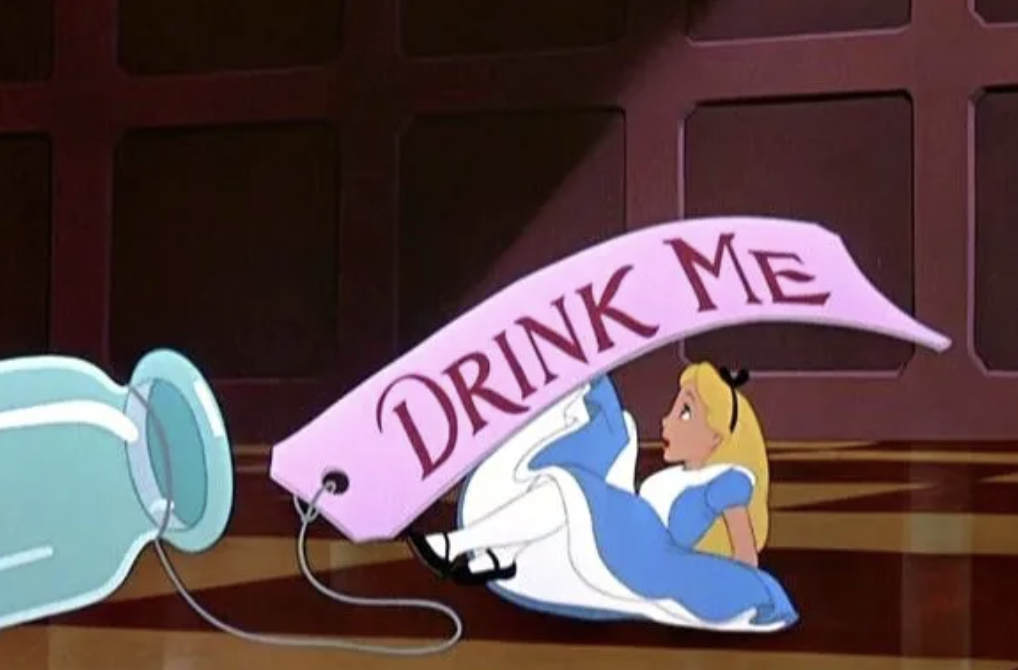
The rabbit hole is one of modern culture's great passage devices. One descends through it as through a tunnel, a dream, an archive, a network or a narrative black hole. Wonderland is not elsewhere in a purely geographical sense: it is governed differently. To enter it is to move from a stable space into a space of permanent transformation.
This idea has shaped contemporary pop culture. The phrase down the rabbit hole now names the entry into an endless investigation, obsession, theory, network of information or parallel reality. From The Matrix to psychedelic culture, from video games to virtual worlds, Alice has become a grammar of immersion.
3. Metamorphosis and the Crisis of Identity
The central question in Alice is not only "where am I?", but "who am I when the rules of the world change?" Alice grows, shrinks, doubts her name, her memory, her body and her continuity. Identity is no longer a fixed core; it becomes a constant adjustment between perception, language and environment.
This directly concerns A.L.I. An extraterrestrial intelligence might differ not only through its vocabulary, but through the way it stabilizes a self: multiple bodies, distributed memory, chemical perception, collective intelligence, non-linear temporality. Translating a message would then require understanding what kind of subject speaks through it.
4. Nonsense as a Hard Science of Language
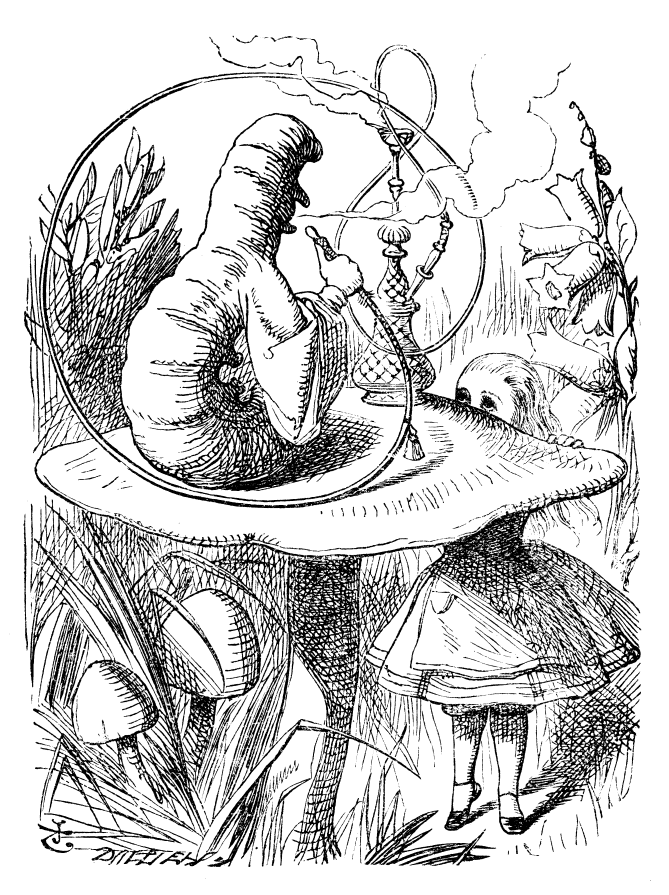
In Alice, words do not always describe the world: they move it. Conversation becomes a logical trial. The Mad Hatter, the March Hare, the Queen, the Cheshire Cat and Humpty Dumpty in Through the Looking-Glass do not simply speak badly; they reveal that meaning depends on a contract. When the contract changes, the sentence becomes foreign.
Gilles Deleuze gave Lewis Carroll an important place in The Logic of Sense. In Carroll, sense is often produced at the surface of things: through wordplay, series, reversals and shifts. It is not a hidden depth to be discovered, but a regime of signs to be learned.
A Deleuzian reading. In Deleuze’s interpretation, Alice is not only a heroine crossing a dream: she becomes the operator of a world where sense is not hidden behind things, but produced at their edge, in the gap between words, bodies and events. Nonsense is not the opposite of sense; it can be its engine, because it forces thought to leave ordinary categories behind. In Carroll, a sentence can slip, split, turn back on itself, and this very movement produces meaning.
This is decisive for A.L.I: if an extraterrestrial message appears absurd, it should not immediately be dismissed as noise. It may belong to another regime of surfaces, another logic in which sense circulates through transformations, thresholds, scale shifts and relations between signs that are not yet ours.
5. Metaphysics: World, Dream, Mirror
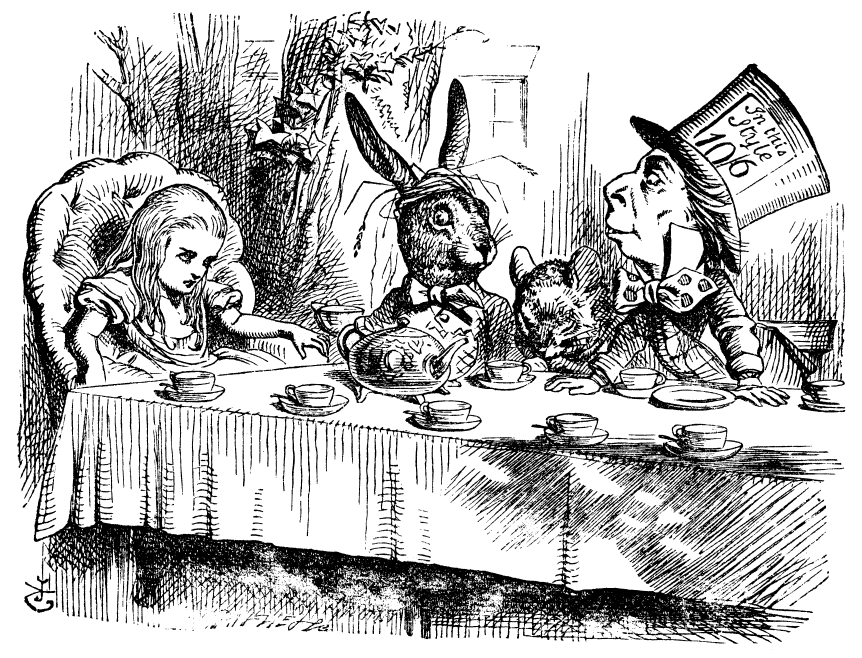
Alice belongs to a long metaphysical history: Descartes' dream argument, Plato's cave, Berkeley's idealism, Leibniz's possible worlds, and modern fictions of parallel realities. The book asks: how can we know that the world we inhabit is the reference world? What if our categories are only local?
In Through the Looking-Glass, the mirror radicalizes the question. The passage is no longer vertical, like the rabbit hole, but reflective. One crosses a surface that resembles the known world while reversing its rules. For A.L.I, the mirror is a powerful image of contact: another intelligence may resemble us enough to be recognized, while reversing the relations between time, language, body and memory.
6. The Cheshire Cat: A Sign Without a Body
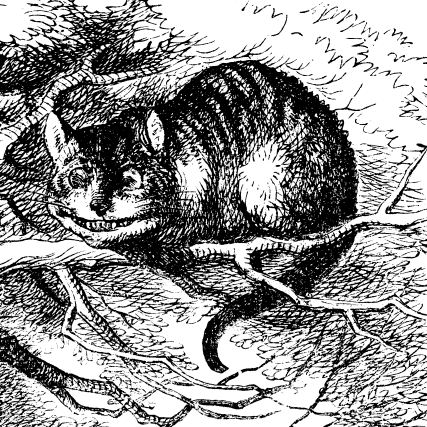
The Cheshire Cat is one of the key figures for a theory of message. It gradually disappears, yet its smile remains. The support vanishes while the sign persists. A message is not necessarily attached to a stable body. It can survive as a trace, a relation, a motif, an afterimage.
This resonates with A.L.I's questions: how do we recognize intention in an incomplete signal? How do we interpret a signature whose sender has vanished? How do we distinguish a natural residue from an addressed sign?
7. Pop Culture: From Psychedelia to Cyberspace
Alice has been continuously reactivated: Disney's 1951 film, Jefferson Airplane's White Rabbit, Jan Švankmajer's and Tim Burton's adaptations, American McGee's Alice, manga, music videos, fashion, gothic aesthetics, cyberpunk and psychedelic culture. Every era finds its own passage in Alice: dream, drug, adolescence, madness, simulation, network, multiverse.
8. What A.L.I Learns from Alice
Alice teaches us that an alien language is not merely a vocabulary. It presupposes a world, a physics, a scale, a memory, a politeness, a temporality and a logic of identity. Interstellar contact may resemble less a word-for-word translation than a gradual entry into Wonderland: a milieu where meaning exists, but according to rules that are not ours.
The central A.L.I hypothesis is this: nonsense can be a method. By creating situations in which our logical habits fail, we expose the hidden assumptions of our own language. A contact protocol could deliberately include paradoxes, scale shifts, mirror games and impossible sentences to test how another intelligence reconstructs coherence.
9. Possible Devices
Semantic Rabbit Hole. An interface in which each click slowly changes the rules of reading: buttons change function, words swap meaning, images become syntax.
Logical Mirror. A two-screen installation: one screen writes a sentence, the other returns it according to an inverted logic. Repetition reveals an alphabet of transformation.
Cheshire Cat. A sound system where voices disappear but leave resonances, acoustic smiles and harmonic fragments that reconstruct an absent sender.
Tea Without Time. A looping radio piece where time never progresses, but meaning accumulates through tiny variations, as if each repeated sentence came from a slightly different universe.
10. Sources and References
Lewis Carroll, Alice's Adventures in Wonderland, 1865; Through the Looking-Glass, 1871.
Martin Gardner, The Annotated Alice, a major reference for the logical, mathematical and cultural readings of Alice.
Gilles Deleuze, The Logic of Sense, 1969, especially the series devoted to nonsense, Carroll and the surface of sense.
Cultural references: Alice in Wonderland, Disney, 1951; Jefferson Airplane, White Rabbit, 1967; Jan Švankmajer, Alice, 1988; The Matrix, 1999; Tim Burton, Alice in Wonderland, 2010; American McGee's Alice, 2000.
Images: John Tenniel's original illustrations for Alice's Adventures in Wonderland, public domain, Wikimedia Commons.