
Some states of consciousness seem to open perceptual zones that ordinary waking awareness cannot reach. Lucid dreaming, trance, hypnosis, deep meditation, out-of-body experience, shamanic vision, sensory deprivation, aesthetic absorption, sudden intuition: these practices and narratives form a troubled constellation, documented, contested, instrumentalized, yet persistent.
For A.L.I, the question is not simply whether to believe. It is more precise: if contact with a non-human intelligence required a shift in perceptual regime, which tools, traditions and protocols could explore that threshold without collapsing into confusion?
1. Changing consciousness, changing access
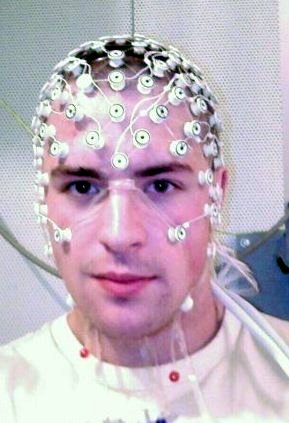
An altered state of consciousness is not necessarily spectacular. It may be produced by fatigue, rhythm, breathing, sound repetition, hypnosis, isolation, meditation, pain, dreaming or certain substances. What changes is the organization of attention: body, time, memory, mental imagery and selfhood are no longer arranged in the same hierarchy.
In such states, people report stronger mental images, synesthetic perception, stable inner scenes, out-of-body sensations, encounters with presences, or access to information felt as external to the subject. Science recognizes these subjective states; it remains much more cautious about their ability to produce objectively verifiable knowledge.
2. Charles Tart: mapping states
Psychologist Charles T. Tart played an important role in legitimizing the study of altered states of consciousness. His contribution is methodological: instead of treating these states only as anomalies, he approached them as organized configurations of perception, memory, identity and attention.
This is useful for A.L.I: if a signal becomes readable only in a certain mental state, then the state of the observer is part of the receiving apparatus. One no longer measures only an external phenomenon; one also measures how an organism becomes capable of perceiving it.
3. Castaneda: initiatory narrative and critical zone
Carlos Castaneda's books powerfully shaped the imagination of the 1960s and 1970s around shamanism, perceptual training and passage into non-ordinary realities. In these narratives, the world is not merely seen: it is assembled. Initiation consists in shifting the point of assembly, changing how reality becomes coherent.
But Castaneda is also a critical case. His anthropological status has been strongly contested, and his texts are now often read as literary constructions as much as testimonies. For A.L.I, this ambiguity matters: it forces us to distinguish between narrative, method and proof. A narrative can generate powerful forms without constituting empirical evidence.
4. Monroe, Campbell and architectures of experience
Robert Monroe popularized out-of-body experiences and developed, with the Monroe Institute, sound protocols based on binaural beats and focus states. Thomas Campbell, a physicist and former participant in that research environment, later formulated My Big TOE, a speculative cosmology in which consciousness, information and reality are thought as parts of a larger system.
These models are controversial, but they interest A.L.I for one reason: they imagine consciousness as an interface. The subject is not only a passive receiver, but a terminal capable of synchronizing with different levels of reality, information or simulation. Even cautiously, this can inspire artistic protocols: sound, synchronization, experience journals, comparison between subjects, search for shared motifs.
5. Remote viewing, Gateway, Ganzfeld: protocols and limits
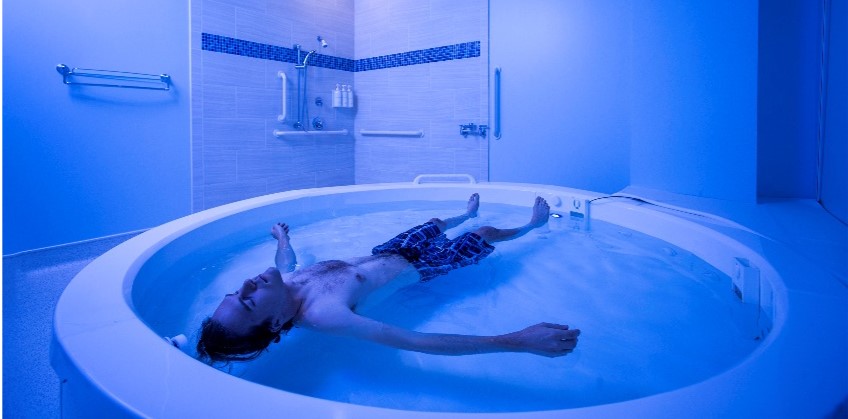
Remote viewing programs linked to Stargate, declassified documents around the Gateway Process, and Ganzfeld experiments belong to a history of testing non-ordinary perception in more protocol-driven settings. The important point is not to conclude too quickly, but to observe the experimental conditions: isolation, relaxation, sensory noise reduction, minimal instructions, hidden targets, after-the-fact comparison.
Results in these fields remain debated. Some meta-analyses suggested weak but non-trivial effects; other researchers emphasize bias, replication difficulty and data selection problems. For A.L.I, this tension is productive: it shows that a contact protocol must survive the desire to believe. It must accept failure, repetition, blind testing, archives and comparison.
6. Extrasensory experiences and ufology
In ufology and abduction narratives, communication is often described as telepathic, imagistic, emotional or intrusive. Witnesses rarely describe ordinary articulated language; they speak instead of mental scenes, packets of information, sudden certainties, messages received without voice.
This form of communication raises a central question: if the message arrives as mental imagery, how can it be distinguished from internal production? The issue is not only psychological; it is semiological. We must look for invariants: repeated motifs across subjects, structures too precise to remain vague, temporal correspondences, measurable effects, possible material traces.
7. Hypnosis, meditation and mental imagery as a laboratory
Hypnosis shows that a subject can strongly modify perception, attention and memory under certain conditions. Meditation can stabilize attention and make internal phenomena observable when they are usually drowned in mental noise. Lucid dreaming opens a space where image becomes manipulable, almost experimental.
These practices can serve as a laboratory for A.L.I: not to prove telepathy, but to learn how to produce, receive, describe and compare mental images. A contact interface could ask several participants to enter a given state, receive an image, draw it, encode it as keywords, then compare the results without knowing the target.
8. A.L.I prototype: threshold chamber
One could imagine an installation titled Threshold Chamber. It would combine soft light, guided breathing, sound frequencies, partial isolation, minimal instructions and written or vocal recording. Participants would not try to “see extraterrestrials”, but to map their perceptual thresholds.
- Phase 1: neutral induction, breathing, noise reduction.
- Phase 2: hidden target appearing as sound, image or pattern.
- Phase 3: immediate description of mental images.
- Phase 4: blind comparison between target, narratives and drawings.
- Phase 5: archive of correspondences, errors and drift.
9. What this brings to A.L.I
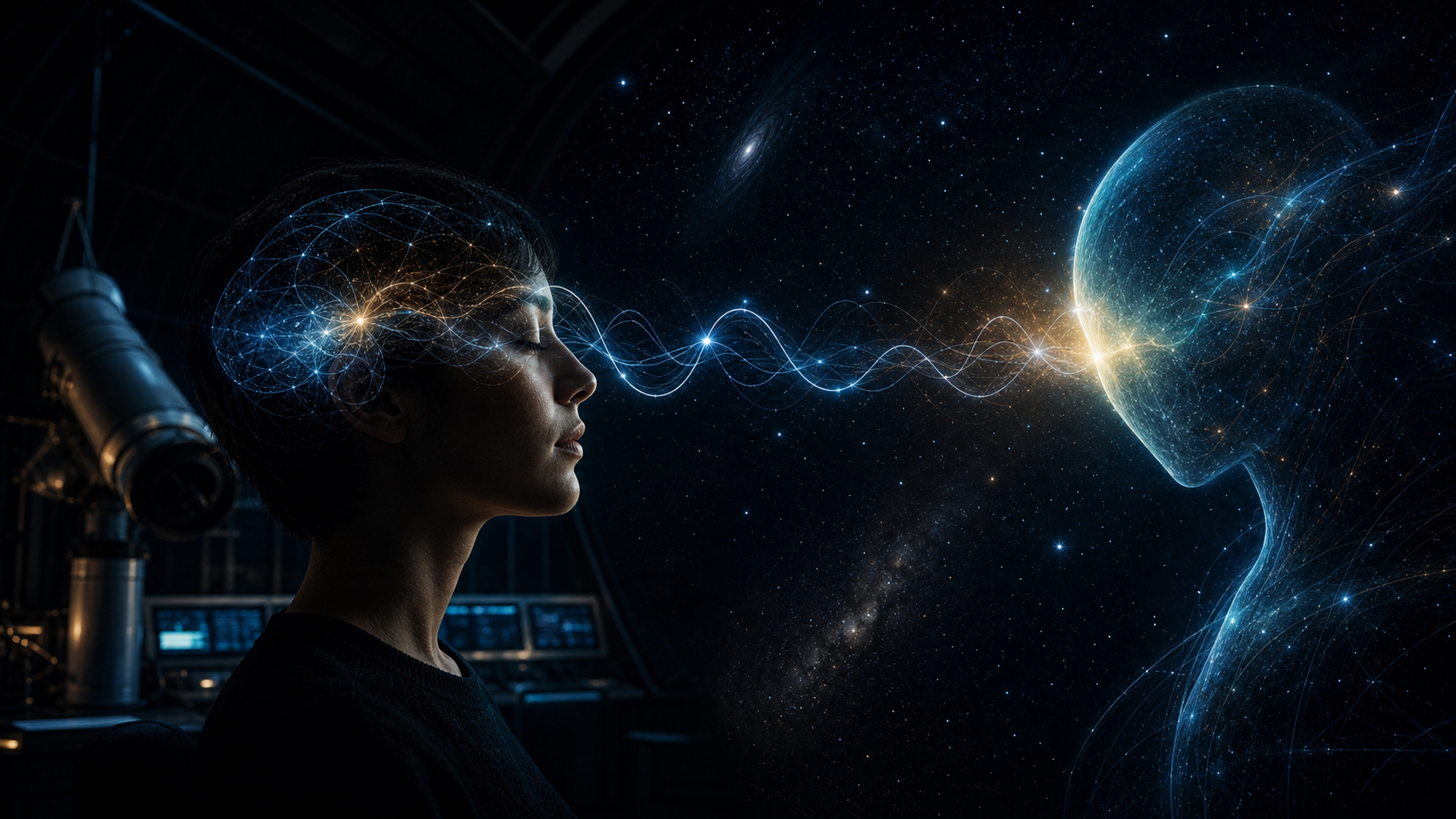
Altered states of consciousness should not replace antennas, radio signals, mathematics or analytical protocols. They add another hypothesis: the receiver of the message may also be biological, attentional and imaginal. An alien civilization might not only transmit content, but induce in the receiver a state capable of making that content readable.
The question then becomes: how can we design an art-science of thresholds? How can unstable experiences be documented without reducing or mythologizing them? How can we invent a language in which inner images become comparable, archivable and criticizable?
This article therefore proposes a path: A.L.I could explore altered states of consciousness as fragile interfaces, not to assert the existence of an extrasensory channel, but to experiment with the conditions under which impossible information begins to take form.