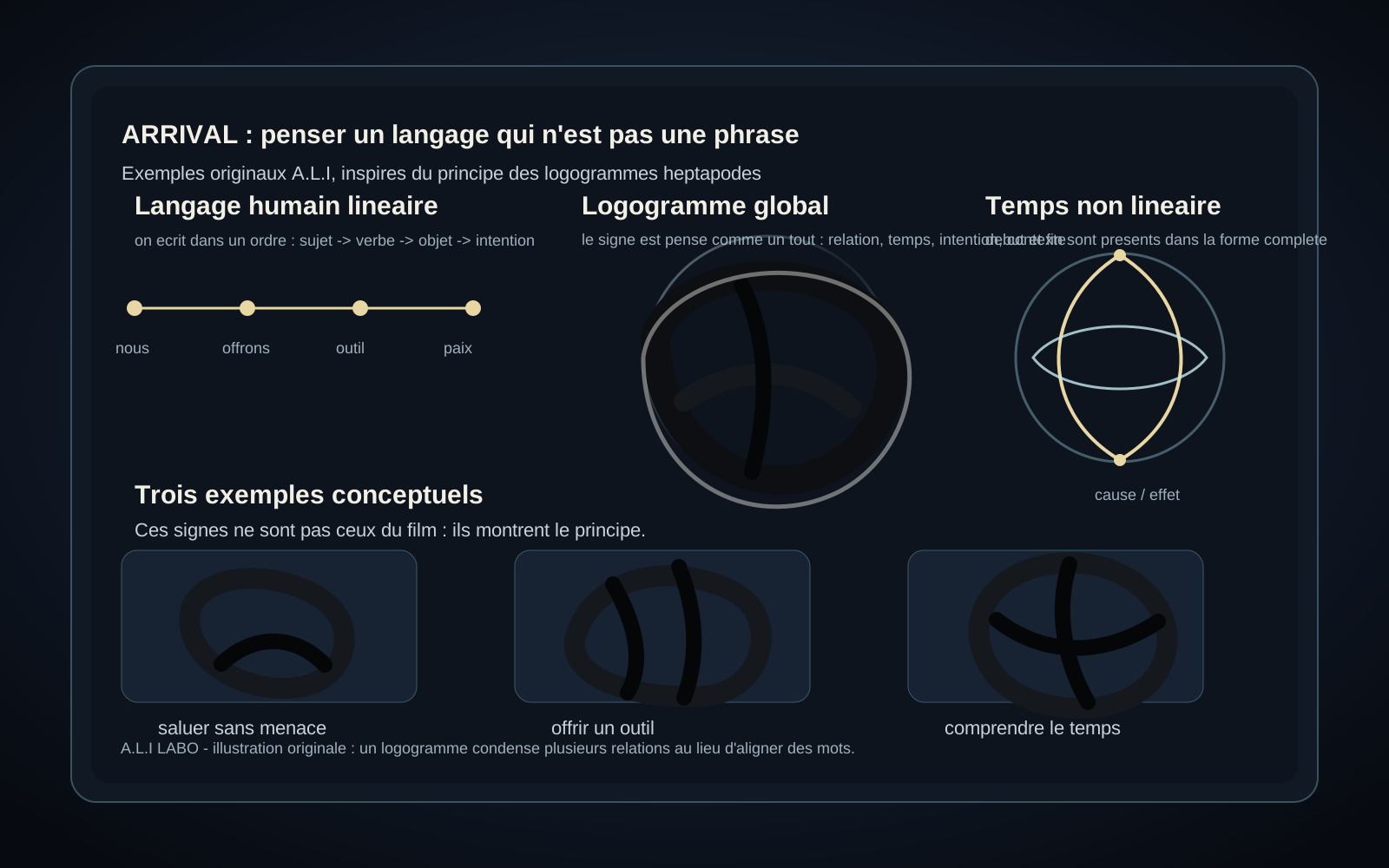
Hypothesis: Arrival is one of the strongest cinematic models for A.L.I because it treats language not as decoration, but as the real site of first contact.

The Film
Denis Villeneuve’s film, adapted from Ted Chiang’s Story of Your Life, follows linguist Louise Banks as she tries to communicate with heptapods whose ships appear around Earth. The drama is not only geopolitical. It is grammatical.

Heptapod Writing
The heptapods write with circular ink-like logograms. A sign is not built letter after letter. It appears as a whole form whose variations encode meaning. The circle suggests simultaneity, completion and a non-linear relation to time.
Language and Time
The film uses a strong version of linguistic relativity: learning the heptapod language changes Louise’s perception of time. Language becomes a cognitive technology, not merely a code.
Protocol of Translation
The film is also illuminating because it shows the practical difficulty of contact: establishing names, actions, questions, pronouns, intention and trust. “Weapon” and “tool” become a crisis of translation. A single ambiguity can become planetary danger.
Design Lessons for A.L.I
- a language can be visual before it is vocal;
- syntax can be spatial rather than linear;
- translation is political, emotional and technical at once;
- the receiver changes while learning the message;
- misunderstanding is not noise, it is part of the encounter.
Prototype
A.L.I could build a logogram generator: visitors type a sentence, and the system creates a circular sign whose thickness, gaps, orientation and texture encode grammar. Another visitor attempts to decode it through repeated examples.
Critical Note
The film is fiction, but its central intuition is powerful: a truly alien language may require changing our habits of time, body, order and causality.
LABO question: can a language be learned without also transforming the learner?