Hypothesis: DNA may not only be the chemical support of terrestrial life. For A.L.I, it can be thought of as a code already there: a molecular system of writing, memory, replication, correction and transmission. If some building blocks of life are common across the Universe, then life itself could become a first cosmic language.
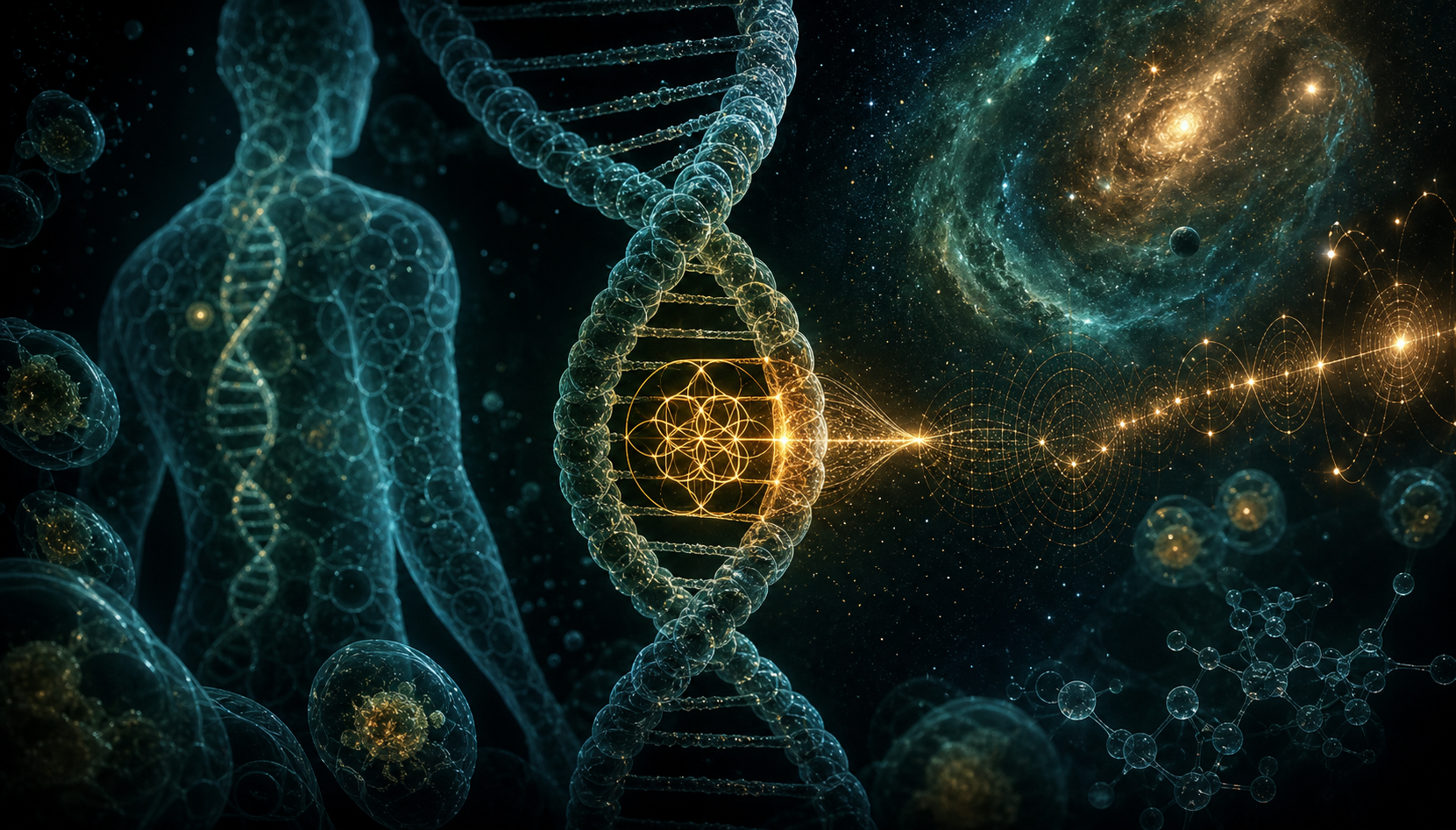
Are the Bases of Life Universal?
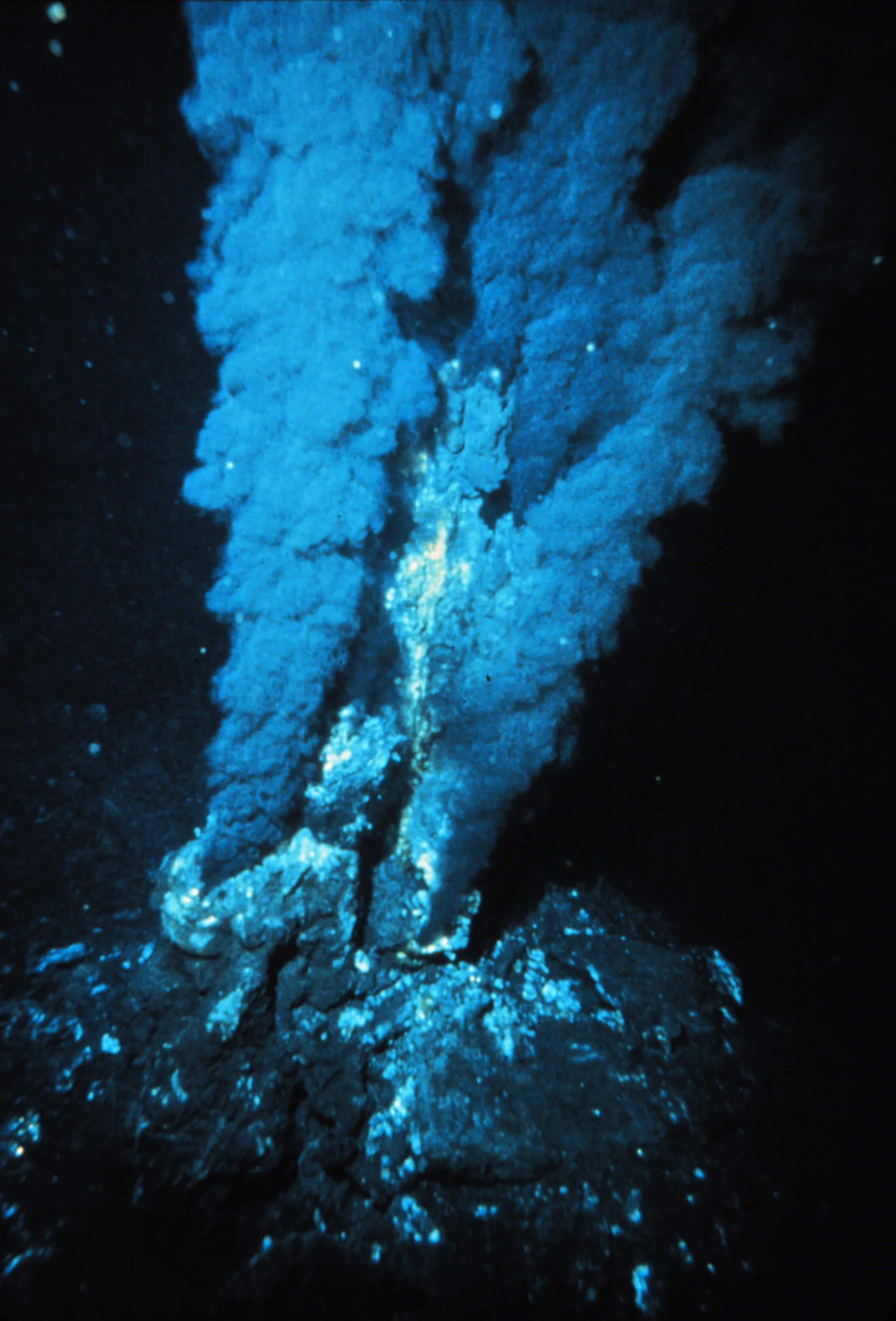
On Earth, known life uses shared molecules: nucleic acids, amino acids, sugars, lipids, water, ions and chemical energy. DNA and RNA use nitrogenous bases such as adenine, cytosine, guanine, thymine and uracil. These bases are not abstract symbols: they are molecules, with geometry, bonds and chemical constraints.
Astrochemistry shows that several building blocks of life can form beyond Earth. Amino acids and nucleobases have been identified in meteorites, and samples from asteroid Bennu revealed important organic compounds, including the five nucleobases used by terrestrial DNA and RNA.
It would be excessive to claim that terrestrial DNA is necessarily universal. But it becomes reasonable to ask whether some chemical alphabets are favored by the Universe. Perhaps life, when it appears, often converges on similar solutions: carbon-based molecules, chains capable of carrying information, structures able to copy and mutate.
From Genetic Code to Language
DNA already works as a code. A sequence of bases is read, transcribed and translated. Three bases form a codon. Some codons correspond to amino acids. Others mark stops. Terrestrial life rests on this correspondence between sequence and fabrication.
DNA
=> RNA
=> codons
=> amino acids
=> proteins
=> organism
This system is not a human language, but it has several properties that matter for A.L.I: limited alphabet, syntax, redundancy, error, correction, memory, translation and expression. Life is a machine that reads code and produces forms.
The question becomes vertiginous: if we are made of code, where does language begin? In words? In cells? In chemistry? In the ability of one structure to be read by another?
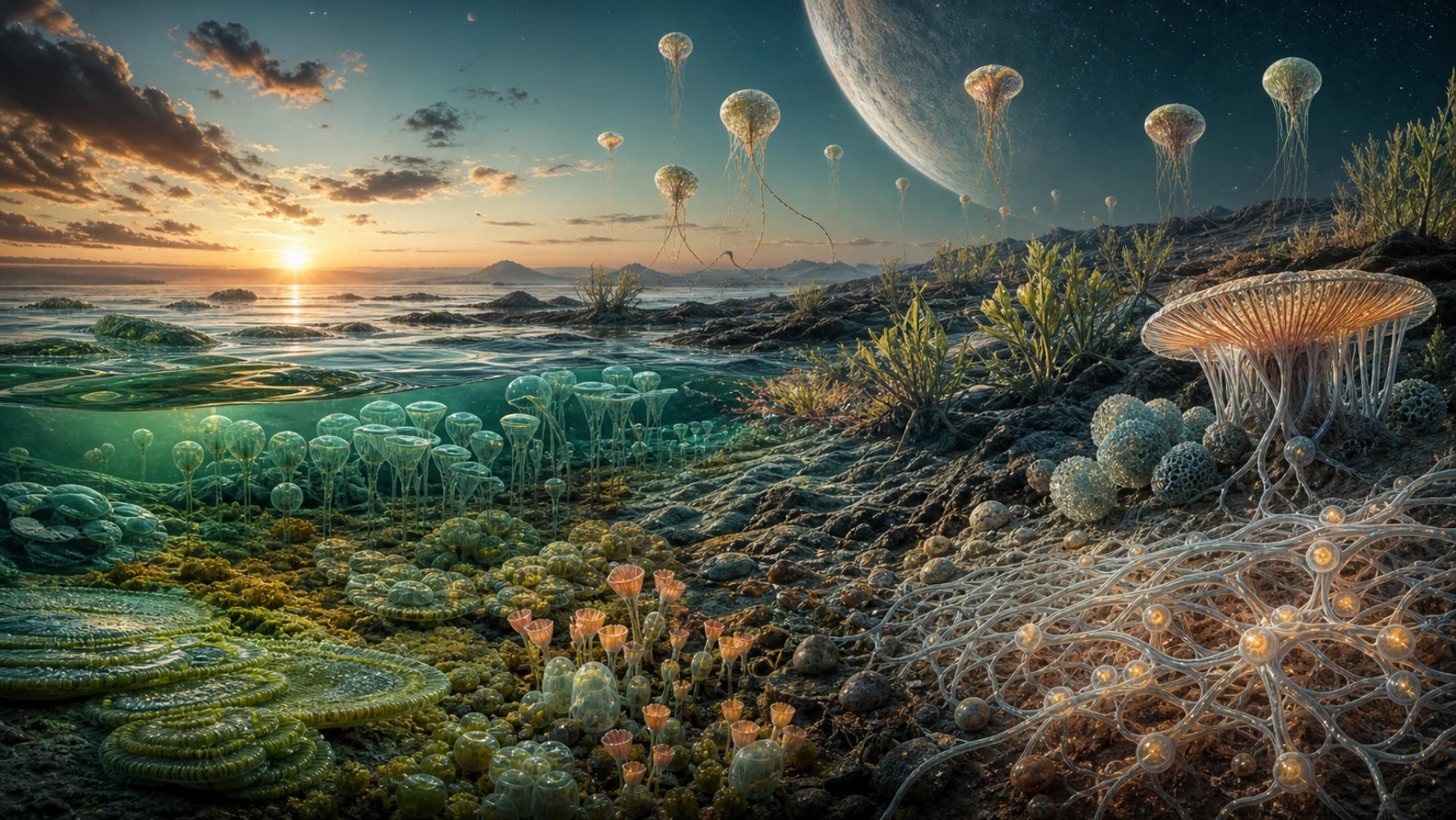
Panspermia: Seeded Planets
Panspermia is the hypothesis that life, or its precursors, could travel from one world to another. It exists in several versions. The most cautious version speaks of organic molecules delivered by meteorites, asteroids or comets. A stronger version imagines microbes surviving certain transfers between planets. An even more speculative version, directed panspermia, imagines that a civilization could intentionally seed planets.
Francis Crick and Leslie Orgel formulated a famous version of directed panspermia in 1973. Their idea was not a proof, but a proposal: if a civilization wanted to spread life, it could send microorganisms or systems capable of initiating a biosphere elsewhere.
For A.L.I, this hypothesis is crucial because it turns life into a delayed message. A civilization would not send us a sentence, but a process. Not “hello,” but a seed capable of becoming a living planet.
DNA as a Very Slow Message
A radio message can travel fast, but it fades or gets lost. An object can survive for a long time, but remain mute. Life has a strange property: it can copy itself. It can carry information through time, not by remaining identical, but by transforming.
In a speculative perspective, DNA could therefore be seen as a very slow message. It does not transmit a stable sentence, but a capacity: to replicate, vary, explore, adapt and produce increasingly complex forms.
seeding
=> biosphere
=> evolution
=> intelligence
=> reading the code
=> recognition of an origin
The message would only become readable at the end, by beings capable of understanding that they themselves are made of writing.
A Hidden Signature in Life?
We can push the hypothesis further, but carefully. Imagine that a civilization wanted to seed a planet. It might leave a signature in the biological code: not an obvious sentence in DNA, but a statistical structure, a pattern of redundancy, an anomalous constraint, a mathematical key or a synthetic layer buried in sequences that are not immediately functional.
To date, we have no evidence of such an artificial signature in terrestrial life. But as a research fiction for A.L.I, the idea is powerful: we would search for a message not in the sky, but in our own matter.
The Reversal: We Would Be the Receiver
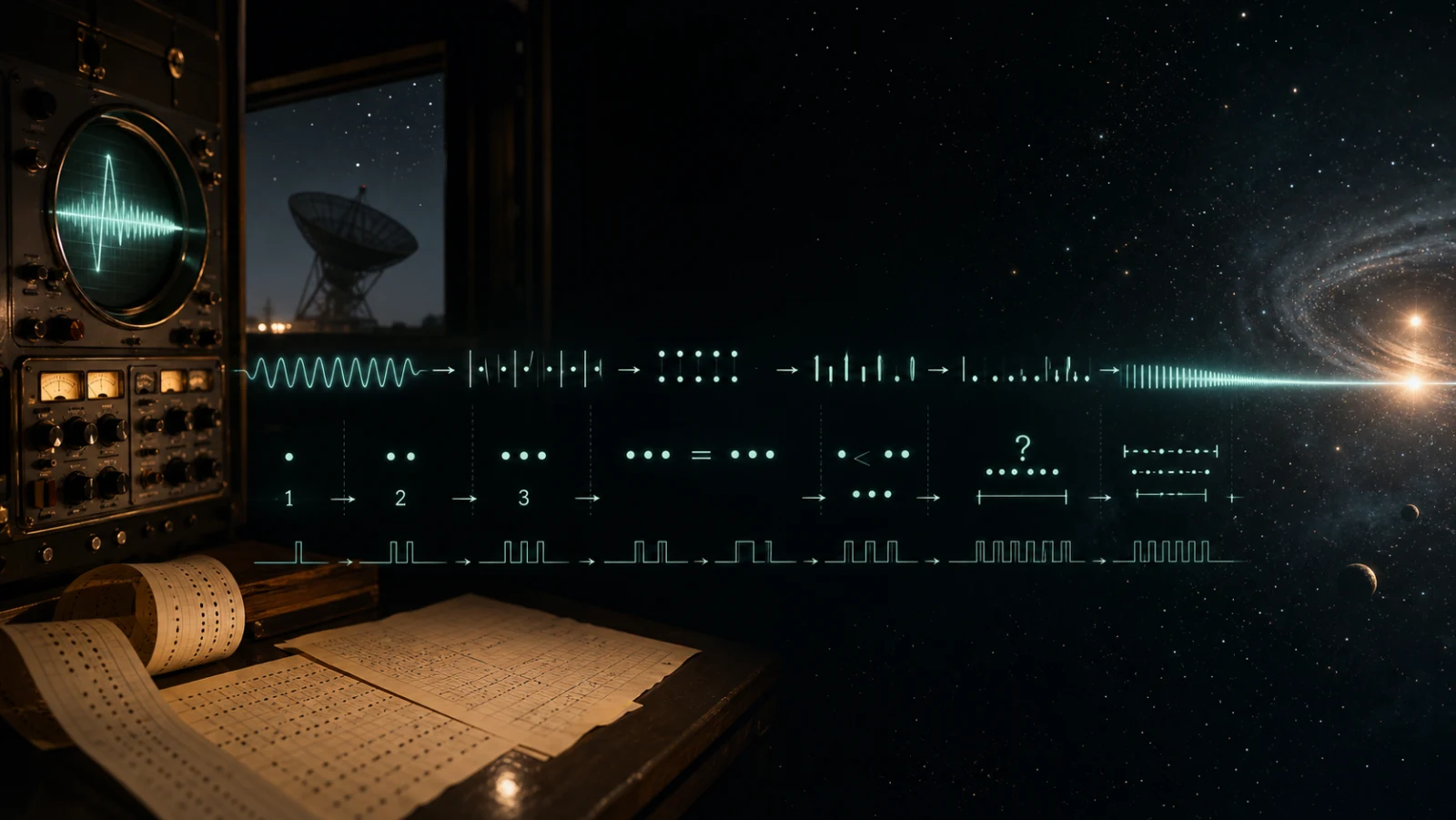
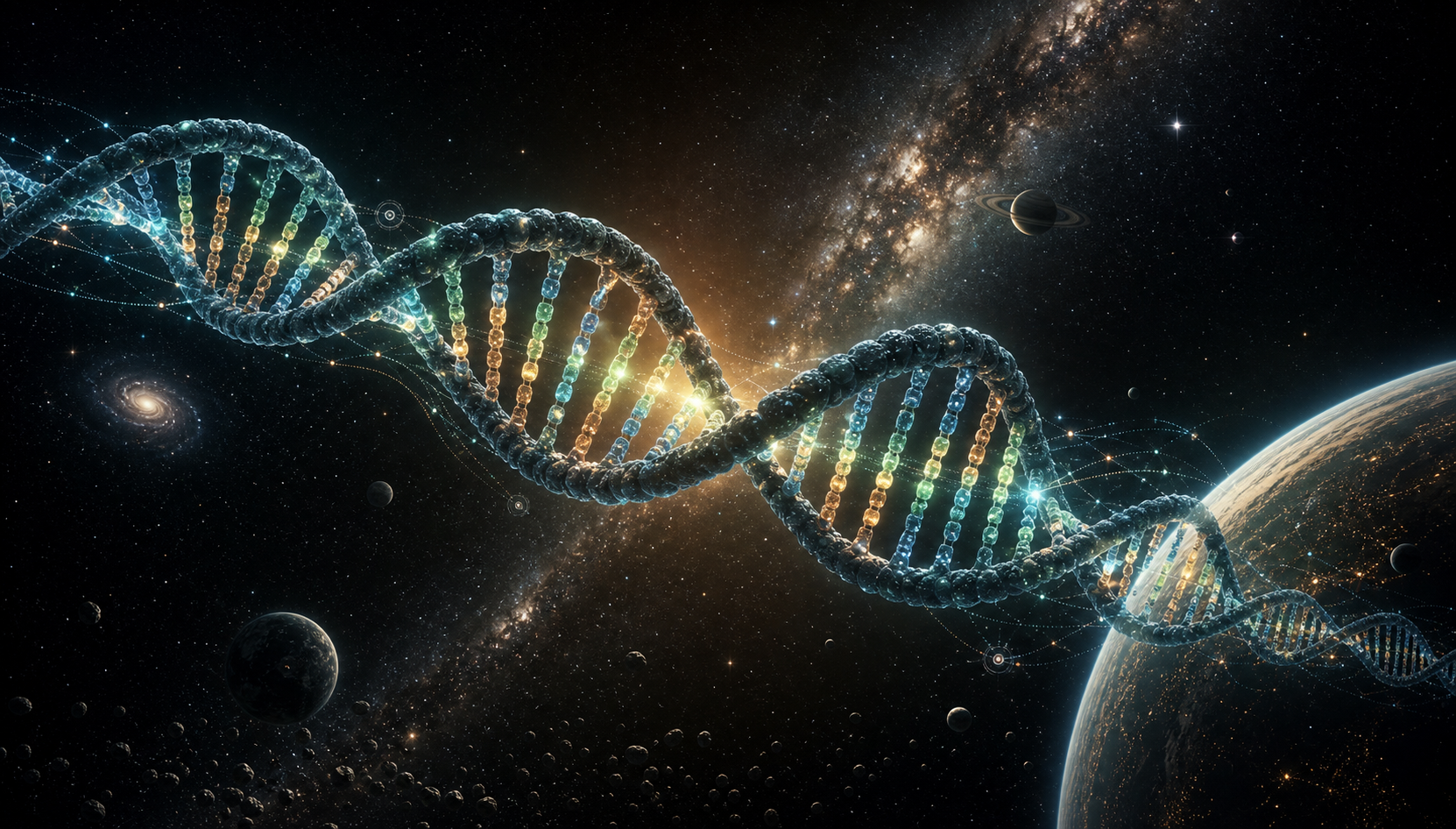
In classical contact scenarios, we receive an external signal: radio, light, object, trajectory. Here, the reversal is radical. The signal would already be inside us. We would be the medium, the receiver and perhaps the late decoder.
The discovery of a signature would not be the end of the message, but its beginning. It would indicate where to search, how to read further, which structures to compare and which experiments to launch. The signature would be a door, not a complete content.
biological signature
=> possible proof of intention
=> decoding key
=> new sequences to read
=> response protocol
=> contact
The A.L.I question becomes: how could we build a protocol capable of distinguishing a real signature from chance, evolutionary constraint or an illusion of reading?
Would Everything Be Code?
Saying “everything is code” can become dangerous if we forget matter. DNA is not a computer file floating in the void. It is a molecule inside a cell, inside an organism, inside an environment. The code exists only because it is read, repaired, copied, expressed and selected.
But the idea remains fertile. If life rests on readable systems, then language may not be a late human invention. It may be a general property of systems that transmit and transform themselves.
The genetic code, human languages, radio protocols, AI latent spaces and interstellar signals could be seen as different forms of the same problem: how does one structure become readable by another?
A.L.I Prototype: Genome Signal Reader
One could imagine a prototype called Genome Signal Reader. It would not claim to find a real extraterrestrial message in DNA. Instead, it would simulate several layers of reading: real genetic code, statistical motifs, fictional artificial signatures, false positives and decoding keys.
The visitor would see how a sequence can become molecule, text, rhythm, image, noise, proof or mirage.
DNA sequence
=> visualization
=> repeated motifs
=> signature hypothesis
=> statistical test
=> speculative decoding
=> A.L.I response
Conclusion
DNA forces us to shift the question of contact. Perhaps the first interstellar message will not be received by an antenna, but discovered in the very structure of life. Perhaps the bases of life are common because the Universe favors certain chemistries. Perhaps some planets have been naturally or intentionally seeded. Perhaps the biological code contains only the history of evolution. Or perhaps it also contains a question.
For A.L.I, the most important thing is not to claim that our DNA hides an extraterrestrial signature. It is to imagine the conceptual instruments that would allow us to recognize such a signature if it existed.
LABO question: if we are made of code, could first contact begin by learning how to reread ourselves?