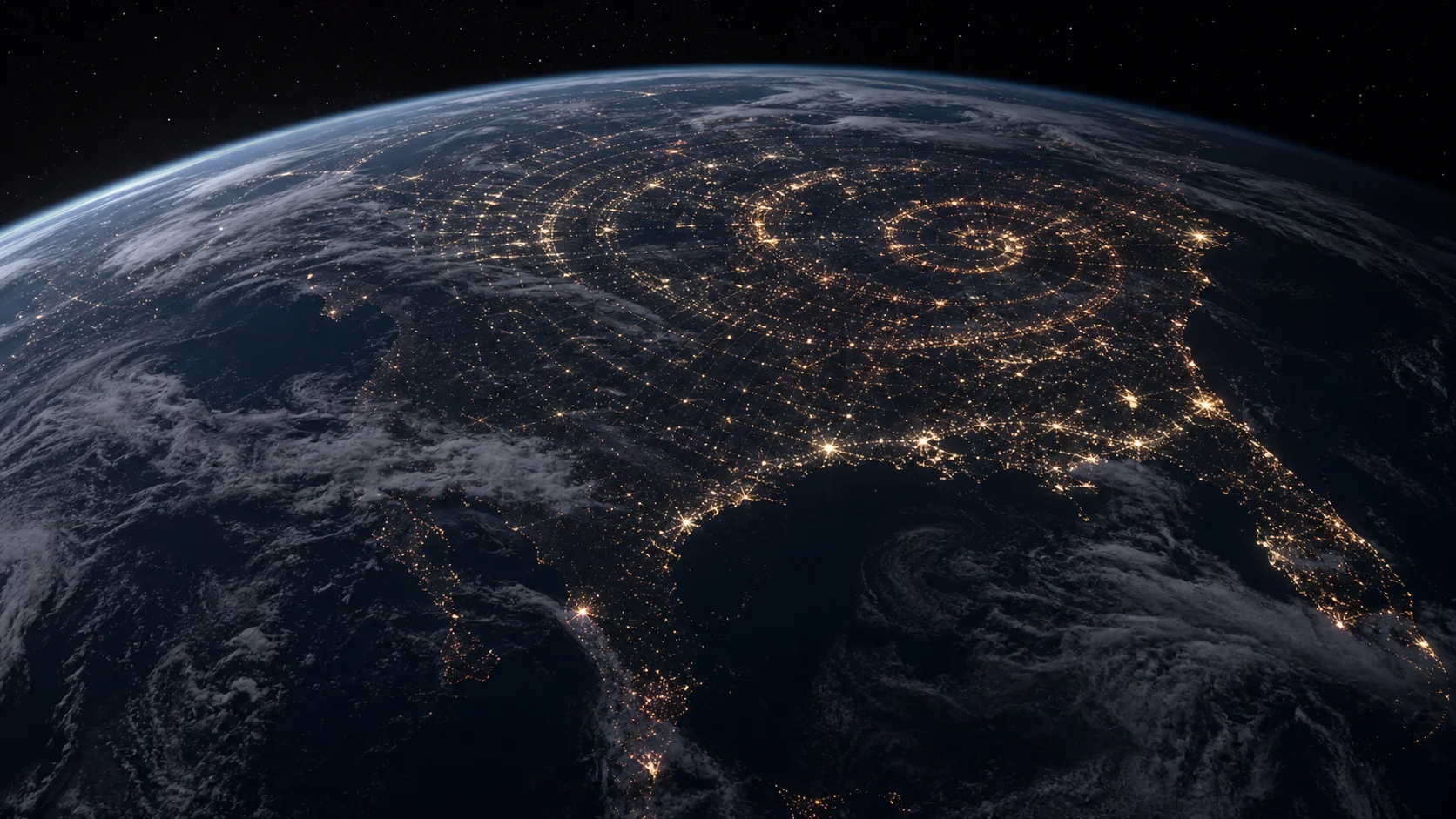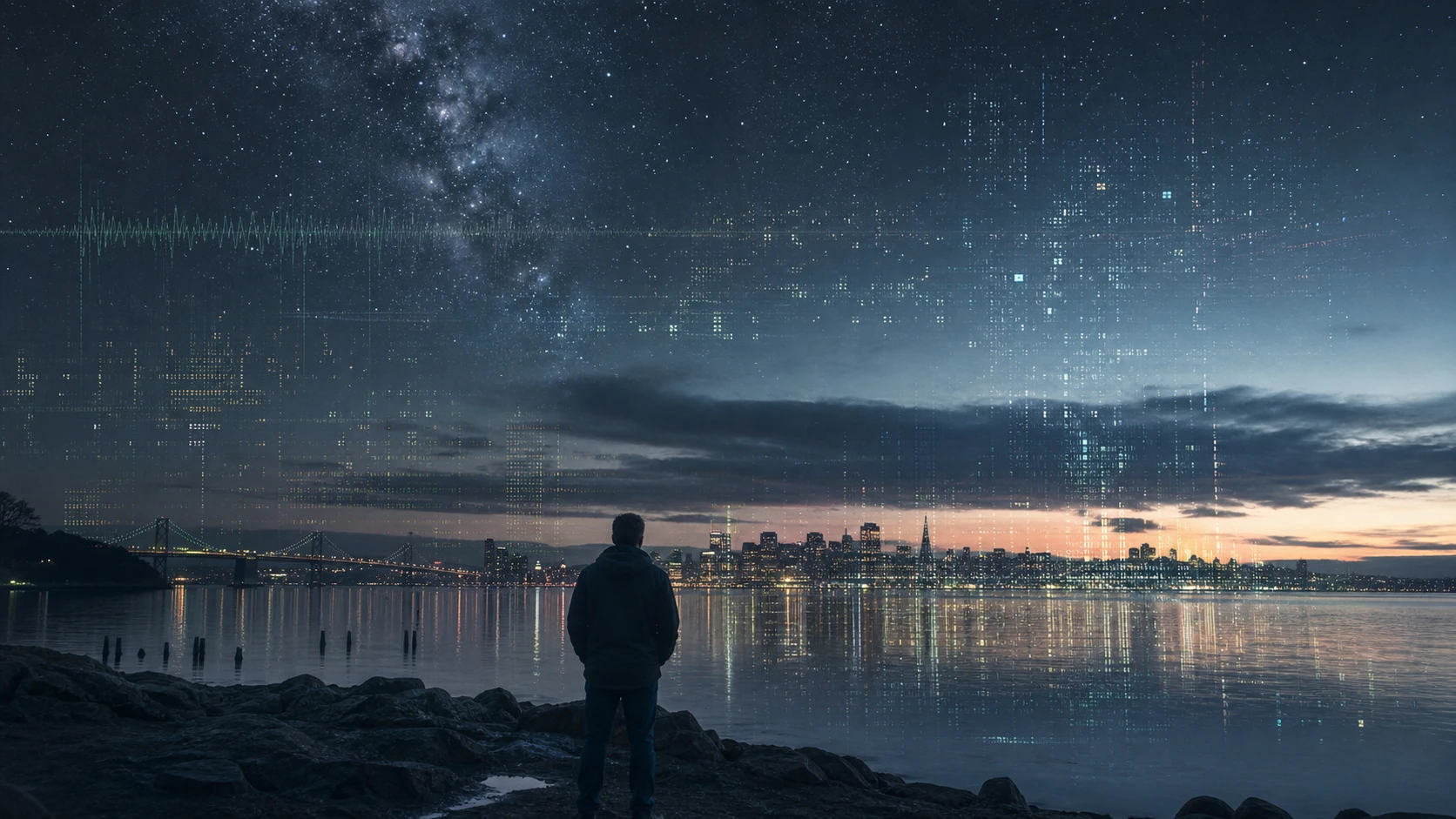
Hypothesis: the universe is filled with signatures. Not necessarily messages in the human sense, not sentences, not alphabets, but motifs: traces, anisotropies, repetitions, deviations, distributions, vibrations, spectra, asymmetries, structures.
A signature is not necessarily an intention. It may be the imprint of an event, the memory of an origin, the consequence of a physical law or, in the most vertiginous hypothesis, the trace of an intelligence capable of writing at cosmic scale.
For A.L.I, the question becomes: how can we distinguish a natural signature, a technological signature, a biological signature, a cosmological signature and an intentional signature?
The primordial signature: the cosmic microwave background
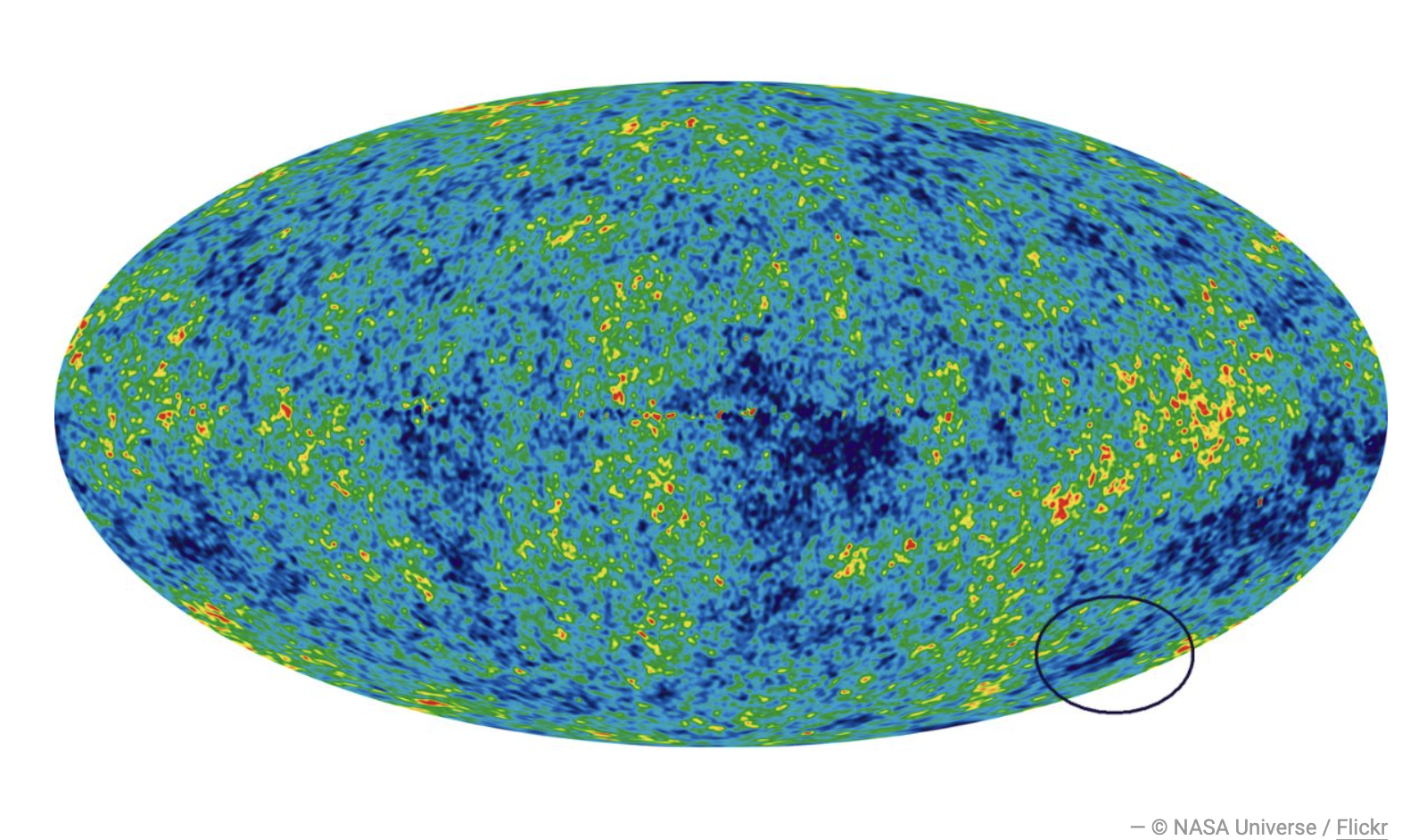
The oldest observable signature of our universe is the cosmic microwave background, or CMB. It is fossil light, emitted when the universe became transparent about 380,000 years after the Big Bang. Before that, the universe was an opaque plasma: light could not travel freely.
Today, this light reaches us as microwaves, almost uniform in every direction. Almost uniform, but not entirely. The tiny temperature variations of the CMB, mapped by COBE, WMAP and Planck, are essential: they are the initial differences that later allowed galaxies, clusters, filaments and cosmic voids to form.
The primordial signature is therefore not a message written afterwards. It is a birth imprint. A map of the universe when it was still almost homogeneous, yet already carrying all future structures.
For A.L.I, it is a fascinating model: a tiny, almost invisible information can contain the matrix of an immense organization.
Reading a pattern larger than us
We are used to thinking about messages at our own scale: a voice, a sentence, an image, a radio signal, a light pulse. But the universe operates on other dimensions.
- A cosmic pattern may be too large to be seen from a single point.
- It may be too slow to be perceived within a human lifetime.
- It may be too ancient to be understood as an event.
- It may be too faint to appear without instruments.
- It may be too distributed to look like a message.
The CMB map, the distribution of galaxies, the cosmic web, gravitational waves, exoplanet spectra or fast radio bursts are all examples of signatures that humans do not perceive directly. Instruments, mathematics, models and statistics are required.
The cosmos is not silent. It is unreadable to the naked eye.
The cosmic web: gravity as writing
At very large scales, galaxies are not randomly distributed. They form filaments, walls, nodes and voids: the cosmic web. Gravity, dark matter and the expansion of the universe have sculpted this immense network.
This web is a signature because it encodes a history: expansion, gravitation, dark matter, dark energy, initial conditions. It is a kind of sentence written by physical laws, but on a page too vast to be seen except through reconstruction.
A.L.I could propose an artistic hypothesis: what if a very advanced intelligence did not try to send a punctual message, but instead modulated structures at large scale? Not writing “hello” in a radio frequency, but producing a statistical anomaly in a cosmic distribution.
Gravitational waves: signatures in spacetime
Since 2015, LIGO has opened another way of listening to the universe: gravitational waves. These are not electromagnetic waves, but ripples in spacetime produced by extreme events such as black hole or neutron star mergers.
They do not carry an image in the usual sense. They carry a form: a temporal signal, a curve, a chirp, a signature of mass, speed, distance and collision.
This type of signal matters to A.L.I because it shifts the very idea of communication. Could an intelligence use gravity as a medium? For us, this is almost technologically impossible. But conceptually, a civilization capable of acting on stellar masses or compact objects could produce signatures at a scale we do not yet know how to interpret as intentional.
Between the infinitely small and the infinitely large
The question of signatures forces us to compare scales.
- Planck length: about 10-35 m.
- Elementary particles: about 10-18 to 10-15 m depending on the object.
- Atoms: about 10-10 m.
- DNA: a few nanometers wide.
- Human body: about 1 m.
- Planet: thousands of kilometers.
- Milky Way: about 100,000 light-years in diameter.
- Observable universe: about 92 billion light-years in diameter.
Between the Planck length and the observable universe, there are roughly 60 orders of magnitude. This means that our natural perception occupies a tiny band in the scale of reality.
A.L.I could therefore state a simple idea: an extraterrestrial or cosmic signature may exist, but outside our intuitive band of perception.
Signature as pattern
A signature is not necessarily an isolated sign. It may be a pattern.
A pattern may be a regularity, a repetition, a symmetry, a symmetry breaking, an anomalous compression, an improbable distribution, a correlation between distant phenomena, or a structure repeating across several scales.
This is where the idea becomes especially powerful for A.L.I. We tend to search for a message as if we were searching for a sentence. But another intelligence might send a message the way one composes a statistical landscape.
a repeated anomaly
across several scales
with compressible structure
and mathematical coherence
beyond chance
The message would not be immediately “read”. It would be detected as a structure that resists natural explanation.
Multiverse: a signature from elsewhere?
The idea of a multiverse remains speculative. It appears in some models of cosmic inflation, in some interpretations of quantum mechanics and in theoretical physics hypotheses. There is currently no direct observational proof of another universe.
But as an A.L.I hypothesis, the multiverse opens a powerful question: if our universe is only one region among others, could it carry a trace of interaction, collision or neighborhood with another universe?
Some models have imagined that collisions between bubble universes could leave signatures in the cosmic microwave background. These ideas remain highly debated, but they give form to a radical question: could a message come not from a civilization located in our space, but from another cosmological frame?
In that case, communication would no longer mean sending a signal from one star to another. It would mean recognizing an imprint in the very parameters of the universe.
An intelligence at very large scale
Could a very advanced civilization communicate at cosmic scale? Classical scenarios imagine radio signals, lasers, megastructures, stellar light variations or artifacts sent through space. But one can push further:
- voluntary modulation of a star;
- alignment of orbital objects to produce a periodic signature;
- use of gravitational lenses;
- a network of synchronized probes at galactic scale;
- a message embedded in the distribution of artifacts;
- a temporal signature repeated over millennia;
- an artificial structure detectable only through statistical analysis.
At very large scale, the message would no longer be an object. It would be an architecture.
What exceeds human vision
The problem is not only technical. It is perceptual and philosophical. A human being sees a narrow band of the electromagnetic spectrum. A human lives a few decades, inhabits a planet, and thinks at the scale of gestures, words, sounds and images. But the universe can carry signatures in microwaves, neutrinos, polarization, gravitational waves, atmospheric chemistry, galaxy distributions, physical constants or structures evolving over millions of years.
A.L.I must therefore imagine interfaces that expand perception: transforming cosmological data into forms, sounds, rhythms, maps, scores, images and objects.
Interstellar language might begin with a prosthesis of perception.
A.L.I Prototype: Cosmic Signature Reader
One could imagine a prototype called Cosmic Signature Reader. It would not claim to discover a real extraterrestrial signature. It would stage several levels of reading:
cosmic microwave background
=> primordial variations
=> origin of structures

cosmic web
=> filaments / voids / nodes
=> gravity + dark matter

gravitational waves
=> collision / mass / distance
=> temporal signature

fictional artificial anomaly
=> multi-scale repetition
=> message hypothesis
The installation could display real data, then introduce fictional signatures: compressible motifs, impossible symmetries, repetitions across several scales. The visitor would have to decide: chance, natural law, noise, or intention?
Conclusion
Searching for signatures in space is not only searching for extraterrestrials. It is learning to read the universe as a surface of inscription.
The cosmic microwave background is a birth signature. Gravitational waves are signatures of extreme events. The cosmic web is a signature of structure. Biosignatures are signatures of life. Technosignatures would be signatures of intelligence.
And perhaps one day, a signature will appear that fits no known category. Then A.L.I's real question will be: are we capable of recognizing a message that was not written at our scale?