We expect contact to appear: a signal emerges, a form becomes visible, a voice answers. The disappearance hypothesis reverses this scene. A radically other intelligence might become legible only when something is missing. It would not enter the world as one more object, but as a precise interruption: a subtracted frequency, an incomplete image, a repetition that always skips the same place, a blind spot that moves with the observer.
Previous A.L.I articles have examined invisibility as a traversing particle, a psychic channel, an encoded future, a limit of perception, or a metaphysical presence. This text shifts the question: can disappearance become an operation, a syntax, and a method of contact?
1. To disappear is not necessarily to cease to exist
Everyday experience easily confuses three events: the destruction of an object, its departure from our perceptual field, and the loss of the information needed to describe it. Physics separates them. A particle can be absorbed and its energy transferred; a star can collapse and remain detectable through gravity; a wave can fall below an instrument’s threshold without ceasing to exist.
A black hole radicalises the problem. It is not directly visible, yet it bends light, accelerates matter, and leaves a measurable shadow. The Event Horizon Telescope did not photograph a black object against a bright background: it reconstructed, from radio telescopes distributed across Earth, the region from which light is missing. The first image of M87* is therefore an image produced by structured absence.
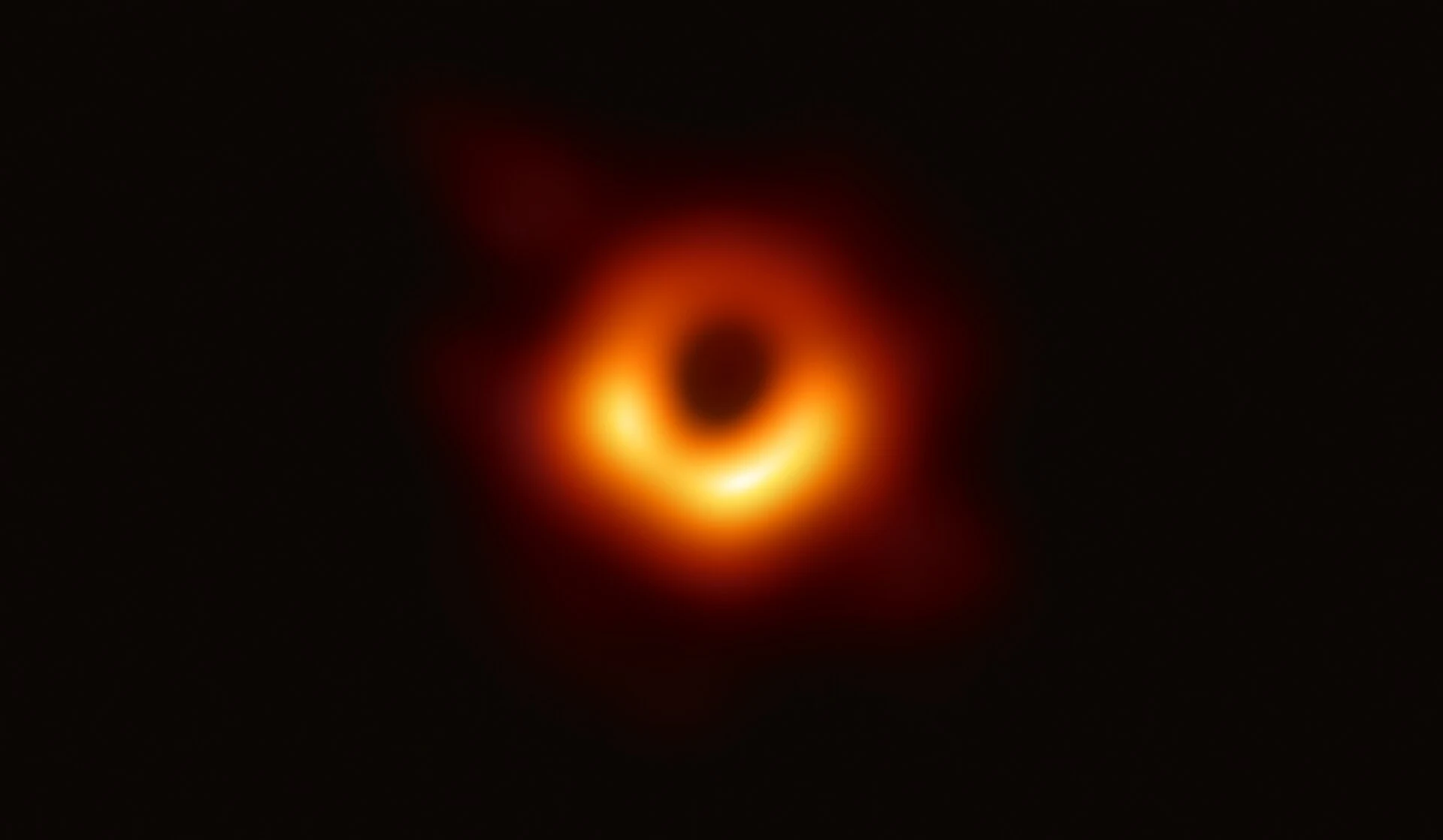
The black-hole information paradox asks whether information falling beyond the horizon is truly lost. Contemporary theories seek to avoid an absolute disappearance of information. The useful A.L.I question becomes: which peripheral traces can demonstrate that an absent event actually occurred?
2. The invisible is a relation between a phenomenon and a detector
Nothing is invisible in itself. Something is invisible to an organ, scale, frequency, or protocol. Infrared is absent to the human eye and ordinary to a thermal sensor. Dark matter does not emit the expected light, but its gravity changes galaxies. An image can even be hidden from conventional imaging while remaining encoded in the quantum correlations of photons.
This instrumental relativity prevents us from treating absence as pure emptiness. It forces us to describe the phenomenon-detector pair. An extraterrestrial message may have crossed our environment for a long time without entering the categories of our instruments. It would not be silent; we would be deaf to the relation that makes it audible.
3. Perceptual blind spots
The brain does not receive a complete copy of the world. It selects, stabilises, and predicts. Change blindness shows that major alterations can go unnoticed when attention is interrupted. Daniel Simons and Christopher Chabris’s “invisible gorilla” experiment demonstrates that a salient event can subjectively disappear when a perceptual task directs resources elsewhere.
This limit matters to A.L.I. The problem may not be to build a more powerful telescope, but to identify what our way of looking systematically excludes. A genuinely alien signal could inhabit our filters, data-cleaning routines, deleted outliers, and sequences that algorithms classify as noise.
4. Psychology: the absence that remains present
Human disappearance does not produce the same psychological state as confirmed death. Psychologist Pauline Boss coined ambiguous loss for situations in which someone is physically absent but psychologically present, or physically present but no longer accessible.
This coexistence of incompatible propositions—absent and still present—creates unresolved tension. It resembles the position of an observer facing an unconfirmed signal: contact cannot be declared, but the previous state cannot be restored. Disappearance creates a condition of waiting. It keeps an address to the other open.
5. Philosophy: presence, trace, and gap
Western philosophy has often privileged presence: truth should give itself clearly, here and now. In Maurice Merleau-Ponty, however, the visible already contains latent depth—an invisible that is not a second world but the unexposed structure of this one. What appears has hidden sides, distances, and delays.
Jacques Derrida calls trace the way the present remains worked by what is no longer and what is not yet. A trace is not the weakened presence of an intact origin; it is the mark of a difference. In Specters of Marx, the ghost becomes a political and temporal figure: what returns without ever having been fully present.
A.L.I can turn this into an operative proposal: a message does not need to transport its sender; it can organise the gap through which another passage is inferred.
6. Art makes works through withdrawal
In 1953, Robert Rauschenberg asked Willem de Kooning for a drawing and erased it. Erased de Kooning Drawing shows almost nothing, yet the act of erasure, the frame, and the inscription turn withdrawal into an artwork. In 1958, Yves Klein emptied the Iris Clert Gallery: the space was empty “in appearance only.” The Centre Pompidou later traced this history of empty exhibitions, from Klein to Robert Barry.
John Cage’s 4′33″ does not remove sound; it withdraws the expected musical performance so that environmental sounds become audible. Christian Boltanski builds presences from anonymous photographs, clothes, and inventories. Sophie Calle turns following, lack, and the missing person into narrative protocols. In these works, absence is not a lack of matter; it activates viewers, who reconstruct what is missing.
7. Ghosts, spirit photography, and invisible entities
Ghosts give cultural form to a contradiction: something acts without a verifiable body. In the nineteenth century, Spiritualism developed alongside the telegraph, photography, and research into waves. Mediums spoke of messages, channels, and recordings. New technology became a model for communication with the dead.

Double exposures, staging, and manipulation explain many historical images. The psychical research of William James and the Society for Psychical Research attempted to apply protocols to mediumistic testimony, without producing a reproducible demonstration accepted by the scientific community.
A firm distinction is necessary: ghosts, entities, and invisible beings are powerful cultural, psychological, and anthropological facts; their physical existence is not established. Yet these narratives remain useful to A.L.I because they reveal how humans attribute intention to peripheral effects: noise, movement, sourceless voices, coincidence, or return.
8. The A.L.I hypothesis: contact as organised subtraction
Suppose an intelligence cannot appear in our perceptual space, or refuses to. To signal its presence, it can act on what we expect. It does not create an event; it removes one element from a predictable series. If the subtraction is repeatable, structured, and independent of instrumental error, absence acquires a syntax.
A negative alphabet could use:
- the gap: one pulse is missing from a regular sequence;
- occlusion: a known background is interrupted by a moving geometry;
- delay: an expected signal returns with an informative offset;
- cancellation: two waves interfere and produce localised silence;
- the blind spot: the effect exists only outside direct viewpoint;
- the trace: only the altered environment indicates that a passage occurred.
This grammar would be economical. It does not require a sender to reproduce our images or sounds. It requires only a shared world and regularities that two observers can learn to disturb.
9. Three experiments for making absence testable
The correlated-absence detector
Install independent sensors—light, radio, vibration, magnetic field, temperature—and search not for an increase but for a simultaneous, geometrically organised drop. A local fault should affect one channel; a meaningful absence should produce a stable relation across several. The system must preserve rejected data so that the algorithm does not erase its own object of study.
The chamber of blind spots
In a room, projections, directional sound, and gaze tracking construct a form that is perceivable only at the periphery. Whenever a visitor looks directly at it, it vanishes; when the gaze shifts away, it recomposes. Several visitors must coordinate positions to reconstruct the complete form. The installation turns the impossibility of direct seeing into a collective reading protocol.
The lacunary message
Transmit a redundant mathematical sequence from which selected values are omitted. The positions of the missing terms encode a second message. The first level teaches the rule; the second turns absence into writing. This protocol can be tested with humans, animals trained on sequences, and AI models prohibited from silently completing gaps.
10. How not to confuse contact, malfunction, and the desire to believe
A science of disappearance must be more demanding than a science of appearance, because absence easily invites projection. A credible result should meet at least four conditions: predict where the gap will recur; be recorded by independent instruments; survive blind controls; and transmit a structure more compressible or coherent than chance.
The protocol must publish failures, thresholds, and cleaning operations. Every disappearance created by the apparatus—filtered data, saturated sensor, lost file, attentional bias—must remain the primary explanation. The extraterrestrial hypothesis becomes relevant only after this archaeology of our own blind spots.
11. A meeting in the gap
Contact would then be neither face-to-face nor the transmission of already formed content. It would take place in the difference between what should happen and what does happen, between two measurements, two images, two presences. The other would not be the object we see, but the possible cause of a difference we learn to share.
The disappearance hypothesis therefore proposes a simple reversal: search less for what appears than for what organises its withdrawal. The invisible is no longer the opposite of the message. It becomes its medium, and the gap the first common space between two worlds.
References and further reading
- Event Horizon Telescope — First image of M87*.
- Stanford Encyclopedia of Philosophy — Black-hole information loss.
- Vernière and Defienne — Hiding images in quantum correlations.
- American Psychological Association — Pauline Boss on ambiguous loss.
- Stanford Encyclopedia of Philosophy — Maurice Merleau-Ponty.
- Stanford Encyclopedia of Philosophy — Jacques Derrida.
- SFMOMA — Robert Rauschenberg, Erased de Kooning Drawing.
- Centre Pompidou — Voids, a Retrospective.
- Society for Psychical Research — History.