A Dyson sphere is not first of all a science-fiction object. It is an observational hypothesis: if a civilization captures a significant fraction of its star’s light, it must reject heat. That heat could appear as an infrared excess in large sky surveys.
For A.L.I, the idea matters because it moves the search for extraterrestrial intelligence away from intentional messages. A civilization does not need to speak to us in order to leave a trace. It may be detectable through infrastructure, energy metabolism, or an anomaly that was never written as a signal. The Dyson sphere turns contact into indirect reading: not “who is calling us?”, but “what organization of the world produces this signature?”
1. Dyson’s idea: not a shell, a thermal balance
In 1960, Freeman Dyson proposed searching for artificial infrared stellar sources as a complement to radio SETI. The popular image is often a rigid shell around a star. That image is misleading. A continuous structure would be mechanically implausible. The most discussed version is closer to a swarm: many collectors, habitats or satellites intercepting part of the stellar radiation.
The physical principle is simple. A star emits visible and near-infrared light. A technology that absorbs this energy for work, computation, habitation or production must reject degraded energy as heat. Depending on its temperature, that heat moves toward the mid or far infrared. The object being searched for is therefore not a visible “sphere”, but an inconsistency in the source’s spectral energy distribution: too little direct starlight, too much thermal emission.
This approach is conceptually strong because it does not assume that the other wants to communicate. It assumes only conservation of energy. A silent civilization can hide its intentions; it has a harder time hiding its thermodynamics.
2. What telescopes are actually looking for
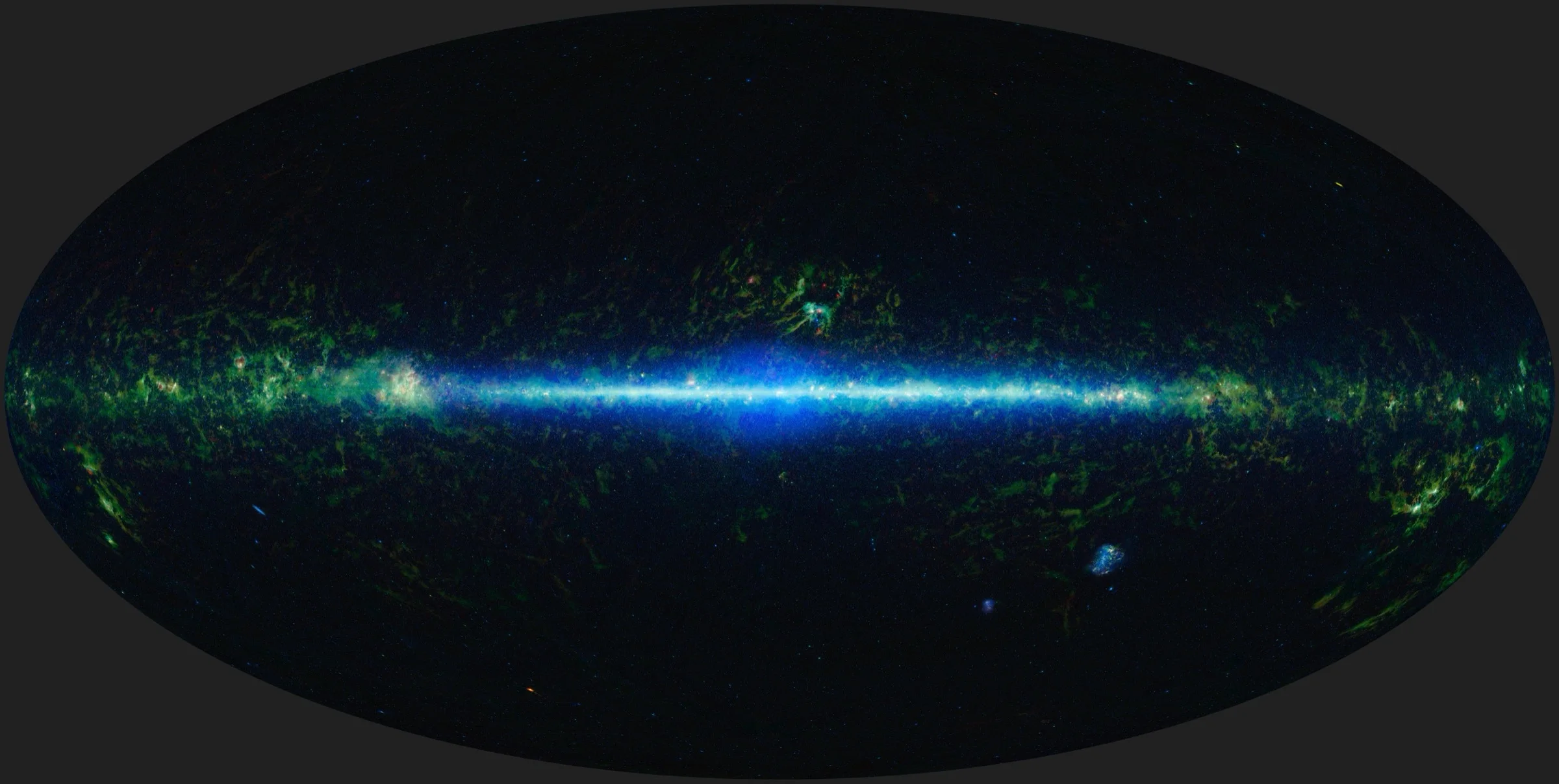
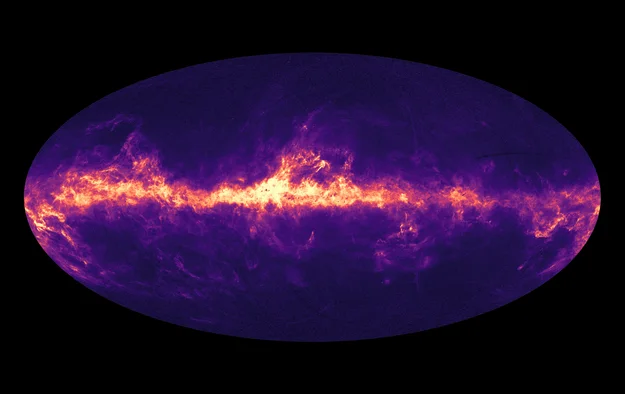
Modern searches combine several catalogues: Gaia for position, distance and optical photometry; 2MASS for near infrared; WISE for mid-infrared bands at 3.4, 4.6, 12 and 22 micrometres. WISE is crucial because it mapped the whole sky and produced a catalogue of hundreds of millions of sources. But its strength is also its weakness: at 12 and 22 micrometres, angular resolution allows contamination by background galaxies, dusty regions or blended sources.
A good Dyson candidate is therefore never merely “red”. It must survive a chain of eliminations: bad measurement, saturation, circumstellar dust, young star, debris disk, nebula, background galaxy, quasar or unresolved companion. The search is less a treasure hunt than a differential diagnosis of the sky.
3. Project Hephaistos: seven candidates, zero certainty
Project Hephaistos gave this hypothesis a concrete contemporary form. A 2024 study in Monthly Notices of the Royal Astronomical Society examined about five million sources by combining Gaia DR3, 2MASS and WISE. After photometric filters, image classification, signal-to-noise cuts and visual inspection, the pipeline retained seven candidates deserving follow-up. The authors are precise about their status: anomalies compatible with some partial Dyson sphere models, not detected civilizations.
The filtering details matter for A.L.I. They show that detecting unknown intelligence is first an exercise in statistical humility. In Hephaistos II, millions of sources become hundreds of thousands, then thousands, then hundreds, then seven. The result is not a narrative triumph; it is a protocol of doubt.
Follow-up work has strengthened this caution. Recent analyses of two candidates show that infrared excess can be explained by red background galaxies projected very close to the observed star. In other words, the sky superposes things that do not touch. A civilization can be imitated by an alignment.
4. Tabby’s Star: the lesson of a runaway hypothesis
KIC 8462852, known as Tabby’s Star, crystallized the modern megastructure imagination. The Kepler telescope observed deep and irregular dimming, sometimes up to about 20 percent. The extraterrestrial megastructure hypothesis circulated because the light curve resisted ordinary explanations.
Multi-wavelength data cooled that scenario. Spitzer, Swift and ground-based observations showed stronger dimming in ultraviolet than in infrared, pointing toward fine dust rather than a giant opaque structure. Tabby’s Star remains interesting, but above all as a warning: imagination is useful for forming hypotheses, dangerous when it replaces the hierarchy of evidence.
5. Dyson scenarios
Collector swarm. This is the most plausible form: many orbital objects capture a fraction of the light with partial coverage. Its signature would vary with geometry and re-emission temperature.
Computational infrastructure. A civilization could convert part of stellar energy into massive computation. The thermodynamic question then becomes: where, and at what temperature, does it reject the entropy produced?
Orbital habitats. A distributed population of stations, mirrors and habitats may produce a more diffuse signature than a single object. The swarm is no longer only a machine; it becomes an environment.
Fossil artifact. A structure could outlive its builders. The technosignature would not be the speech of a living civilization, but a stellar-scale archaeological remainder.
Extreme cases. Speculations exist around white dwarfs, pulsars or black holes as energy sources. They are fascinating, but farther from the current observational strategy around main-sequence stars.
6. Consequences for A.L.I
Contact can be unintentional. A.L.I must think not only about messages, but also about signatures. A language can be produced by a civilization; a technosignature can be produced by its energy economy.
Ambiguity becomes central. A message is often designed to be understood. An infrared excess is not. We need a hermeneutics of non-addressed traces: reading without assuming that the other has written.
Proof requires several instruments. WISE can raise the alert, Gaia provides distance and stellar coherence, JWST or ALMA can separate a star from a background galaxy. Interpretation is collective, slow and instrumental.
Civilization becomes an ecology. A Dyson sphere is not merely an engineering feat. It is a relation to a star, to waste heat, expansion, maintenance and risk. It forces us to imagine intelligence as the sustainable or predatory management of an energy flow.

7. Careful speculations
If a partial Dyson sphere existed, it would probably not look like a smooth wonder. It would be incomplete, aging, shaped by orbits, conflicting uses, repairs and migrations. It could leave temporal signatures: infrared variations, irregular occultations, changes in apparent temperature. The technosignature would not be a fixed point, but an industrial weather system around a star.
Another speculation concerns silence. A civilization capable of such a project might choose not to emit powerful radio messages. It would not need to hide in order to be hard to understand. It might simply live at an energetic and temporal scale where our categories of signal, intention and reply become poor.
The reverse scenario is also possible: an advanced civilization might avoid visible Dyson spheres because they are costly, unstable, detectable or ethically absurd. The absence of massive megastructures would then not mean the absence of intelligence, but the trace of other technical models: sobriety, miniaturization, dispersion, integration into an environment, or a deliberate choice not to maximize energy.
8. A.L.I hypothesis: a grammar of heat
A.L.I could treat technosignatures as a language without an explicit speaker. A grammar of heat would describe three levels:
- Instrumental syntax: which data, filters, measurement errors and angular resolutions?
- Energetic semantics: how much light is captured, at what temperature is it re-emitted, with what variability?
- Cosmic pragmatics: what type of organization could produce this signature, and why should we not conclude too quickly?
This grammar would not say “we have found a civilization.” It would allow us to formulate the previous step correctly: “here is an anomaly whose natural explanations are becoming less simple; here are the observations that could make it speak more clearly.”
9. Conclusion: intelligence as excess, then as doubt
Dyson spheres are powerful because they make intelligence observable without conversation. They are dangerous because they immediately attract narrative. Between the two lies A.L.I’s task: building protocols in which wonder produces better questions, not false certainties.
An infrared anomaly is not a voice. It is an invitation to verify. Perhaps the first sign of another civilization will be neither a word, nor an image, nor a music, but poorly explained heat, lost in the map of the sky.
References and further reading
- Freeman J. Dyson — “Search for Artificial Stellar Sources of Infrared Radiation”, Science, 1960.
- Project Hephaistos II — Dyson sphere candidates from Gaia DR3, 2MASS, and WISE, MNRAS, 2024.
- Project Hephaistos IV — JWST observations of two Dyson sphere candidates, 2026.
- WISE All-Sky Data Release, NASA/IPAC Infrared Science Archive.
- NASA/JPL — Tabby’s Star and the dust explanation, 2017.
- NASA/JPL — SPHEREx and future all-sky infrared spectroscopy, 2025.
- G-HAT — The search for Type III civilizations with WISE, Wright et al., 2014.