At every moment, the world contains more information than we can perceive. Infrared light crosses a room without becoming visible colour. Vibrations too slow or too fast escape our hearing. A weak signal dissolves into noise. A highly compressed image looks like a meaningless mosaic until the correct decoder reconstructs it.
Starting from this ordinary situation, we can propose a more radical hypothesis: the future may already be among us, not as a completed film but as distributed, pixelated information inaccessible to the resolution of our senses and concepts. In the same way, interstellar messages may already cross our instruments without being recognised as messages.
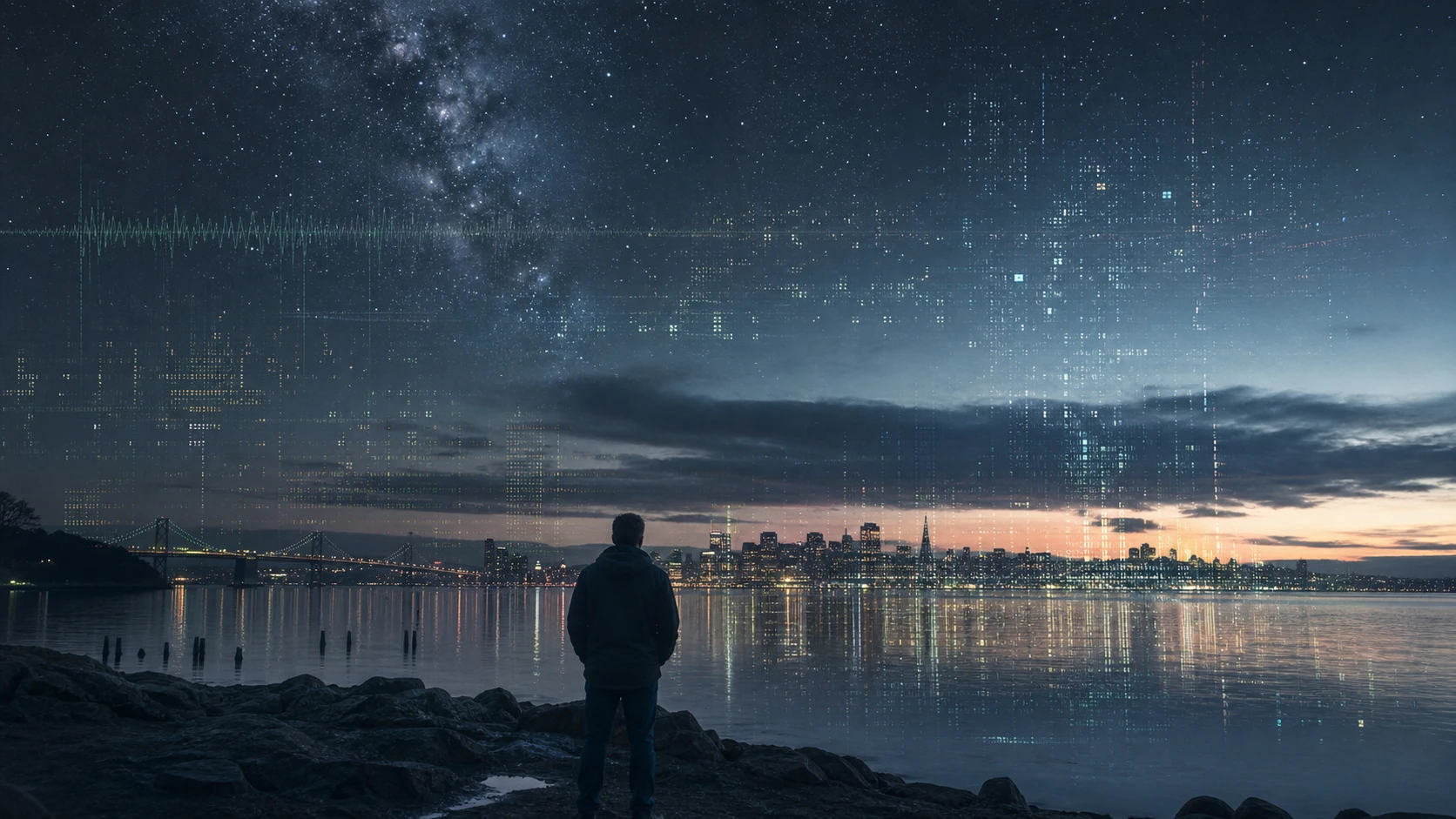
The scope of this proposal must be clear. Current physics does not allow us to claim that information freely travels from the future into the present. The hypothesis therefore separates three levels: what physics can describe, what information theory can formalise and what art can construct as an experience.
1. What kind of future could be “already here”?
The philosophy of time offers several competing models. Presentism holds that only the present truly exists. The block universe, commonly associated with eternalism, treats past, present and future events as regions of one four-dimensional spacetime. Between them, the growing block imagines reality accumulating past and present while the future is not yet formed.
Relativity weakened the idea of a universal “now”: observers in relative motion do not necessarily divide spacetime into identical planes of simultaneity. This does not prove that tomorrow sends messages backwards. It means that the intuitive division between past, present and future is not simply and absolutely built into physical models. The Stanford Encyclopedia of Philosophy also makes clear that the block universe remains a debated philosophical interpretation, not a camera through which tomorrow can be watched.
2. The light-cone safeguard
In relativity, every event has a light cone. Its causal past contains what could have influenced it; its causal future contains what it may influence. Between them lie regions with which no signal can be exchanged faster than light.
To say that the future may belong to the global structure of spacetime is not to say that it is available as mail delivered in advance. Existing in a model and being accessible to an observer are different things. The encoded-future hypothesis does not seek to violate that boundary. It asks whether the present already contains constraints, tendencies and correlations whose consequences we cannot yet reconstruct.
3. The present as a low-resolution image
We never access the whole world. Our senses sample particular frequencies, speeds and thresholds. The brain does not receive a complete copy of reality: it combines incomplete data with expectations, models and prediction errors. Research on predictive processing describes perception as an active negotiation between sensory evidence and internal models.
Pixelated is used here as a precise metaphor. A pixel is not a tiny object hidden in nature; it is a unit chosen by a measuring device. If the grid is too coarse, different forms become identical. If sampling is too slow, a rhythm disappears or turns into false motion. If dynamic range is too narrow, the signal merges with the background.
| Cause of invisibility | What we observe | What may be missing |
|---|---|---|
| Threshold too high | Silence or noise | A weak but structured signal |
| Resolution too low | A uniform mass | Organised detail |
| Wrong timescale | A click or drift | A sentence that is too fast or too slow |
| Wrong modality | No image | A structure carried by polarisation, phase or motion |
| Missing key | A random sequence | A compressed or encrypted archive |
| Missing concepts | A pattern without meaning | Semantics foreign to our categories |
4. Do present conditions already contain their futures?
In an ideal deterministic system, a sufficiently precise state would allow its evolution to be calculated. That is the horizon of Laplace's demon. Chaotic systems, however, show that tiny initial differences can produce widely divergent trajectories. Knowing the equations does not always grant exact prediction because uncertainty in the initial state eventually dominates.
The future can therefore be constrained without being readable. A seed does not contain a miniature photograph of the tree, but an organisation capable of producing certain forms under certain conditions. An atmosphere contains the processes of future weather without providing an exact long-range forecast. A human decision opens and closes branches without fully writing what will happen.
In this view, the future “among us” is not one scenario stored in a hidden cache. It is a field of possible futures with unequal probabilities, whose conditions of formation are carried by the present. We perceive a few large pixels: a climatic trend, political fragility, growth, learning. The rest remains below our resolution or beyond our computing power.
5. Information can exist while its meaning remains invisible
Claude Shannon's information theory made it possible to measure information quantity, noise, redundancy and channel capacity. It does not state what a message means. A sequence may be transmitted perfectly without being understood; another may look disordered because it is strongly compressed.
The Stanford Encyclopedia's overview of information stresses the difference between technical measures and semantic content. Coding turns one structure into another to resist noise or reduce size. The receiver must know, discover or infer the inverse transformation.
This is where the hypothesis becomes useful for A.L.I: a phenomenon is not “message-free” merely because we lack its decoder. The reverse is equally important: a strange form is not necessarily a message. Criteria must distinguish organisation, natural origin, instrumental artefact and intention.
6. We already know how to read an invisible past
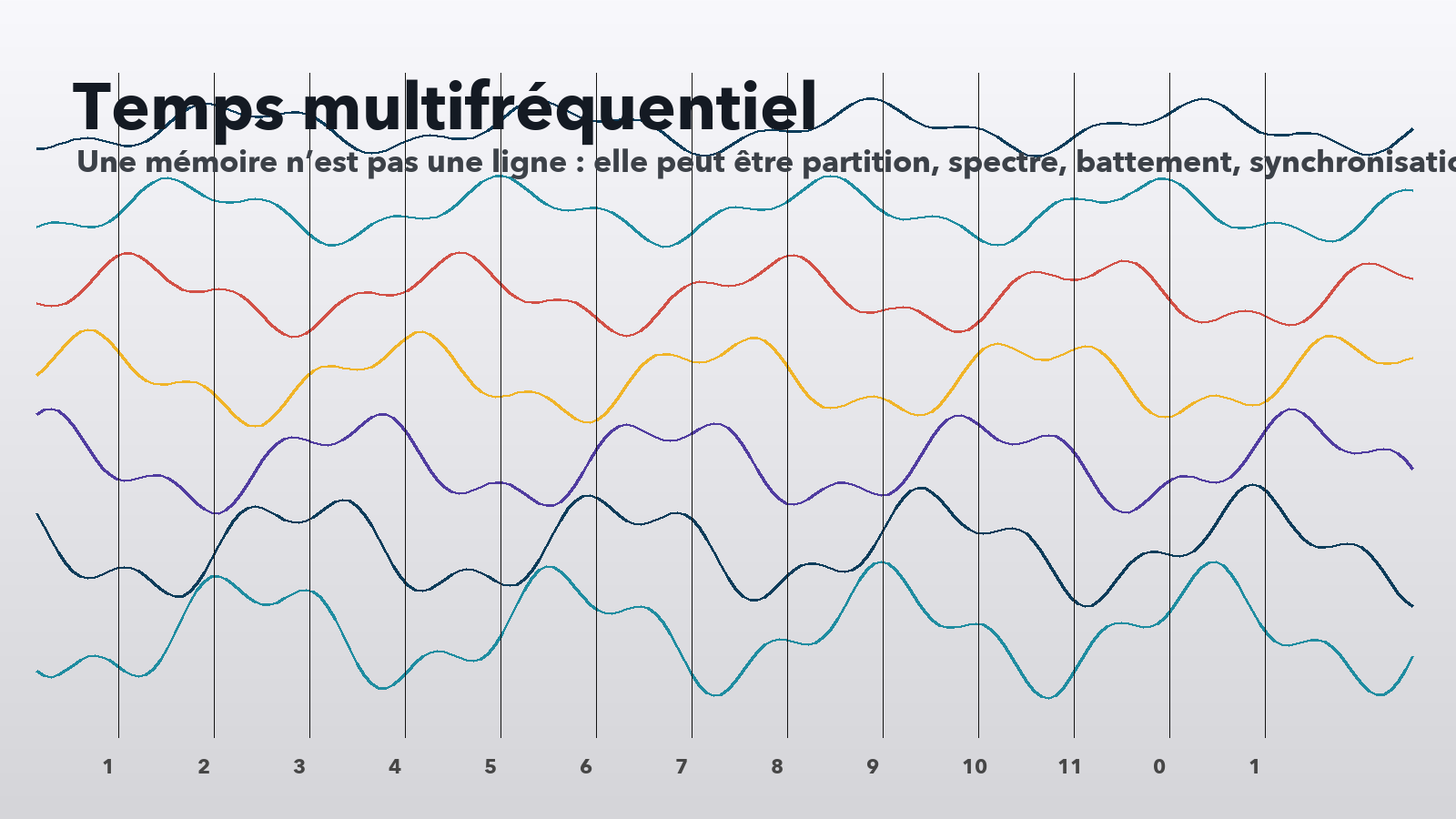
The strongest analogy comes not from the future but from the past. Light received today can carry the state of a vanished star. Tree rings record seasons. DNA preserves traces of evolutionary branches. Polar ice traps ancient atmospheres.
WMAP's map of the cosmic microwave background is a spectacular example: minute temperature variations in the oldest accessible light become an image of conditions in the early Universe. The past is not present as conscious memory; it is encoded in matter or radiation that an instrument and a model render legible.
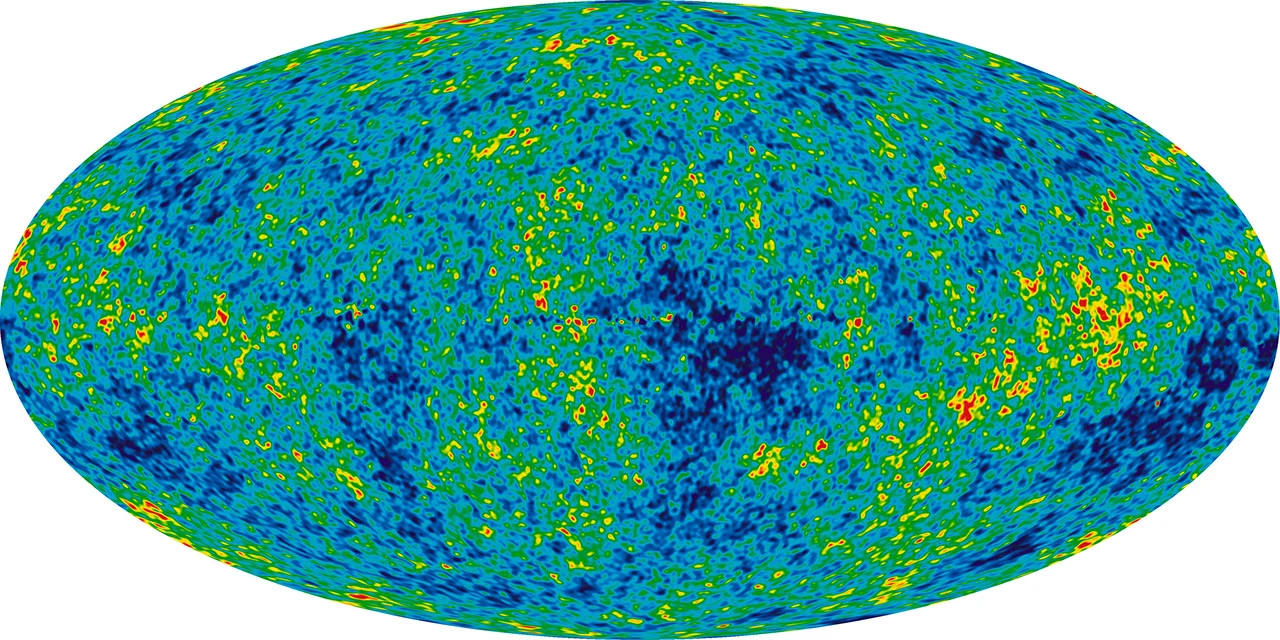
The encoded-future hypothesis makes a speculative shift: are there comparable structures in the present that are not archives of the past but unreadable conditions of possible futures? The difference is decisive. A trace of the past can be compared with other archives; a supposed trace of the future may always be a projection made by the observer.
7. What if an interstellar message is already in our data?
SETI no longer means waiting for a clear voice on one radio frequency. Searches examine narrow-band radio signals, pulses, optical transients, atmospheric or industrial signatures, infrared excesses and other technosignatures. According to the SETI Institute, a very narrow carrier may be easier to detect than any modulation that contains a message. We might recognise an artificial emission without yet accessing its content.
Several problems can make a physically present message unreadable:
- Wrong moment: a brief signal may occur between observations.
- Wrong speed: a conversation may last a millisecond or several centuries.
- Wrong frequency: we search bands chosen from our own technological history.
- Propagation: interstellar plasma can broaden or distort an initially narrow signal.
- Wrong object: we discard as noise what does not fit our technosignature models.
- Wrong idea of language: the message may lie in intervals, cross-channel correlations, polarisation or an unimagined transformation.
NASA notes that artificial intelligence can search enormous datasets and identify patterns that rigid human criteria might miss. But AI can also overfit data, reproduce our biases or mistake an instrumental anomaly for a discovery. It should propose candidates, not manufacture certainty.
8. The false-signal test
Our brains spontaneously seek form. That capacity lets us read faces, tracks and constellations; it also produces pareidolia and apophenia. The larger the dataset, the more impressive accidental patterns it will contain.
A serious protocol therefore requires independent repetition, detection by different instruments, coherent localisation, elimination of terrestrial interference, testable predictions and open methods. A convincing decoder should not merely explain the signal used to build it; it should predict a structure withheld from the decoding process.
9. The A.L.I hypothesis: a distributed future
The hypothesis can now be stated without turning it into belief:
The future would not be present as a complete image. It would be distributed through the current state of the world as constraints, correlations, memories, branches and probabilities. Our senses and languages produce only a low-resolution reconstruction. Likewise, an interstellar message may be physically present in a signal while remaining absent from our perceptual world because we lack the scale, model or key.
This proposal brings two unknowns together without confusing them. The future and the extraterrestrial are forms of radical otherness: one has not yet been lived, the other has not yet been understood. In both cases, we risk projecting expectation onto ambiguous material. In both cases, changing instruments and language can make previously invisible order appear.
10. Four experiments to make the hypothesis operational
The Multiresolution Decoder
A program replays the same data stream through hundreds of temporal and frequency windows. It does not seek one familiar pattern but scales at which repetition, possible compression, response or hierarchical structure appear. Results are compared with random controls and known interference.
The Alien Codec Challenge
Teams invent messages without a shared alphabet. One encodes; another receives only the signal and minimal physical context. The experiment measures what actually survives the absence of common culture: number, symmetry, causality, rhythm, demonstration, image or interaction.
The Room of Weak Futures
An installation observes a space without identifying individuals. It produces several probabilistic projections of what may happen seconds later: a silhouette rises, a light goes out, an object moves. Images remain incomplete and pixelated. When one possibility occurs, it gains definition while the others fade. The work does not claim to predict the future; it materialises the difference between possibility, probability and event.
The Observatory of Missed Messages
Astronomical, acoustic and environmental archives are reanalysed with parameters deliberately foreign to human habits: extreme durations, correlations between distant sensors, polarisation, topological geometry and nonlinear transforms. Every anomaly must then survive an adversarial review by another team.
11. A predicted future already acts on the present
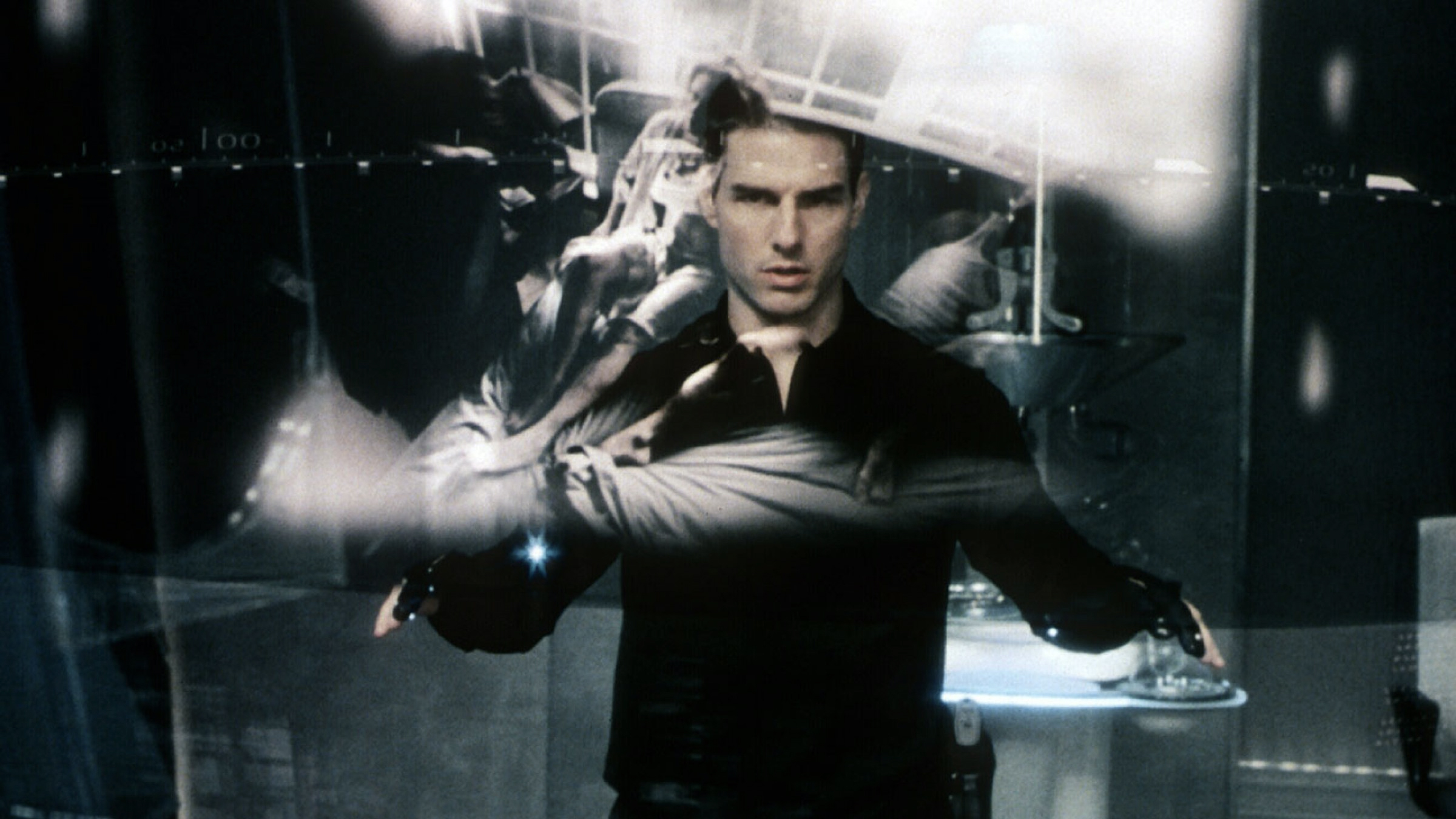
A prediction is not neutral. Announcing a shortage can trigger the purchases that make it real. A risk score can guide an administrative decision and trap a person inside the assigned category. In Minority Report, the claim to see future crime turns possibility into present guilt.
If our decoders grow more powerful, their stakes will not be purely scientific. We will have to ask who selects the data, defines anomaly, owns the instrument and bears the decision. Making a future visible can alter the future one believed one was merely observing.
12. Arrival: learning to perceive a time that is not ours
In Denis Villeneuve's Arrival, adapted from Ted Chiang's Story of Your Life, heptapod writing does not unfold word after word. The circular sign is produced as a whole whose ending is already engaged at the beginning. Learning the language changes Louise Banks's experience of time.
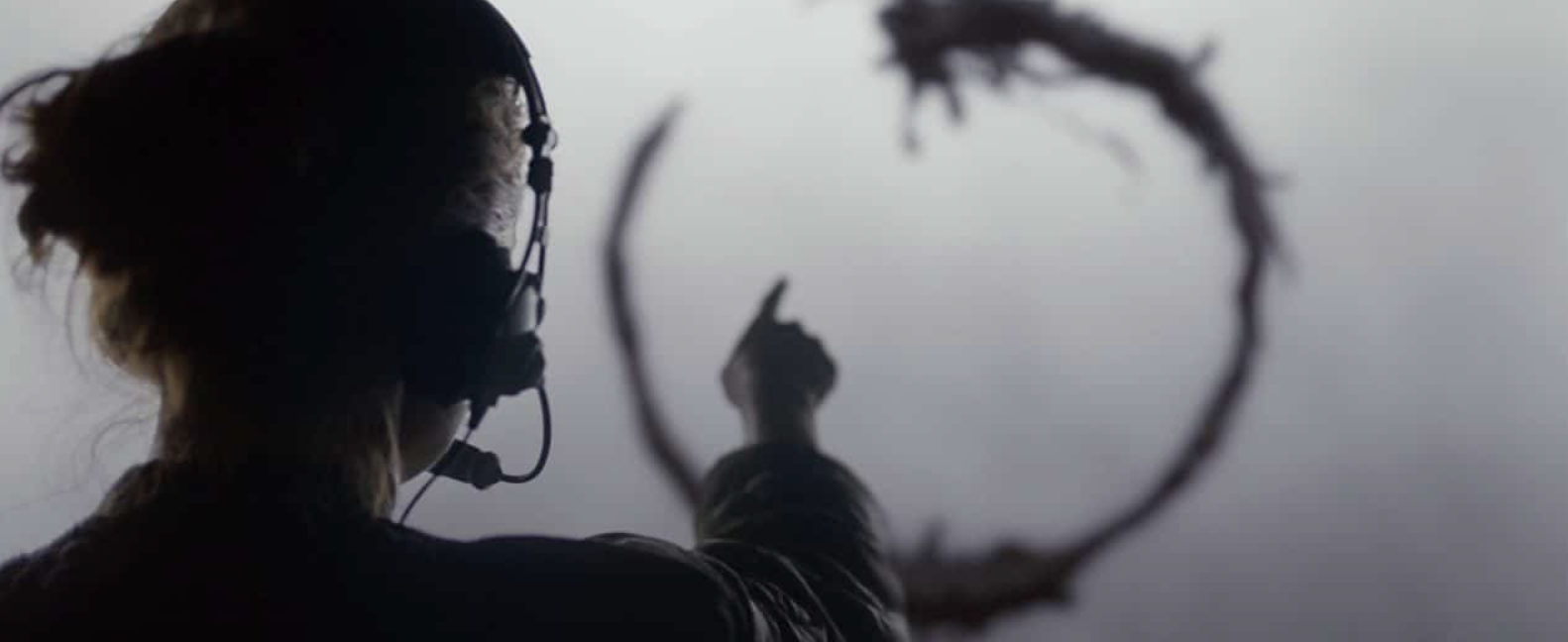
The film is not a demonstration of physics. It is a thought experiment about language and perception: if our grammar changed radically, would the temporal resolution of our world change with it? A.L.I can retain the question without promising foresight. Inventing a language may also mean inventing what can become perceptible.
13. Conclusion: build the decoder before declaring absence
We often say that the future does not yet exist and that the silence of the sky contains nothing. Both statements may describe the current limits of our instruments as much as the world itself.
The encoded future is not a scientific certainty. It is a research method: before declaring information absent, test whether it is merely below threshold, outside scale, outside frequency, outside language or outside concept. This shift guarantees no revelation. It asks us to build better sensors, stronger controls and imaginaries capable of receiving a structure that does not yet look like a message.
Sources and further reading
- Stanford Encyclopedia of Philosophy, “Time”.
- Stanford Encyclopedia of Philosophy, “Being and Becoming in Modern Physics”.
- Stanford Encyclopedia of Philosophy, “Chaos”.
- Nature Reviews Neuroscience, predictive processing.
- Stanford Encyclopedia of Philosophy, “Information”.
- NASA, WMAP Overview.
- SETI Institute FAQ.
- SETI Institute, stellar plasma and broadened signals.
- NASA, technosignatures and artificial intelligence.
- Ted Chiang, Stories of Your Life and Others.
- Arrival, Denis Villeneuve.