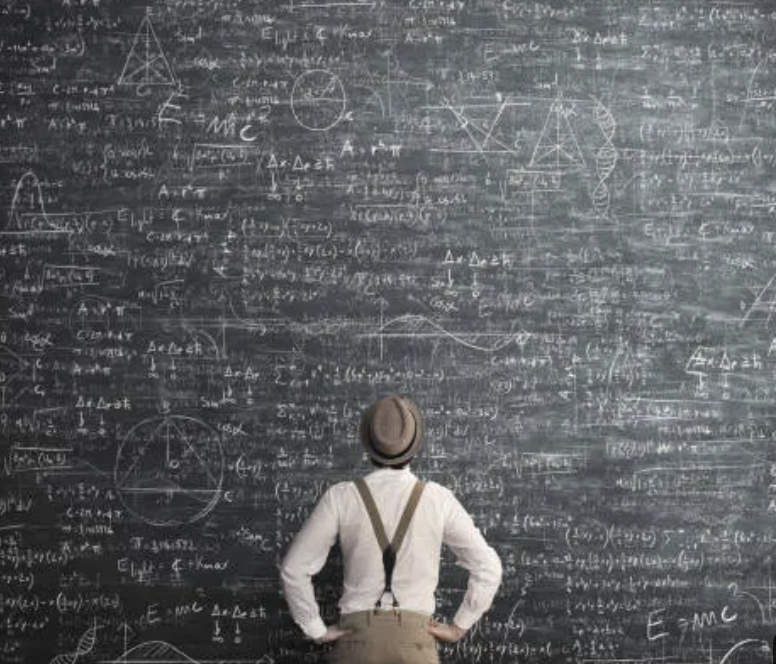
Exomathematics is used here as a working hypothesis for A.L.I: if a non-human intelligence shares neither our bodies, nor our acoustics, nor our culture, it might still develop formal structures we could recognize as mathematics. But those mathematics would not necessarily be ours. They might privilege other objects, other intuitions, other ways of proving, organizing space, classifying continuity, discreteness, symmetry or time.
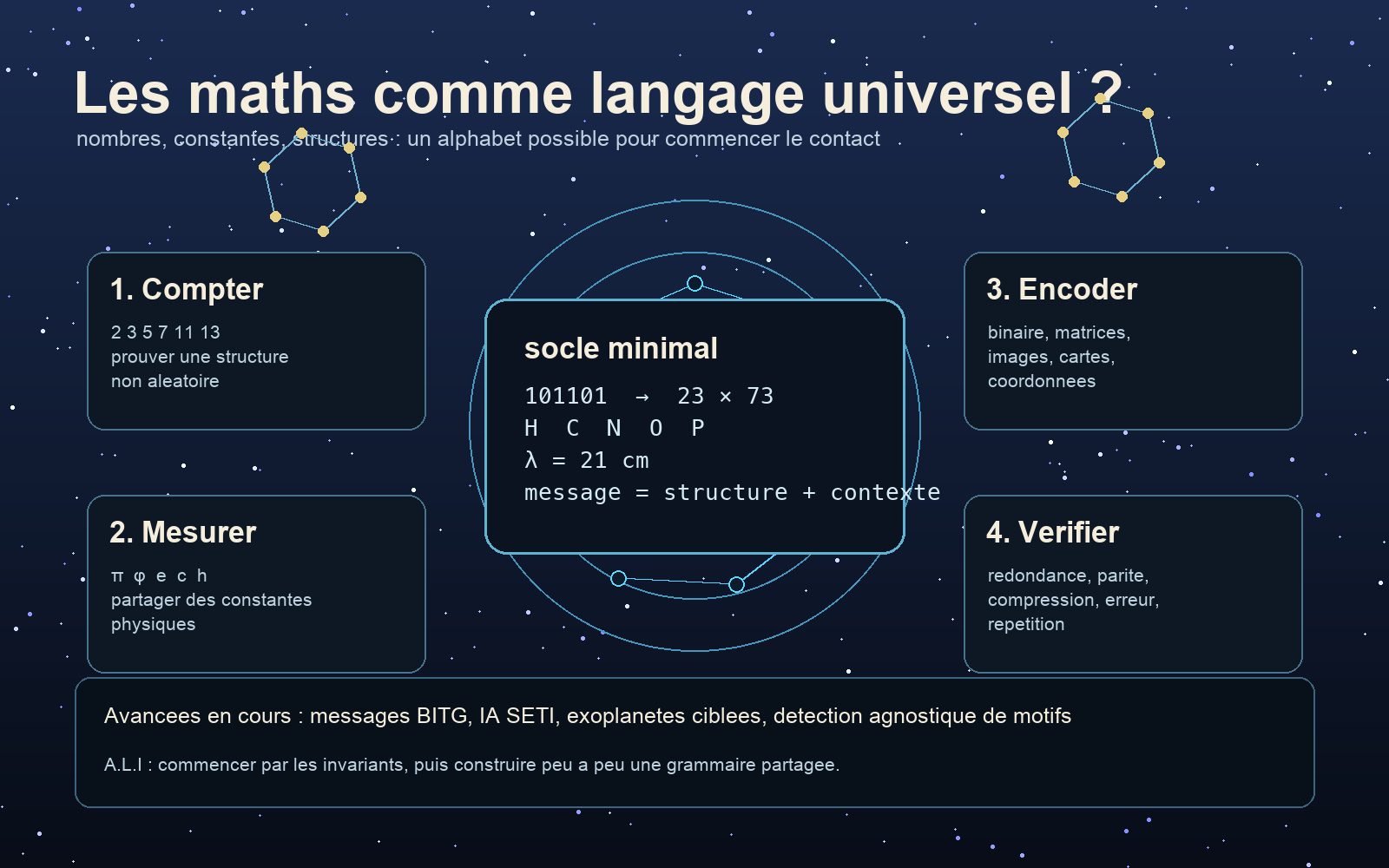
So this is not only about sending prime numbers into space. It is about a language that begins with invariants, then moves toward a deeper strangeness: forms, relations, transformations, constraints, models and proofs.
Why Greg Egan matters for A.L.I
In Greg Egan's science fiction, mathematics is not just an intellectual backdrop. It becomes a medium of thought. Two stories are especially useful here.
Glory stages an encounter with foreign mathematics. The challenge is not simply to translate a sentence, but to understand a civilization through its abstract objects: what it considers important, what it chose to explore, what it finds elegant or provable. Otherness passes through the very form of thought.
Riding the Crocodile introduces another issue: galactic communication is not only a problem of code, but of duration. Even if a message is perfectly constructed, it travels at finite speed. Dialogue becomes an architecture of waiting, memory and relay.

A.L.I hypothesis: three layers of an exomathematical message
1. Recognition signal. The message first shows that it is artificial: repetitions, primes, proportions, spectra, symmetries or physical constants.
2. Formal grammar. The message introduces its own rules: how to read a sequence, how to bind a symbol to an operation, how to identify a transformation, how to distinguish data, rules and comments.
3. Mathematical strangeness. Once the channel is established, the message offers objects that are not immediately human: unusual topologies, non-intuitive geometries, alternative logics, categories, graphs, dynamics, visual proofs or compressed structures.
Conceptual sequence
A possible protocol would not try to send a direct sentence such as “we are here”. It might send a progression:
detectable regularity → reading rule → simple mathematical object → variation → proof → question.
The final step is decisive: intelligence may be recognized not only by what it states, but by what it asks. A mathematical question can become a call.
Important limit: entanglement does not replace the message
This post also extends the previous reflection on quantum entanglement. As far as current physics tells us, entanglement cannot transmit information faster than light. It can, however, inspire a poetics of relation: correlations, shared states, deferred proof, comparison of measurements and common memory.
Possible prototype
For A.L.I, we could create an exomathematical message generator: an interface where one chooses a structure, then the system produces several layers of transmission. A simple radio layer, a pixel-image layer, a sound layer, then a layer of proof or transformation. The final object would be signal, score and riddle at once.
The central question becomes: how can we build a message that we can still read ourselves, while it already begins to move us beyond our ordinary habits of language?
References
- Axiomatic - Greg Egan: a hard-SF short-story collection, useful for situating Egan's speculative universe around cognition, mathematics and formal systems.
- Glory - MathFiction entry: a reference focused on the mathematical dimension of the story.
- Riding the Crocodile - full text on Greg Egan's website: the key story for galactic communication and duration.
- Riding the Crocodile - MathFiction entry: a complementary reference on the story as mathematical fiction.