
If the Milky Way has had billions of years to produce worlds, organisms and perhaps technological civilizations, why do we observe no indisputable presence? The Fermi paradox lies in this tension. It proves neither that we are alone nor that extraterrestrials are hiding. Above all, it exposes the gap between the vastness of what could exist and the tiny portion we have actually examined.
For A.L.I, this is less a question of absolute silence than of illegibility. A signal may be too weak, too brief, too old, too slow, too fast, or carried by a medium to which we pay no attention. It may not have been designed for us. Before asking “where are they?”, we must therefore ask: what would we be capable of recognizing as the trace of a radically different intelligence?
1. A lunchtime question becomes a scientific problem
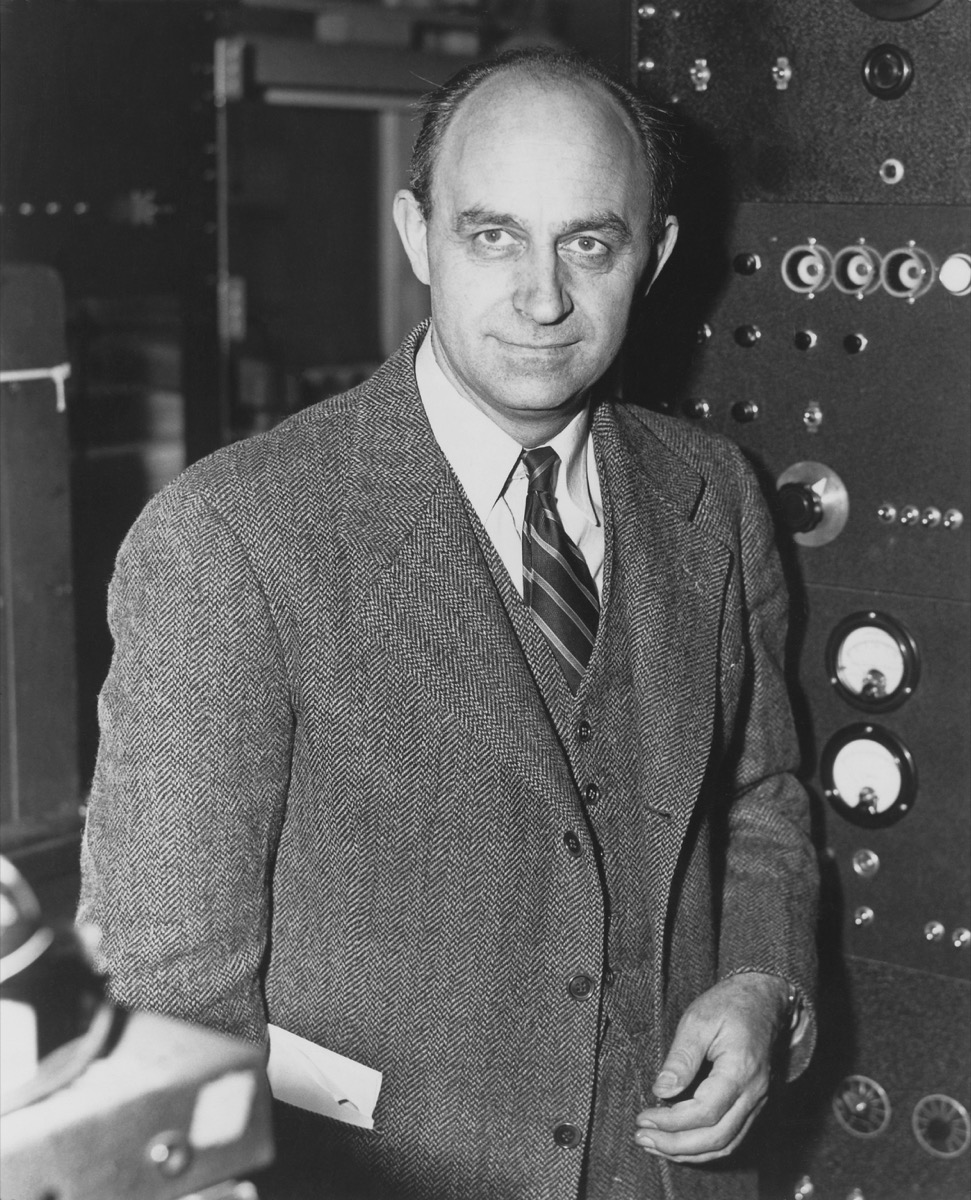
Enrico Fermi (1901-1954), an Italian-born American physicist and the 1938 Nobel laureate in physics, reportedly asked “Where is everybody?” over lunch at Los Alamos around 1950. The phrase condensed an intuition. The galaxy is old; even travel far below light speed could, under some expansion assumptions, traverse it in a fraction of its age. Ancient civilizations might therefore have left probes, emissions, altered planets or other artifacts.
Three moments are often conflated. Fermi asked an informal question. Michael H. Hart formalized the absence-of-visitors argument in 1975. The Drake equation, introduced in 1961, organized factors that might produce communicating civilizations. “Fermi-Hart problem” is therefore a more precise label: a conditional tension, not a mathematical contradiction.
2. What the paradox assumes
The argument becomes strong only if several assumptions hold at once: life emerges often enough; technological intelligence is not exceptionally rare; civilizations last; they produce detectable traces; some explore or transmit; and our instruments and categories can recognize those traces. If even one condition is false or extremely uncommon, the silence becomes less surprising.
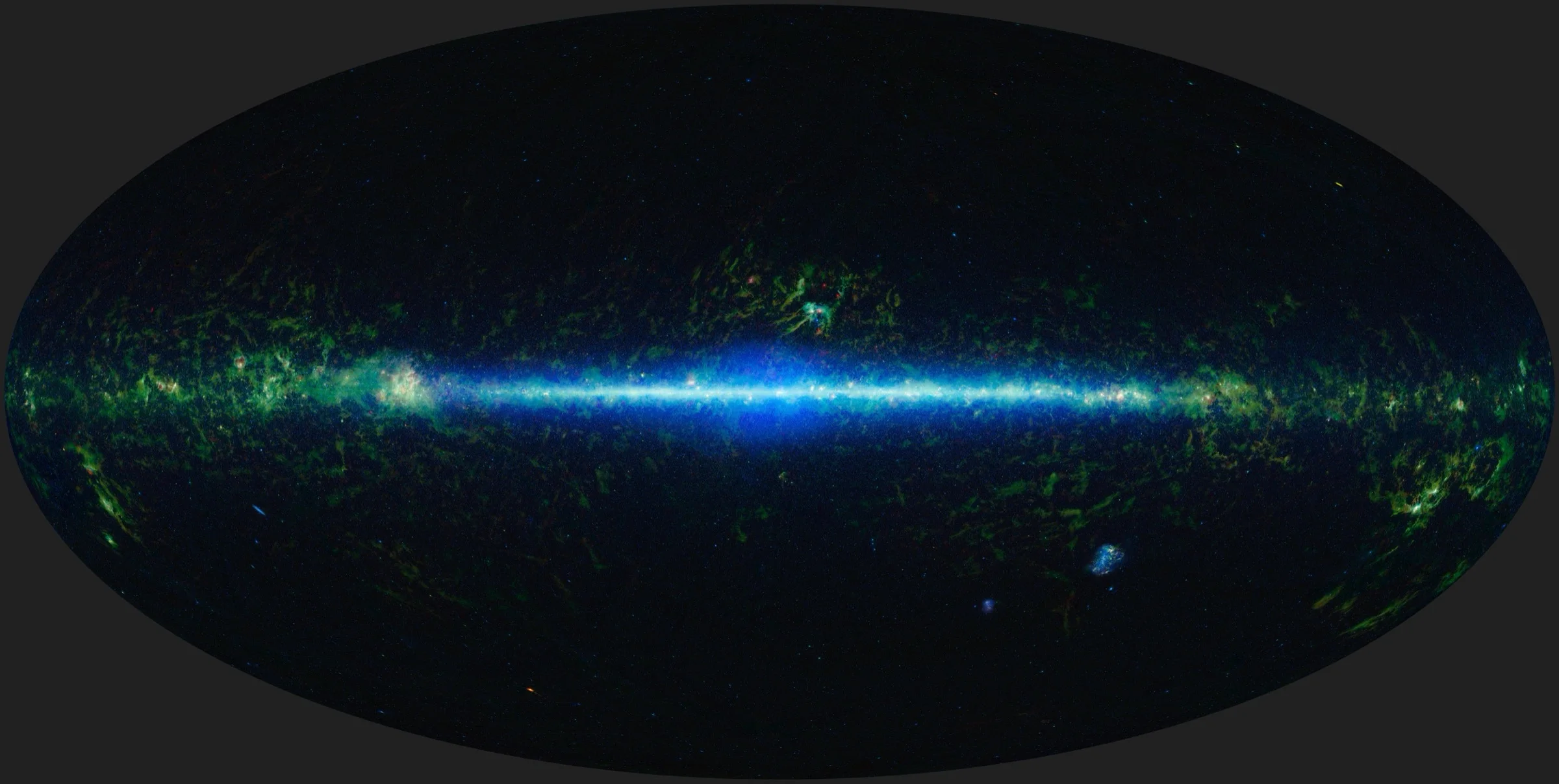
The Milky Way is roughly 100,000 light-years across and contains hundreds of billions of stars. Yet size alone says nothing about how many civilizations overlap with us in time. Two societies could arise in the same galaxy a hundred million years apart and never share a present. The paradox is therefore as temporal as it is spatial: another intelligence must not only exist elsewhere, but exist now, transmit through an accessible channel, and persist long enough to be heard.
3. Observed silence is not galactic silence

Saying “we have heard nothing” creates a false sense of completeness. A SETI search must select a direction, frequency, bandwidth, sensitivity, duration, modulation type and moment. This produces an immense search space. In 2018 Jason Wright, Shubham Kanodia and Emily Lubar developed the cosmic haystack metaphor: depending on the parameters, the fraction searched remains comparable to a small pool against Earth's oceans.
A null result is still meaningful when its limits are stated. It may rule out, around selected stars and frequencies, continuous beacons above a given power. It does not rule out intermittent, directional, energy-efficient, ancient, biological, optical, gravitational or unknown-physics channels. The scientifically responsible statement is not “nobody is speaking,” but: no confirmed technosignature has been identified in the very limited region of possibility space we have examined.
4. Four families of explanations
Rarity and the Great Filter
Simple life may be common while complex cells, cumulative intelligence or technology are exceptionally rare. Robin Hanson's Great Filter names a highly improbable step between inert matter and a civilization durably visible on a cosmic scale. If the filter lies behind us, humanity may be extraordinarily rare. If it lies ahead, most civilizations may vanish before becoming interstellar.
Short-lived, sustainable or non-expansionist civilizations
Longevity matters more than the raw number of origins. A technological society may collapse, choose low-energy stability, migrate into compact digital environments or reject expansion. Classical versions of the paradox sometimes project a human history of continuous colonization onto the Universe. An advanced intelligence might instead favor stability, miniaturization, low waste heat and protection of its environment.
The wrong channel or the wrong category
We primarily search for products of our own technological history: radio, lasers, industry and spacecraft. An oceanic, collective, vegetal, mineral or distributed intelligence might never build a transmitter. A post-biological civilization might compress its activity into cold and discreet regions. Contact would then fail not because of distance but because of an ontological error: we expect an object or message while the relevant phenomenon may be a rhythm, an ecological transformation or an organization of matter.
Non-interference and concealment
John A. Ball's zoo hypothesis imagines observers who avoid disturbing a young civilization. Other scenarios suggest quarantine, a shared non-contact rule or silent monitoring. They are difficult to test because any absence can be reinterpreted as successful concealment. Their scientific value remains limited until they generate falsifiable predictions.
5. The dark forest: powerful fiction, not evidence
In The Dark Forest, the second volume of Liu Cixin's trilogy, each civilization moves like a hunter through a night forest. It cannot know another's intentions or rate of development. Revealing one's position may therefore create an existential risk. Silence becomes rational; preemptive destruction is its darkest extension.
The model assumes that information remains unreliable, a preemptive strike is possible, cooperation offers no sufficient benefit and behavior converges on distrust. No observation confirms these premises at interstellar scale. The dark forest should be treated as a thought experiment about asymmetry and trust, not as an established solution to the paradox.
6. Searching for technologies rather than voices
Contemporary searches broaden listening into the study of technosignatures: radio or laser pulses, industrial pollutants in an atmosphere, infrared waste heat, artificial illumination, anomalous transits, propulsion, probes or artifacts in the Solar System. A technical signature need not be a message. It may be a by-product, like terrestrial emissions leaking into space.
This distinction changes the problem. A civilization may be detectable without wishing to communicate, or may wish to communicate without being detectable to us. A.L.I must separate three levels: a trace of activity, a structured signal, and an addressed message. Confusing them can quickly turn an anomaly into a contact narrative.
7. Listening, answering, remaining silent
SETI listens; METI proposes intentional transmission. Between them lies a political question: who is entitled to speak for Earth? The international post-detection protocols recommend independent verification, transparency and consultation before any reply. They do not amount to a binding global treaty capable of preventing a transmission.
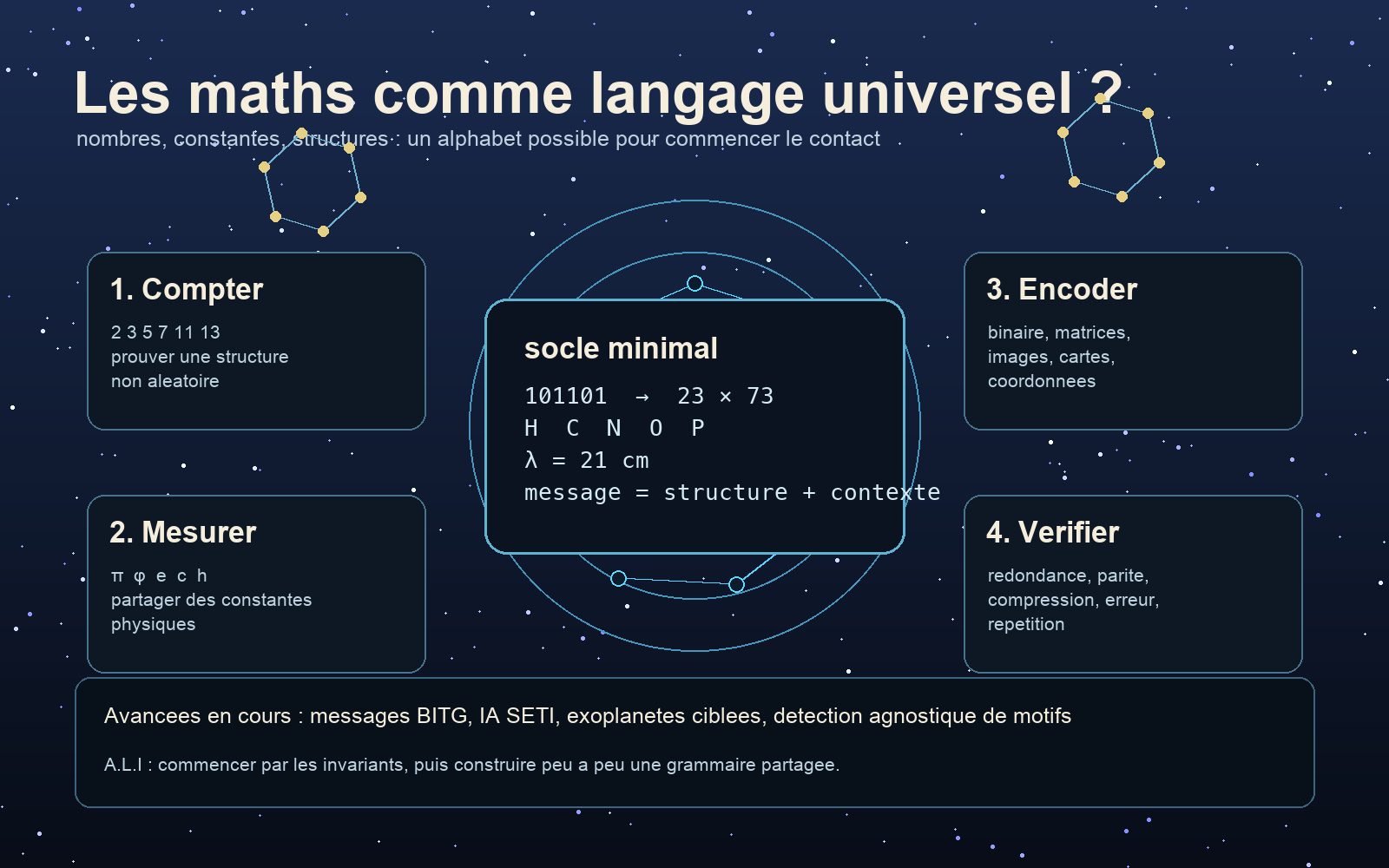
The Fermi paradox therefore suggests an ethics of slowness. First contact may not begin with a long portrait of humanity, but with a gradual protocol: detect, confirm, establish regularity, exchange minimal evidence, test reciprocity, and only then increase information. Delay is not necessarily a defect in language; it may be its first safety rule.
8. What the Great Silence changes for A.L.I
Silence can contain several meanings that we cannot yet separate: nobody transmits; nobody transmits now; a signal cannot reach us; we lack the right organ, instrument or concept; or transmitters choose discretion. A.L.I can work within this interval without turning uncertainty into belief.
- A gradual grammar: begin with simple, repeated and reversible patterns requiring little interpretation.
- A multichannel message: carry the same relation through number, light, rhythm, image and frequency so that each layer checks the others.
- Proof without a full address: demonstrate intention without immediately disclosing everything about the sender.
- Silence as an explicit sign: encode pauses, delays and withdrawals so interruption, caution and ending can be distinguished.
- A right not to answer: design contact as a proposal, never as an intrusion.
9. Three laboratory experiments
Atlas of silences
An installation receives several real astronomical data streams and represents not only detected events but unobserved regions, interruptions, sensitivity thresholds and missing durations. The visitor discovers that “emptiness” is partly produced by the instrument as well as observed in the sky.
Withdrawing beacon
A beacon emits a recognizable pattern, then gradually reduces its precision and power. To continue the exchange, the receiver must demonstrate understanding without receiving all the information. The work tests trust by stages rather than immediate exposure.
Blind decoders
Several groups receive the same signal through different media: sound, light, vibration or numbers. Together they must reconstruct a common invariant. The experiment measures what survives when a message changes sense, culture and medium.
10. A library of the Great Silence
Science fiction has often exposed the paradox's dilemmas better than lists of solutions. His Master's Voice by Stanisław Lem stages the inability to know whether a cosmic signal is a message and what our interpretations reveal about us. Contact by Carl Sagan instead imagines a signal containing its own translation device. Liu Cixin turns transmission into strategic risk. These stories offer A.L.I three positions: undecidability, the generous address and radical caution.
11. Conclusion: silence is not absence
The Fermi paradox persists because it combines biological, technological, temporal and political unknowns. It provides no answer; it improves our questions. A silent sky may indicate the rarity of intelligent life, the short duration of civilizations, the poverty of our instruments or the inadequacy of our concepts.
For A.L.I, its most productive lesson is methodological: a contact language must learn to describe the limits of its own listening. Before inventing what we would tell another civilization, we need forms that prevent us from missing its presence.
Sources and further reading
- SETI Institute - The Fermi Paradox
- CNRS News - Gabriel Chardin, “Fermi's Paradox and Missing Aliens”
- Eric M. Jones - Where is Everybody? An Account of Fermi's Question
- David Brin - The Great Silence
- Anders Sandberg, Eric Drexler and Toby Ord - Dissolving the Fermi Paradox
- Jason Wright, Shubham Kanodia and Emily Lubar - How Much SETI Has Been Done?
- NASA Science - Searching for Signs of Intelligent Life: Technosignatures