To think about a message coming from a universe with additional dimensions, we must begin modestly: not by trying to imagine the fourth dimension directly, but by watching what happens when a three-dimensional world crosses a two-dimensional world. This is the gesture of Flatland, Edwin A. Abbott’s 1884 book: a square living in a flat world encounters a sphere from a world he cannot conceive.
Flatland: The Shock of the Flat World
In Flatland, inhabitants have no height or depth. They know length and width. If a sphere crosses their world, they do not see a sphere. They first see a point, then a circle that grows, then a circle that shrinks, then nothing. The whole object remains invisible. Only its section with the Flatland plane becomes perceptible.
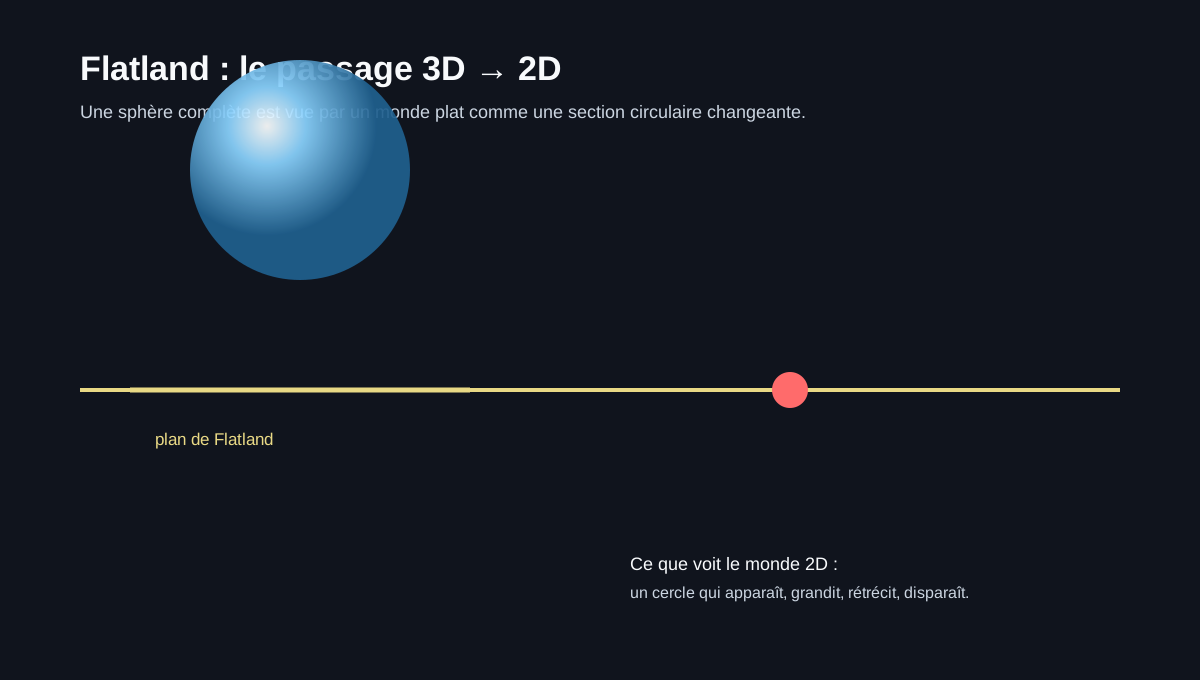
complete 3D sphere
        ↓ slice in a 2D plane
circle appears, grows, shrinks, disappears
This analogy is decisive for A.L.I. If a four-dimensional phenomenon crossed our three-dimensional world, we would not see the full object. We would see a 3D slice, or a sequence of 3D slices. The object might seem to appear from nowhere, change shape, pass through a wall, disappear, or leave a trace impossible to explain with ordinary geometry.
From Cube to Plane
Before the tesseract, we can look at a cube crossing a plane. For a 2D being, an inclined cube would not be perceived as a cube. It would become a polygonal form changing over time. The slice is not false: it is only incomplete.
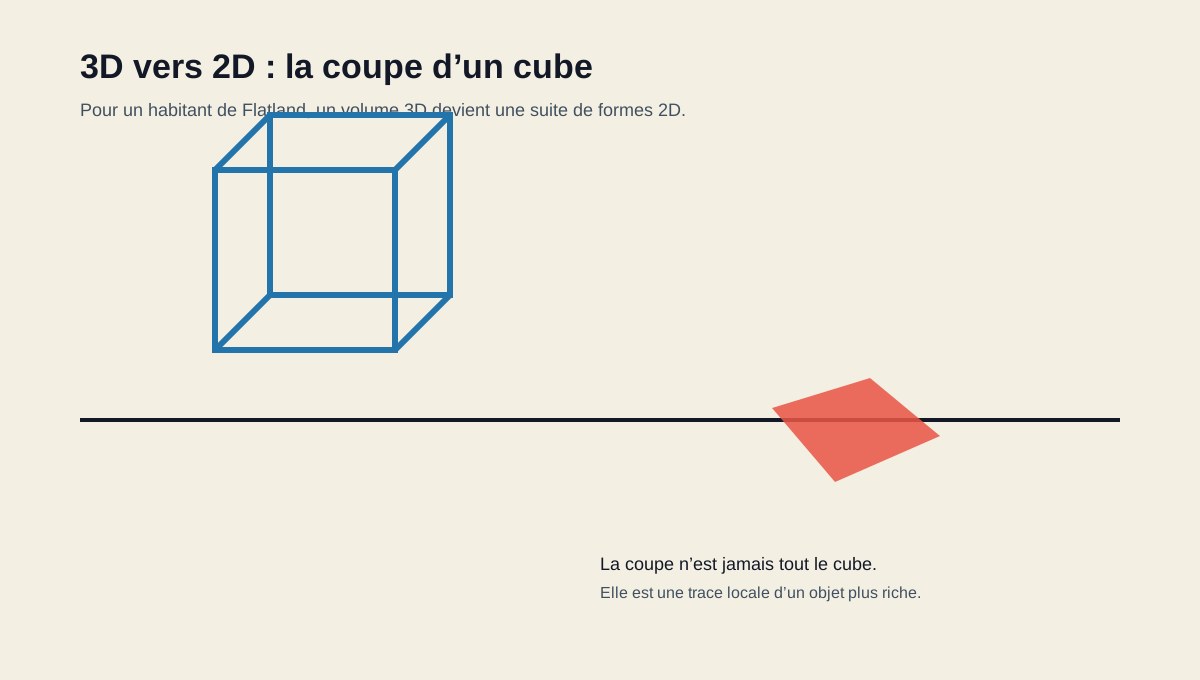
The decoding problem begins here. If we receive only slices, we must reconstruct the source object. We must record sequence, speed, invariants, symmetries and repetitions. A message from an additional dimension might be less a sentence than a succession of coherent appearances.
Hypercube, Tesseract, 4D Shadow
A four-dimensional hypercube is often called a tesseract. It can be built by analogy:
| Dimension | Object | Construction | Boundary |
|---|---|---|---|
| 0D | point | single position | no extension |
| 1D | segment | a stretched point | 2 vertices |
| 2D | square | a segment stretched perpendicularly | 4 sides |
| 3D | cube | a square stretched perpendicularly | 6 square faces |
| 4D | tesseract | a cube stretched in a direction perpendicular to the other three | 8 cubic cells |
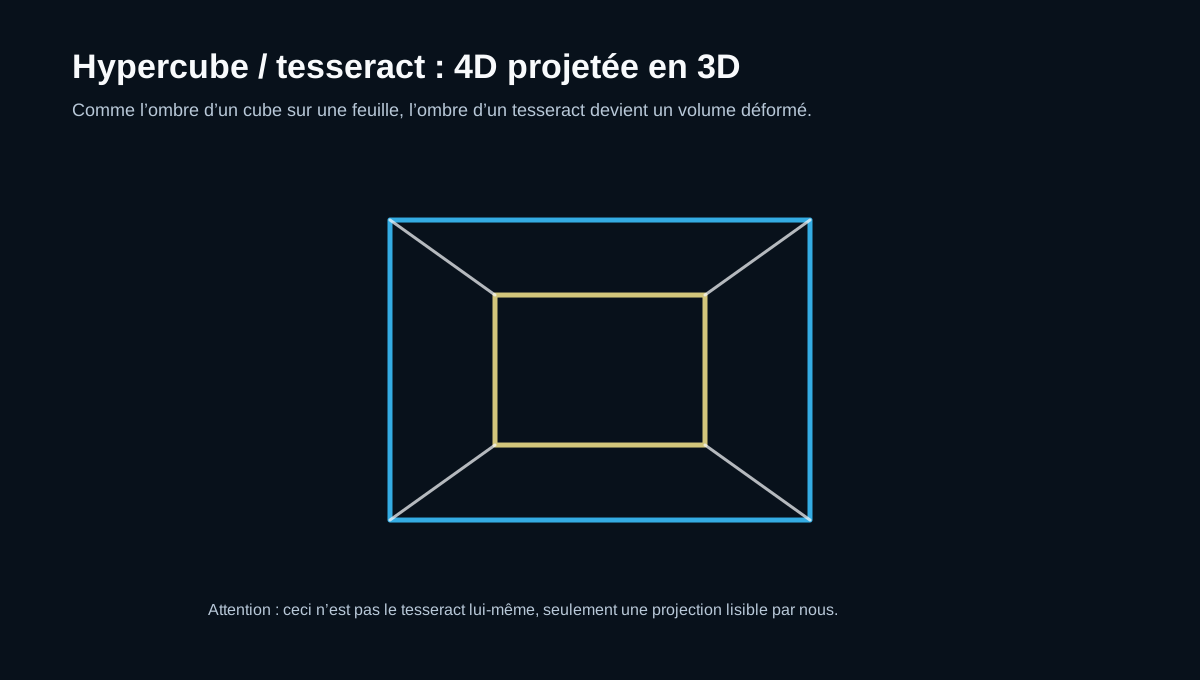
The tesseract cannot be directly seen by our eyes. What we represent is a projection, a shadow or a slice. Just as the 2D shadow of a cube may deform its squares, the 3D projection of a tesseract deforms its cubes. The familiar “cube inside a cube” image is therefore a translation, not the object itself.
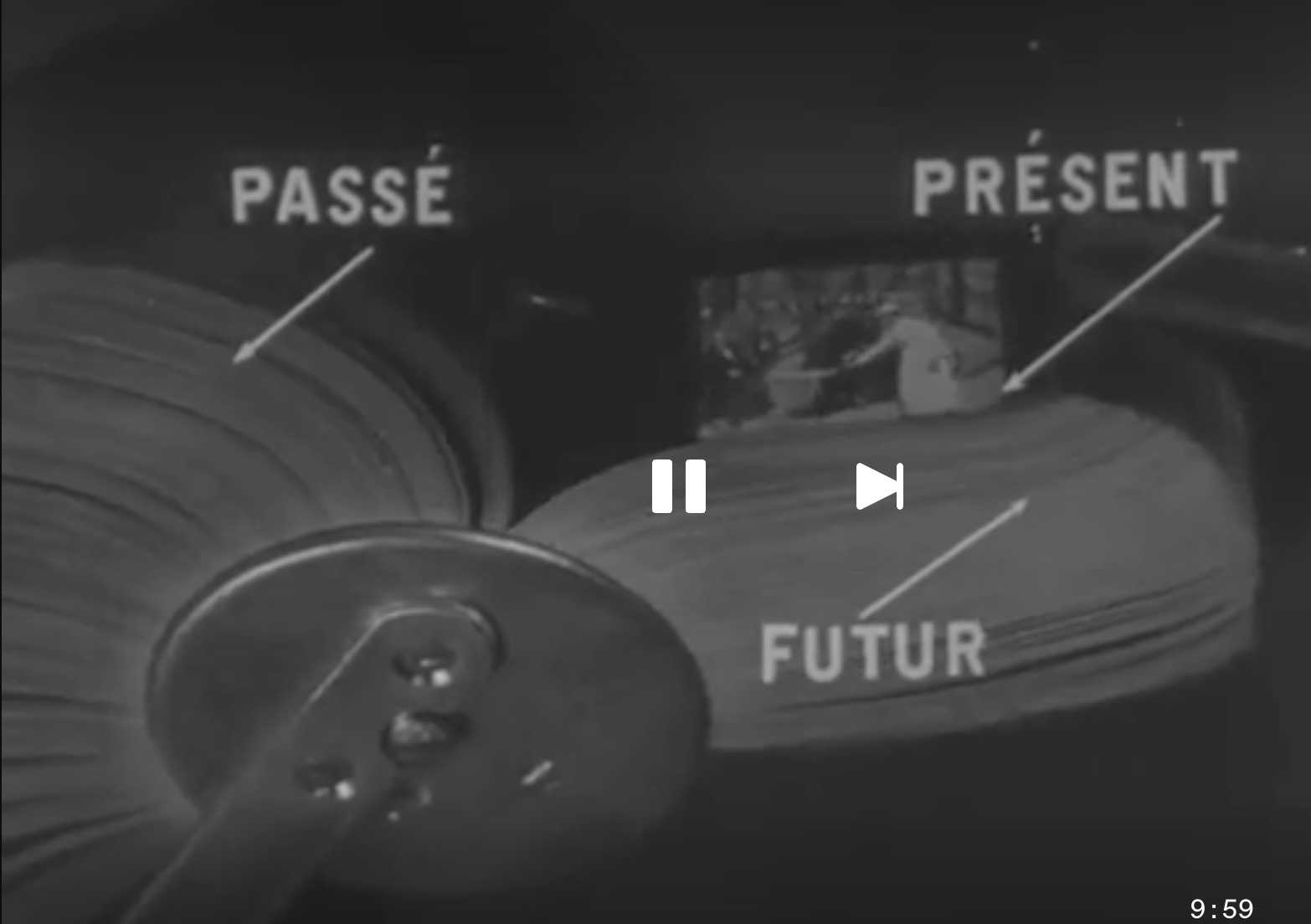
Jean Painlevé: Filming the Fourth Dimension
Jean Painlevé devoted a short film to this question: La Quatrième Dimension, made in 1936 with Achille-Pierre Dufour. The film presents the known dimensions, then introduces a hypothetical fourth dimension, using diagrams, cinematic tricks and a very visual pedagogy. What matters for A.L.I is not only the mathematical content: it is the idea that cinema can become a visualization laboratory for what escapes direct experience.
Painlevé matters because he approaches science as a cinema of forms. The fourth dimension is not merely explained: it is staged. For a project like A.L.I, that approach is precious: when a phenomenon exceeds our senses, we must invent translation devices, images, slices, rhythms and projections.
How Could We Decode a 4D-to-3D Message?
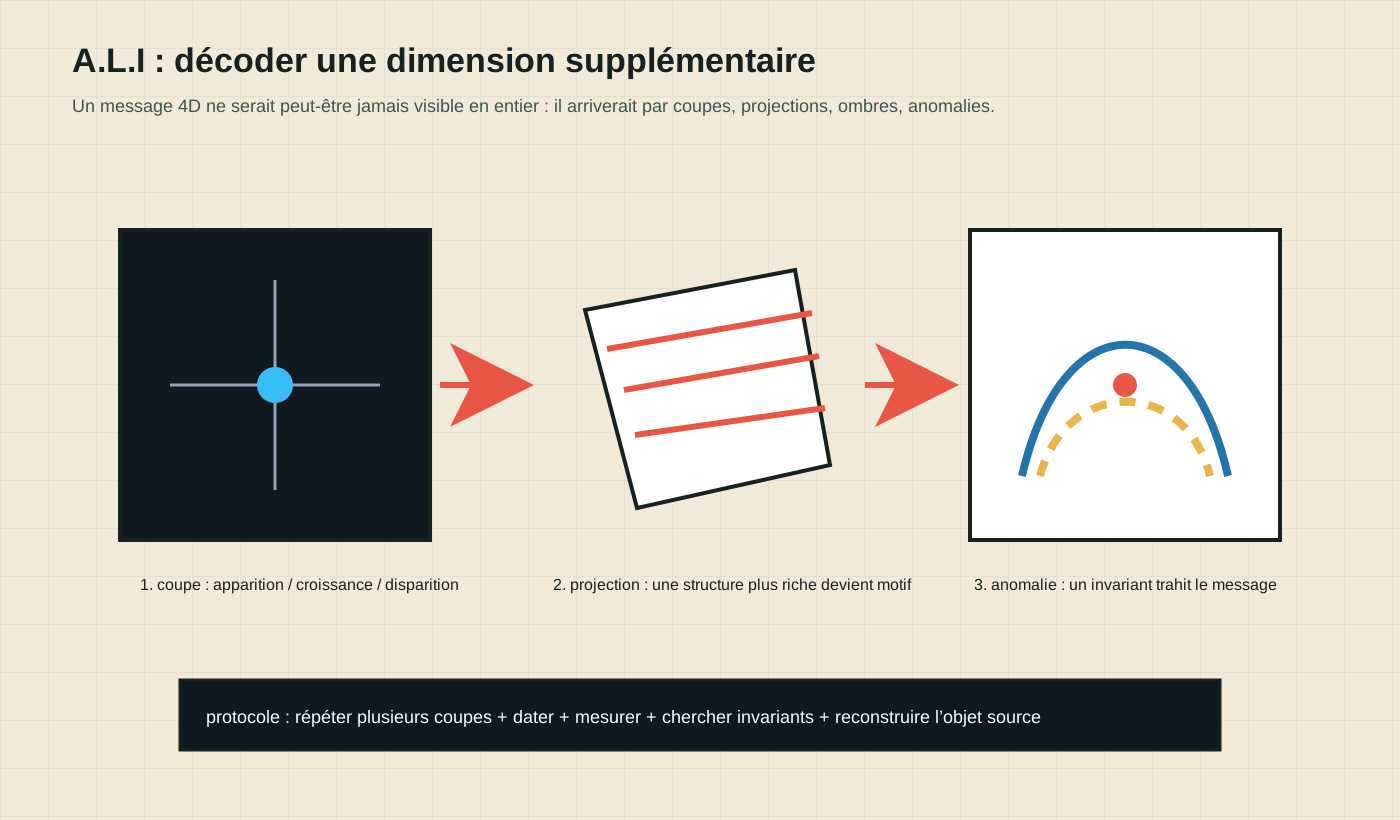
If a message came from a world with additional dimensions, we would probably not receive the whole message. We would receive a local trace. That trace would have to be treated as a slice of a larger object.
observed 3D phenomenon
        ↓
sequence of slices / projections / anomalies
        ↓
repeated measurements over time
        ↓
reconstruction of a possible source structure
        ↓
symbolic interpretation
Several clues could hypothetically signal a transdimensional origin:
- Appearance without trajectory: a volume appears instead of entering from a visible direction.
- Coherent transformation: the form changes while preserving mathematical invariants.
- Impossible crossing: an object seems to pass through a closed boundary.
- Unusual symmetry: separate parts remain linked as if they belonged to one invisible structure.
- Coded repetition: variations return according to a rhythm resembling an alphabet or grammar.
Sending a Message Toward a World with Additional Dimensions
The reverse is harder. An inhabitant of a 4D world would see our 3D world as we can see a 2D slice. It might see inside some objects, bypass barriers we believe closed, or read several aspects of a volume at once. To send it a message, we would need to produce something that remains readable despite dimensional loss.
A.L.I could imagine three strategies:
| Strategy | Principle | Possible message |
|---|---|---|
| Geometric invariant | Build a structure that preserves a stable relation under projection | prime numbers, proportions, symmetries |
| Sequence of slices | Evolve a 3D form over time as if it were a deliberate slice | alphabet through growth, rotation, disappearance |
| Multi-support redundancy | Repeat the same pattern in light, sound, radio and matter | proof of intention rather than accident |
A.L.I Prototype: Alphabet of Slices
A simple prototype would create an alphabet not with letters, but with transformations of sections. For example:
A = slow appearance of a sphere
B = cube becoming rectangle then disappearing
C = two separate volumes growing together
D = rotation with central invariant
E = pattern crossing a closed surface
The message would be played as a choreography of slices. It could be displayed in 3D, printed as a sequence, projected in light, or sent as data to a system able to reconstruct the source form.
The Trap: Projection Is Not Intention
A strange projection does not prove that there is a message. Noise, optical artifacts, sensor errors or natural phenomena can produce surprising forms. A.L.I should therefore separate three levels: observation, mathematical structure, and only then the hypothesis of intention.
seeing ≠ understanding
understanding a form ≠ proving a message
proving a message ≠ knowing the sender
Central Question
If we are to a 4D world what Flatland is to us, then a message from that world might never look like a sentence. It might look like a geometric apparition, a stable anomaly, a sequence of slices, a coherent shadow. A.L.I’s task would then be to become a science of thresholds: learning to read what only partly enters our world.
Sources and Animations
- Project Gutenberg - Flatland: public-domain text by Edwin A. Abbott.
- Criterion Channel - The Fourth Dimension: page for Jean Painlevé’s 1936 film.
- Light Cone - La Quatrième Dimension: technical page and synopsis.
- Dailymotion - Institut de Cinématographie Scientifique - La 4ème Dimension: correct video link for Painlevé’s film.
- Bartosz Ciechanowski - Tesseract: remarkable interactive explanation of tesseracts, projections and slices.
LABO question: if we received only one slice of a message from a higher dimension, could we tell the difference between a natural anomaly and an intention?