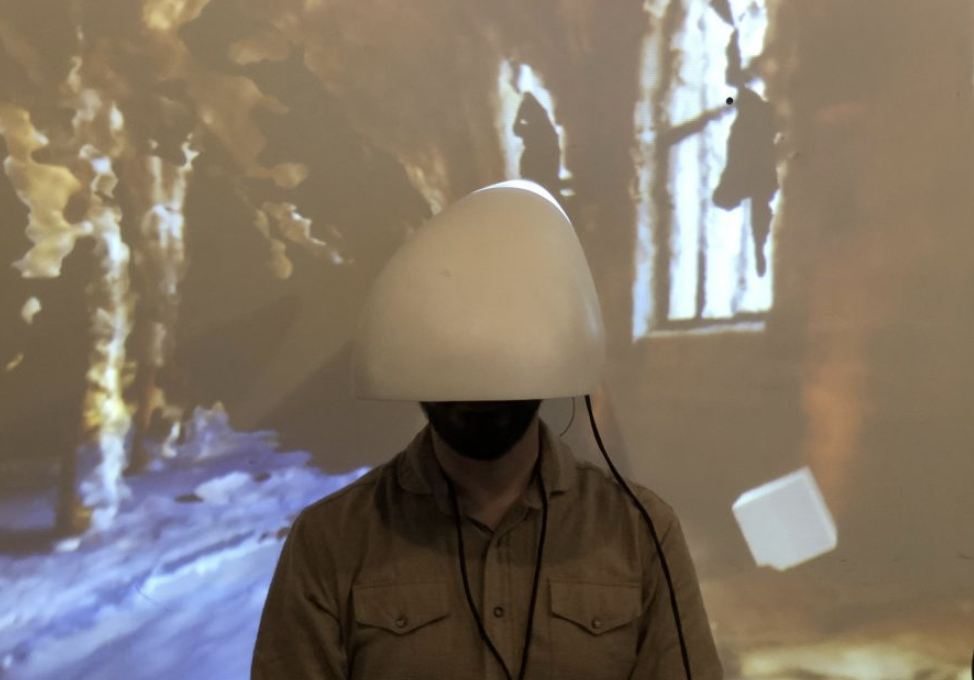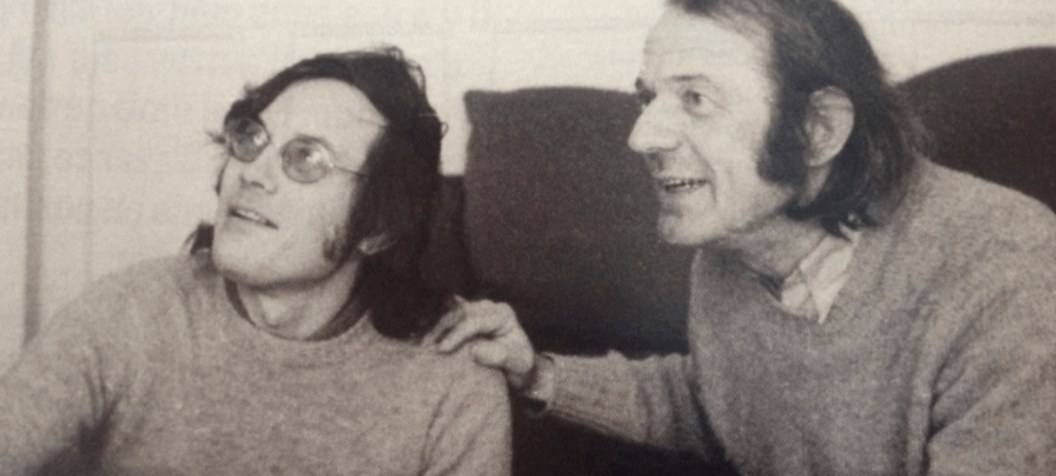
What if human intelligence were not a fixed quantity, but an architecture that learning can continuously reconfigure? The brain changes through experience: connections strengthen or weaken, strategies become automatic, perceptual maps specialize, and isolated facts organize into models. Yet plasticity has limits. Practice usually makes us better at what we practice; it does not automatically turn a local skill into general intelligence.
For A.L.I, this tension opens a hypothesis: augmented intelligence may not be a merely “more powerful” brain, but a brain that has learned to build new representations, inhabit several perceptual worlds, and cooperate with an AI that organizes access to knowledge too vast to hold alone. An advanced civilization might then not be absent: it might be present in a form we have not yet learned to recognize.
1. A brief history of intelligence
In ancient Greece, intelligence was not yet a score. Nous named the faculty of grasping the intelligible; metis was situated, adaptive cunning. Aristotle described several operations of the soul rather than a single power. Medieval thought placed memory, reason and imagination within a moral and theological order. In modernity, Descartes made thought the sign of the subject, while Locke's empiricism emphasized experience and the acquisition of ideas.
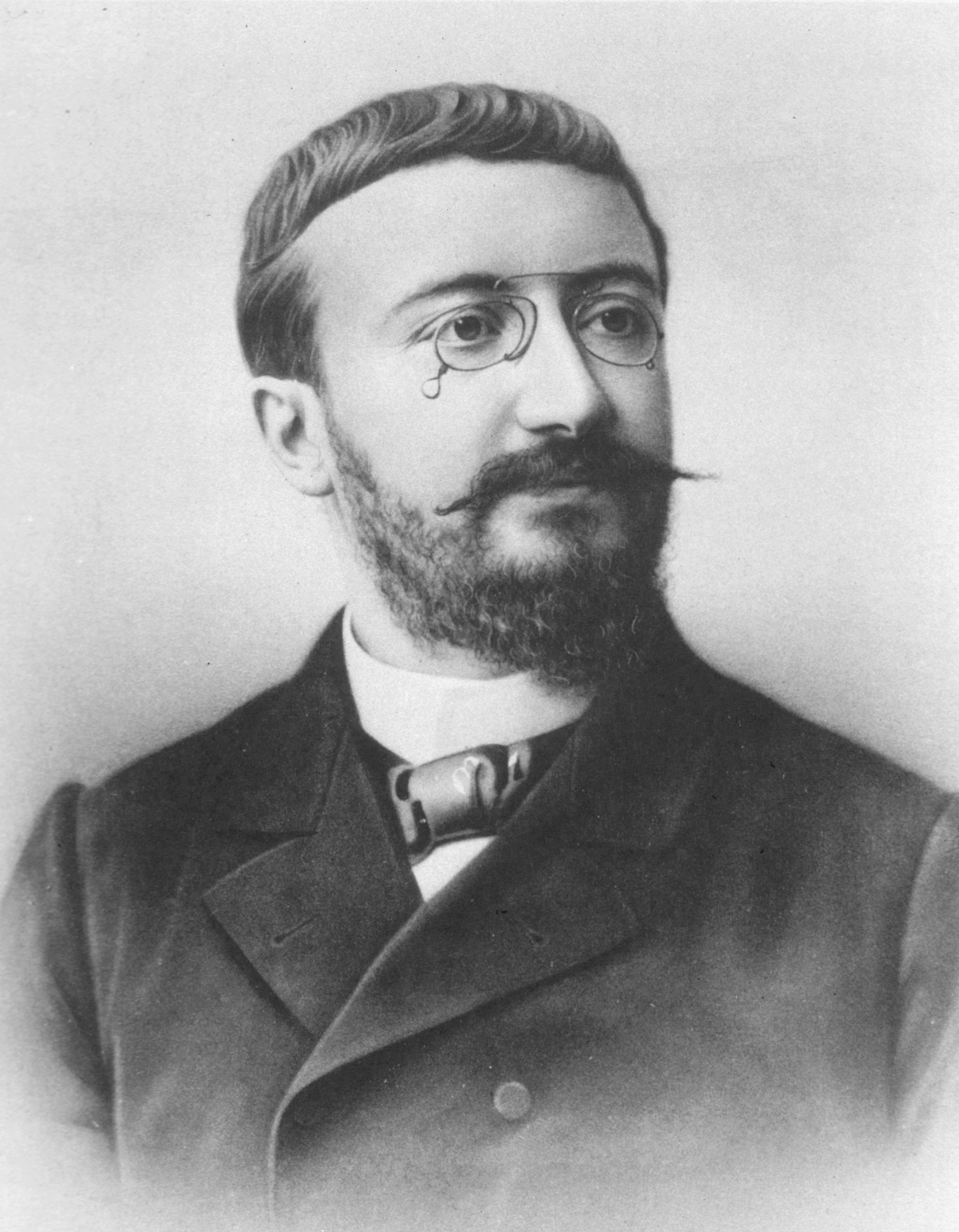
The nineteenth century gradually turned a philosophical question into an object of measurement. Francis Galton investigated individual differences; Charles Spearman proposed a general factor, g, in 1904. In France, Alfred Binet and Théodore Simon devised a scale to identify children in need of educational support. Binet resisted turning it into a permanent label: the instrument was meant to guide education, not imprison a person in a number.
Contemporary theories distinguish fluid intelligence, crystallized knowledge, working memory, processing speed, executive control, creativity, social cognition and metacognition. IQ predicts some outcomes, but it does not summarize a person or every form of adaptation. The history of testing also shows how measurements of intelligence can be diverted into eugenics, social ranking and cultural bias.
2. What plasticity actually permits
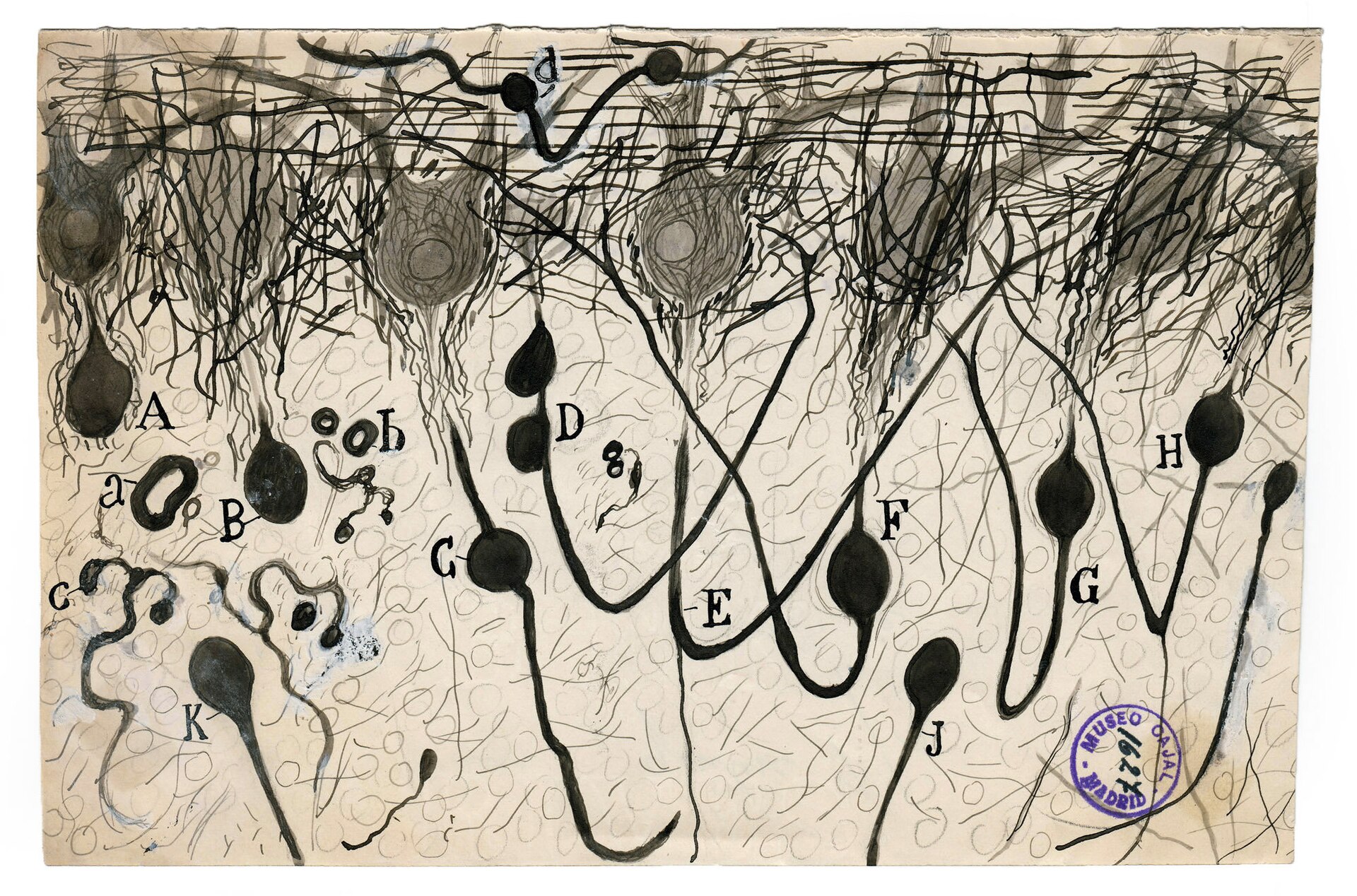
Brain plasticity is the nervous system's capacity to change its operation and sometimes its structure through activity, experience, injury or learning. It unfolds across several scales: synaptic efficiency, growth or retraction of processes, myelination, functional redistribution, strategy learning and network reweighting. Long-term potentiation provides an important cellular model of memory without reducing all learning to a single mechanism.
An adult brain can learn a language, an instrument, mathematics, a new motor coordination or the use of a brain interface. Expertise changes what can be perceived: a radiologist distinguishes patterns invisible to a novice; a musician hears structure; a naturalist identifies species in what initially appears to be a uniform landscape. Learning therefore also manufactures new perceptual objects.
Plasticity is neither infinite nor uniform. Sensitive periods, age, sleep, attention, health, emotion, social context and prior knowledge all shape learning. The brain must also preserve what it already knows: too much plasticity would create instability, too little would block adaptation. It continuously negotiates between transformation and conservation.
3. How the brain learns
Several robust principles emerge from learning science. Attention selects; prediction error signals that a model should change; spacing consolidates better than cramming; active retrieval strengthens memory more than rereading; interleaving related problems improves discrimination; sleep participates in consolidation; explaining to someone else forces knowledge to be restructured. A Nature Reviews Psychology synthesis reviews the evidence for spacing and retrieval practice.
Knowledge does not grow through accumulation alone. Experts compress: they group details into meaningful units, recognize regularities and mobilize schemas. Compression frees working memory and makes it possible to reason over larger structures. Learning-based augmentation therefore depends less on storing billions of facts than on acquiring better structures for connecting them.
4. How far can the brain follow?
The hypothesis meets a decisive experimental limit: far transfer. Cognitive training generally improves the trained task and sometimes related tasks, but benefits seldom generalize to global intelligence. A meta-analysis of 87 publications found no convincing evidence that working-memory training durably improved intelligence, reading or arithmetic. A more recent meta-analysis reports neural changes and behavioural gains while leaving their exact degree of generalization open.
This does not destroy the hypothesis; it relocates it. Becoming highly skilled is not becoming omniscient. Credible augmentation would combine deep learning, varied situations, metacognition, embodiment, cooperation, external tools and explicit strategy transfer. It would also accept forgetting: an intelligence unable to remove anything would drown in its own traces.
5. AI as adaptive teacher and exocortex
An AI can reformulate a concept, generate graded exercises, identify a recurring error, vary modalities, schedule spaced retrieval and simulate an interlocutor. In a controlled trial published in 2025, an AI-powered tutor improved learning in a specific university setting. Other studies show that an AI giving direct answers can improve immediate performance while weakening independent learning.
The aim is therefore not to delegate thought, but to build an AI pedagogue of plasticity. It would not always answer. It would choose the right obstacle, request a prediction, retrieve a notion as it begins to fade, offer a different representation, and test transfer outside the exercise. It would act as an exocortex: not replacement memory, but an external layer that organizes the conditions under which the brain transforms itself.
6. Accelerated learning: promise and caution
Neurofeedback, virtual reality, transcranial magnetic stimulation, weak electrical stimulation, adaptive interfaces and multisensory environments all seek to facilitate selected forms of learning. Outcomes depend strongly on task, protocol and individual. A meta-analysis of transcranial stimulation combined with working-memory training reports a modest positive effect on transfer, not instantaneous acquisition of complex knowledge.
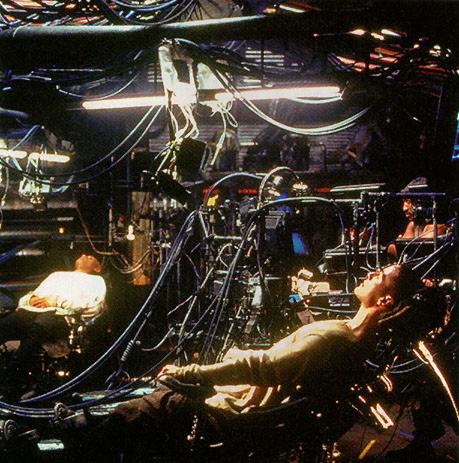
Science fiction often imagines direct skill upload, as in The Matrix. A real brain must integrate knowledge with sensory, motor, affective and social networks. Describing a movement is not performing it; receiving information is not understanding it. The most plausible acceleration will probably come from precisely orchestrating attention, feedback, sleep, difficulty and context, rather than from a button that injects knowledge.
7. Implants and the connected brain
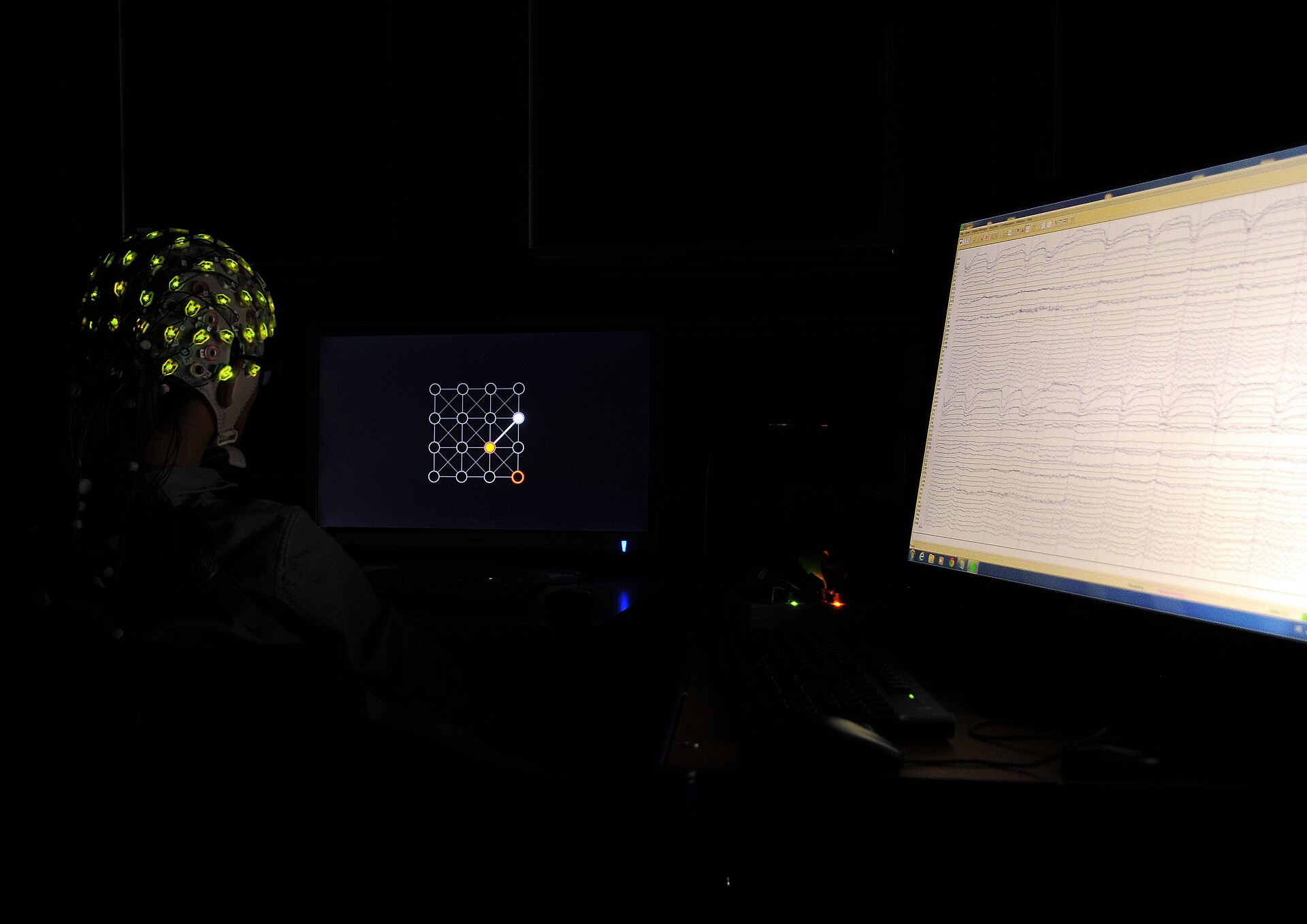
Brain-computer interfaces do not yet make a brain “more intelligent.” They restore or open a channel. In 2025, a brain-to-voice neuroprosthesis synthesized expressive speech in real time for a person with ALS from 256 microelectrodes. Other systems decode silent speech, control a cursor or translate motor intention.
A sensory implant requires reciprocal learning: the algorithm learns the brain, and the brain learns the algorithm. This co-adaptation matters to A.L.I. A future interface might convert magnetic fields, ultrasound, infrared or chemical data into patterns that the cortex learns to feel. “Extrasensory” would then have a technical meaning: not paranormal power, but the gradual incorporation of a channel previously absent from the human Umwelt.
8. From brain-to-brain links to instrumented telepathy
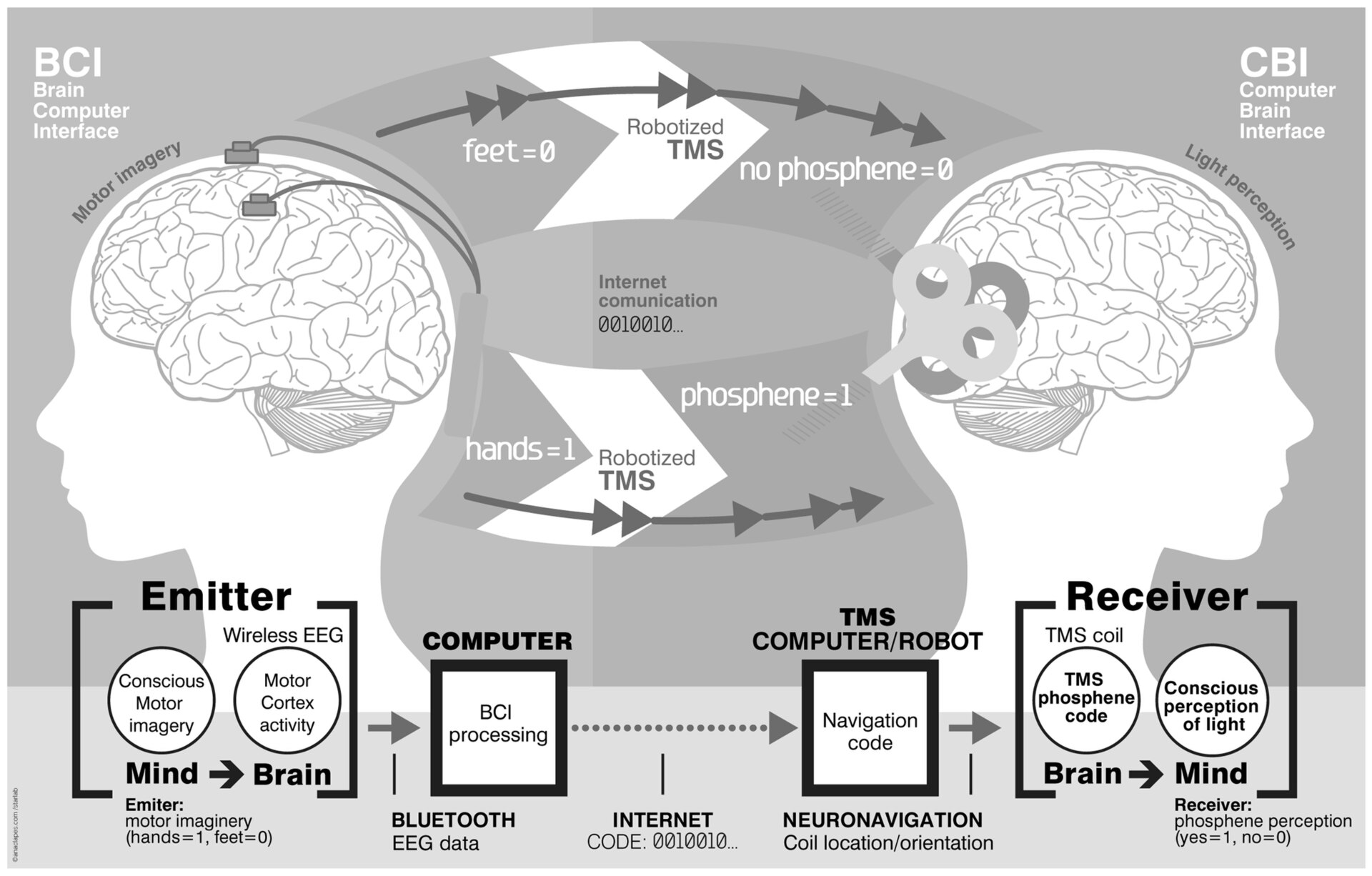
Experiments have already transmitted rudimentary information between human brains. In 2014, a team linked EEG, a computer network and magnetic stimulation for a visuomotor task. The information remained binary and machine-mediated. In 2019, BrainNet enabled three participants to collaborate on a Tetris-like task.
This is not unrestricted mind reading, still less evidence of paranormal telepathy. It is extremely narrow neural telegraphy. Yet it demonstrates that a brain can learn to give meaning to a minimal artificial signal. The decisive step would be to move from an imposed bit to a learned sensory grammar and eventually to a shared conceptual space.
9. Interligence: Networked Intelligence
A.L.I proposes the term interligence for an intelligence that no longer resides entirely in an individual, but in the quality of links among several brains, bodies, machines, memories and environments. The word joins intelligence with interconnection. It is not a simple sum of intelligence quotients: interligence appears when a network can distribute perception, compare models, preserve a shared memory, correct errors and produce an understanding that none of its members possessed alone.
Our societies are already partly interligent. Science combines observations, instruments, controversies and archives distributed across generations. An orchestra, a rescue team or an animal community performs operations whose success depends more on coordination than on an all-powerful individual. BrainNet experiments remain extremely elementary, but they give this intuition an experimental form: three people can be linked through brain-computer interfaces and cooperate on one task from unevenly distributed information.
A network is not intelligent by nature. It can amplify conformity, panic, misinformation and the biases of its members. The power of interligence would depend on its topology, the diversity of its perspectives, trust, the right to dissent, feedback speed and the way it arbitrates conflict. A collective brain without critical mechanisms could become less lucid than each of its parts.
For A.L.I, an advanced extraterrestrial civilization might be a subject distributed among organisms, artificial intelligences, habitats and archives. Its “individual” might be a planet, a swarm or an interstellar network. Searching for an isolated speaker would then be a category error: the message might be addressed to a human interligence yet to be built, capable of synchronizing multiple skills and sensibilities.
10. Consciousness as an Engine of Access and Distribution
What role does consciousness play in this augmentation? Neuroscience generally distinguishes intelligent performance — learning, solving, predicting and adapting — from consciousness, understood as subjective experience and the ability to report selected mental states. The two dimensions often overlap in humans, but they are not equivalent. Complex operations become automatic and unconscious through learning; conversely, a conscious experience may be vivid without producing especially intelligent problem solving. Contemporary AI performance reinforces this possible dissociation: systems accomplish selected cognitive tasks without evidence that they are conscious.
According to global neuronal workspace theory, information becomes conscious when it is made broadly available to attention, memory, decision and action. Integrated information theory instead emphasizes the system's degree of integration. An adversarial comparison published in Nature in 2025 challenged central predictions of both models without producing a winner. There is therefore no single accepted definition of consciousness, nor a demonstrated scale mechanically linking “power of consciousness” to intelligence.
We can nevertheless formulate a working hypothesis: consciousness may be less a reservoir of power than an engine of access, selection and distribution. It could allow information to cross boundaries among perception, memory, emotion, imagination and decision; metacognition adds the ability to observe one's own errors and redirect learning. An “intelligence of consciousness” would then mean neither brighter nor mystical consciousness, but a finer capacity to choose what becomes accessible, sustain several perspectives and redistribute information at the appropriate level of the system.
The possible correlation between intelligence and consciousness should therefore be decomposed. More stable consciousness may support attention; more differentiated consciousness may enrich perceptual categories; more reflective consciousness may improve error correction. Yet more subjective experience does not guarantee better inference, and more computation does not guarantee richer experience. These are partly independent axes whose relationships remain to be measured.
At the scale of interligence, a more speculative question appears: can several consciousnesses form anything beyond effective cooperation? A collective brain could share information without sharing a single inner point of view. Collective consciousness has not been established. A.L.I can nonetheless turn it into an artistic and cognitive experiment: build a device in which no participant holds the whole message and a form becomes perceptible only when the group learns to distribute attention, memory and decision.
11. Learning from other Earthly intelligences
Before claiming dialogue with an extraterrestrial civilization, augmented intelligence should better encounter intelligences already present: birds, cetaceans, cephalopods, fungi, forests and collectives. AI can search thousands of hours of sound and behaviour for regularities, but correlation is not enough: a signal must be connected to situation, body and consequences for the animal.

The ideal device would be triangular: the animal learns our signals, the human learns its signals, and AI adjusts the interface without erasing difference. Such a method would replace the fantasy of immediate universal translation with slow, reciprocal interspecies pedagogy.
12. Defining Access Intelligence
We propose the term access intelligence for an organism's capacity to acquire the representations needed to perceive and understand a domain that was previously cognitively closed. It is measured not only by calculation speed but by five capacities: inventing new sensors; learning a perceptual grammar; maintaining multiple incompatible models; recognizing one's own limits; and turning discovery into a shareable relation.
A highly advanced civilization might communicate through patterns spanning multiple scales, temporal structures, environmental modifications or signals requiring a long initiation. The message would not be a sentence to decode but a curriculum. Its first part would teach the receiver how to perceive the second; the second would build concepts needed by the third. Contact would begin before meaning, through gradual transformation of the receiver.
This reverses the classic SETI question. Rather than only asking “what signal should we send?”, it asks “what intelligence must we become for the signal to exist for us?” AI could test thousands of learning paths and search for one that makes a foreign structure progressively learnable without reducing it to our categories.
13. Five Experiments for A.L.I
The alien curriculum
Build a program that generates a non-human language in several levels. No dictionary is supplied. AI observes the participant's errors and reveals only the exercises needed to construct the next representation. The outcome is not memorization but transfer to unseen messages.
A school for additional senses
Convert light polarization, magnetic fields or chemical data into touch or sound. After several weeks, test whether participants stop consciously “translating” and begin to perceive stable forms directly.
The reciprocal interspecies translator
Bring together ethologists, artists and AI models to construct an interface in which both species must learn. Every proposed “word” remains attached to video, context and a degree of uncertainty.
The installation “School for a Not-Yet-Human Intelligence”
An evolving room exposes visitors to sound, light and tactile signals. It gives no verbal instructions; it responds to collective strategies, changes its grammar and gradually introduces new dimensions. On leaving, each visitor receives not an intelligence score but a map of the transformations they made possible.
The Interligence Laboratory
Distribute one message among several participants: one receives only rhythm, another geometry, a third colour variations, and a fourth the AI's responses. No one can resolve the structure alone. The device measures how the group builds shared memory, signals uncertainty and reaches — or fails to reach — a shared concept. The installation would make visible the difference among information aggregation, collective intelligence and hypothetical collective consciousness.
14. Cultural References: The Dream and Its Price
In Daniel Keyes's Flowers for Algernon, Charlie Gordon's spectacular augmentation changes his understanding, relationships and solitude. Limitless reduces augmentation to a drug granting near-unbounded capacity. In The Matrix, skills are downloaded, yet Neo must still test them through body and consciousness: the passage from information to belief and action becomes the real learning process. Ghost in the Shell asks what remains of identity when memory, body and network become permeable. Ted Chiang's story Understand pushes augmentation toward levels of thought that become mutually unreadable.
These works share a warning: greater cognitive power guarantees neither relationship, ethics nor happiness. Intelligence can become so specialized that it can no longer speak with others. For A.L.I, augmentation matters only if it also increases the ability to translate, doubt and remain in relation.
15. Neuroethics: Who Decides What the Brain Should Become?
AI-guided pedagogy could optimize attention but also normalize ways of thinking. An implant can restore communication while collecting intimate mental data. Unequal access to neurotechnology could establish a lasting cognitive hierarchy. UNESCO's Recommendation on the Ethics of Neurotechnology, adopted in 2025, emphasizes dignity, autonomy, identity, freedom of thought, mental integrity and protection of brain data.
Interligence adds another responsibility: deciding who may write into shared memory, disconnect a member, modify distribution rules or speak for the collective. Protecting individual consciousness must remain a condition of any networked intelligence.
Augmented intelligence must therefore remain reversible, pluralistic, explainable and accessible. It should not impose a single model of performance. A.L.I's aim is not to manufacture a superior human, but to imagine a human more capable of encountering what is not human.
Conclusion: contact as learning
The brain can transform itself extensively, but not arbitrarily. It learns best when knowledge becomes action, perception, error, retrieval, sleep, relationship and model. AI can accelerate transformation if it acts as teacher rather than substitute. Brain interfaces can open channels, but they do not yet deliver ready-made ideas.
The final hypothesis now unfolds across three levels: access intelligence transforms what a brain can perceive; interligence distributes this capacity through a network; consciousness may orient what becomes available, shareable and decidable. None of these dimensions is sufficient by itself.
The final hypothesis is simple: a radically new communication may require not a better message but a new apprenticeship of the receiver. Perhaps we are not merely waiting for a signal. Perhaps we are still at school for the organ that will be able to hear it.
Sources and further paths
- A. Green and D. Bavelier, review of brain plasticity and learning.
- C. Carpenter et al., spacing and retrieval practice.
- M. Melby-Lervåg, T. Redick and C. Hulme, working-memory training and transfer.
- G. Li, Y. Liu and A. Chen, 2026 meta-analysis of computerized working-memory training.
- Instantaneous brain-to-voice neuroprosthesis, Nature, 2025.
- Learning to operate an imagined-speech interface, 2025.
- A direct human brain-to-brain interface, PLOS ONE.
- BrainNet, a collaborative three-brain interface.
- Controlled trial of an AI-powered tutor, 2025.
- UNESCO Recommendation on the Ethics of Neurotechnology.
- Paris Brain Institute, consciousness, global neuronal workspace and integrated information.
- Cogitate Consortium, adversarial testing of two theories of consciousness, Nature, 2025.
- Ken Mogi, artificial intelligence, human cognition and the possible dissociation of intelligence and consciousness.