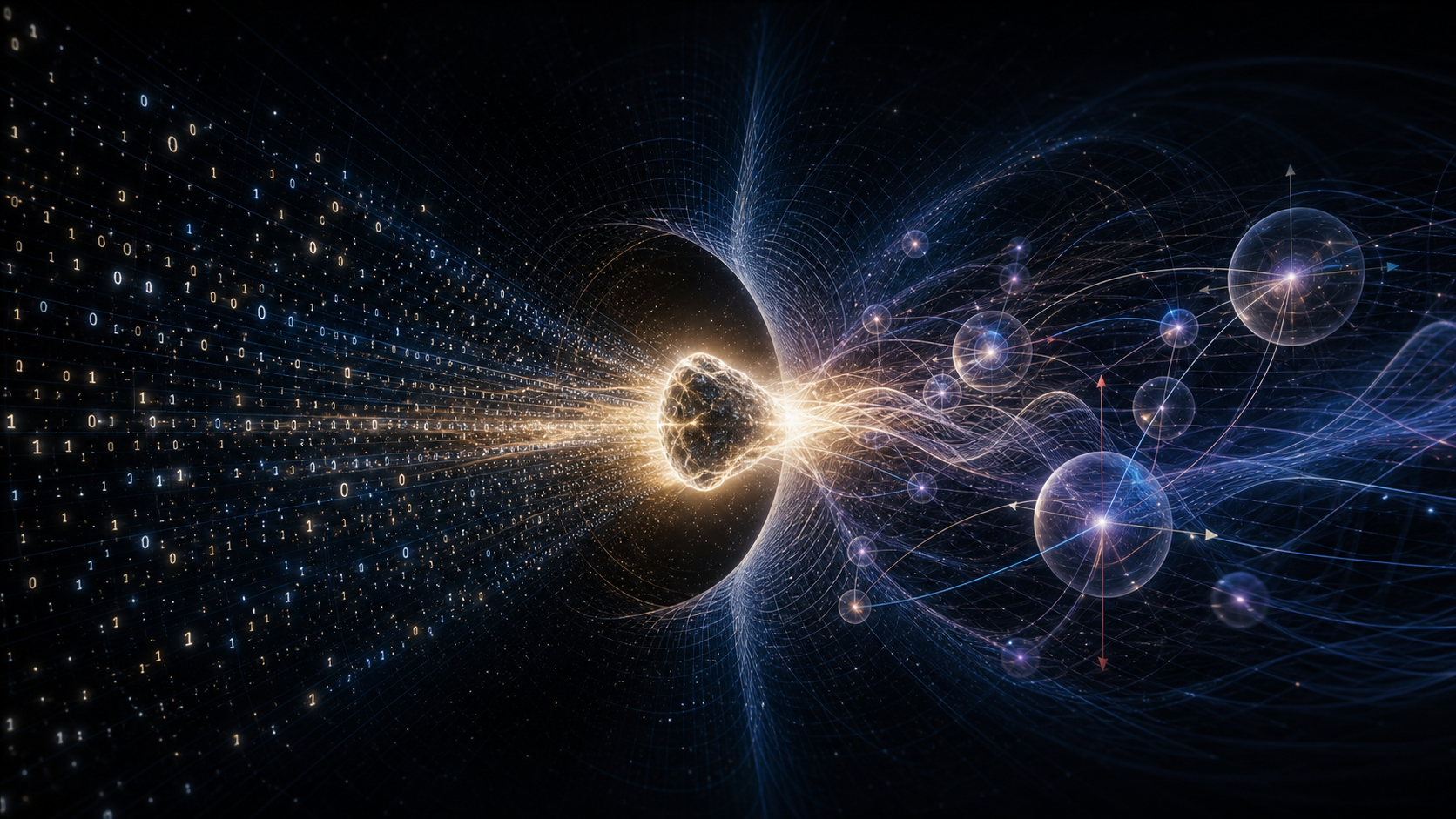
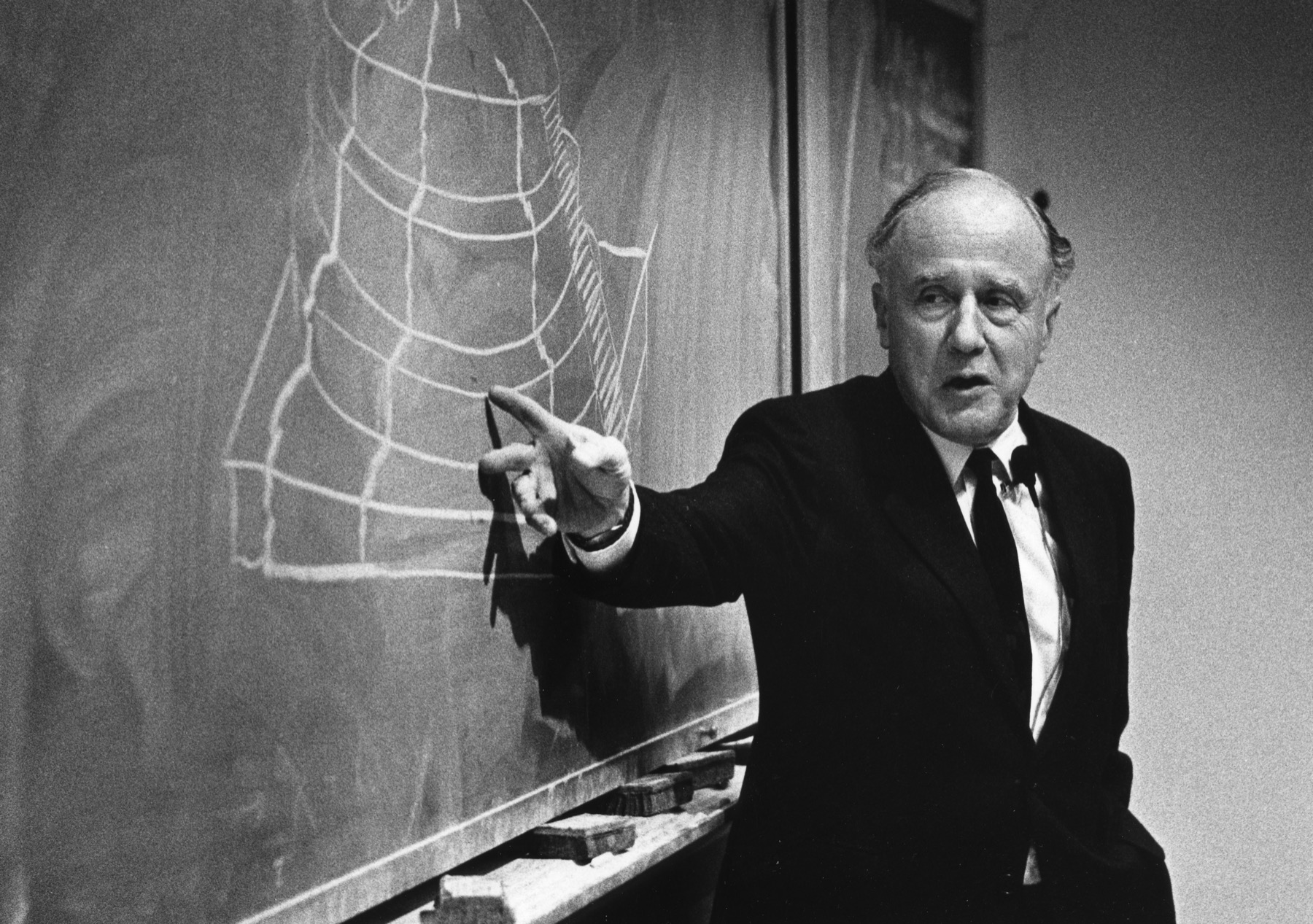
What if matter were not first a thing, but an answer? With his famous phrase It from Bit, John Archibald Wheeler proposed a dizzying idea: every element of physical reality, every it, may derive its existence from an act of information, from a bit, meaning a minimal distinction: yes / no, 0 / 1, present / absent.
This does not simply mean that the universe is a computer in the ordinary sense. It suggests a reversal: instead of treating information as a secondary description of matter, Wheeler asks whether matter itself may emerge from questions asked of the world and from the answers obtained. Reality would not only be what is there, but what becomes readable when an interaction, a measurement or an observation produces a fact.
1. The bit: the smallest difference that makes a world
A bit is a binary decision. It does not yet tell a story, but it opens the possibility of structure. A light on or off, a pulse received or absent, a particle detected or not: each event can be read as a difference. For Wheeler, the universe may be composed, at its deepest level, of a vast network of elementary answers.
This intuition speaks directly to A.L.I: how could a non-human intelligence recognize a signal? Before understanding a language, one must recognize a difference: this rather than that, rhythm rather than noise, pattern rather than randomness. In this sense, a contact language may begin as a grammar of distinctions.
2. The participating observer
Wheeler also spoke of a participatory universe. This does not mean that the human mind magically creates the cosmos. It means that, in quantum physics, measurement plays a central role: some properties become definite only when an apparatus, an environment or an observer makes them observable.
The world is therefore not only a pre-written stage that we passively read. It is also a story of interactions. The signal, the sensor, the measurement and the interpreter belong to the same scene. For A.L.I, this is crucial: an extraterrestrial message would not only be content to translate, but an event of relation. The reading protocol may matter as much as the message itself.
3. From It from Bit to It from Qubit
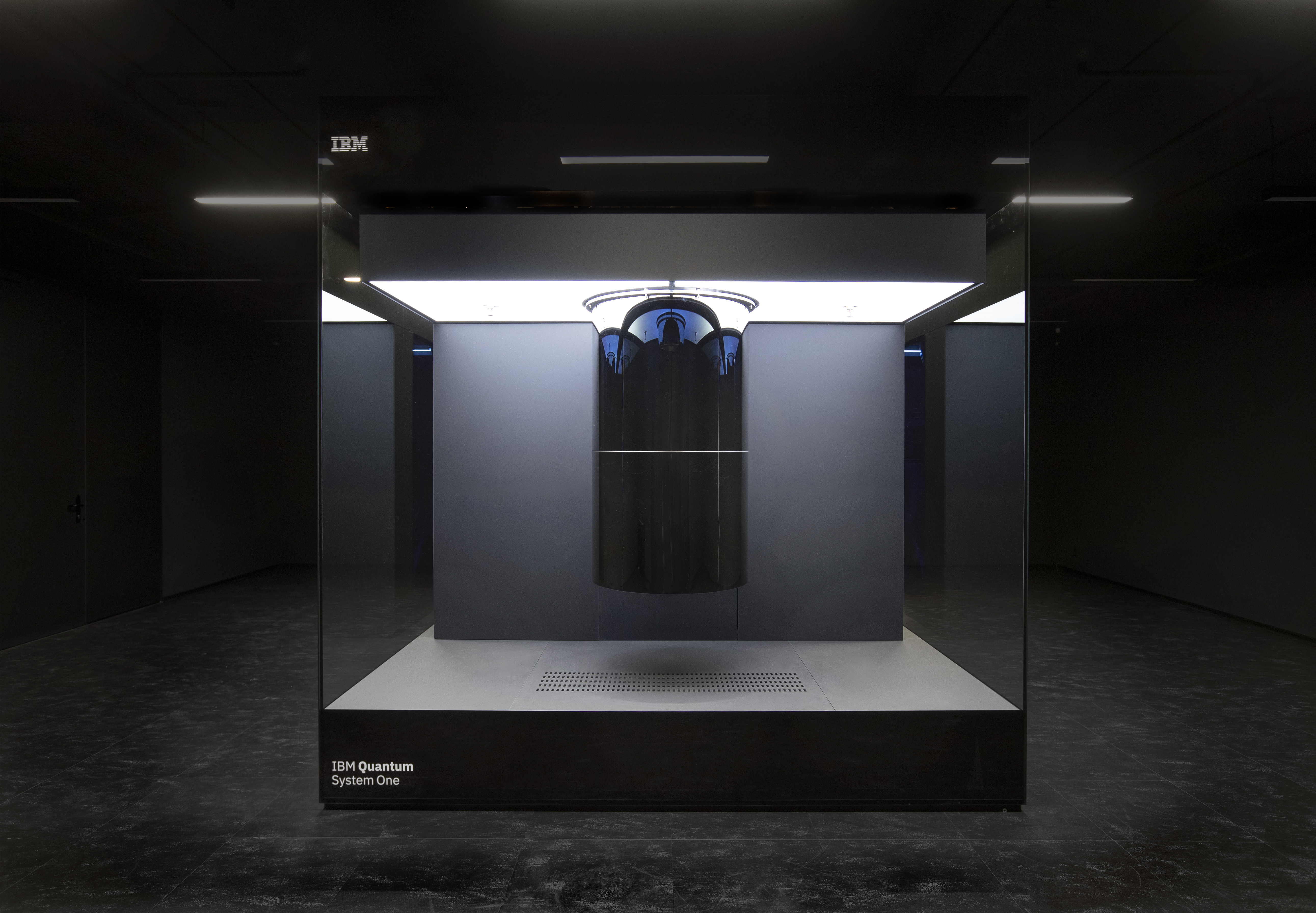
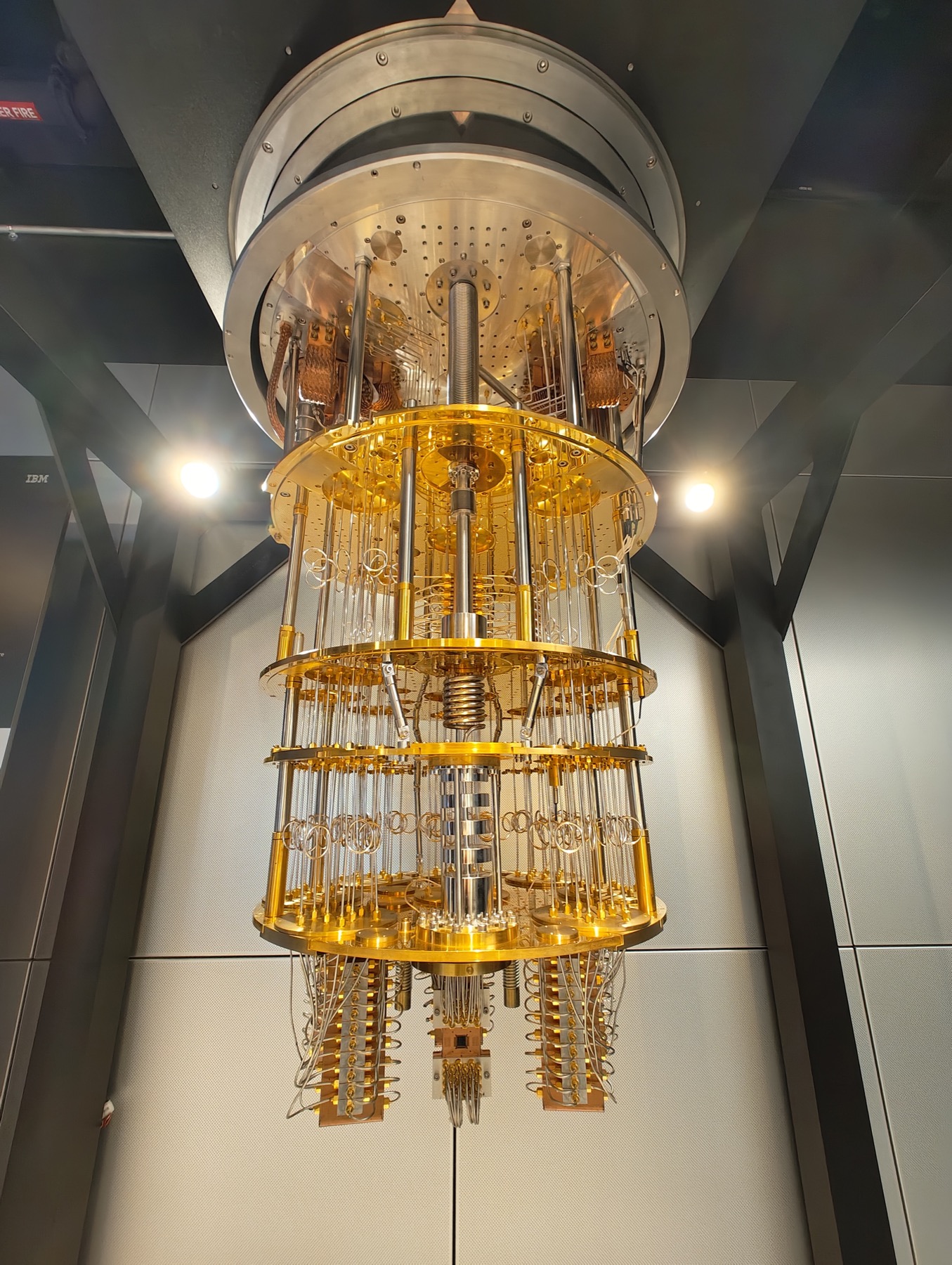
Since Wheeler, the physics of information has shifted the question. The classical bit, 0 or 1, is no longer enough to describe the quantum world. We must move toward the qubit, the unit of quantum information capable of existing in a superposition of states. A qubit is not simply 0 or 1: it can carry a combination of possibilities, with phase, amplitude and relations to other qubits.
With the qubit, information is no longer only a binary answer. It becomes an architecture of possibilities. Two qubits can be entangled: their states are no longer described separately, but as one shared structure. This does not allow faster-than-light messaging. But it reveals a form of correlation that exceeds our classical intuition of separation.
4. Spacetime as an informational structure
The contemporary program often summarized as It from Qubit explores an even more radical hypothesis: spacetime itself may emerge from relations of quantum information. In work on black holes, holography, entropy and quantum error correction, geometry is no longer only a container. It may be the visible result of a deeper network of entanglement.
In other words: what we call distance, neighborhood, volume or horizon may depend on how quantum information is organized. This is not a completed theory, but it is a major research direction. It changes the question: is the universe made of things, or of relations capable of producing things?
5. What this changes for an interstellar language
If an advanced civilization had understood or exploited this informational layer of reality, its language might not look like a sequence of words, sounds or images. It might take the form of a protocol of correlations, a statistical pattern, a signature in noise, a structure repeated across physical measurements.
An It from Bit message would say: “I know how to produce a recognizable distinction.” An It from Qubit message would say: “I know how to organize possibilities, correlations and relations.” Contact would no longer be only a text transmitted through space, but a way of building a shared space of reading.
6. A.L.I prototype: a bit / qubit grammar
One could imagine an artistic and scientific prototype in four layers:
- Bit: binary pulses, light, Morse, alternation, presence / absence.
- Pattern: repetitions, prime numbers, symmetries, matrices, intentional errors.
- Qubit: simulated superposition, probabilities, states not determined before reading.
- Entanglement: two separated interfaces producing correlated results after classical comparison.
Such an installation would not claim to send an actual quantum message to the stars. It would stage a question: when does a difference become a sign? When does a sign become a relation? And when does a relation become a shared world?
7. Toward a language of the conditions of reality
The force of It from Bit and It from Qubit is that they move communication to a deeper level. Before vocabulary, there is distinction. Before the sentence, there is measurement. Before the message, there is the protocol that makes the message possible.
For A.L.I, this opens a major path: an interstellar language may not only be a language of contents, but a language of the conditions of reality. Communicating with another intelligence would then mean building with it a shared space in which something can be recognized as information.