What if first contact began neither with a correctly identified signal nor with a grammar finally translated, but with an earlier decision: to accept that the other is not a confirmation of what we already know? Emmanuel Levinas shifts the problem in precisely this direction. Before understanding the other, we are already called to respond.
This proposition is not a method for decoding extraterrestrial messages. It imposes a discipline on the decoder: do not confuse interpretation with possession, classification with knowledge, or response with annexation. For A.L.I, it suggests a pre-semiotic ethics, prior to the message’s content yet already engaged in relation.
1. A philosophy against reducing the Other
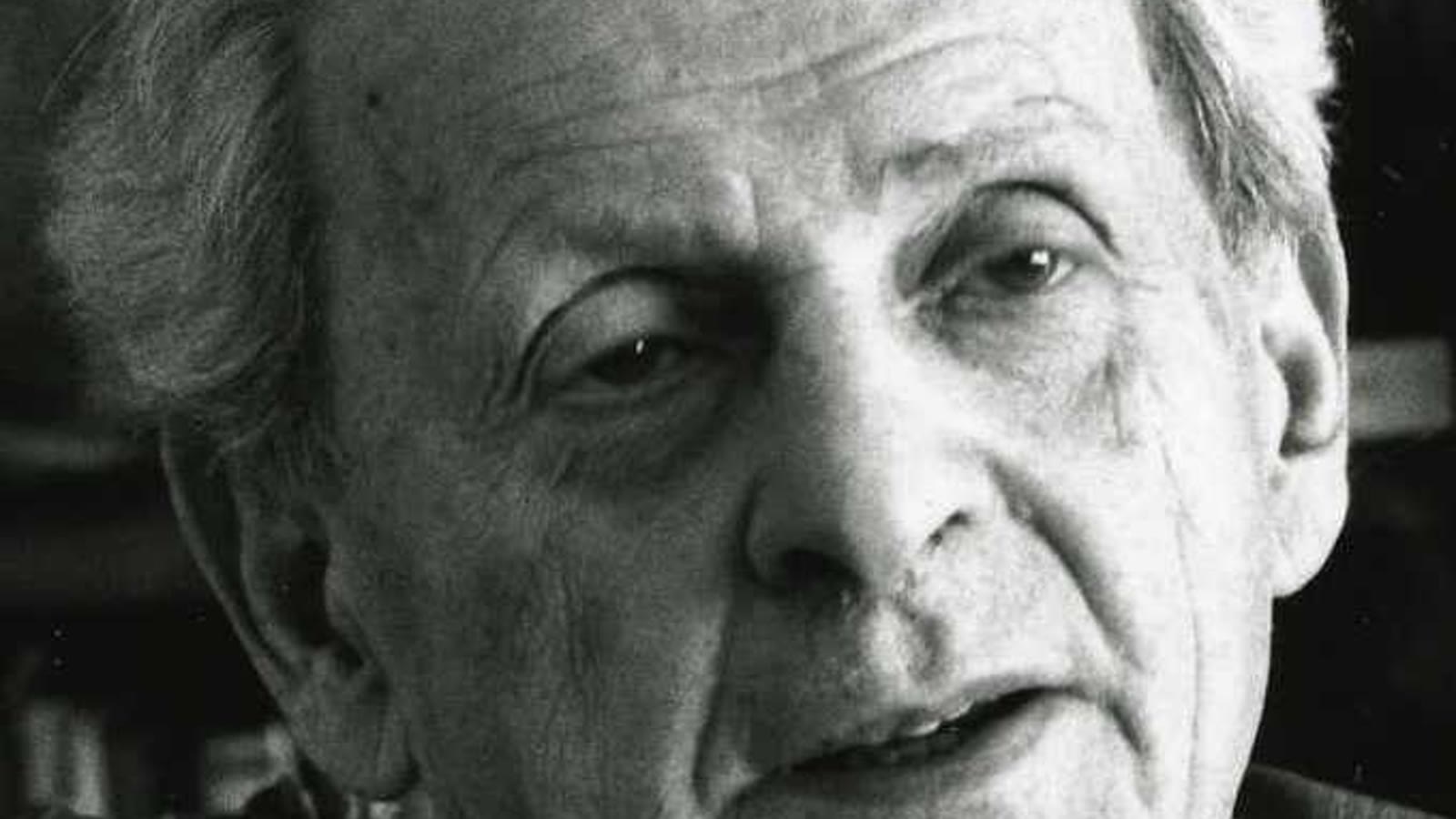
Emmanuel Levinas (1906-1995), born in Kaunas to a Lithuanian Jewish family, studied Husserl and Heidegger before developing a body of work marked by war, captivity, and the murder of part of his family. It would be reductive to derive his entire philosophy from this history. Yet his work consistently resists a temptation in Western thought: reducing the unknown to the known, exteriority to sameness, and singularity to an available concept.
In Totality and Infinity (1961), “totality” names a system that absorbs differences into a comprehensive view. “Infinity” is not measurable immensity; it is what, in the Other, always exceeds my representation. A genuine encounter begins when knowledge meets its limit.
2. The face is not an image
The Levinasian “face” is neither a portrait nor a set of features nor a biometric device. It is the event through which the Other is exposed yet resists becoming an object. Vulnerability is not weakness here: it puts my power into question. The face signifies before I have completed its identification.
To say that “the face speaks” does not mean that information is hidden in eyes or muscles. Its first speech is address: I stand before someone whom I could harm, ignore, or reduce, and whose presence makes those gestures ethically meaningful. Ethics thus begins before recognition is complete.
3. Language before information
For Levinas, language is more than the circulation of content. Before what is said lies the fact of speaking to someone. This orientation changes communication: the interlocutor is no longer a technical destination but the source of an obligation. Relation precedes the message it makes possible.
For A.L.I, an interstellar signal could be poor in information yet rich in address: repetition, waiting, correction, modulation in response to an answer. Conversely, an immense archive may remain relationless if it leaves no place for its recipient’s interpretation or reply.
4. Buber: from I-It to I-Thou
In I and Thou (1923), Martin Buber distinguishes the “I-It” relation, which treats the world as an object of use and knowledge, from the “I-Thou” relation of reciprocal presence. Both Buber and Levinas refuse to reduce relation to an operation performed by the subject.
They nevertheless diverge. Buber’s dialogue tends toward mutuality; Levinasian responsibility is asymmetrical. I cannot wait for the Other to become responsible for me before acknowledging my own obligation. This asymmetry matters when facing an unverifiable, distant interlocutor that cannot answer on human timescales.
5. Derrida: every hospitality meets a threshold
Jacques Derrida reads Levinas with admiration and concern. Absolute hospitality would ask the Other for neither name, origin, nor reciprocity. Yet every actual hospitality has a door, language, institution, and conditions. Unconditional hospitality remains the demand that sets necessarily conditional rules in motion.
Decoding has the same structure. To recognise a signal, we select frequencies, remove noise, choose units, and project models. These operations are necessary, but they already exert violence by forcing the unknown to appear inside our instruments. Ethics does not require abandoning analysis; it requires exposing its filters and preserving what they exclude.
6. Ricoeur: from solicitude to just institutions
In Oneself as Another (1990), Paul Ricoeur links solicitude for a person to justice for all. Face-to-face encounter is insufficient once the “third party” appears: multiple others, conflicts, resources to distribute, and collective decisions.
First contact would never concern two isolated minds. Observatories, governments, companies, scientific communities, and publics would decide how a signal is preserved, interpreted, and answered. Ricoeur therefore completes Levinas: openness to alterity must become procedure, plural voices, traceable decisions, and just institutions.
7. The animal limit: who is granted a face?
Levinas remains largely anthropocentric. In “The Name of a Dog, or Natural Rights,” the dog Bobby recognises the humanity of prisoners whom guards had reduced to numbers. Yet Levinas hesitates to grant non-human animals the full status of face and responsibility. Scholars including Peter Atterton, Tamra Wright, and Bob Plant have examined this limit.
Derrida radicalises the question in The Animal That Therefore I Am: the animal looking at me is not “the Animal” in general, but a singular living being that disrupts the category through which I thought I understood it. For A.L.I, this is decisive. If we cannot encounter terrestrial intelligences without measuring them solely against the human, we may miss extraterrestrial intelligence simply because it does not resemble us.

8. A face without a face: AI, swarm, planet, signal
What becomes of the ethics of the face when there are no eyes, skin, or individual? Intelligence could be distributed across a swarm, forest, atmosphere, or computational network. It might produce only a number sequence, the periodic modification of a star, or an artefact outliving its makers.
We must then detach the face from human form. “Face” can name a resistance to appropriation: evidence that an organisation has ends of its own and cannot be exhausted by our model. This extension is an A.L.I hypothesis, not a direct conclusion from Levinas. It preserves the force of his thought without placing a human mask upon the extraterrestrial.
9. SETI: understanding a radically Other species
SETI research has often prioritised detection: distinguishing an artificial signal from noise. NASA’s collective volume Archaeology, Anthropology, and Interstellar Communication argues that moving from detection to understanding requires the humanities and social sciences. Interpreting a message independent of all terrestrial history means attempting to comprehend the mindset of a “radically Other” species.
This formulation echoes Levinas, with a crucial difference: anthropology still seeks knowledge, whereas Levinas asks what that knowledge does to the being it describes. A rigorous science of contact should therefore hold together two requirements: verify evidence without hastily inventing an interlocutor, and refuse to reduce a possible interlocutor to what our instruments can measure.
10. Two fictions: Arrival and Solaris
In Denis Villeneuve’s Arrival, Louise Banks does not begin by imposing a lexicon. She exposes her body, name, and the possibility of exchange. The film also shows that translation has military and political consequences. “Weapon” may mean “tool”; misunderstanding is never purely linguistic.
In Solaris, extraterrestrial life resists more radically. The ocean responds through forms drawn from human memory, turning every contact into projection. The Levinasian question becomes vertiginous: how can I know that I encounter the Other if what I see is made from my own memories?
11. The A.L.I hypothesis: a pre-semiotic ethics
A.L.I proposes six rules that apply before a signal has yielded its meaning:
- Suspend the name. Describe what is observed before deciding who speaks.
- Preserve the signal’s alterity. Archive raw data, filters, and rejected elements.
- Multiply interpreters. No laboratory, state, or AI model should own meaning alone.
- Document uncertainty. Separate facts, inferences, projections, and fictions.
- Preserve a right to silence. No response is not permission to exploit or speak for the Other.
- Keep responses revisable. Future generations must be able to criticise, contextualise, and correct them.
12. Installation: The Faceless Face
An installation would place visitors before a signal that refuses to become a portrait. A luminous surface would react to distance, voice, and waiting time without producing an avatar. Every attempt at classification would erase part of the phenomenon; each pause would restore previously invisible detail.
Several visitors could propose answers, but none would be sent immediately. The system would display disagreement, uncertainty, and what each interpretation removed. The work would not simulate an extraterrestrial. It would make tangible our impatience to transform an unknown presence into a familiar object.
13. Four thought experiments
- The Other without an individual. If an entire biosphere answers, whom do we address?
- The Other too slow. A response unfolds over three centuries: can responsibility survive without immediate reciprocity?
- The dangerous Other. Does respect prohibit self-protection? Levinas does not abolish the third party or justice; ethics is not naivety.
- The false face. A terrestrial AI produces the expected signal. Does obligation depend on origin, consciousness, or merely the capacity to answer?
14. Critical position
Not every strange phenomenon should become a “face.” Such inflation would dissolve the concept and encourage superstition. Yet reserving moral consideration for the visible human would repeat the gesture Levinas teaches us to question: deciding in advance what form the Other must take to count.
A.L.I’s proposal therefore rests on a double discipline: epistemic rigour and ethical restraint. Verify without humiliating, interpret without absorbing, respond without possessing. First contact may not be the moment when we finally understand a message. It may be the moment when we accept that something addresses us before we know how to name it.
LABO question: how can a protocol recognise address without manufacturing the face of whoever sends it?
References and further reading
- Stanford Encyclopedia of Philosophy — Emmanuel Levinas.
- Stanford Encyclopedia of Philosophy — Martin Buber.
- Stanford Encyclopedia of Philosophy — Paul Ricoeur.
- Peter Atterton and Tamra Wright (eds.) — Face to Face with Animals.
- Stanford Encyclopedia of Philosophy — phenomenology, Levinas, and information technology.
- NASA — Archaeology, Anthropology, and Interstellar Communication.