
Men in Black is a science-fiction comedy, but it is also a powerful conceptual machine for A.L.I. The film imagines a world in which extraterrestrials are not about to arrive: they are already here, integrated, hidden, administered and monitored. Contact is not a future event. It has become an infrastructure.
1. The extraterrestrial as population, not exception
In many contact stories, the alien appears as a single apparition: one ship, one species, one message. Men in Black reverses that logic. Extraterrestrials form a multiple, composite, almost ordinary population.

2. The cosmic immigration office
The film turns the extraterrestrial into an administrative problem. The Men in Black classify, regulate, erase, move and negotiate. Contact is treated as a secret public policy.
3. Secret agreements, governments and Area 51
The film plays with a strong belief in UFO culture: the idea that governments may already know about an extraterrestrial presence, or even have agreements with certain species. Historically, Area 51 is linked to secret aeronautical programs such as U-2 and A-12 OXCART. Symbolically, however, it became the place where secret technology, the sky and the alien hypothesis overlap.
4. Erasing memory: controlling the story of contact
The neuralyzer transforms communication into narrative control. What matters is not only what happened, but what witnesses will be able to say afterwards. Any contact protocol must manage the psychic and social effects of revelation.
5. Orion: the galaxy on the collar
The Orion scene is a masterpiece of semiotic displacement. The characters first interpret “Orion's Belt” at astronomical scale. But the solution is local, tiny and literal: Orion is the cat, and the belt is his collar. The message was right; the scale of reading was wrong.
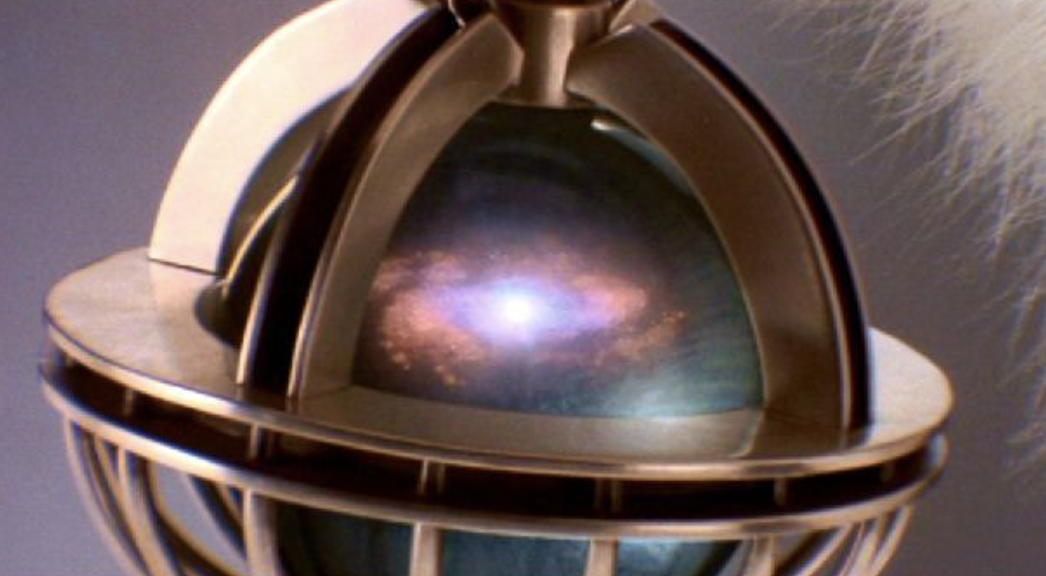
6. A galaxy as transportable object
Orion's marble contains a galaxy, or at least a miniaturized cosmic structure. The image suggests a universe that can be encapsulated, displaced, possessed and coveted. Space is no longer only immense extension; it becomes compact object.
7. Infinite loop of dimensions
The film extends this intuition: our world may appear as an element inside a larger set, itself handled at another scale. The immense becomes tiny; the tiny becomes immense. The universe is no longer a stable totality, but a cosmic nesting structure.
8. The problem of trans-scalar translation
How can one translate a message from a scale that is not ours? An intelligence operating at another level might manipulate structures we perceive as weather, chance, genetics, dream or cosmic event. The message may be too large or too small to recognize.
9. A.L.I hypothesis
For A.L.I, the Orion scene becomes a matrix: search for the message at several scales at once. Sky, object, body, jewel, city, institution, galaxy, marble. Interstellar language may be less a sentence than a system of correspondences between dimensions.