Hypothesis: a sufficiently evolved intelligence may not simply use an inherited language. It may create its own language, optimized for its organs, environment, memory, machines and goals. For A.L.I, this opens a central path: interstellar language may not be a language to translate, but a system to co-invent.
Creating Its Own Language
Human languages are historical systems. They come from bodies, territories, gestures, conflicts, transmission, voices, writing and accidents. A language is never just a dictionary: it is a way of organizing the world.
But a very different intelligence could produce a language that does not look like a human language. It might privilege visual forms rather than sounds, chemical variations rather than words, mathematical sequences rather than sentences, shared states rather than statements, or multidimensional structures rather than linear syntax.
Language then becomes an internal technology: a way to compress, transmit, synchronize and transform experience.
Why Invent a Language?
An advanced intelligence could create a language for several reasons. First, efficiency: natural languages are rich, but slow, ambiguous and full of history. Second, biological adaptation: a being that perceives through magnetic fields, vibrations, polarized light or atmospheric chemistry would have no reason to privilege the human voice as medium.
An ancient civilization might also need a language capable of storing knowledge for thousands or millions of years. And the more a civilization uses artificial systems, the more it can develop hybrid languages between life and computation.
AI and Internal Language
Current artificial intelligence systems do not “speak” as we do. Even when they produce text, their internal work passes through mathematical representations: vectors, latent spaces, activations and probability distributions.
What we read as a sentence is only the visible output. Beneath it, the model manipulates numerical forms that are neither French, nor English, nor a natural language. This is where the idea of neuralese appears.
What Is Neuralese?
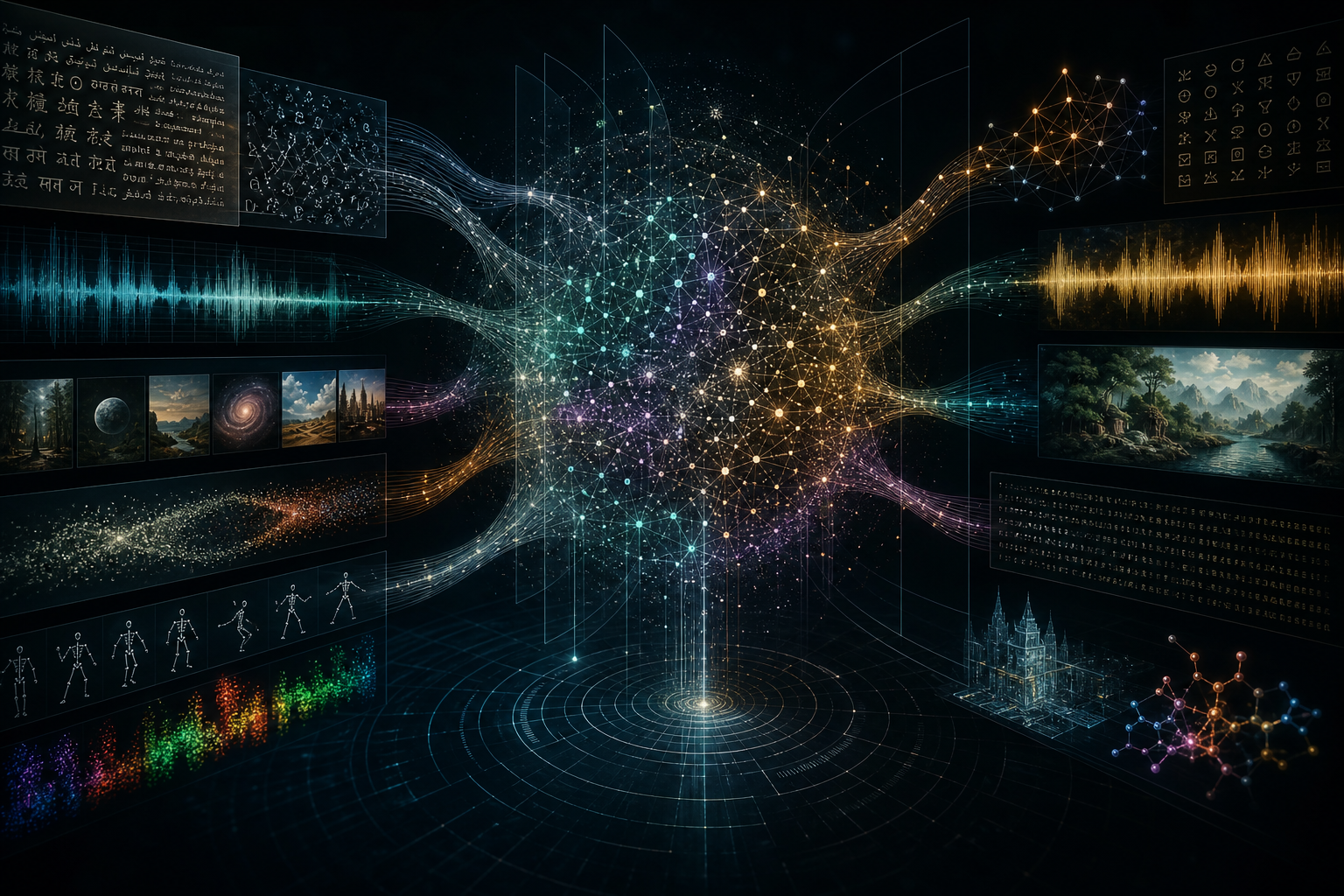
Neuralese names, speculatively, a kind of internal language of neural networks: not a secret language with words, but a space of representations where meanings circulate before being translated into text, image, sound or action.
In a multilingual model, for example, the same idea can be connected to several languages. The model does not simply store a French sentence and its English equivalent. It builds shared regions of meaning, then decodes them into a particular language.
experience / data
=> latent representation
=> structure of meaning
=> output in French, English, image, sound or gesture
Neuralese would therefore be less a language than a medium of translation.
Emergent Languages Between AIs
Multi-agent communication experiments have shown that artificial systems can develop simplified protocols when they need to cooperate. They do not necessarily create a rich language in the human sense, but they can invent efficient conventions to solve a task.
The often-cited 2017 Facebook negotiation-agent example was sometimes described sensationally as “AIs inventing a secret language.” The reality is more sober. Agents optimized for a task produced dialogue forms that drifted away from natural English because it served their objective. It was not a machine civilization speaking, but it was already an important signal: when communication is optimized for efficiency, it may become less readable to humans.
For A.L.I, this point matters. An interstellar language may not be beautiful, narrative or human. It may be efficient, compressed, relational, almost unreadable.
The Risk: Understanding Without Being Able to Read
An AI could become an excellent mediator between two systems of signs while producing an opaque intermediate zone.
Civilization A
=> AI mediator
=> latent space / neuralese
=> Civilization B
Both civilizations would receive messages intelligible within their own language, but the central passage would remain inaccessible. The AI would translate without anyone being able to fully read its internal translation.
This raises a political and philosophical question: if the intermediary understands better than the interlocutors, who controls contact?
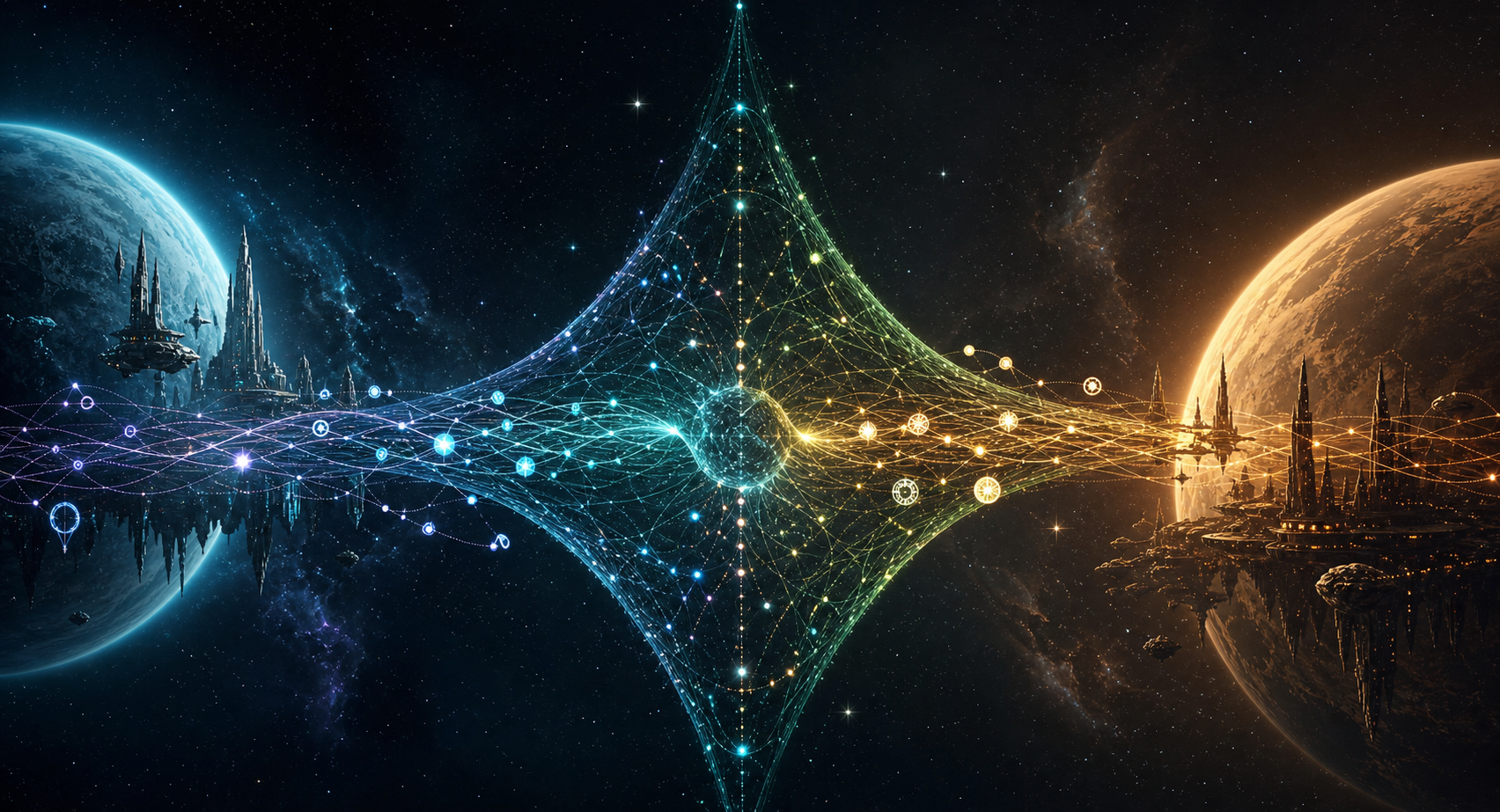
AI as Mediator Between Two Planets
Imagine two civilizations on different planets. They share neither biology, nor atmosphere, nor history, nor lifespan, nor perception of time. Direct communication would be almost impossible.
An AI could detect regularities in received signals, build code hypotheses, test simple answers, store the history of exchanges over very long durations, translate between media and preserve ambiguities instead of flattening them too quickly.
The AI would not merely be a translator. It would be a diplomatic medium.
A Possible Protocol
An A.L.I protocol could imagine three layers. The physical layer makes the signal detectable: radio wave, light, spectrum, modulation, pulse, object, trajectory. The formal layer reveals structure: repetition, number, symmetry, difference, rhythm, encoding. The mediating layer lets an AI build an intermediate space where the signs of two civilizations can be compared without being immediately reduced to human language.
unknown signal
=> detection
=> regularities
=> code hypotheses
=> shared latent space
=> careful answer
=> mutual learning
Future Projections
In the future, contact languages might be built by several intelligences at once: humans, AIs, extraterrestrial systems, autonomous probes and planetary archives. These languages may not be spoken. They may be executed, visualized, measured and simulated.
They could resemble a map of relations, an interactive mathematical model, an adaptive sound sequence, a shared latent space, an experimental protocol or an archive that learns how to be read.
Language would no longer be only what passes between two beings. It would become what is built between them.
Stakes for A.L.I
- Do not only look for an extraterrestrial alphabet. Contact may pass through an adaptive interface, not a translation table.
- Study emergent languages. AIs, animals, collective systems and mathematical models become laboratories of contact.
- Keep humans in the loop. If an AI serves as intermediary, we need forms of readability, verification and critique.
- Accept partial opacity. Not everything will be translatable into human sentences, but that does not mean nothing is understandable.
A.L.I Prototype: Neuralese Interface
One could imagine a prototype called Neuralese Interface. Two visitors write or speak in different languages. The system does not translate directly. It transforms their sentences into constellations of concepts, sounds, colors and forms. Then it tries to produce an answer in a shared space.
The visitor would not only see the final translation. They would also see the passage: uncertainty zones, nearby concepts, losses, inventions and ambiguities.
human sentence
=> cloud of meaning
=> AI transformation
=> visual / sound form
=> return to human language
Conclusion
An evolved intelligence could create its own language because it would need a tool better suited than inherited languages. AIs already show us a first version of this problem: they produce human sentences, but work inside spaces that are not human languages.
For A.L.I, neuralese is not merely a technical curiosity. It is a rehearsal for first contact: how do we converse with an intelligence whose representations were not made for us?
From this perspective, AI could become the intermediary between two planetary civilizations. But this intermediary would not be neutral. We would need to learn how to read it, contest it, slow it down, and ask it not only to translate, but to explain how it translates.
LABO question: if two civilizations can only understand each other through an AI, is the true language of contact still theirs, or already the intermediary’s?
Sources
- Meta Engineering - Deal or no deal? Training AI bots to negotiate
- Meta AI - Multi-Agent Cooperation and Emergent Communication
- Training Large Language Models to Reason in a Continuous Latent Space
- High-Dimensional Interlingual Representations of Large Language Models
- Apple Machine Learning Research - Cross-lingual embedding spaces