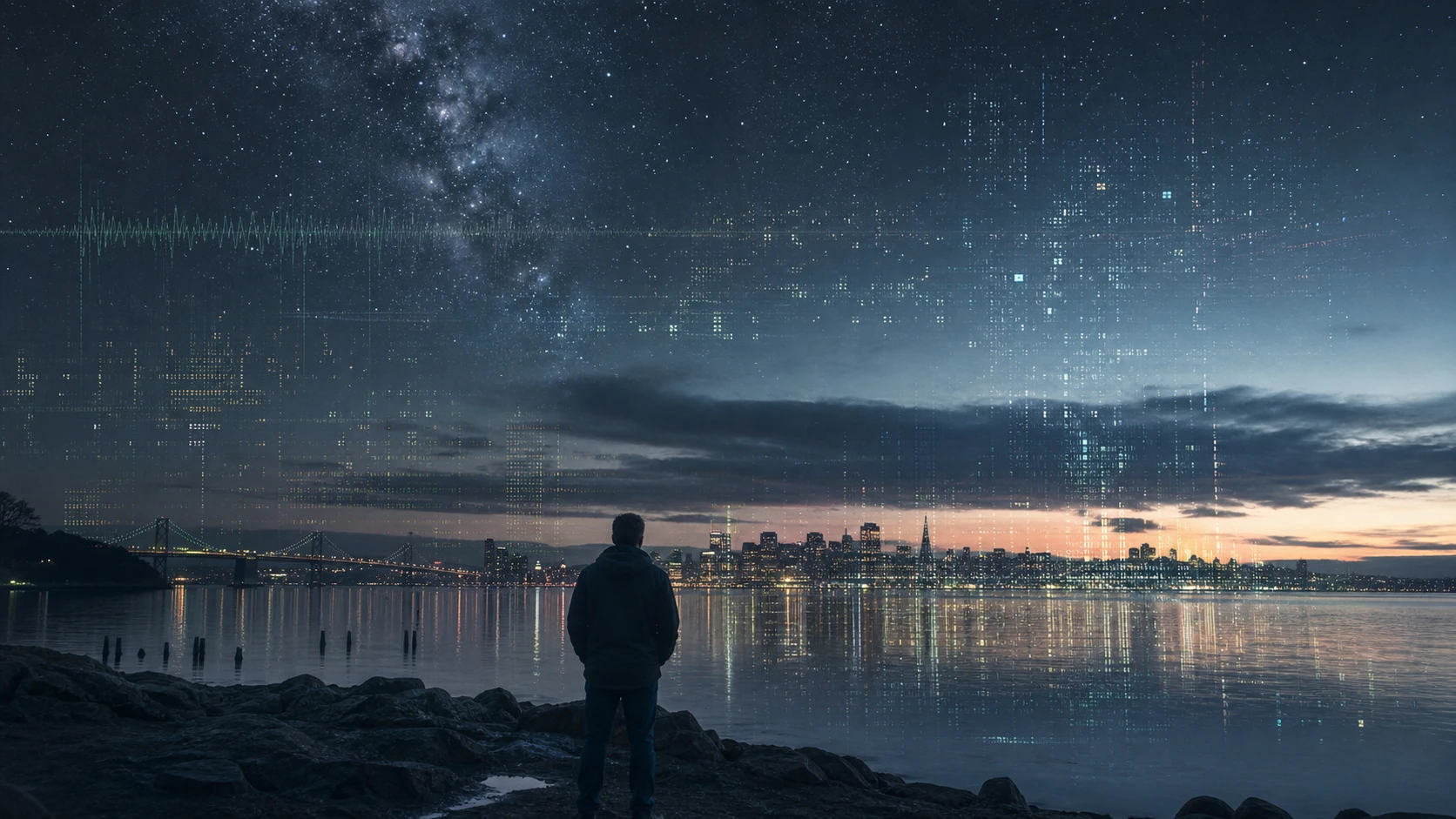
In the usual imagination of contact, an extraterrestrial message arrives through light: radio waves, lasers, optical flashes, electromagnetic modulation. But there is another family of messengers, far more discreet: neutrinos. These elementary particles, produced by the Sun, supernovae, nuclear reactors, particle accelerators and extreme cosmic events, interact so weakly with matter that they can cross the Earth almost as if it were transparent.
For A.L.I, this property opens a vertiginous hypothesis: could a contact language be designed not to be immediately visible, but to cross opacity? Could a message be sent through a planet, a star, a dust cloud, or a region of space where light is blurred? The neutrino is not only a particle: it is a figure of the ghost message, the sign that passes through while almost refusing to be captured.

An almost invisible particle
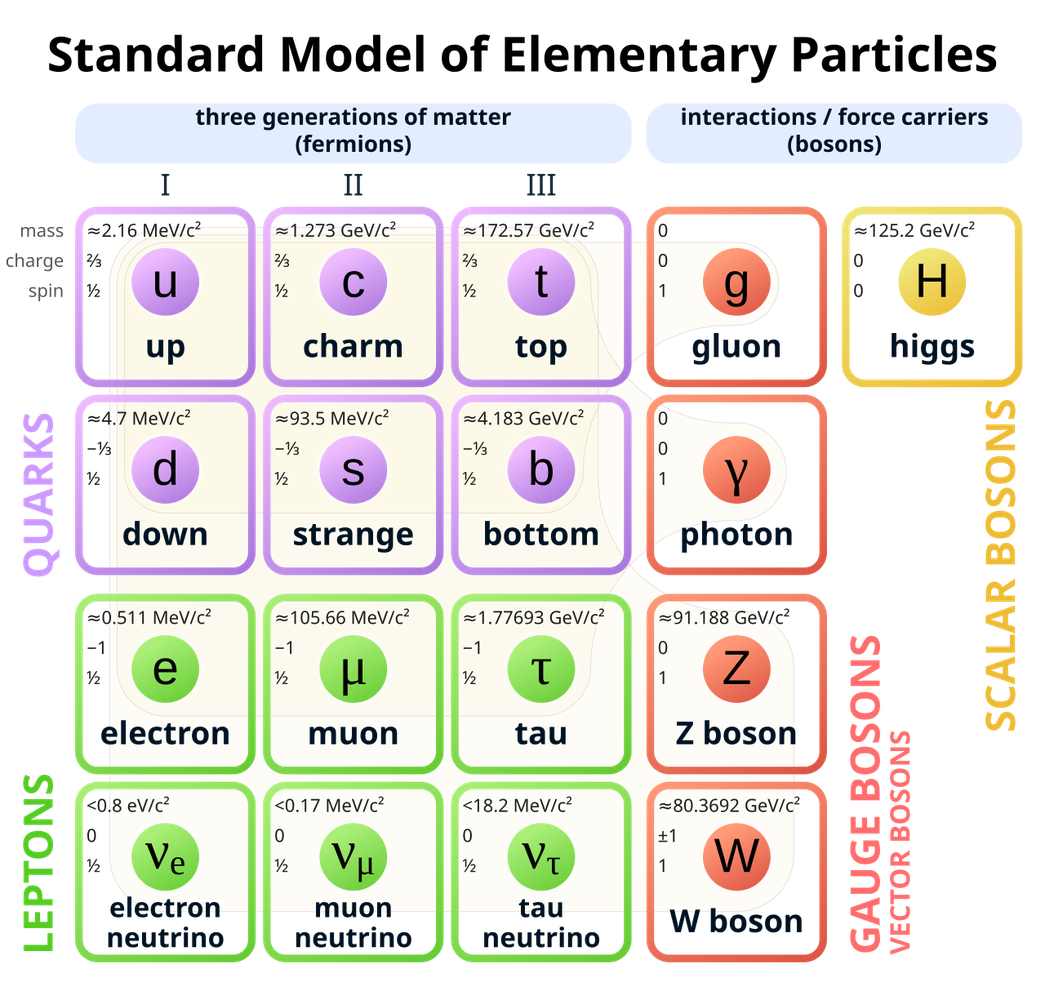
The neutrino belongs to the Standard Model of particle physics. It exists in several flavors, associated with the electron, the muon and the tau. Its mass is extremely small, its electric charge is zero, and it interacts with matter only through the weak interaction and gravity. This discretion makes it paradoxical: it is everywhere, but almost undetectable.
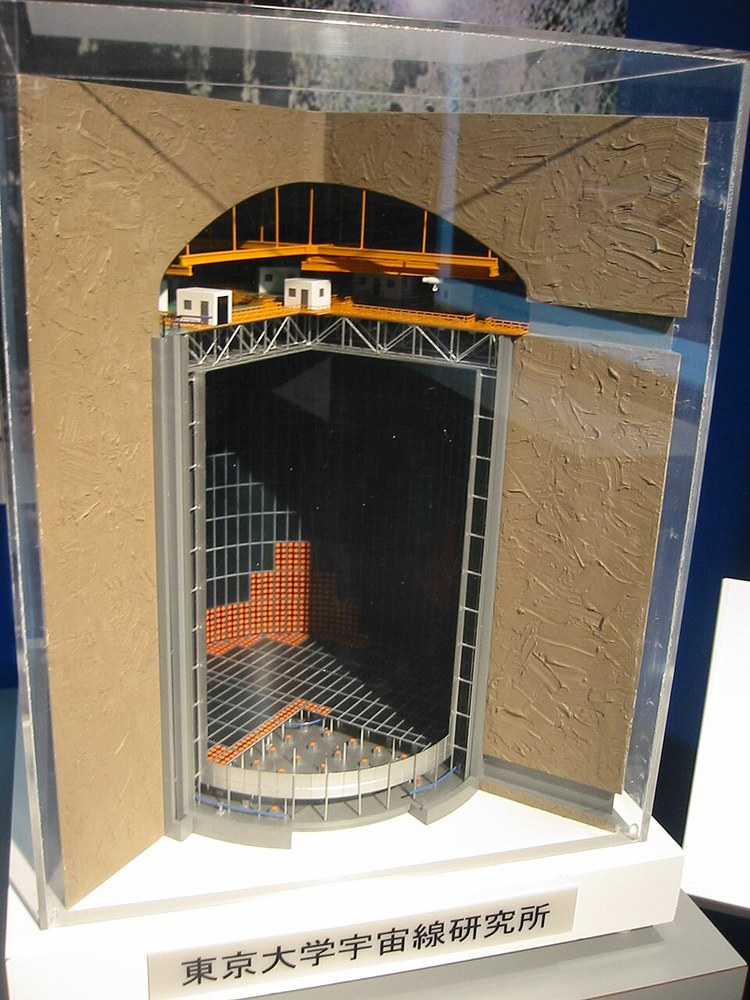
Every second, billions of solar neutrinos pass through our bodies. They do not speak to us, they barely touch us, they leave no sensible trace. Yet in giant detectors such as Super-Kamiokande in Japan or IceCube in Antarctica, a few rare interactions become visible as Cherenkov light, produced when a charged particle created by a neutrino interaction crosses a transparent medium faster than light propagates through that medium.
The precedent: sending a message with neutrinos
The idea is not purely speculative. In 2012, a team of researchers demonstrated that a message could be transmitted using a neutrino beam. The experiment, carried out with Fermilab’s NuMI beamline and the MINERvA detector, encoded the word neutrino and sent it through roughly 240 meters of rock. The data rate was extremely low and the infrastructure enormous, but the principle was established: human information can be converted into a modulation of a neutrino beam and reconstructed at reception.
This experiment does not make neutrino communication practical today. Instead, it reveals a fertile limit: when a channel is almost impossible to use, it clarifies what communication really means. One must decide what to encode, how much energy to spend, how much redundancy to produce, what detector to build, and what kind of patience to adopt.
Why would an advanced civilization choose this channel?
A civilization capable of producing and detecting neutrino beams precisely might be tempted by this medium for several reasons.
- Crossing obstacles: where light is absorbed, blurred or scattered, neutrinos keep moving.
- Sending without a visible surface: the message can pass through a planet and reach a receiver on the other side.
- Signing a high technological threshold: a highly structured artificial neutrino signal would be difficult to confuse with natural noise.
- Creating a rare communication: this channel selects its receivers. It speaks only to those who have already developed advanced experimental physics.
This last idea matters for A.L.I: some languages may not be designed to be universal in an immediate sense, but to become legible only beyond a technical, cosmological or cognitive threshold. A neutrino message would then be less a bottle thrown into the sea than a message placed behind a door: it forces the receiver to build the instrument that makes it perceptible.
Reading the Sun in neutrinos
Neutrinos have already transformed the way we look at the sky. Detectors do not simply see luminous objects: they allow us to observe internal processes. The Sun, for example, can be reconstructed from neutrinos produced in its core. This changes the very notion of an image: we no longer photograph a surface, we capture a deep activity.

A neutrino message could operate through the same reversal: not as an image placed before us, but as a structure emerging statistically from events that are almost indistinguishable. The language would not be a sentence, but an accumulation, a patience, a form understood only after enough occurrences have been collected.
A.L.I hypothesis: an alphabet of crossing
One can imagine a minimal neutrino alphabet. Each symbol would not be a spoken letter, but a measurable configuration: average energy, pulse rhythm, apparent direction, time distribution, alternation of silences and bursts, prime-number repetitions, variation in event frequency. A grammar could emerge from the combination of three dimensions: time, energy and direction.
The first message should not be narrative. It could be a demonstration of structure: prime numbers, physical constants, recognizable periodicities, then very simple images reconstructed statistically. As with Arecibo, a matrix would be needed. But here the matrix would not be a radio packet: it would be a cloud of rare events distributed in time.
Thought protocol
- Produce a sky simulation in which each point corresponds to a detected neutrino event.
- Encode a simple image into a series of statistically rare pulses.
- Add natural noise, as if the message crossed a realistic cosmic environment.
- Ask an AI program to recover the hidden structure without knowing the initial code.
- Compare several methods: correlation, unsupervised learning, sequence models, time-energy transforms.
This experiment could become an installation: a dark room, a sky of points, nearly silent events, and an image that appears only after several minutes of observation. The public does not receive a message immediately. It learns to wait, to suspect an organization, to move from perception to decoding.
Limits and beauty of the impossible channel
Neutrino communication is currently unrealistic for ordinary use. It requires powerful accelerators, enormous detectors, considerable energy and a very low data rate. But this is precisely what makes it conceptually interesting. It forces us to imagine a language in which every bit is costly, every symbol must be justified, and silence is almost the whole message.
From an A.L.I perspective, the neutrino proposes an aesthetics of rarity. A civilization speaking this way might not be trying to chat. It would produce slow, deep inscriptions able to cross worlds. It would write in almost nothing, with particles that almost never stop.