If we had to look on Earth for the most convincing example of a non-human intelligence, it might be neither dolphin, crow, nor great ape. It might be the octopus. Not because it comes from elsewhere, but because it solved perception, decision, and action through an architecture radically different from ours, on a branch of life separated from vertebrates for more than half a billion years.
For A.L.I, the octopus is not a convenient metaphor for the extraterrestrial. It is a real case study: a complex intelligence without a skeleton, with almost no rigid parts, whose cognition is distributed across a central brain, peripheral neural networks, hundreds of chemosensory suckers, and skin that changes state. It forces a difficult question: how do we address a being whose “self” may not be located anywhere in particular?
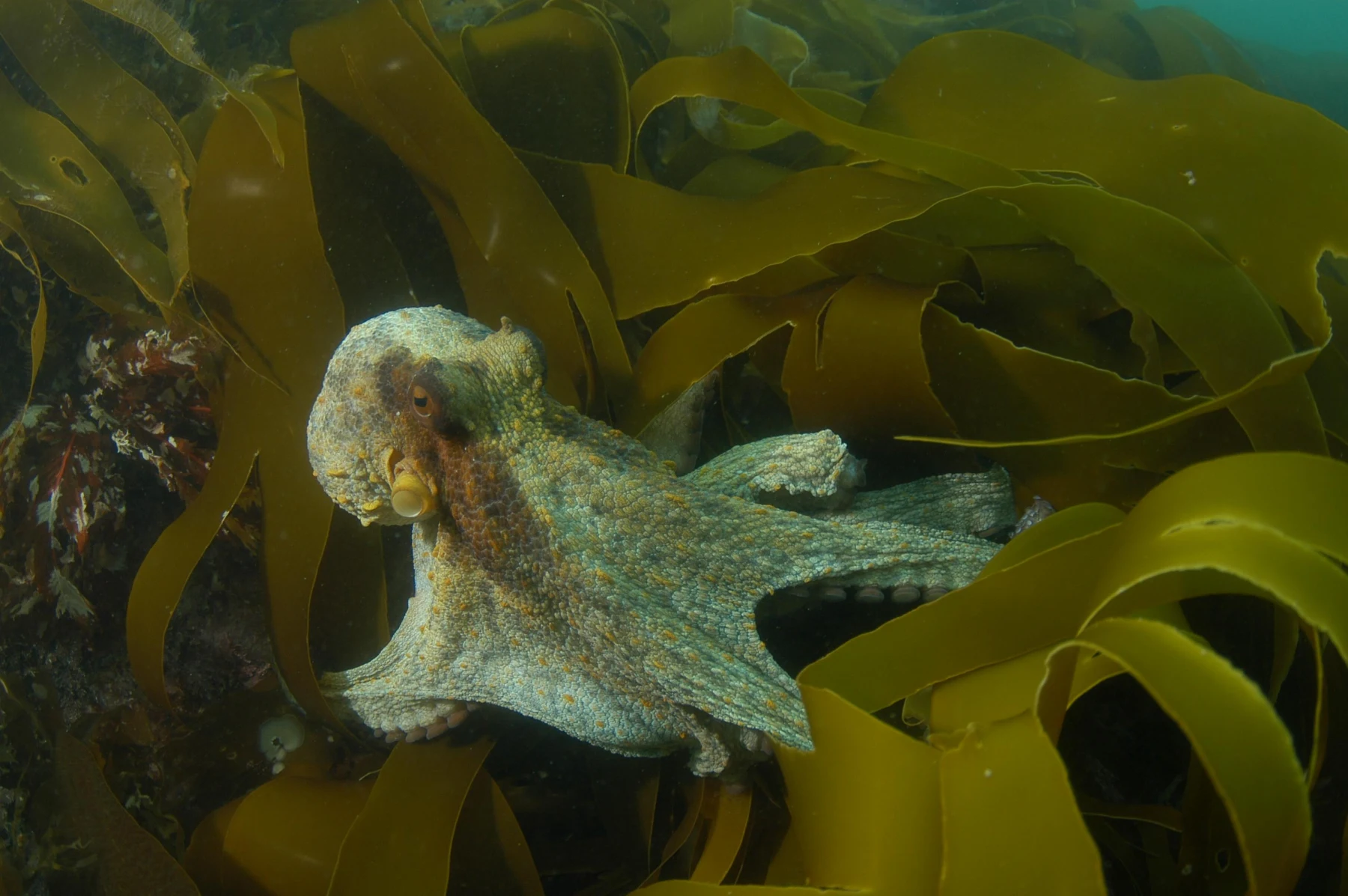
1. One brain, eight arms, several levels of decision
The common octopus has approximately 500 million neurons. Current estimates place almost 200 million in the central brain and optic lobes, and roughly 300 million in the axial nerve cords of its eight arms. Saying it has “nine brains” is compelling but inaccurate. The system remains hierarchical: the central brain organises goals, intermediate centres coordinate the body, and arm circuits handle much of the sensory and motor detail.
This delegation is essential. An octopus arm has no fixed joints; it can bend, shorten, elongate, twist, and stiffen almost anywhere. If the brain calculated every contraction, the number of parameters would be immense. Instead, it appears to issue general commands—reach, explore, retrieve—which peripheral networks turn into local movements. Isolated arm preparations can still produce coordinated movements, grasp, or recruit neighbouring suckers. This does not prove that a severed arm “thinks” alone. It shows that computation is deeply embodied in the limb.
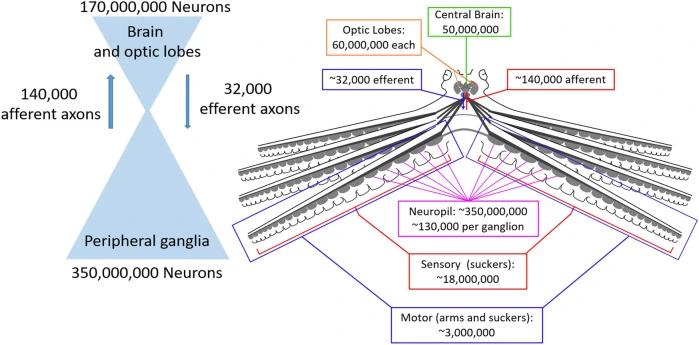
The bottleneck between brain and periphery is instructive. It imposes compression: the centre neither receives every detail nor sends every micro-command. Octopus unity emerges through constant negotiation among levels of control. Its intelligence is less a command room than a federation.
2. Touching, tasting, and deciding in the same place
Each sucker combines adhesion, touch, and chemoreception. The arms do not merely manipulate the world; they taste it on contact. Specialised chemotactile receptors respond to poorly soluble molecules deposited on surfaces. A rock, prey, and shelter are not only seen from the head; they are read by a constellation of mobile sensors.
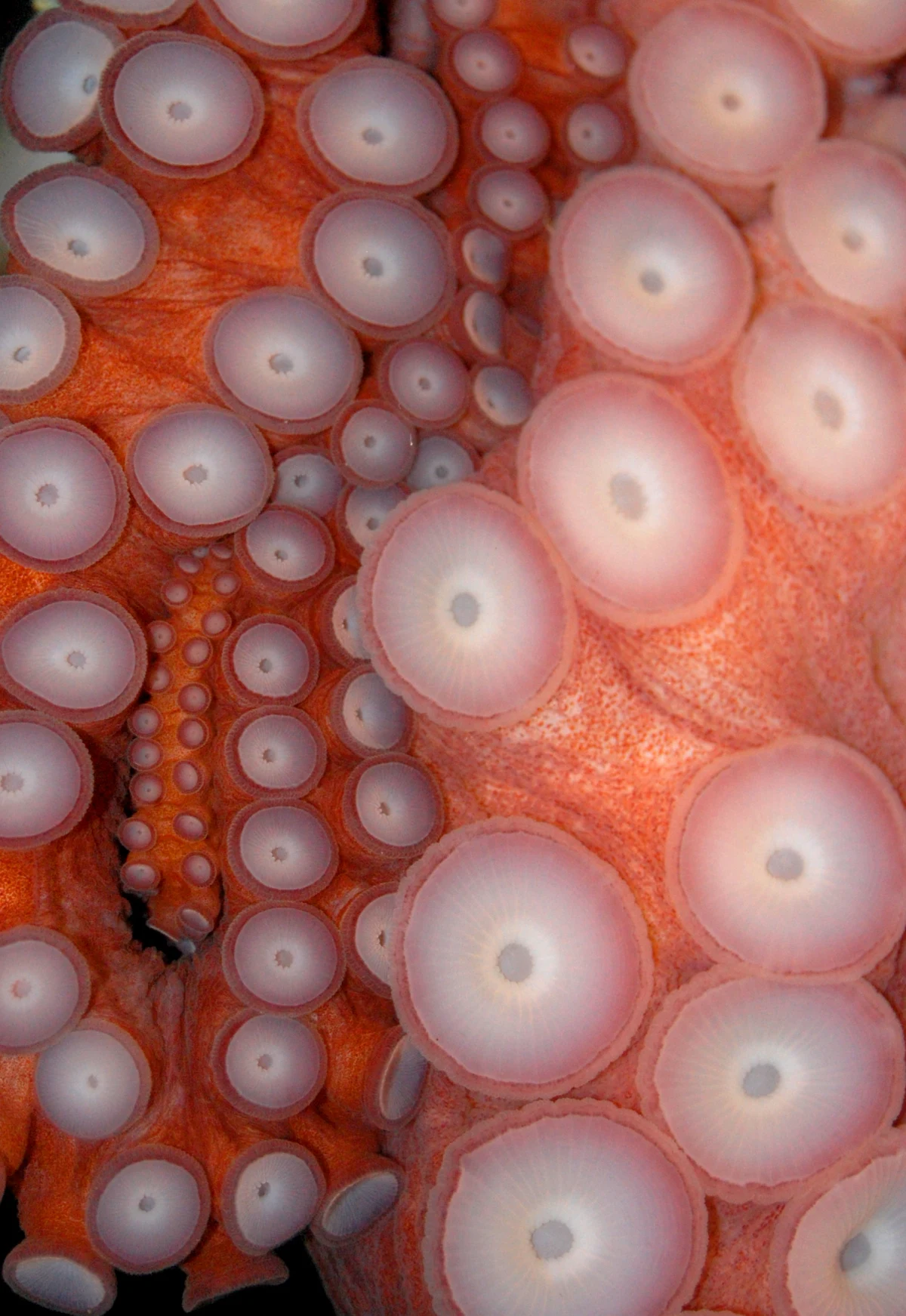
This organisation blurs human categories. For us, an eye perceives, a brain interprets, and a hand acts. In the octopus, one structure can perceive and act through a short loop. For A.L.I, this continuity suggests that a non-human language might be inseparable from the matter it explores. A sign would not represent an object at a distance; it would be a way of touching, attaching to, tasting, and transforming it.
3. Skin that senses light and becomes a display
Vision in the octopus species studied relies mainly on a single opsin type, making colour vision like ours unlikely. Yet their camouflage matches colours, contrasts, patterns, and textures with astonishing accuracy. Their skin contains pigmentary chromatophores, reflective iridophores, scattering leucophores, and muscles capable of changing surface texture.
In 2015, a study of Octopus bimaculoides showed that isolated skin samples react to light: chromatophores expand under white or blue illumination, a phenomenon called LACE, for light-activated chromatophore expansion. R-opsin proteins and several phototransduction components are expressed in the skin. Precision matters: the skin does not form an image like an eye, and the relationship between local photoreception, chromatophores, and the central nervous system is still being studied. Yet the skin does detect light independently of the eyes.
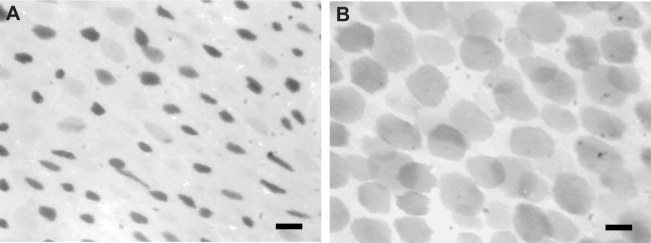
This surface is expressive as well. Cephalopods produce bands, spots, contrasts, iridescence, relief, and polarised signals for camouflage, threat, or social interaction. The entire body becomes a dynamic medium. Where humans often separate message from support, the octopus merges them: its skin is sensor, display, and living boundary at once.
4. RNA editing: plasticity without extraterrestrial mystery
Coleoid cephalopods extensively modify some RNA molecules after transcription from DNA. This A-to-I editing can alter the resulting protein, especially in the nervous system. A 2017 study identified tens of thousands of conserved recoding sites in octopuses, squid, and cuttlefish. In 2023, experiments showed that cold acclimation greatly increases editing at thousands of sites in the nervous systems of several species.
The “software update” analogy is useful only within limits: an octopus does not consciously rewrite its genome or choose its proteins. Editing acts on temporary RNA molecules through inherited cellular mechanisms. It nevertheless offers a timescale of adaptation faster than mutation and selection over generations, with a possible trade-off: preserving sequences required for editing may slow DNA evolution in surrounding regions.
In 2018, a paper linked the Cambrian explosion, viruses from space, and even octopus eggs delivered by a comet. This panspermia proposal provides neither a testable mechanism nor genomic evidence for an extraterrestrial octopus origin. Available data are explained by terrestrial evolution. The octopus becomes useful to A.L.I precisely when we stop declaring it alien: Earth alone is sufficient to produce radical cognitive otherness.
5. Intelligence on another evolutionary branch
The last common ancestor of cephalopods and vertebrates lived more than 500 million years ago and probably possessed a much simpler nervous system. Since that split, the two lineages independently built large nervous systems, camera-type eyes, learning, memory, exploration, and flexible decision-making.
This convergence does not imply that evolution follows a plan. It shows that shared constraints—moving, anticipating, capturing, avoiding, remembering—can produce comparable solutions from different materials. Yet divergences matter equally: a boneless body, semi-autonomous arms, distributed chemotactile perception, instantaneous skin control, and often short lives.
The octopus therefore extends the Umwelt hypothesis, the work on animal language, and research into distributed biological networks. It shows that an intelligence can converge with us on some problems while remaining almost incommensurable in how it inhabits a body.
6. Where does the subject begin and end?
We easily project a small human into the heads of other animals. Philosopher Peter Godfrey-Smith instead asks us to take seriously an experience whose centre of gravity is mobile. The octopus brain receives and coordinates, yet its arms retain sensorimotor memories and considerable autonomy. The subject may be less concentrated, more fluid—sometimes unified by a task and sometimes distributed among simultaneous explorations.
We cannot infer consciousness directly from anatomy. “Eight minds” would be as speculative as a single inner commander. Yet this uncertainty is productive. It reveals that our pronouns—I, you, we—already contain a theory of the subject. A message beginning with “you” assumes that the sender can count its recipients. Faced with distributed cognition, grammar itself may fail.
7. Octopus in philosophy, literature, and cinema
In Other Minds, Peter Godfrey-Smith combines philosophy of mind, evolution, and diving to describe a second Earthly history of consciousness. Sy Montgomery’s The Soul of an Octopus focuses on encounters with individuals and the possibility of interspecies relation. The documentary My Octopus Teacher makes prolonged attention between a human and a wild animal visible, while reminding us not to confuse emotional proximity with identical perceptual worlds.
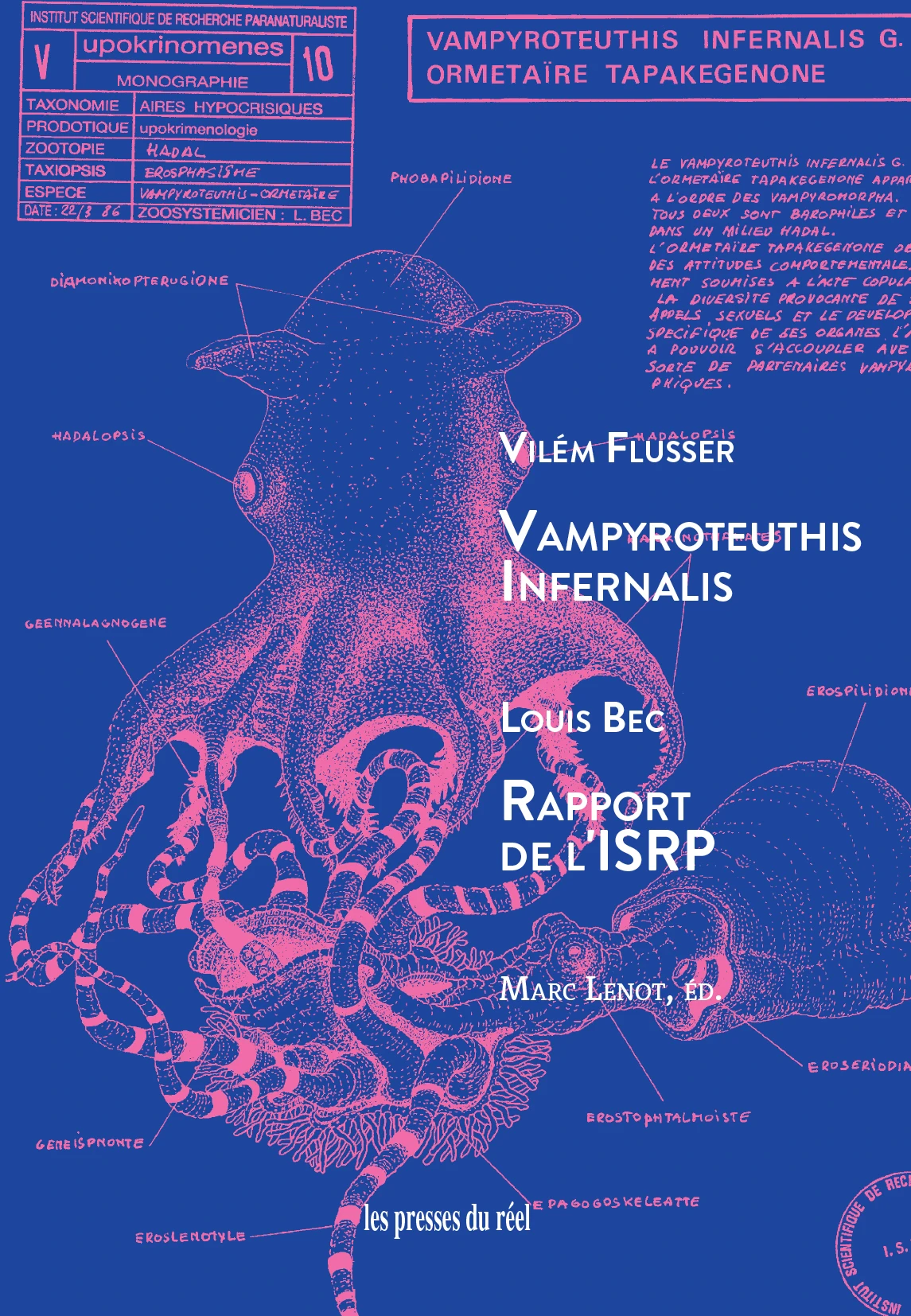
In Vampyroteuthis Infernalis, Vilém Flusser and Louis Bec construct a philosophical fable around an abyssal cephalopod. The vampire squid becomes humanity’s inverted mirror: its environment, organs, and values decentre anthropology. Donna Haraway more broadly uses tentacular thinking to imagine alliances and responsibilities beyond the isolated subject. These works do not describe octopuses as laboratories do; they test what their form does to our concepts.
8. Three A.L.I protocols inspired by the octopus
The message to nine recipients
Build a network with one centre and eight peripheral modules. Each module receives a different part of a message and can act locally before exchanging with the centre. The message is understood only when local responses coordinate without becoming uniform. The experiment measures what must remain decentralised and what must be compressed to circulate.
The contact skin
Build a membrane covered with light, touch, and chemical sensors, paired with pixels, inflatable surfaces, and moving textures. An incoming signal produces not a sentence but a bodily transformation. Two membranes gradually learn to answer each other through pattern, pressure, relief, colour, and rhythm. The protocol searches for a language in which reading and being modified are the same operation.
The distributed address
Transmit a proposition that makes no sense to an isolated receiver. Eight human agents, simulated animals, or AI models each receive a local rule. Their collective behaviour must produce an answer that none possesses alone. The recipient is neither an individual nor a crowd, but the organised relation among parts.
9. What the octopus changes about contact
A classical interstellar protocol imagines a sender, a channel, and a receiver capable of extracting the same symbolic object. The octopus suggests another scene. A signal may be divided across peripheries, transformed during perception, inscribed on the body, and resolved in action. Understanding no longer means rebuilding a sentence in a central brain; it can mean producing viable coordination.
A non-human civilisation might likewise distribute cognition across organisms, machines, environments, and timescales. Asking “who is speaking?” might be as awkward as asking which sucker is the octopus. We would need to recognise intention without immediately seeking a single author, and a response without demanding that it return through the same channel.
The octopus is not an extraterrestrial. It is more useful than that: Earthly proof that intelligence has multiple architectures. Before inventing a language for the stars, A.L.I must learn to address a body that thinks differently, here, beneath the ocean’s surface.
References and further reading
- Evolution of cephalopod nervous systems, Current Opinion in Neurobiology, 2023.
- Toward an Understanding of Octopus Arm Motor Control, 2023.
- Structural basis of sensory receptor evolution in octopus, Nature, 2023.
- Ramirez and Oakley — Eye-independent light sensing in octopus skin, 2015.
- Albertin et al. — The octopus genome and the evolution of cephalopod novelties, Nature, 2015.
- University of Chicago — RNA editing and genome evolution in cephalopods, 2017.
- University of Chicago — RNA editing during cold acclimation, 2023.
- Cephalopod Behavior: From Neural Plasticity to Consciousness, 2022.