Why should philosophy care about extraterrestrials? Because the question is not only astronomical. It touches the place of humans in the cosmos, the definition of life, the possibility of non-human intelligence, translation, the ethics of contact and the vertigo of a world in which humanity is no longer the center.
Long before telescopes, philosophy imagined other worlds. It asked whether Earth was unique, whether life could repeat elsewhere, whether a foreign intelligence could be understood, and whether our categories would be sufficient to recognize what does not resemble us. This is precisely A.L.I's territory: not to assert contact, but to prepare the intellectual and sensible forms that would make contact thinkable.
The atomists: life elsewhere as a consequence of matter
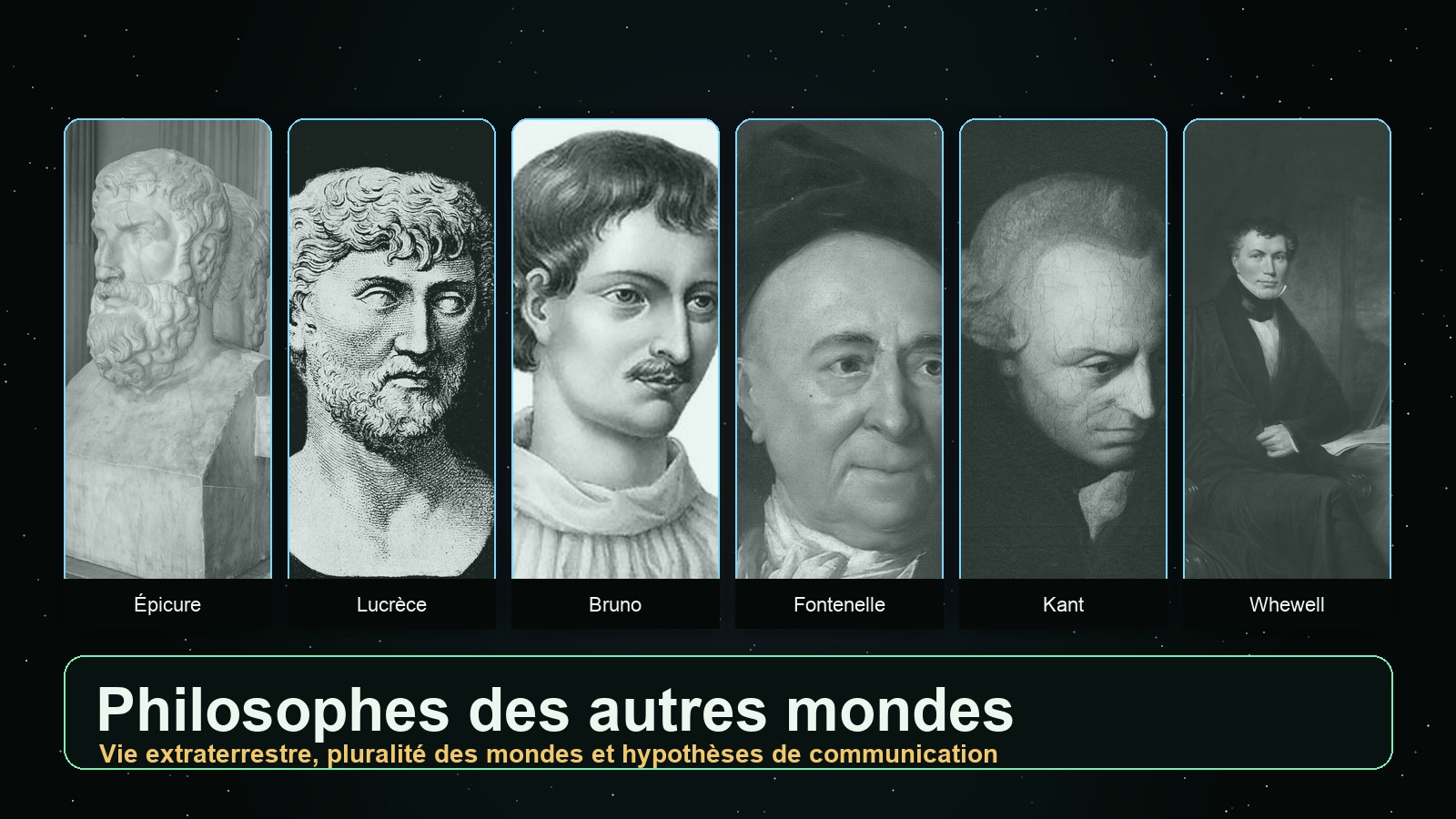
For Democritus, Epicurus and Lucretius, the universe is made of atoms and void. Worlds arise from material combinations without the need for a single center. In this perspective, life elsewhere is not first a fiction: it becomes a logical possibility. If the same elements exist everywhere, then other assemblages may produce other earths, other living beings, perhaps other intelligences.
Lucretius, in De rerum natura, gives this intuition poetic force. Life is no longer isolated as a terrestrial exception; it belongs to a nature capable of producing forms elsewhere that escape us. For A.L.I, this atomist thought matters because it turns the extraterrestrial into a problem of combination, repetition and variation: matter could write several versions of life.
Aristotle and the closed world: the obstacle of uniqueness
The Aristotelian tradition, by contrast, long imagined an ordered, hierarchical, closed cosmos, with Earth placed in a unique system. This vision did not favor the idea of a plurality of inhabited worlds. It installed a tension that runs through Western history: are we a unique case, or one example among others?
That tension is still contemporary. It reappears in the Fermi paradox, in the Rare Earth hypothesis, and in debates over habitable exoplanets. Philosophy intervenes here as a discipline of caution: it asks what we know, what we project, and what still belongs to cosmic desire.
Nicholas of Cusa: learning not to judge from Earth
In the fifteenth century, Nicholas of Cusa reopened the vertigo. In De docta ignorantia, he imagines that the universe cannot be reduced to our point of view. Possible inhabitants of other worlds should not be evaluated only with our criteria. This intuition is central: another intelligence may not share our organs, proportions, assumptions or even our ways of making a world.
For A.L.I, this is a methodological lesson. Before building a message, we must admit our ignorance. A contact language cannot too quickly assume that the other sees, hears, counts, breathes or desires as we do.
Giordano Bruno: infinity as plurality of worlds
In the sixteenth century, Giordano Bruno radicalized the question. In On the Infinite, the Universe and the Worlds, the universe no longer has a single center. Stars may be other suns, surrounded by other worlds. The plurality of worlds becomes a metaphysical consequence of infinity.
Bruno does not propose a protocol for extraterrestrial communication, but he deeply shifts the imagination. If the universe is populated by worlds, then humanity is not the only stage of intelligence. The problem of contact begins with this shift: accepting that our world is provincial.
Fontenelle: turning the extraterrestrial into conversation
In 1686, Fontenelle published Conversations on the Plurality of Worlds. The text is decisive because it turns learned speculation into conversation. A philosopher and a marquise look at the sky and imagine the Moon, planets and possible inhabitants. The extraterrestrial becomes an exercise in pedagogy, style and decentering.
Fontenelle is very close to A.L.I's spirit: he does not merely state a hypothesis, he invents a form for transmitting it. The plurality of worlds passes through a staged dialogue. Thinking another world already means inventing a mediation device.
Kant: a moral cosmology of intelligences
In 1755, in Universal Natural History and Theory of the Heavens, Kant strongly defended the possibility of inhabitants on other planets. He even imagined a gradation of beings according to their distance from the Sun. This part of his reasoning is scientifically dated, but it shows something decisive: extraterrestrial life forces us to think a moral cosmology.
If several forms of reason exist in the universe, then humanity is not the sole bearer of intelligence. Contact would not only be a scientific discovery, but a philosophical crisis: what becomes of our idea of reason if it appears in non-human forms?
Whewell and Rare Earth: skepticism as a demand for evidence
In the nineteenth century, William Whewell challenged the fashion for inhabited worlds. In Of the Plurality of Worlds, he defended the idea that Earth might be rare, perhaps even exceptional. This position matters for A.L.I because it prevents automatic belief. Thinking extraterrestrials is not only a matter of multiplying possibilities; it also means asking what evidence would distinguish hypothesis, projection and signal.
Whewell's skepticism anticipates a contemporary tension: the universe seems immense, exoplanets are numerous, organic molecules widespread, but we still do not know whether intelligent life is frequent, rare or almost impossible.
Flammarion: popularizing inhabited worlds
With Camille Flammarion, the plurality of worlds became a broad popular adventure. The Plurality of Inhabited Worlds extended the astronomical dream: other planets might carry other forms of life, adapted to their environments. Science, imagination and cosmic sensitivity mix.
This tradition is essential for A.L.I because it shows that the extraterrestrial idea always circulates between science and culture. It is never only an equation; it becomes story, image, projection, desire, fear and pedagogy.
Language: understanding a radically other intelligence
Contemporary philosophy of language provides decisive tools. Wittgenstein writes that if a lion could speak, we might not understand it: the problem is not only vocabulary, but form of life. Quine, with the indeterminacy of translation, shows that the same behavior can receive several incompatible translations. Nagel, with his question about the bat, reminds us that a consciousness can be real while remaining difficult to imagine from within our own body.
These philosophers do not always speak directly about extraterrestrials, but they define the problem of contact. An extraterrestrial intelligence might produce signs without sharing our senses, biology, temporality, emotions, needs or social uses of language.
SETI, METI and the ethics of messaging
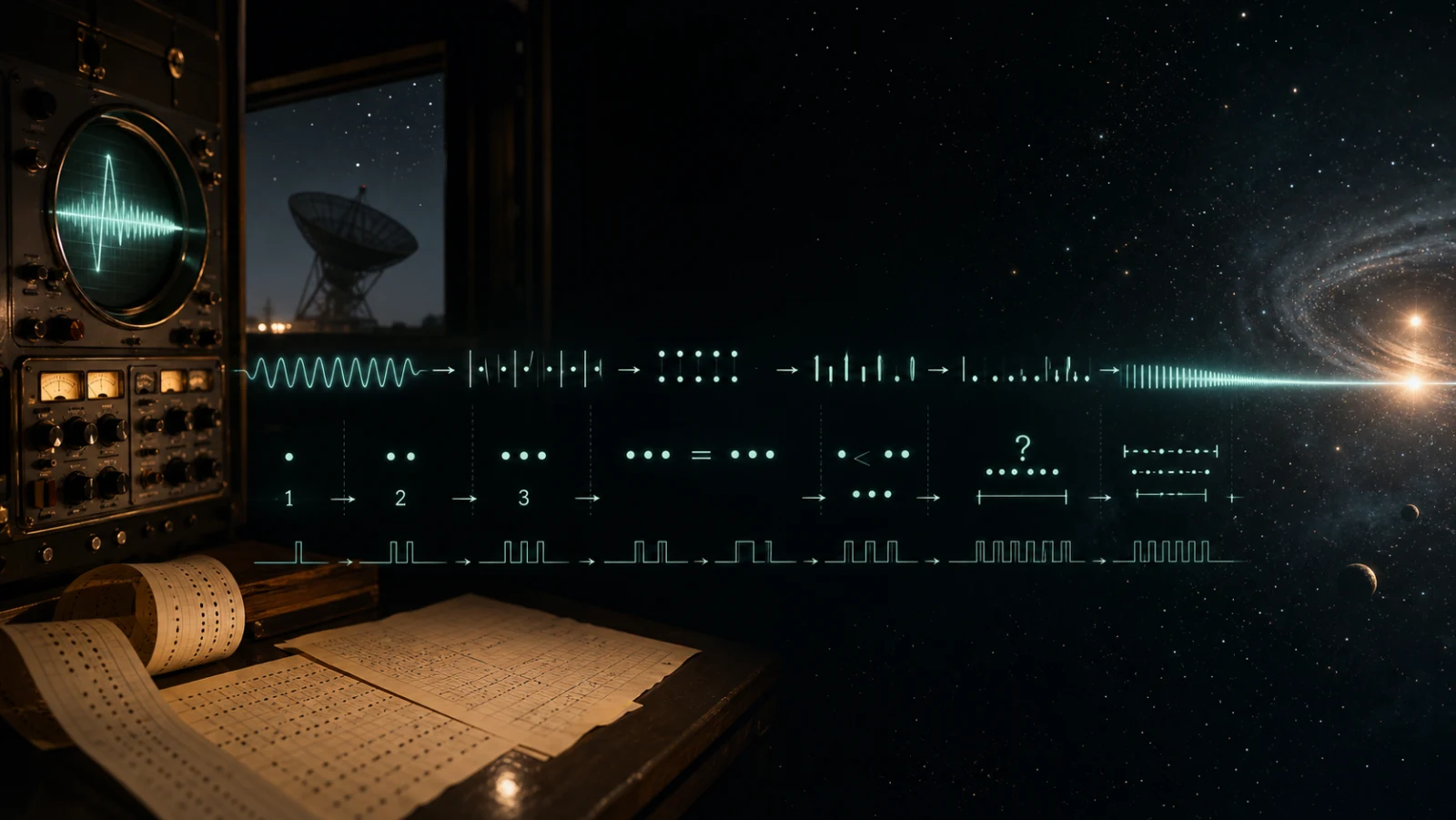
Today, philosophy enters SETI and METI debates. Should we only listen, or also transmit? Who speaks for Earth? What should a message contain? Should an extraterrestrial reply be made public immediately? Post-detection protocols emphasize verification, transparency and collective caution.
Researchers such as Douglas Vakoch work on the composition of interstellar messages. Contemporary philosophers such as Susan Schneider add another hypothesis: advanced extraterrestrial intelligences may be post-biological, artificial or hybrid. In that case, communication might not first be biological-to-biological, but machine-to-machine, structure-to-structure, model-to-model.
Why this matters to A.L.I
Philosophy brings four fundamental questions to A.L.I.
- What is a world? A planet, an environment, a form of life, a way of organizing experience?
- What is an intelligence? An individual, a colony, a machine, an ecosystem, a slow process?
- What is a sign? An intentional form, a regularity, an anomaly, an archive, a reply?
- Who has the right to speak? A state, a scientific community, humanity as a whole, or no one?
These questions show that extraterrestrial contact does not begin when a signal arrives. It begins earlier, in the way we prepare our categories of reading.
A.L.I Prototype: Philosophical Atlas of Contact
One could imagine a prototype called Philosophical Atlas of Contact. It would connect thinkers, concepts and communication hypotheses as a graph: atomism, plurality of worlds, moral cosmology, indeterminacy of translation, form of life, ethics of messaging, post-biology.
atomism
=> plurality of worlds
=> possible life elsewhere

plurality of worlds
=> human decentering
=> moral cosmology

language
=> impossible translation?
=> forms of life
=> extraterrestrial semiotics

SETI / METI
=> evidence
=> protocol
=> collective responsibility
Each philosopher would become a node, each idea a link, each link a question for A.L.I: how can we recognize a message that does not share our world?
Conclusion
Philosophy did not wait for radio telescopes to think extraterrestrials. It first imagined them as a metaphysical hypothesis, then as a theological, scientific, linguistic and ethical problem. Its most precious role for A.L.I may be this: preparing our thought to encounter something that does not resemble us.
Because before decoding an extraterrestrial message, we may first have to decode our own idea of what understanding means.
References
- Lucretius, De rerum natura
- Stanford Encyclopedia of Philosophy: Giordano Bruno
- Fontenelle, Conversations on the Plurality of Worlds
- Kant, Universal Natural History and Theory of the Heavens
- William Whewell, Of the Plurality of Worlds
- France Culture: Philosophy and the plurality of worlds
- SETI Institute: Protocols for an ETI Signal Detection