
What if poetry were one of the most advanced forms of communication with extraterrestrial intelligence? Not because it is clearer than science, but because it accepts what ordinary language often tries to reduce: ambiguity, vibration, metaphor, silence, the unconscious, the plurality of meaning.
For A.L.I, poetry opens a strong hypothesis: first contact may not pass through a translatable sentence, but through a form capable of producing resonance. A non-human intelligence may not understand our dictionaries, but perceive regularities of breath, return, rupture, image and density.
1. A brief history of poetry as language technology
Poetry often precedes writing. In many cultures, it is first oral: song, formula, memorized story, invocation, prayer, epic. Rhythm and repetition serve memory, transmission and community. Poetry is not only an art: it is a technology of memory.
Ancient forms often associate poetry, sacred speech and cosmology. Hymns, psalms, ritual songs, oracles, epics: the poem carries a speech that exceeds the individual. It does not only say "I think." It speaks from a larger place: ancestors, gods, cosmos, people, spirit, unknown.
Historical markers. Homer, Vedic hymns, psalms, Sappho, shamanic songs, Sufi poetry by Rumi or Ibn Arabi show that poetry has long held memory, rhythm, body and cosmos together. It is not first a separate "literary genre": it is a practice of address to the invisible, the community, the dead, gods, elements.
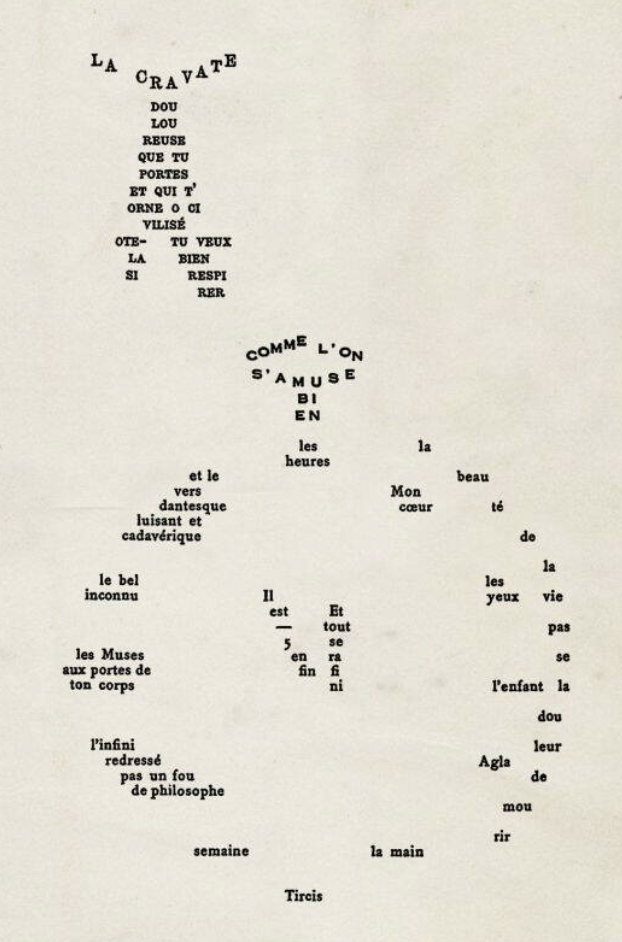
With writing, poetry also becomes a graphic architecture. Lines, stanzas, blanks, alignments, calligrams, ideograms, typography: the poem shows that language is not only a sequence of words, but a spatial and sonic object.
Spatial poetry. Mallarmé, with Un coup de dés jamais n'abolira le hasard, turns the page into a field of forces: type sizes, blanks, dispersion. Apollinaire, with Calligrammes, turns the poem into a figure. Later, concrete poetry by Eugen Gomringer, Augusto and Haroldo de Campos, Ian Hamilton Finlay or bpNichol turns the word into a visual, almost sculptural object. For A.L.I, this lineage is decisive: it shows that a poem can become map, constellation, diagram or interface.
Image-calligraphies. Arabic, Persian, Hebrew and East Asian calligraphic traditions remind us that writing can be sign, breath, image, gesture and rhythm at once. In these forms, text does not merely name: it becomes a graphic body. For non-human communication, this hybridization is precious because it gives the receiver several simultaneous handles: reading, seeing, following movement, recognizing structure.
2. Poetry and ordinary language
Ordinary language often seeks efficiency: naming, describing, ordering, transmitting stable information. It tries to reduce uncertainty. Poetry, by contrast, works with uncertainty. It does not only say one thing: it makes several levels appear simultaneously.
Ordinary language says: "the light arrives." A poem can make us feel time, distance, body, lack, waiting, color, trembling. It does not replace information: it increases it through sensory layers.
Language against pure information. Rimbaud speaks of the "derangement of all the senses"; Mallarmé wants to "give a purer sense to the words of the tribe"; Paul Celan writes after catastrophe in a broken, dense, almost mineral language. In Emily Dickinson, cuts, dashes and condensation turn the poem into a machine for suspending meaning. These poets matter for A.L.I because they do not only transmit content: they change how the receiver becomes able to receive.
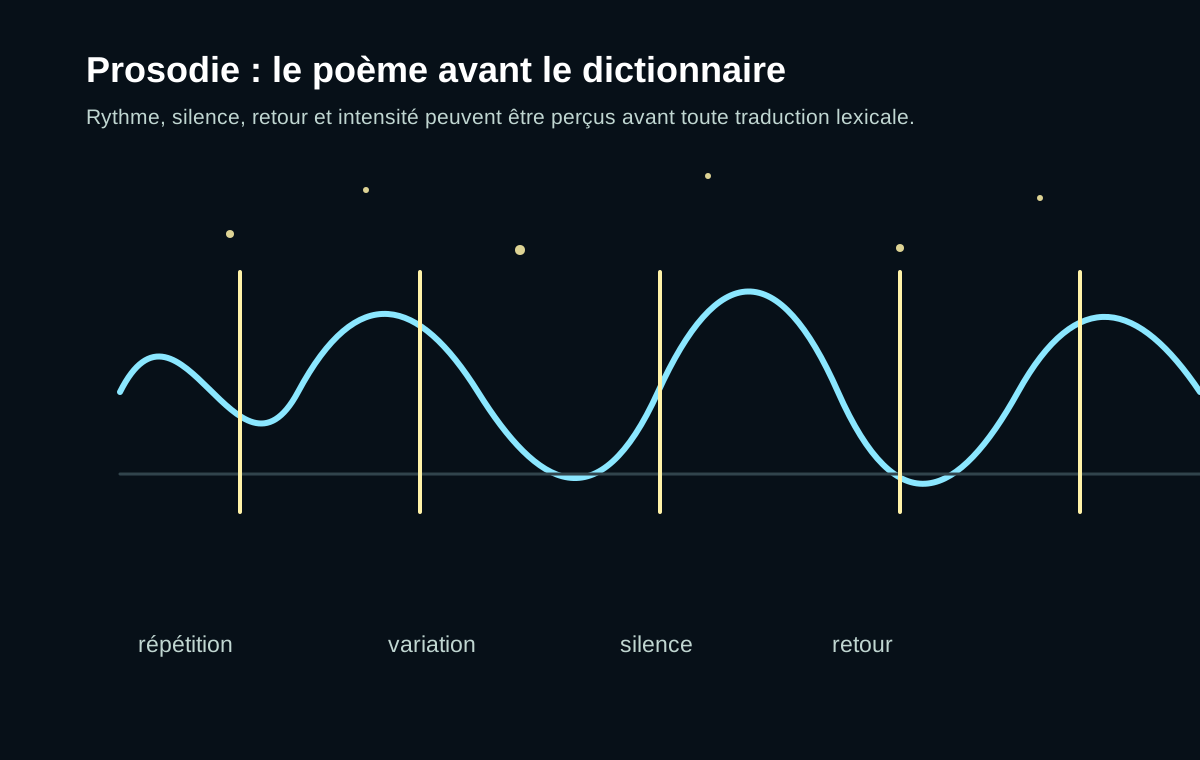
Poetry operates through several procedures:
- rhythm: a temporal structure before lexical meaning;
- metaphor: a displacement between distant domains;
- ellipsis: what is missing becomes active;
- ambiguity: several readings coexist;
- mental image: language becomes an inner scene;
- silence: blank, pause and interruption participate in the message.
These properties matter for A.L.I because they bring language close to experience. The poem does not merely transmit content. It transforms the receiver's state.
3. Poetry as a non-literal signal
An extraterrestrial intelligence may not possess ears, mouth, human syntax or body. Yet it might detect regularities: alternation, symmetry, rupture, repetition, density, transformation. Poetry could therefore be designed as a form of non-literal signal.
An interstellar poem would not necessarily be translated word by word. It could be read as a score of variations: intensities, returns, motifs, delays, silences. It would be a writing of relation rather than a writing of objects.
Sound poetry and proto-language. Hugo Ball at Cabaret Voltaire, Kurt Schwitters with Ursonate, Antonin Artaud in his glossolalia, Henri Chopin with sound poetry on tape, Bernard Heidsieck and François Dufrêne move the poem toward mouth, breath, cry, syllable and tape recorder. Here, language becomes acoustic signal before becoming dictionary. This is a direct A.L.I path: an external intelligence might first recognize vibration, repetition and modulation.
Here poetry becomes close to music, mathematics and ritual. It does not only say "this is what we know." It says: this is how our mind organizes the unknown.
4. Automatic writing and forces beyond us
Automatic writing occupies a particular place. In nineteenth-century spiritualism, it was often understood as dictated by spirits. In Surrealism, André Breton took it up as a method for letting thought speak outside rational control. In both cases, the author is no longer a sovereign master: they become receiver, channel, surface of inscription.
We can analyze this without choosing too quickly between belief and skepticism. Automatic writing can be seen as access to the unconscious, involuntary associations, buried memories and linguistic structures that act before the will. But it can also be thought poetically as a situation in which the subject accepts being crossed by what exceeds them.
Automatism, chance, cut-up. Breton and Soupault published Les Champs magnétiques as an experiment in automatic writing. Brion Gysin and William S. Burroughs invented or systematized cut-up: cutting, displacing, making the text speak otherwise. John Cage used chance and the I Ching; Jackson Mac Low composed with chance operations, silences and durations. These practices displace the author: the poet becomes an operator of a device where something writes with them.
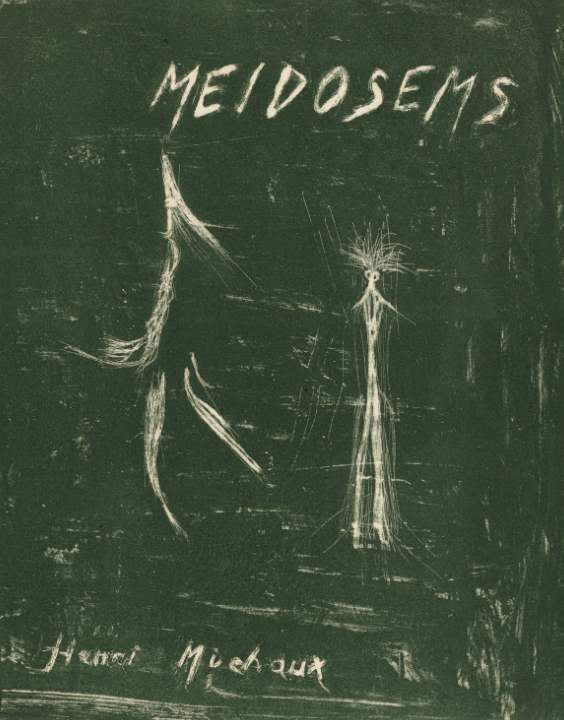
Michaux is a decisive reference here: his figures are neither only drawings nor only signs. They resemble graphic organisms, writings of beings, alphabets without translation. For A.L.I, they show how poetry can leave the sentence and become apparition.
For A.L.I, this position is essential: learning to write as if language came from elsewhere. Not claiming that extraterrestrial forces dictate sentences, but creating devices where the ego becomes less central and the text lets unexpected forms pass through.
5. A.L.I hypothesis: the poem as psychic antenna
I propose the following hypothesis: a poem can function as a psychic antenna. It does not necessarily capture an external signal in the physical sense, but it configures the mind to receive differently: through analogy, dream, rhythm, resonance, drift and image.
The poem would then be an instrument of controlled disorientation. It disturbs language enough for other associations to become possible, but not so much that all structure is lost. It stands between code and apparition.
Unconscious and reception. This idea resonates with Freud and Jung, but also with spiritualist, mediumistic and visionary practices: Hélène Smith and her "Martian" studied by Théodore Flournoy, mediumistic drawings, invented alphabets, glossolalic writings. For A.L.I, these are not proofs of contact, but archives of forms produced when human language believes it is crossed by otherness.
In communication with an external intelligence, this property could be decisive. A message that is too literal imposes our categories. A poetic message opens a common space where several readings can survive.
6. Making contact poetry
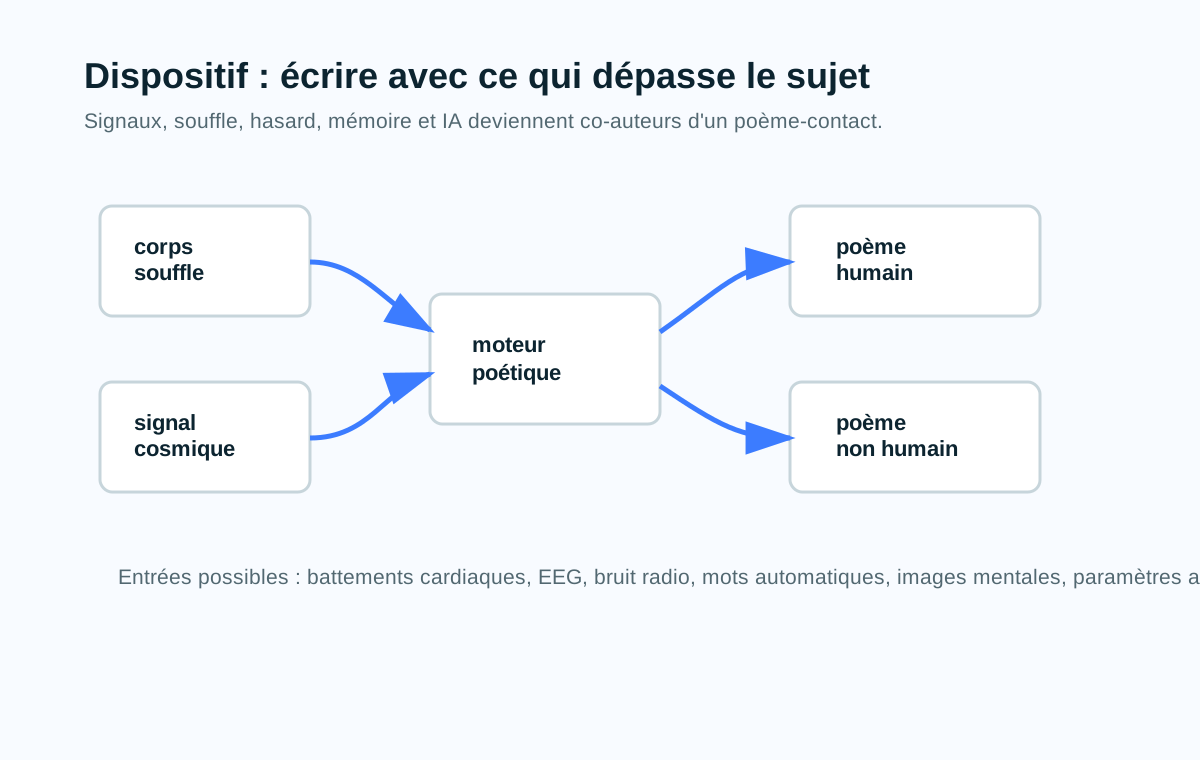
Several contact-poetry devices can be imagined:
Procedural poetries. Oulipo, founded around Raymond Queneau and François Le Lionnais, explores literature under constraints. Queneau's Cent mille milliards de poèmes is almost a printed combinatorial machine. Georges Perec shows that a constraint can produce a world. Bernadette Mayer proposes writing experiments as protocols of perception. These approaches are essential for A.L.I: they turn the poem into a procedure, therefore into something transmissible and replayable.
- Radio-poem: capture cosmic noise, transform it into rhythmic constraints, then write under these constraints;
- EEG-poem: use a reader's brain activity as modulation for a text;
- Dream-poem: collect dream fragments and recombine them into an alphabet of images;
- Automaton-poem: let a program produce variations, then keep those that seem to carry intention;
- Collective poem: several participants write without reading each other, then a system extracts motifs, returns and correspondences;
- Stellar poem: convert astronomical data into prosody, blanks, repetitions and stanzas.
These devices do not try to prove contact. They try to fabricate conditions of reception: making language more porous, more sensitive, more able to welcome another form.
7. Possible program: contact poem generator
A computational prototype could work as follows:
- input 1: a stream of astronomical or radio data;
- input 2: a multilingual poetic corpus;
- input 3: a human bodily stream, breath or heartbeat;
- module 1: extraction of rhythmic motifs;
- module 2: generation of fragments through AI;
- module 3: automatic perturbation through controlled chance;
- output: visual, sonic and textual poem, accompanied by its generation score.
The key point would be to preserve the trace of the process. The poem would not only be an aesthetic result. It would be a reproducible experiment: a message whose conditions of appearance can be replayed.
Technical references. One could draw from John Cage's mesostics, Jackson Mac Low's operations, Burroughs and Gysin's audio cut-ups, but also contemporary generative poetry, poetry bots, performed reading and text-to-speech. The goal is not to replace the poet with the machine, but to create a chain of agents: body, chance, archive, statistical model, cosmic noise, human decision.
8. Possible installation: Chamber of Exterior Writing
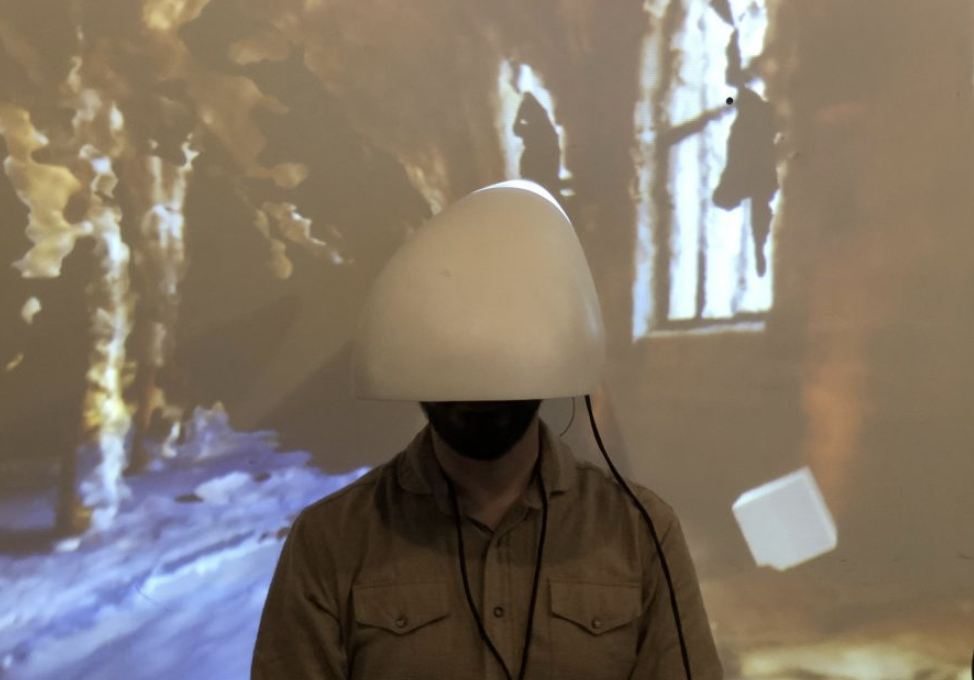
An A.L.I installation could be called Chamber of Exterior Writing. The public enters a dark room. At the center: a table with paper, microphone, breathing sensors, radio antenna and screen. The room diffuses a faint sonic breath derived from space data. The visitor writes without clear instructions for a few minutes.
The system analyzes writing rhythm, pauses, repetitions and insistent words. It crosses them with radio noise and produces a second poem, like a response. The visitor leaves with two texts: the one they believe they wrote, and the one the machine extracted from what passed through them.
Installations and inheritances. This chamber could dialogue with Fluxus, George Brecht's textual scores, La Monte Young's environments, Ian Hamilton Finlay's poem-objects, Jaap Blonk's sound readings or PennSound archives. It could also function as a public laboratory: every visitor adds a trace, and the whole becomes an evolving corpus of contact attempts.
The installation does not ask: "did an extraterrestrial speak?" It asks: "what speaks when I stop fully controlling language?"
9. Why poetry might be ultimate
Poetry may be an ultimate form of communication not because it is superior to mathematics or science, but because it accepts not closing meaning. It can survive imperfect translation. It can carry rhythm without shared vocabulary. It can make a mental image exist even when concepts diverge.
Interstellar contact will perhaps need proofs, numbers, constants and protocols. But it will also need something more fragile: a way of saying otherness without reducing it. This may be where poetry becomes indispensable.
10. References
- Encyclopaedia Britannica - Poetry
- Poetry Foundation - Poetry
- MoMA - Surrealism
- Tate - Automatism
- André Breton - Manifestoes of Surrealism
- Basmala, 1924, by Aziz Efendi - Wikipedia / Wikimedia Commons
- Guillaume Apollinaire - Calligrammes, Gallica / BnF
- Henri Michaux - Meidosems, Centre Pompidou
- Poetry Foundation - Language Poetry
- Poetry Foundation - Emily Dickinson
- Poetry Foundation - Paul Celan
- UbuWeb - Kurt Schwitters, Ursonate
- Brion Gysin - Cut-ups
- Electronic Poetry Center - Jackson Mac Low
- Academy of American Poets - Jackson Mac Low and chance operations
- Oulipo - Raymond Queneau, Cent mille milliards de poèmes
- Bernadette Mayer - Writing Experiments
- Getty Research Institute - Ian Hamilton Finlay papers
- bpNichol Digital Archive
- PennSound - sound poetry archive