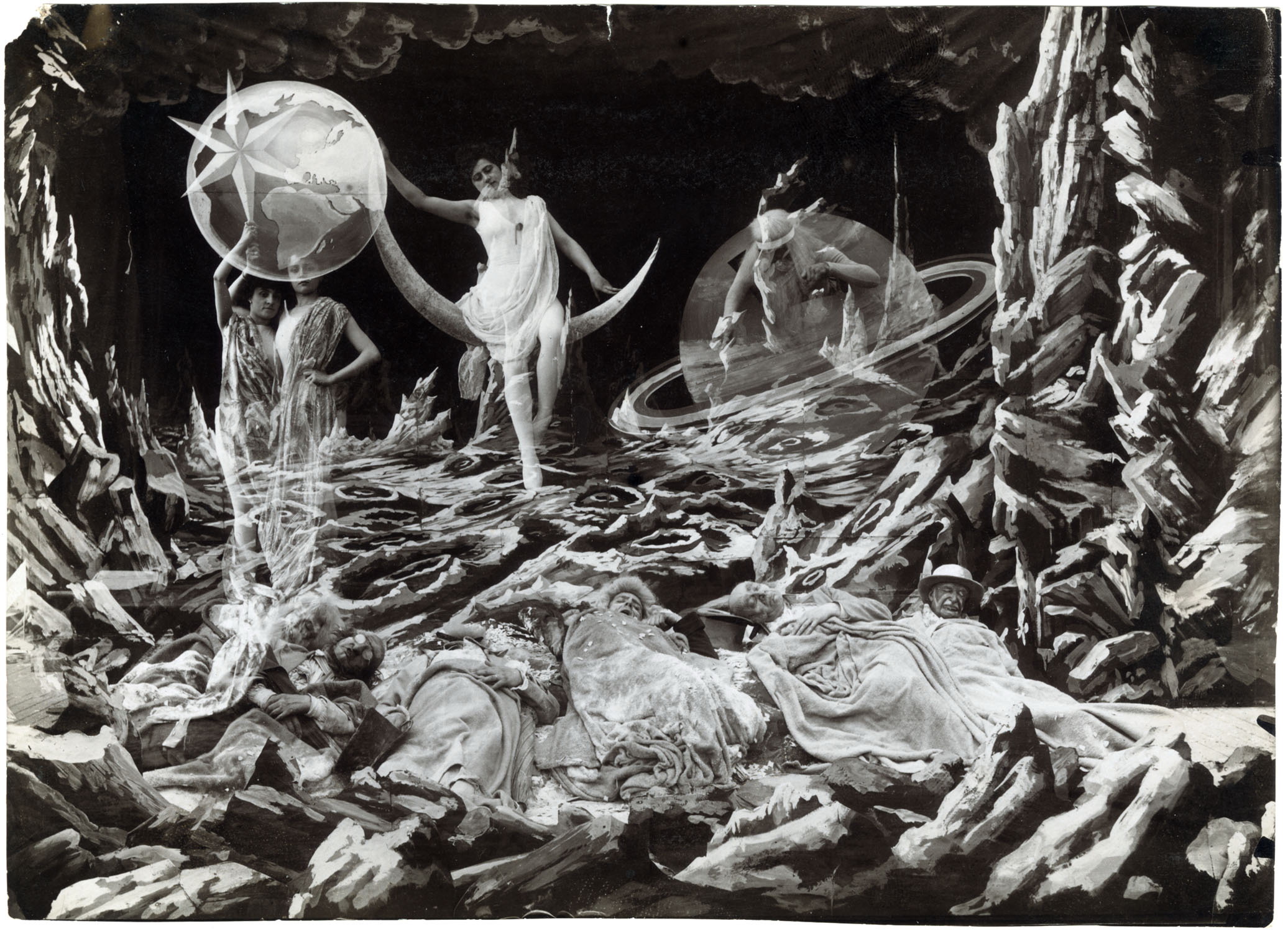

The alien is not only a being from elsewhere. In the history of psychology, it can also be understood as a limit-form of the human mind: image of the unknown, figure of radical otherness, projection of collective anxiety, symbolic apparition, or attempt to give shape to information that ordinary consciousness cannot yet organize.
For A.L.I, this approach matters because it shifts the question. Communicating with a non-human intelligence may not only mean sending a signal into space. It also requires understanding how the human brain produces, filters, distorts or renders certain forms of presence readable.

1. Jung: flying saucers and modern myth
Jung approached flying saucers in A Modern Myth. He did not primarily try to decide whether the objects were physically real. He observed that their collective apparition had psychological meaning. Circular, luminous, celestial forms could be read as modern mandalas: images of a lost center, symbols of wholeness, responses of the unconscious to an age shaped by the Cold War, technology and nuclear fear.

2. Collective unconscious as a space of forms
The Jungian collective unconscious designates a reservoir of symbolic forms that do not depend solely on individual experience. Applied to A.L.I, this raises a question: could an alien intelligence communicate not through vocabulary, but by activating archetypes?
3. Can the brain be programmed to access other channels?
The word programming is dangerous if it promises magical access. But it becomes interesting if understood as attentional training. The brain massively filters information. Changing perceptual conditions can therefore change what becomes visible, audible, memorable or imaginable.
4. Contemporary neuroscience: networks, prediction, internal states
Contemporary cognitive science increasingly treats the brain as a predictive system. It does not passively receive the world: it anticipates, completes, corrects and compares. Perception is a negotiation between incoming signals and internal models.
5. Parapsychology: experimental frontier and contested zone
Parapsychology has attempted to test telepathy, precognition, psychokinesis and remote viewing. Ganzfeld protocols, remote viewing experiments, PEAR Lab and the Global Consciousness Project all searched for anomalous correlations between intention, information and chance. These fields remain controversial, but they have produced protocols for testing forms of communication that escape ordinary channels.
6. Collective experiences: crowd, synchronicity, social field
The idea of collective consciousness takes many forms: Jungian archetypes, crowd psychology, emotional contagion, shared myths, networked attention and algorithmic amplification. Synchronicity adds another possibility: a meaningful configuration of events rather than a direct causal message.
7. The alien as psychic operator
In abduction and contact narratives, extraterrestrials often communicate through mental images, impressions, silent commands, dreams or telepathic messages. Psychology may read these narratives as trauma, dissociation, personal myth or cultural symbol. But it can also ask: how does the brain represent an otherness that exceeds its categories?
8. A.L.I prototype: laboratory of shared images
A.L.I could build a protocol where several participants enter modified attention conditions. A hidden symbolic or geometric target is selected. Participants then describe images, words, sensations and figures. The result becomes a database: keywords, visual motifs, subjective intensity, drawings, divergences and convergences.
9. Hypothesis for A.L.I
If a non-human intelligence wanted to contact us, it would probably have to deal with our psychology. It would not communicate with a neutral receiver, but with a predictive, symbolic, emotional, social and cultural brain. A.L.I could therefore become a workshop for the psychology of contact.