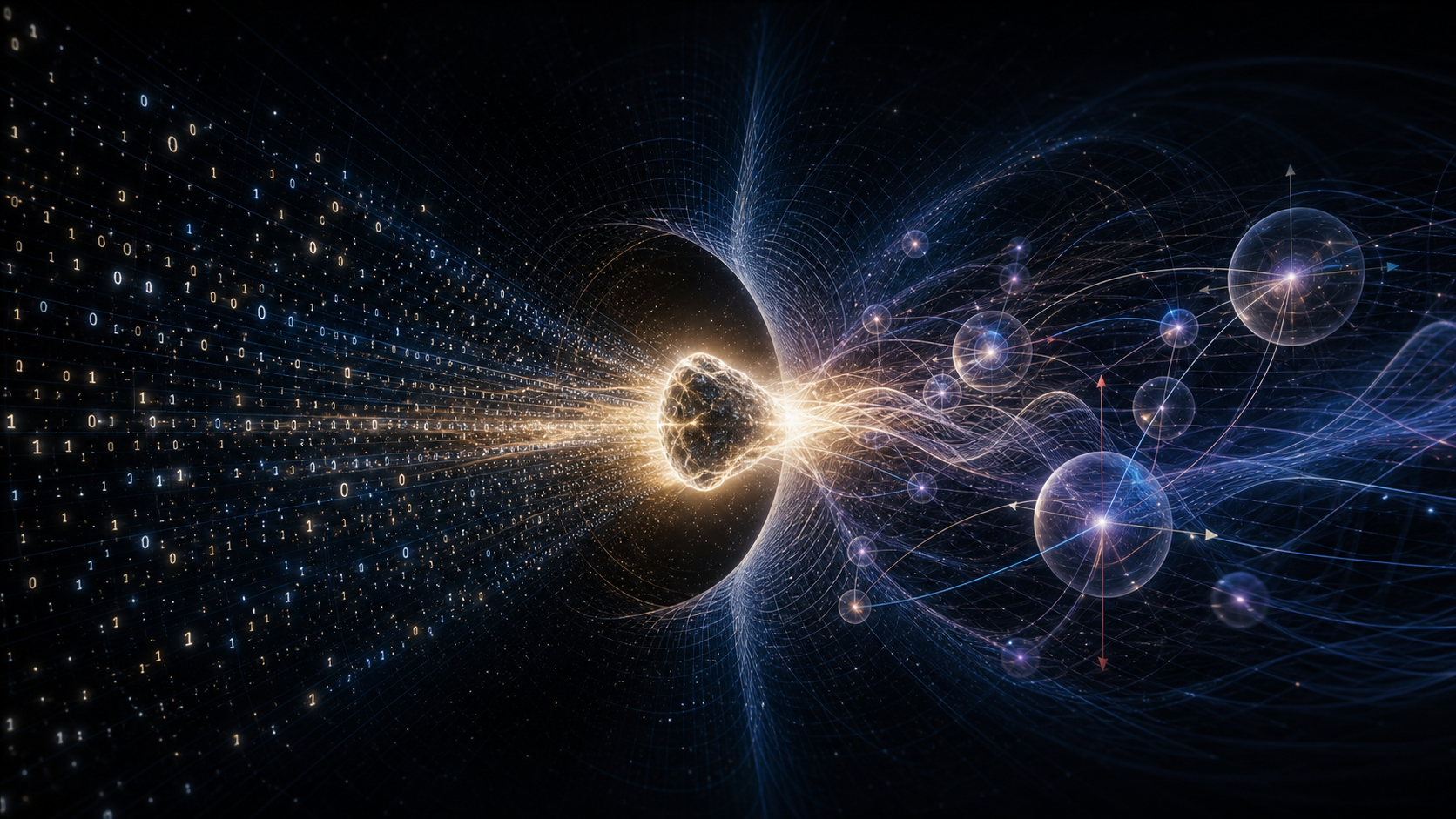

A binary message says yes or no, 0 or 1, presence or absence. Quantum programming forces us to think differently. It does not simply replace binary with a faster version of classical computation; it introduces another way of writing an operation, where information may be superposed, entangled, phase-shifted and only partially made readable through measurement.
1. From bit to qubit: changing the unit of language
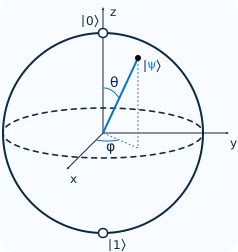
A classical bit carries a determined value: 0 or 1. A qubit can be described as a combination of two possible states before measurement. This is not mere uncertainty: it has amplitude, phase and the capacity to interfere with other computational paths.
2. Programming a state rather than writing a sentence
Quantum programming means preparing a register of qubits, applying quantum gates, sometimes creating entanglement, and then measuring. Frameworks such as Qiskit, Cirq and Q# let us write circuits: Hadamard for superposition, CNOT for correlation, rotations for phase and measurements for classical output.
3. Simple example: a qubit as probabilistic alphabet
In binary, one sends a sequence such as 101100. In a quantum setting, one might prepare states oriented in several bases. Reception would not always yield the same result, but a probability signature. Meaning would come from a distribution rather than a single fixed symbol.
4. BB84: communicating by choosing bases
BB84, proposed by Bennett and Brassard in 1984, is one of the founding protocols of quantum cryptography. It creates a secret key by encoding and measuring qubits in different bases, then publicly comparing the bases used. It shows that communication can concern the conditions of reading, not only the signal itself.
5. Quantum teleportation: transferring a state, not matter
Quantum teleportation does not teleport an object in the science-fiction sense. It transfers an unknown quantum state using an entangled pair and a classical channel. Entanglement alone does not allow faster-than-light messaging, but teleportation provides a strong model: communication can mean transferring a fragile state rather than copying text.
6. Satellites and real-world trials
Long-distance quantum communication experiments already exist. China's Micius satellite demonstrated quantum key distribution across large distances, photon entanglement between separated ground stations and steps toward satellite-based quantum networks.
7. A.L.I protocol: a non-binary message in three layers
- Classical layer: mathematical markers, prime numbers, constants, synchronization time.
- Simulated quantum layer: public description of a simple circuit and comparison of expected distributions.
- Physical quantum layer: photonic states, choice of bases, error detection and non-classical correlations.
8. LLMs and quantum theory: two distribution machines?
A parallel can then be drawn with large language models. An LLM does not choose a word the way a fixed symbolic rule would choose an answer. It computes a probability distribution over possible next tokens, given the context. The generated text is therefore the result of a statistical dynamic: several continuations are possible, some more likely, others almost invisible but never entirely unthinkable.
Quantum mechanics obviously does not work like an LLM. A language model is not a quantum system, and its probabilities are not physical amplitudes. But the analogy is conceptually useful: in both cases, meaning is not given by an isolated symbol, but by a space of possibilities, a distribution, and a context of measurement or generation.
An LLM can therefore be thought of as a dynamic interface between human binary language and more probabilistic forms of information processing. It can handle uncertainty, weigh hypotheses, produce several interpretations of the same signal and translate a fuzzy distribution into readable narrative. In this sense, AI could become a useful mediator between a quantum or quasi-quantum message and a human cognition still attached to sentences.
Within an A.L.I protocol, an AI model could receive not a single message, but a set of distributions: measurement results, errors, correlations, probabilities and variations across bases. Its role would not be to magically “guess” meaning, but to propose families of interpretations, search for invariants, compare patterns and reformulate probabilistic structures as language hypotheses.
The underlying idea is strong: if quantum theory teaches us that reality manifests through distributions and measurements, and if LLMs excel at working within statistical spaces of language, then AI could act as a translation interface between two regimes of information. Not because it is quantum, but because it accepts meaning as a field of possibilities rather than a single code.
9. Extraterrestrial extrapolation: communicating by correlation
An advanced civilization might not send a message as a string of characters. It might propose a correlation protocol: measure here, compare there, verify a distribution, detect a violation, recognize a shared key or reconstruct a structure from repetitions.
10. Limits and caution
Quantum communication does not automatically bypass the speed of light. It is fragile, noisy and sensitive to decoherence. At interstellar scale, preserving or distributing quantum states would be extraordinarily difficult. The conceptual inspiration must therefore be distinguished from current technical capability.
11. A.L.I hypothesis
Binary remains essential for robust messaging. But an advanced interstellar language may need to integrate non-binary forms: probabilities, phases, bases, correlations and distributions. Communication may become the construction of a shared experiment rather than the transmission of a sentence.