There are moments when intelligence does not simply produce a better answer, but a new way of asking questions. A rupture in thought appears when a person, a group or a cultural environment connects domains that its age kept separate: geometry and gravity, anatomy and mechanics, musical fugue and the architecture of time, mathematical logic and computing machines, art and the very definition of art.
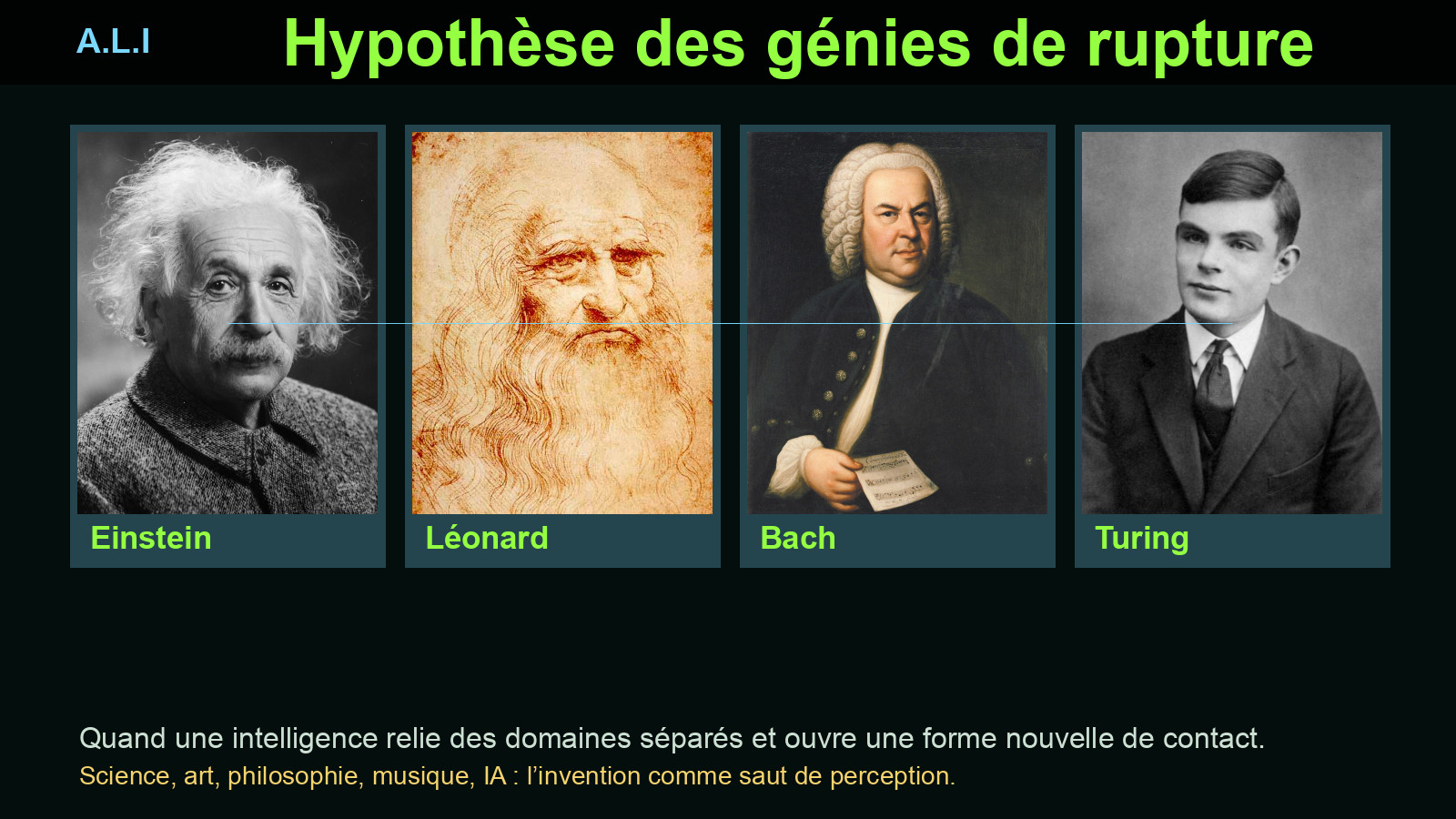
Such figures are often called “geniuses”. The word is dangerous when it turns a collective history into an individual legend. Einstein did not arise outside Maxwell, Lorentz, Poincaré, Mach and the instruments of his time. Leonardo da Vinci belonged to Renaissance workshops, courts, wars and engineers. Bach synthesised European contrapuntal traditions. Turing emerged from the logic of Hilbert, Gödel and Church, and from the historical urgency of computation. Yet something did happen through them: a radical recomposition that altered the whole field.
A.L.I proposes the term rupture intelligence: not the intelligence that accumulates the most information, but the intelligence that discovers an unlikely connection and suddenly makes a new field of action visible. The question then becomes: will solutions to interstellar contact emerge from such a leap, from an unexpected junction between domains that currently seem incompatible?
1. Genius as a point of condensation
Genius is not only an exceptional person. It is also a point of historical condensation. An era accumulates techniques, dead ends, intuitions and badly formulated problems. Then a form appears that gives this set a new coherence. This form may be a theory, an artwork, an instrument, a writing system, an institution or even a gesture.
For Kant, artistic genius gives rules to art without being able to fully explain those rules beforehand. Works of genius become exemplary because they invent their own mode of readability. This remains useful for A.L.I: a language of contact may not be deduced from an existing code. It may have to invent the very conditions under which it can be recognised.
The sociology of science has displaced the heroic narrative. Thomas Kuhn showed that scientific revolutions are not mere progressive corrections but paradigm shifts: the community no longer looks at exactly the same world. Bruno Latour insisted on the networks of instruments, inscriptions, laboratories and actors that make discovery possible. Genius is therefore less an isolated source than a node where relations are reconfigured.
2. Leonardo da Vinci: seeing the living as machine and the machine as living
Leonardo da Vinci fascinates because he crosses boundaries: painting, anatomy, hydraulics, optics, mechanics, architecture, cartography and theatrical design. His notebooks show a thought that draws in order to understand. He does not separate eye from hand, form from experiment, artist from engineer.
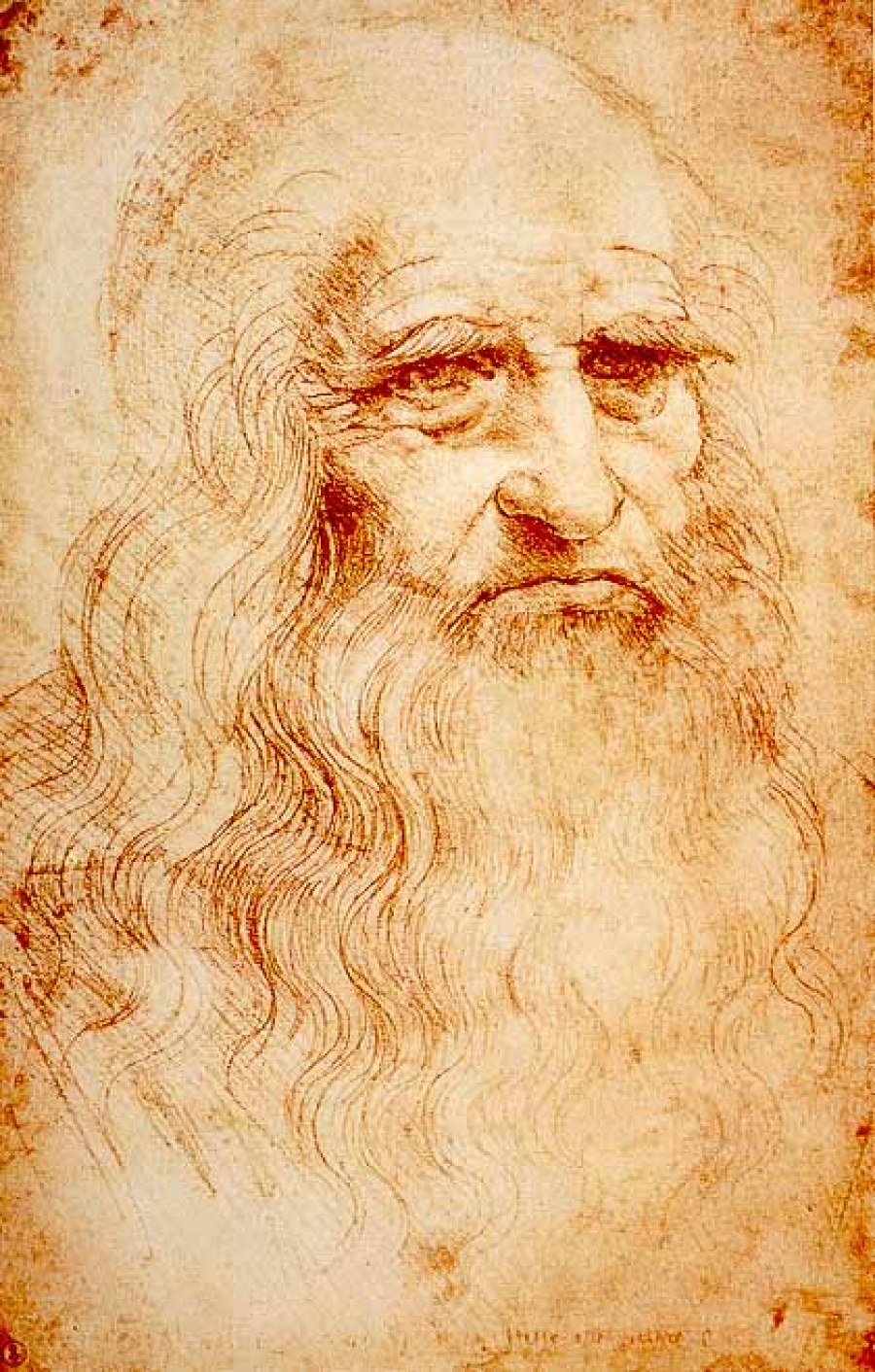
His rupture lies in a method: seeing a vortex of water as hair, a muscle as a cable system, the flight of a bird as mechanics, the human face as mobile geometry. He produces operational analogies. Analogies are not merely poetic images; they transfer a problem from one domain to another.
3. Bach: music as an architecture of time
Johann Sebastian Bach did not invent counterpoint, but he gave it a form of totalisation. In The Art of Fugue, the motif becomes a transformable being: inversion, augmentation, diminution, superposition, mirror, canon. Music becomes a system of relations in which time can turn back upon itself.
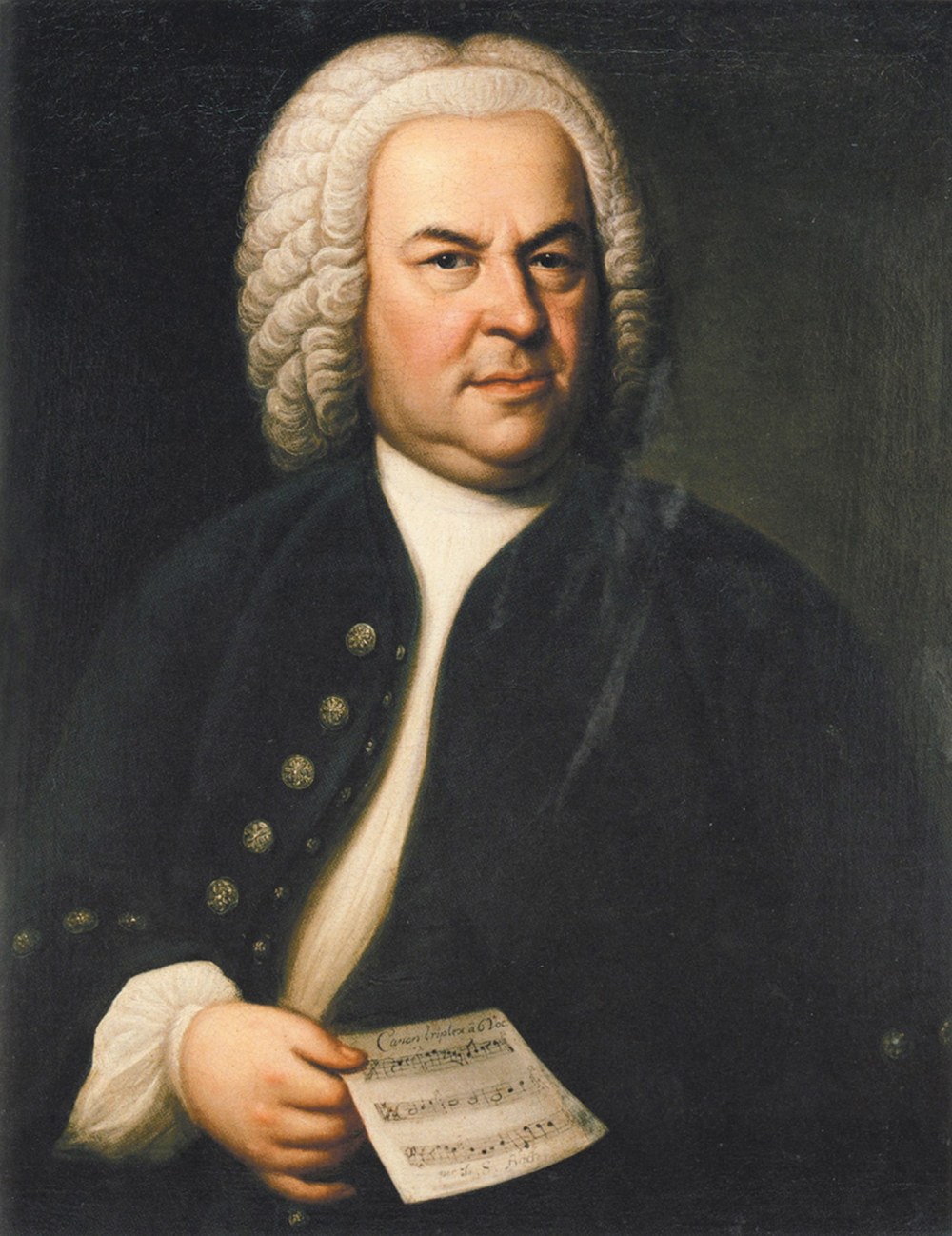
Bach matters to A.L.I because he shows that intelligence may be structural before it is narrative. A fugue does not explain an idea; it makes it work. It shows how minimal information can generate a complex world. This economy is close to interstellar questions: how can one send little, yet enough for the other to reconstruct much?
4. Einstein: changing the frame rather than filling it
Einstein does not merely add one equation to classical physics. He changes the relations between space, time, light, observer and gravitation. His power lies in a conceptual operation: shifting the problem from objects to the frame that makes objects measurable.
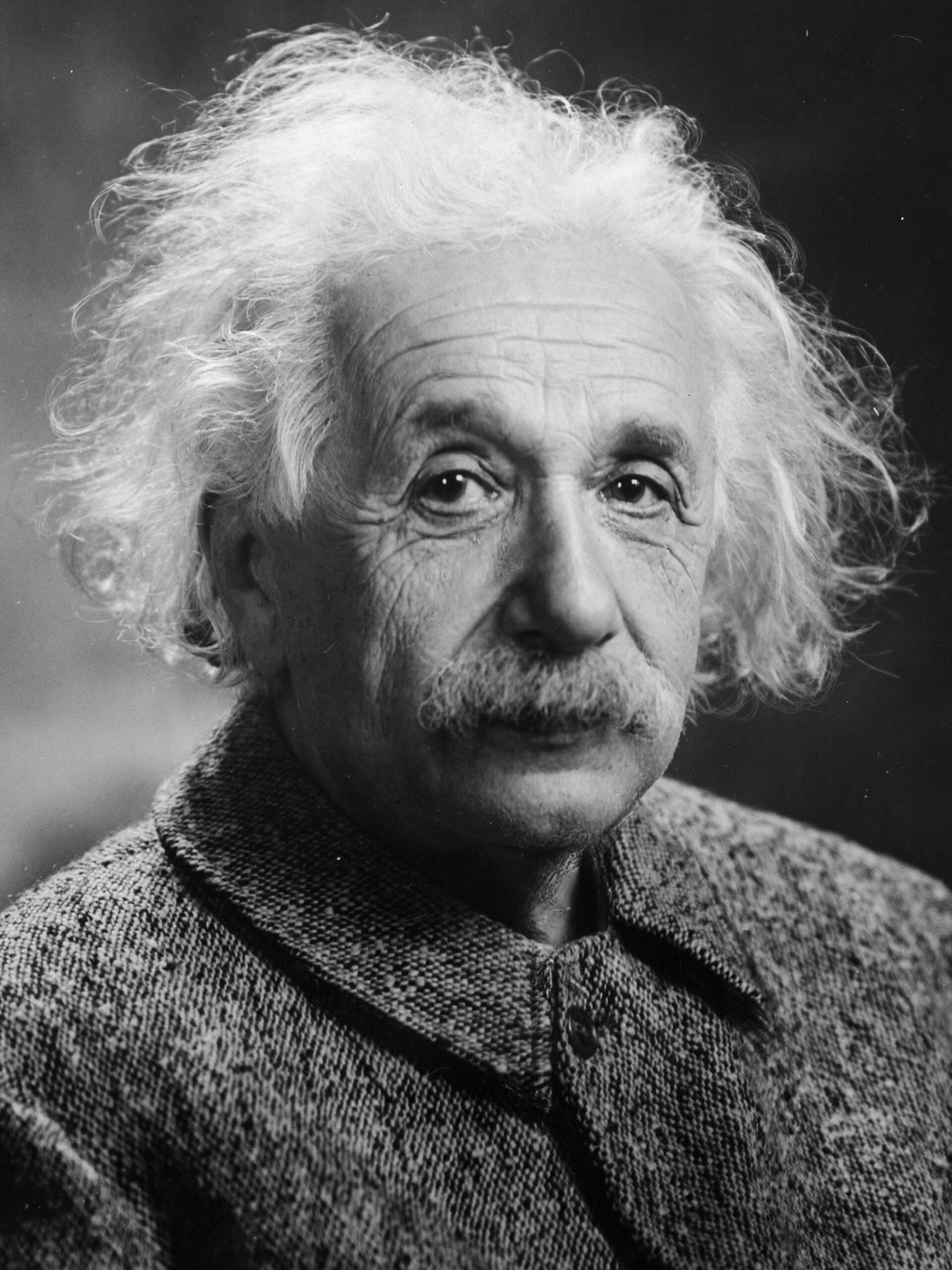
For A.L.I, Einstein sets a demanding question: if we receive no message, perhaps we are searching within the wrong frame. We expect a sentence when the message may be a physical constraint; an emitter when the signal may be distributed; a translation when our definition of sign must be changed.
5. Turing: from logic to artificial life
Alan Turing connects several worlds: mathematical logic, computation, cryptanalysis, machinery and morphogenesis. His abstract machine simplifies the act of calculation until it becomes a general model. His later work on machine intelligence shifts the question “can a machine think?” toward an interactional device. His work on morphogenesis shows how biological patterns can arise from simple chemical relations.
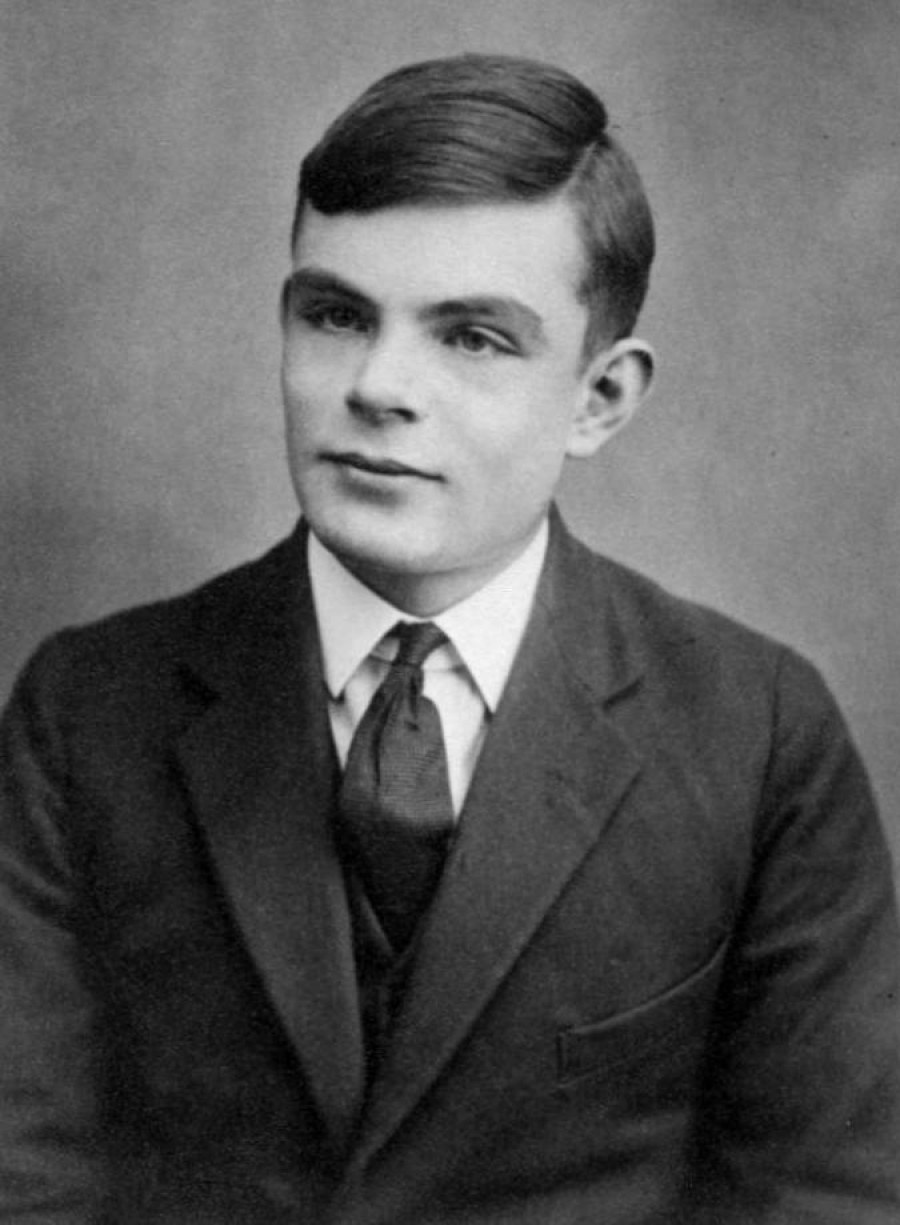
Turing is decisive for A.L.I because he suggests that communication can be thought of as procedure. A sign is not only content; it is an operation on a state. Understanding an extraterrestrial message might mean finding the abstract machine capable of producing, recognising or extending it.
6. Other ruptures: Darwin, Gödel, Duchamp, Lovelace
Darwin connects geology, breeding, economics, travel, classification and deep time. Life ceases to be a collection of fixed essences and becomes historical transformation. Gödel shows that a sufficiently powerful formal system cannot contain everything about itself; a logical limit becomes a metaphysical event. Duchamp, through the readymade, shifts art from the object to the act of designation and context. Ada Lovelace understands that Babbage's Analytical Engine could manipulate more than numbers, opening a symbolic intuition of computation.
In each case, a rupture is also a migration: a concept leaves its original domain and reconfigures another. Selection becomes a general model of transformation; incompleteness becomes a philosophical question; the industrial object becomes art; computation becomes a universal manipulation of forms.
7. Hypothesis: intelligence evolves through thresholds of recombination
The hypothesis can be stated as follows: in the evolution of intelligence, certain stages appear when previously separated domains suddenly become connectable. Human language connected memory, gesture, voice and the collective. Writing connected speech, space and long duration. Mathematics connected perception, abstraction and proof. Computing connected logic, machine and symbol. AI now connects text, image, sound, code and probability.
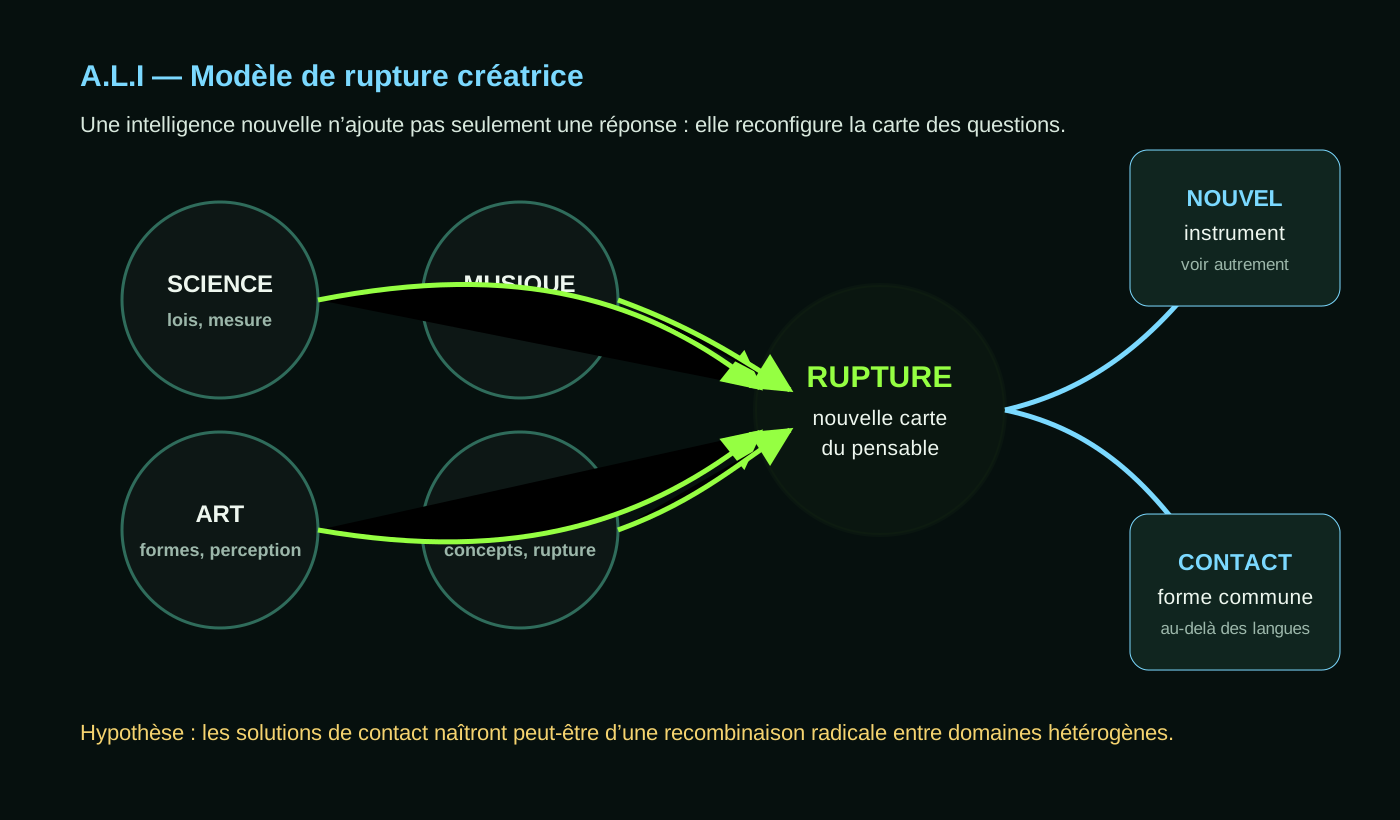
Each threshold expands what an intelligence can manipulate, but each also creates new blindness. Writing stabilises but freezes. Calculation accelerates but reduces. AI associates but can homogenise. The next rupture may not consist in becoming faster, but in connecting differently: body and cosmos, language and matter, consciousness and instrument, living systems and machines, human and non-human.
8. Application to A.L.I: seeking collective geniuses of contact
Interstellar contact will probably not be solved by a single discipline. Radio astronomy can detect signals but cannot by itself produce meaning. Linguistics describes human languages but guarantees little for an intelligence without mouth, hand or linear time. Mathematics offers invariants but may ignore the receiver's biology. Art opens forms but must be held by protocols. AI compares and generates but must be supervised.
A.L.I can therefore seek not an individual genius but a collective genius of rupture: a device in which artists, astronomers, linguists, philosophers, ethologists, coders, musicians, biologists and publics create unexpected connections. The aim is not to mix everything, but to create the right interfaces between domains.
A contact solution may take the form of a hybrid: a luminous fugue based on exoplanets, a grammar derived from animal behaviour, an archive conceived as an organism, a radio instrument translated into mental imagery, an AI trained not to speak humanly but to detect transmodal invariants.
9. Possible experiments
- Atlas of ruptures: map inventions that connected previously separated domains and search for their common structures.
- Laboratory of controlled analogies: ask several groups to translate the same phenomenon into music, geometry, gesture, code and narrative, then measure what remains stable.
- Paradigm machine: build an application that takes an A.L.I problem and deliberately proposes analogies from remote fields: botany, counterpoint, cryptography, theatre, celestial mechanics.
- Orchestra of contact: give each discipline a precise role in a shared protocol: detecting, transforming, interpreting, falsifying, imagining, transmitting.
10. Caution: rupture is not always progress
A rupture can liberate, but it can also destroy. Nuclear energy connects fundamental physics, industry and war. Digital platforms connect humans while capturing attention. AI increases productive capacity while blurring the origin of forms. Rupture intelligence therefore requires an ethics of rupture: what does it make possible, for whom, with which risks and which irreversible effects?
For A.L.I, contact must not be imagined only as a technical feat. A language capable of crossing worlds may transform the societies that receive it. The question is not only: can we speak? It is also: what will we become if a new form of speech appears?
Conclusion: finding the missing form
Great rupture intelligences did not merely add a work or theory to the world. They altered how the world could be seen, heard, measured and inhabited. They found a missing form.
The A.L.I hypothesis is that interstellar contact will require a rupture of the same kind. We should not only wait for the right signal; we must invent the form of thought capable of recognising it. Perhaps the language of contact will emerge when we finally connect domains we thought separate: wave and poem, machine and life, number and emotion, sky and body, science and imagination.
The genius of contact may not be a person. It may be a situation: a workshop in which several intelligences, human and artificial, learn to produce together the rupture that makes the other readable.
References and further reading
- Stanford Encyclopedia of Philosophy, Kant’s aesthetics and genius.
- Thomas S. Kuhn, The Structure of Scientific Revolutions.
- Bruno Latour, We Have Never Been Modern.
- Stanford Encyclopedia of Philosophy, Einstein’s philosophy of science.
- British Library, Leonardo da Vinci.
- Encyclopaedia Britannica, Johann Sebastian Bach.
- The Alan Turing Internet Scrapbook.
- British Library, Ada Lovelace.