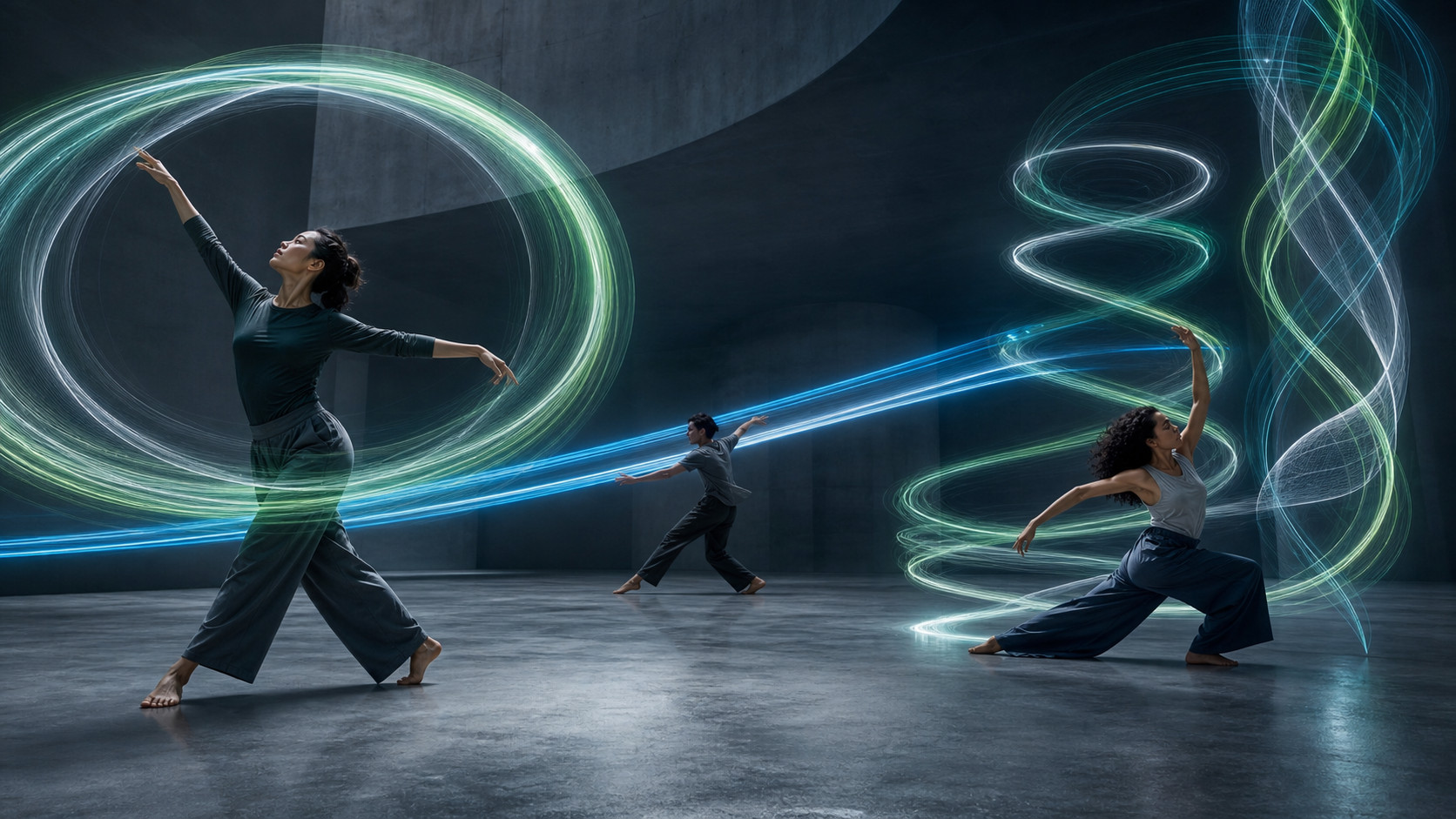
What if the space around us were not merely a volume to cross, but a three-dimensional writing surface? Raising an arm would trace a line. Drawing a circle with the hand would deposit a loop. A walk, a turn of the torso, a pause or an acceleration would become successive signs in an invisible sentence. The body would no longer stand in front of the page: it would be the brush, the ink and part of the reader.
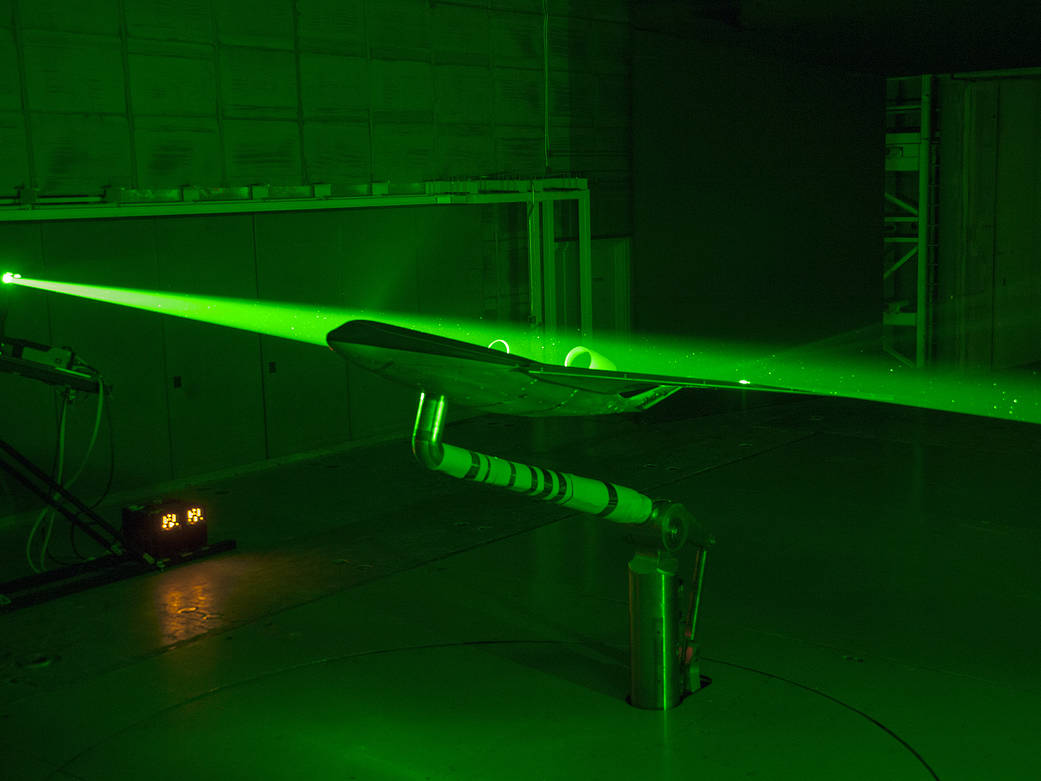
This hypothesis treats air as a medium of inscription. The word “ether” can serve here as an artistic metaphor, provided it is not confused with the luminiferous ether discarded by modern physics. Air is a fluid material: movement produces displacements, vortices and changes in pressure and temperature. These traces dissipate quickly, yet particle image velocimetry and schlieren imaging can reveal part of them. Depth cameras and motion-capture systems can record their geometry. Spatial writing begins where these two realities meet: the fleeting physical trace and its technical memory.
A long history of writing movement
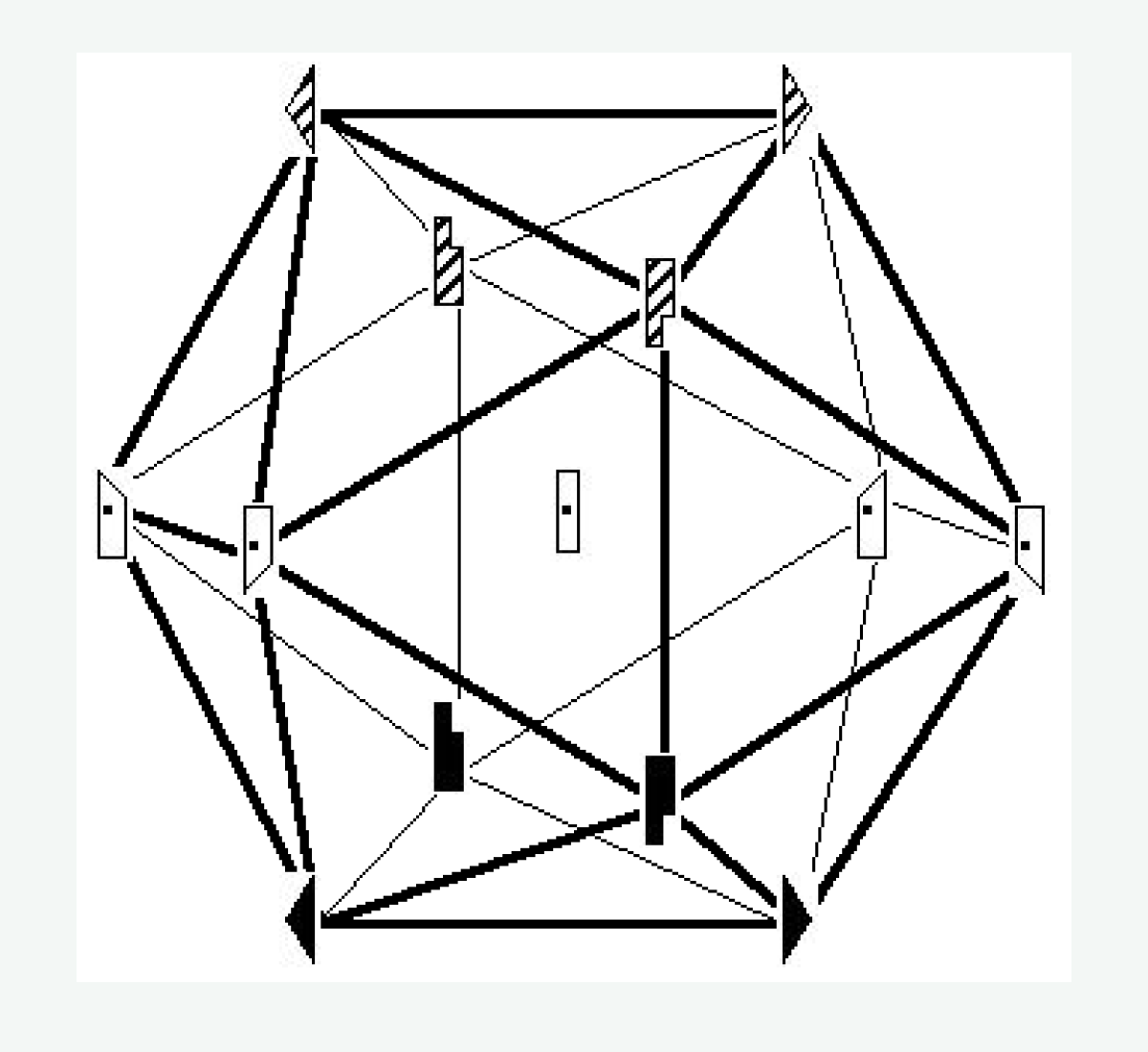
Dance has tried for centuries to preserve what disappears at the moment it happens. Beauchamp–Feuillet notation mapped dancers’ floor paths from above; the floor became a score. In the twentieth century, Rudolf Laban expanded the idea. Labanotation encoded direction, duration, level and body part. Choreutics studied movement through the kinesphere, often represented by an icosahedron surrounding the body, while Eukinetics treated weight, time and flow as meaningful qualities.
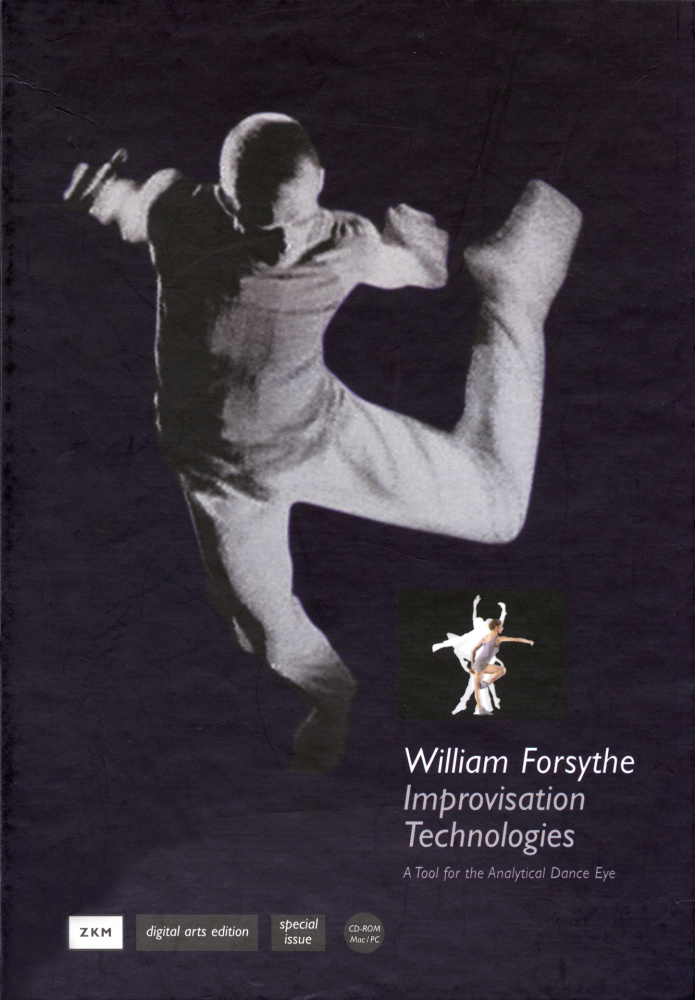
Spatial writing reappears in major works. In Trisha Brown’s Roof Piece (1971), movement is relayed from dancer to dancer across New York rooftops: the city becomes a channel, and each body rewrites what it has received. In William Forsythe’s Improvisation Technologies, animated lines extend the limbs and reveal a latent drawing in space. Merce Cunningham used LifeForms to compose choreography in a three-dimensional environment before embodiment.
Contact Improvisation, initiated in part by Steve Paxton, introduces another essential dimension: meaning emerges between bodies. Weight, gravity, inertia, support and imbalance form a shared vocabulary. No one produces the movement alone; each participant continually responds to what the other makes possible.
The spatial glyph hypothesis
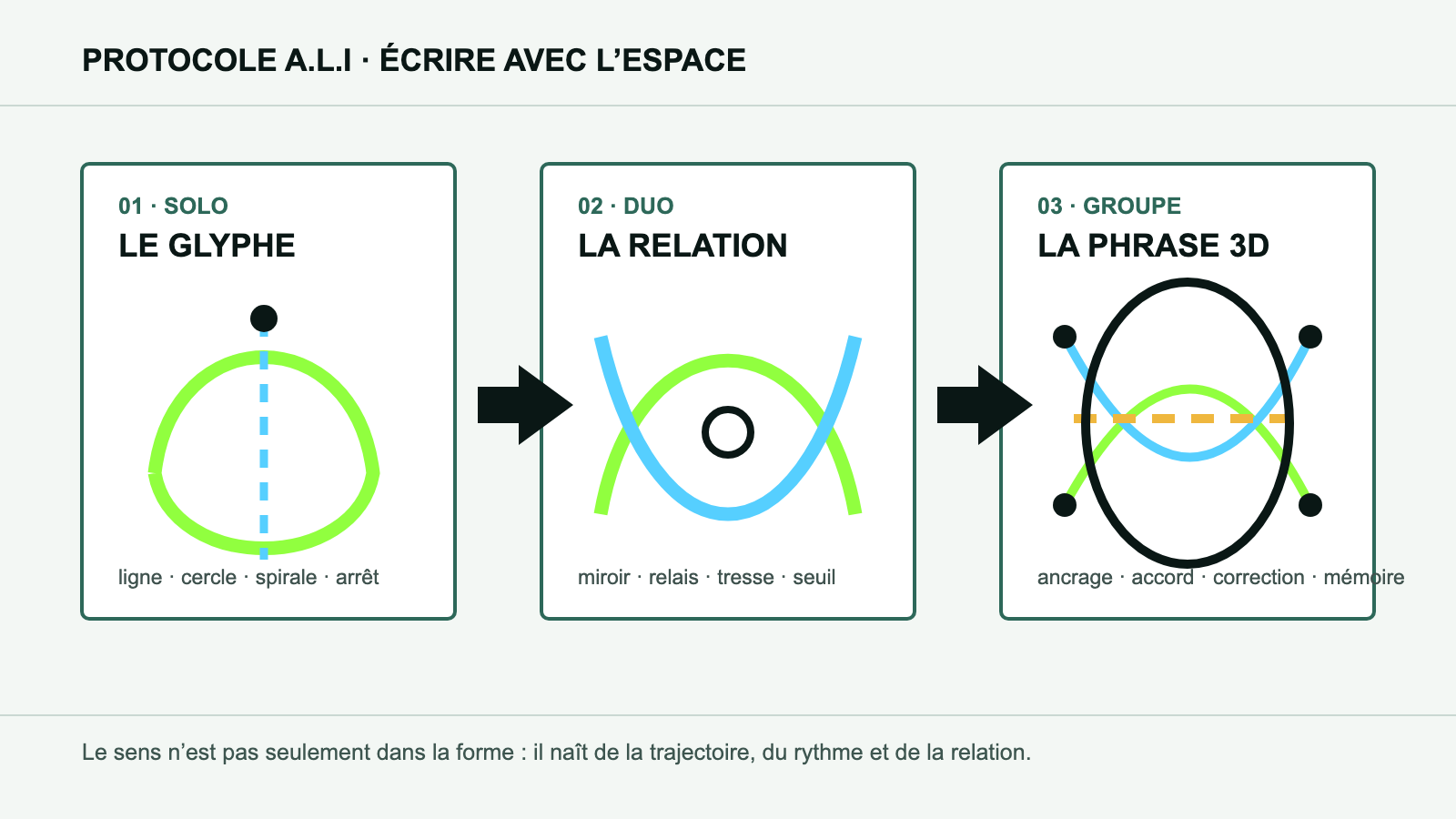
A.L.I proposes the term spatial glyph for a unit of movement structured enough to be recognized and replayed. It would not be defined by a single outline, but by a set of parameters:
G = (trajectory, orientation, speed, duration, body segment, intensity, relation).
A slow loop drawn by the index finger would not be identical to the same loop rapidly drawn by the torso. The former might be a letter, the latter an accent, an emotion, a negation or an instruction. Geometry and temporality would be inseparable.
First level: the body as alphabet
An initial alphabet could use a few simple invariants: line, circle, spiral, crossing, interruption, closure, return and reversal. It would not mime existing letters. A line might announce direction; a circle, repetition or totality; a crossing, encounter; a cut, an ending or doubt. Speed could indicate force, repetition could indicate persistence, and height could indicate register.
The system must not mistake human anatomy for a universal measure. A wheelchair, cane, gaze, prosthesis, robot, drone or animal should be able to produce equivalents. The useful unit is therefore not “raise the right arm” but “trace a continuous, oriented and reversible ascent.” A language becomes portable when it describes relations rather than organs.
Second level: two people write a third text
With two bodies, meaning resides in the interval connecting them. Five operations could form an early grammar:
- mirror: repeat a shape through reversal;
- relay: continue precisely where the other stops;
- braid: intertwine two paths without collision;
- erasure: cross a trace to cancel or correct it;
- threshold: two complementary gestures jointly open a sequence unavailable to either person alone.
The threshold is a bodily key. Like cryptography, it exists only when trajectories, rhythms and orientations coincide. It might trigger an image, sound, data stream or luminous passage. Understanding the message would mean being able to perform its form.
Third level: the group as a three-dimensional sentence
In a group, participants can carry grammatical functions. Some become anchors that stabilize coordinates; others transport motifs; others repeat them to correct errors. The sentence is no longer linear. It becomes a temporary volume crossed by trajectories, synchronizations and deviations.
This community produces a distributed writing brain. The message emerges from negotiation. Local hesitation can become collective punctuation; repeated error, a mutation in vocabulary; unexpected synchronization, a new sign. The intelligence of language lies in the network of relations rather than a central author.
Recent research suggests that shared attention during live performance can synchronize some aspects of spectators’ brain activity. This is not evidence of telepathy; it shows that a common event can physiologically organize a group. See the University College London study. In spatial writing, readers belong to the apparatus: their position, attention and ability to replay a gesture shape what can be understood.
The invisible trace and the grammar of disappearance
A trace in air does not last. What appears to be a weakness can become a grammatical property. A sign may have a time to live: while it persists, it remains active; when it fades, it becomes past. Dissipation can encode doubt, urgency, forgetting or temporary permission. A spatial sentence would possess a memory that pales instead of simply being present or absent.
Three layers may coexist: the very brief physical trace in air; the perceptual trace held for a few seconds in the reader’s body; and the digital trace recorded by sensors. An installation need not retain everything. It could progressively erase its data so that the archive respects the temporality of gesture rather than turning every movement into permanent surveillance.
From positioning GPS to writing GPS
Conventional GPS tells us where we are. A writing GPS would reveal what our displacement inscribes and what the space allows us to read. A series of steps might become a sentence; a path through a city might open a narrative; a precise gesture performed at the right place and time might act as a key.
The system would not merely guide a person toward a destination. It would offer a syntax of movement: cross this line, orbit this point, wait for a second body, then close the loop. The map becomes a score and the journey a performed reading.
The fourth dimension: time makes the sign legible
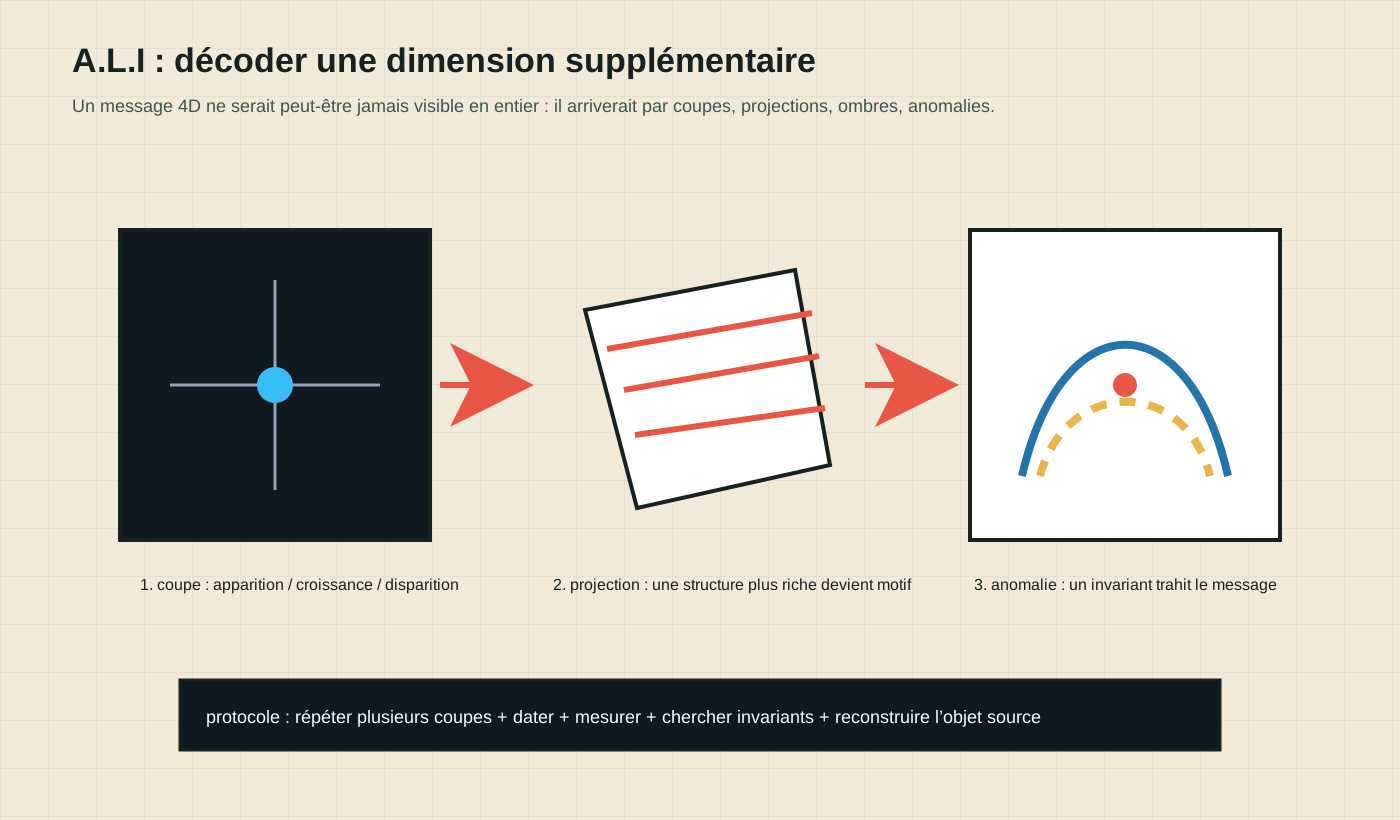
A gesture is already a four-dimensional object: a trajectory through three spatial dimensions unfolding in time. Seen at one instant, the circle does not yet exist; successive positions must be remembered before it can be recognized. The fourth dimension is not decoration here but the condition of reading.
A reader able to perceive an entire trajectory at once might see our dances as we see a printed sentence. Conversely, a message from an intelligence that structures several times simultaneously might appear to us as disconnected events. The A.L.I challenge would be to build instruments capable of recomposing these fragments into manipulable temporal objects.
A feasible experimental protocol
- Capture. A depth camera or body tracker turns joints into 3D points. Particle or light-sheet visualization occasionally reveals the wake in air.
- Inscription. Trajectories are drawn volumetrically in Three.js or WebXR. Their brightness decreases according to an adjustable lifetime.
- Alphabet. A small group learns ten glyphs across different bodies and speeds.
- Blind transmission. One person encodes a sentence without speech; another observes the trace, then tries to replay and interpret it.
- Duet key. Two participants must perform a complementary figure to trigger sound, image or a luminous passage.
- Collective sentence. A group constructs a form no single person can make, testing its resistance to error, absence and changes of scale.
- Non-human test. The same rules are translated to a robot, drone or lighting system to determine whether meaning depends on topological relations rather than human anatomy.
Hypotheses for A.L.I
1. Reading would be participation. A recipient could not understand without moving. Decoding would become choreography rather than passive observation.
2. Relation would become an autonomous channel. Two participants would create a third text that neither authored alone. At group scale, it might develop its own complexity and memory.
3. Forgetting would belong to the code. The disappearance of traces would become a sign. A language could say “now,” “again,” “never again” or “until someone responds” through the way it fades.
4. The body would become cryptography. An exact sequence of positions, speeds and relations could unlock content. The key would be neither a word nor a number, but an embodied action.
5. Spatial invariants might cross species. Continuity, symmetry, periodicity, linkage, knots, orientation and reversal do not guarantee a universal language, but they offer testable forms that assume neither a human voice nor a terrestrial alphabet.
Toward inhabitable writing
Spatial writing turns a simple intuition into a research programme: our movements already produce forms, but we do not yet treat them as sentences. By making them visible, transmissible, replayable and progressively erasable, we can build a language in which the body writes in the world instead of on a separate support.
For A.L.I, this produces a decisive reversal. An extraterrestrial message might not be an object placed before us, but a way of occupying volume, organizing distances, circulating bodies and distributing time. First contact might begin not with “What do you mean?” but with an invitation: show us how to enter your sentence.
References and further reading
- Centre national de la danse — Movement writings
- Laban/Bartenieff Institute — Laban Movement Analysis
- Centre Pompidou — Trisha Brown, Roof Piece
- ZKM — William Forsythe, Improvisation Technologies
- Merce Cunningham Trust — choreography and LifeForms
- Contact Quarterly — What is Contact Improvisation?
- NASA Glenn — flow-field diagnostics