Imagine a very simple shot. A person walks across a room. Behind them, a screen is playing another film. We then slow the entire shot: the body becomes heavy, a glass takes several seconds to fall and every gesture appears to float. Yet the second film, inside the screen embedded in the image, continues at normal speed. It speaks, cuts, breathes and moves as if the slowing of the outer world did not concern it.
This result requires no violation of physics. It only requires two speeds to be prepared before shooting. But it creates a powerful conceptual situation: one image can contain two simultaneous temporal regimes. The screen no longer shows only another space; it becomes a window into another time.
1. Cinema does not record time: it samples it
A camera does not capture continuous motion. It takes a sequence of separate images, each attached to an instant. Projection then turns that discontinuity back into perceived continuity. From its beginning, cinema has been a machine for cutting and reconstructing time.
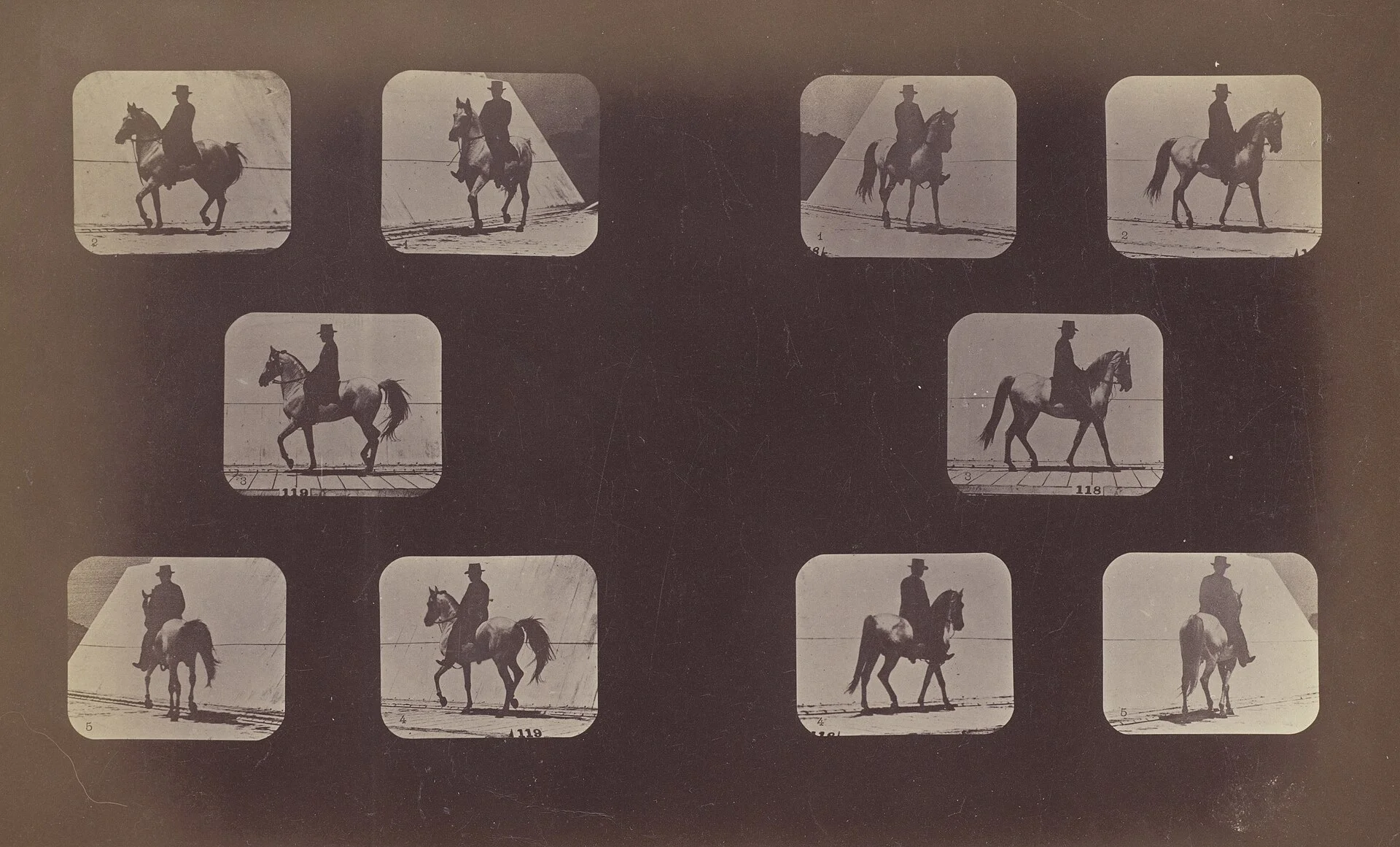
The work of Étienne-Jules Marey and Eadweard Muybridge made phases of motion visible that were too fast for the eye. Marey used chronophotography as a scientific method; his devices isolated the transformations of a walking body, a wing or a flow. Cinematic slow motion extends that gesture: more images are captured during one real second and are then displayed more slowly.
2. The calculation
The slowdown factor is the ratio between capture rate and projection rate:
S = capture frame rate / projection frame rate
If the outer shot is captured at 150 frames per second and played at 30, S equals 5. One second on set becomes five seconds on screen. For the inner film to appear normal after this transformation, it must therefore play five times faster during shooting.
| Element | During capture | After 30 fps projection |
|---|---|---|
| Outer world | speed ×1, captured at 150 fps | speed ×0.2 |
| Film inside the screen | speed ×5 | speed ×1 |
| Desired inner duration | 20 seconds compressed into 4 | 20 normal seconds |
The general relation is straightforward: if the inner content should last T in the result, it must be compressed to T/S during shooting. A twenty-second inner film therefore becomes a four-second signal when S = 5.
3. Test film: two speeds in one shot
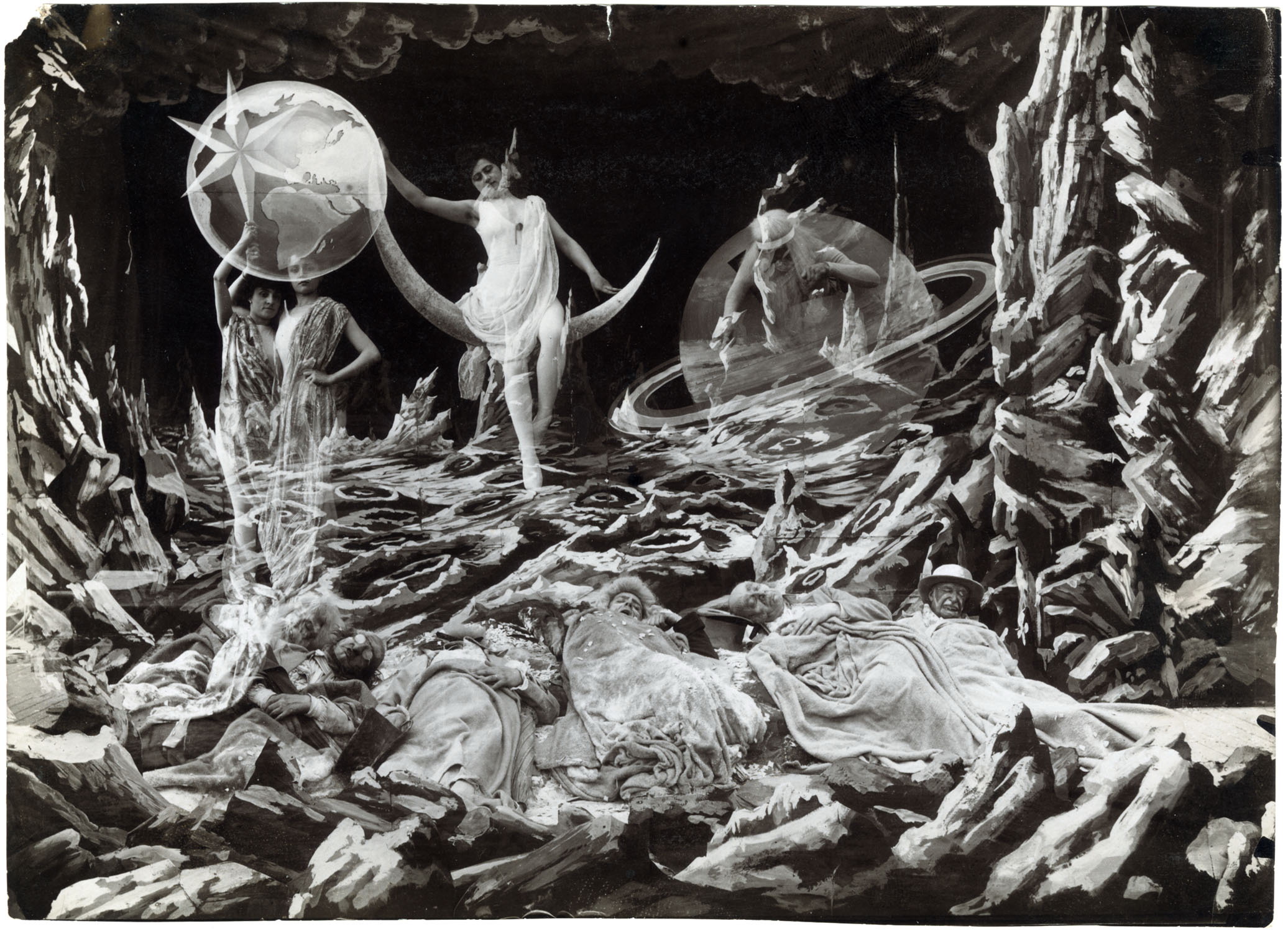
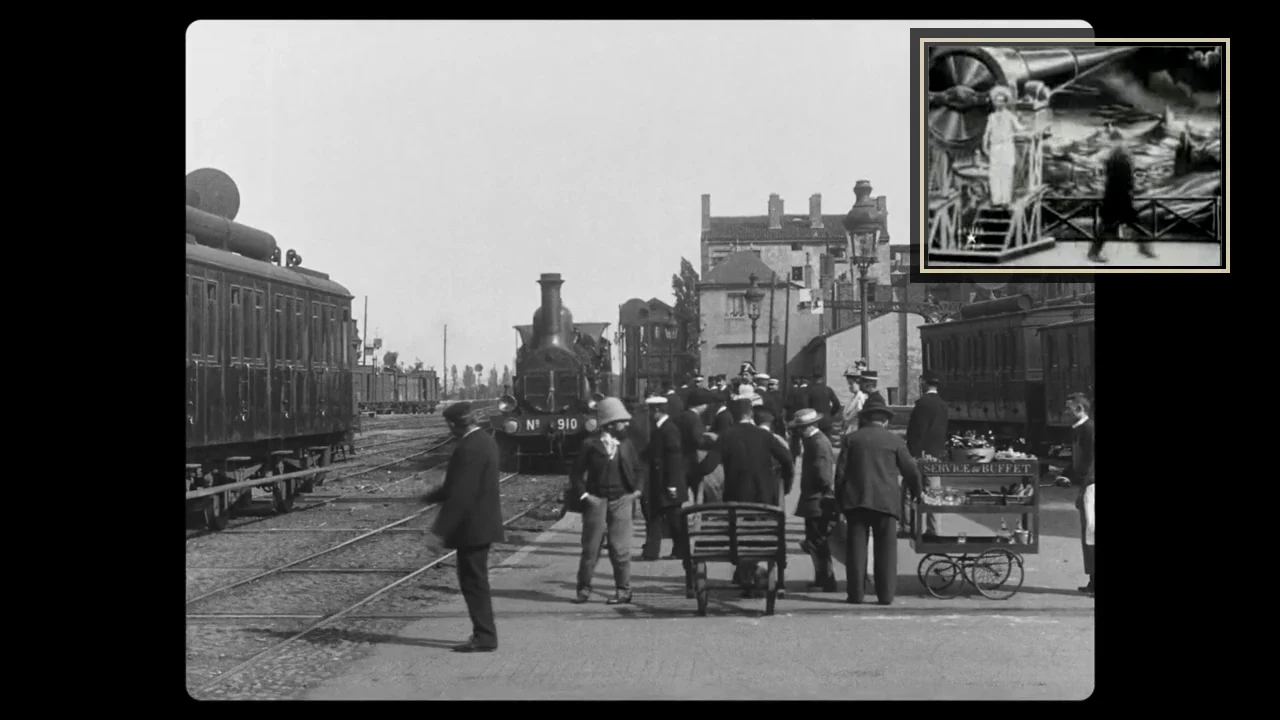
The sequence below uses actual film images. The outer world comes from a train-arrival film produced by the Lumière Company in 1896. The screen embedded in the shot plays twenty seconds from Georges Méliès's public-domain A Trip to the Moon, compressed into four seconds.
The composite contains 600 source frames at 150 fps. The first playback keeps the four-second shooting duration: Méliès runs five times too fast inside the Lumière world. The second re-times exactly the same 600 images at 30 fps and lasts twenty seconds. The travellers and train slow fivefold while Méliès's spacecraft returns to its natural pace.
4. A temporal window rather than a screen
In ordinary film fiction, a screen within the screen belongs to the same present as the characters. A news broadcast, surveillance feed or video call may be delayed, but its playback speed is generally aligned with that of the shot. Here, the embedded screen has an autonomous clock.
This creates a strange dissociation. The outer world may be almost still while an interlocutor continues to live normally inside the image. To the inner figure, the outside spectators would be statues. To the slowed characters, the inner film might resemble accelerated thought, a voice from a denser time, or an intelligence capable of calculating during their immobility.
5. Nested screens and the explosion of speeds
Add a third film inside the second screen. If every level must return to normal speed after the containing level is slowed, the factors multiply:
| Level | Required capture speed when S = 5 |
|---|---|
| Filmed world | ×1 |
| First screen | ×5 |
| Screen within the screen | ×25 |
| Third depth | ×125 |
The formula becomes Sn. Very quickly, the frequencies exceed the capacities of displays, cameras and perception. That technical limit is also an idea: the deeper a message comes from within a temporal hierarchy, the more compressed it must be to reach us. What we receive as an impulse could contain a long sequence in its own frame of reference.
6. Can a compressed future be received?
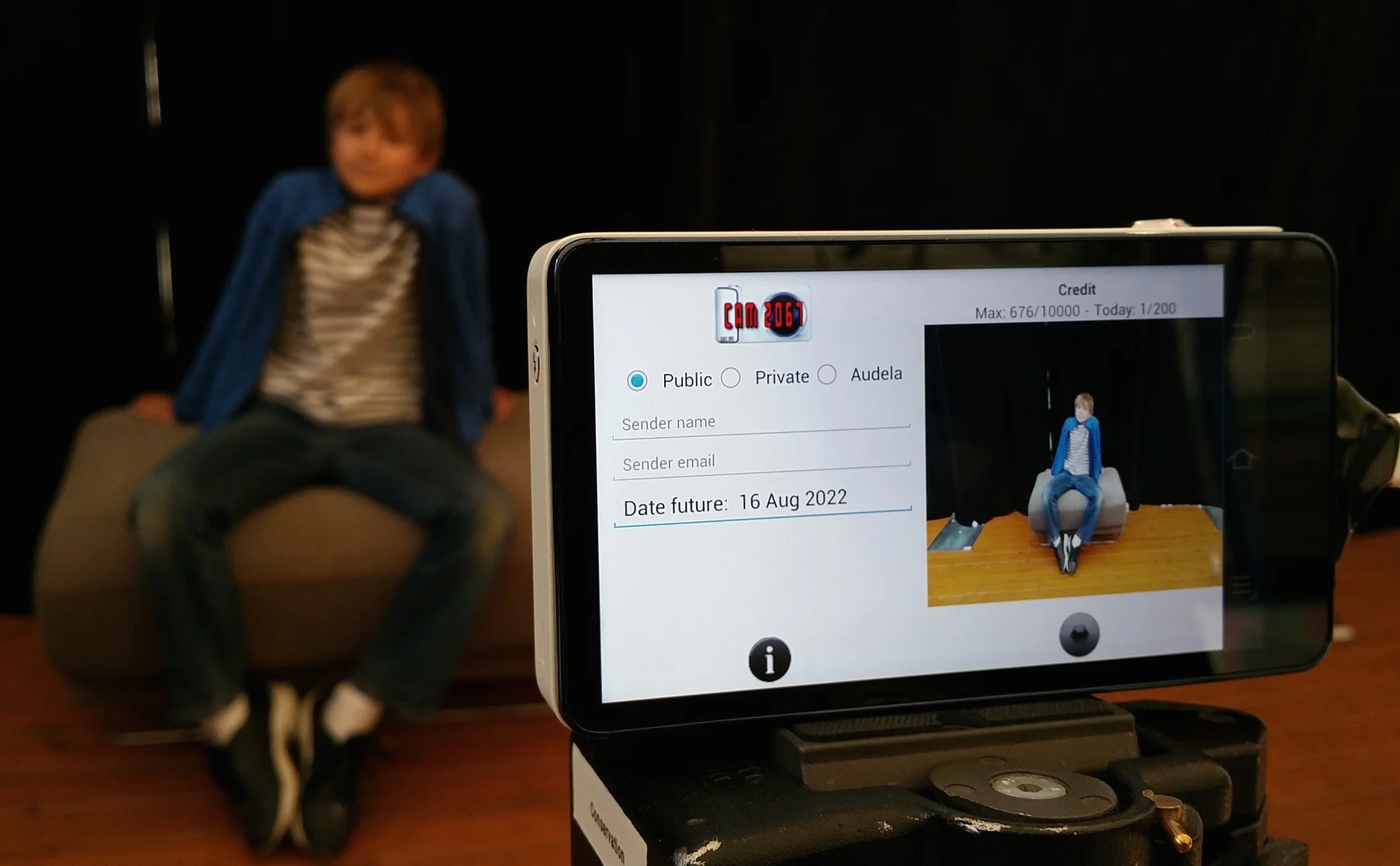
The inner screen does not literally travel into the future; its content was prepared in advance. Yet the device displays a disturbing asymmetry: while four seconds pass on set, twenty seconds of information cross the screen. Slowdown unfolds that information again.
The accelerated film can be understood as a temporally compressed archive, with slowdown acting as decoder. We already do something similar with signals: audio may be slowed, a radio spectrum stretched and a pulse analysed at multiple scales. Speed change creates no information, but it can make a structure readable when it was previously too fast or too slow.
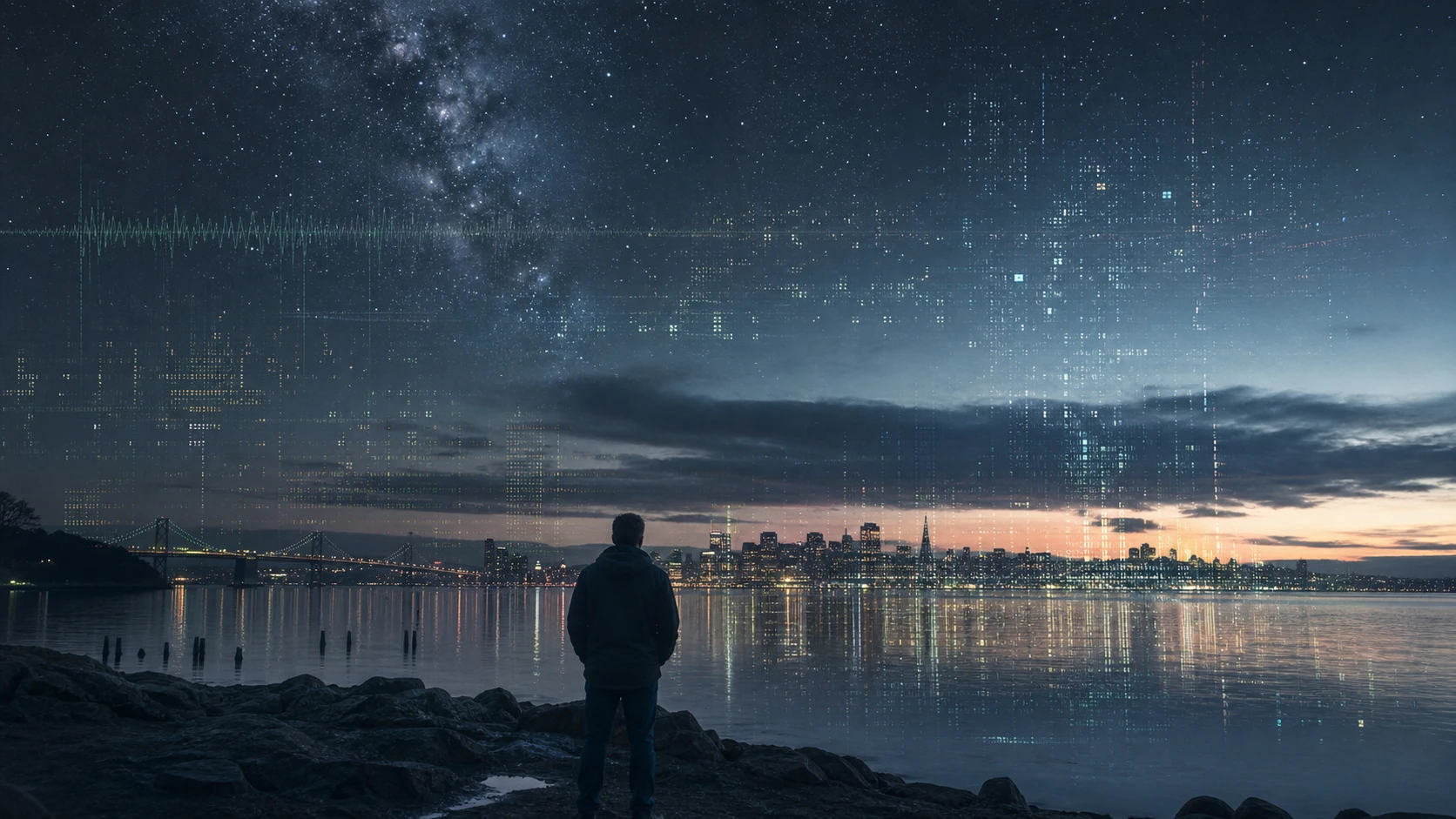
This leads directly to A.L.I: are we searching for extraterrestrial messages at the right speed? An intelligence operating in microseconds might compress entire sentences into what we classify as a click. A geological organism might form one utterance across centuries. The problem would not only be translating signs, but discovering the temporal unit in which they become signs.
7. Sound immediately exposes the device
Slowing an audio track lowers its pitch and stretches every articulation. For an inner voice to remain natural, it too must be accelerated during shooting or replaced later. Modern algorithms can change duration without changing pitch, but their artefacts remind us that speed, timbre and intelligibility are linked.
An installation could expose this difference. The outer world would produce deep, extended, nearly tectonic sound, while the inner screen retains a precise voice. The two soundtracks would make the superposition of temporalities physically perceptible.
8. Artistic precedents: sculpting, synchronising, stretching
Cinema and video art have repeatedly worked on duration. Douglas Gordon stretches Hitchcock's film to twenty-four hours in 24 Hour Psycho, turning suspense into matter, interval and memory. Christian Marclay's The Clock assembles twenty-four hours of film fragments synchronised with real time, making the screen a collective clock.
Inception gives dream levels different speeds, with each depth further dilating duration. Interstellar turns gravity into temporal disagreement between those who leave and those who wait. Arrival imagines circular writing whose complete form seems to contain the beginning and end of the statement. These works do not implement this protocol, but they show how changing time transforms communication, memory and responsibility.
9. Material limits
- Display refresh: a 60 Hz screen cannot cleanly show arbitrarily accelerated content; high-frequency LED panels or direct signal generation provide more room.
- Shutter and flicker: camera and display must be synchronised or bands, beats and missing images appear.
- Rolling shutter: many sensors read line by line, allowing a fast display to deform within one frame.
- Light: high-speed capture reduces exposure time and demands more illumination.
- Sound: a decision must be made about whether sound belongs to outer time, inner time, or both.
These defects can become expressive. Interference between frequencies produces temporal moiré. Bad synchronisation is no longer merely an error; it reveals the conflict between two clocks.
10. Three A.L.I extensions
The Temporal Transcoder
A program receives an unknown signal and replays it simultaneously at hundreds of speeds. It searches for scales where repetitions, grammars, images, non-random distributions or responses to stimulation appear. The interface asks not only “what does this signal mean?” but “at what duration does it begin to mean?”
The Room of Foreign Clocks
Several screens display the same event with factors from ×0.001 to ×1000. Visitors move between worlds where a breath becomes a landscape, plant growth becomes a gesture and a flash contains a conversation. Each display has a soundtrack adapted to its temporality.
The Nested Message
One message contains another and then another. Each level becomes readable only after a precise temporal transformation. The receiver must discover the sequence of factors as a combination. Rhythm becomes content, decoding key and evidence that the signal was constructed.
11. Hypothesis: time may be the first alphabet
Before recognising a letter, one must know where it begins and ends. Before hearing a word, variations must be grouped inside a window of duration. Every communication therefore assumes temporal segmentation, even when presented as a still image. An intelligence that does not sample the world at our rhythm will probably not divide it into the same units.
The temporal screen hypothesis therefore proposes something larger than its cinematic trick: a message may be invisible not because it is too weak, but because its speed places it outside our perceptual present. Searching for another intelligence would require not only dictionaries of forms but instruments capable of moving the boundary of now.
Sources and further reading
- Science Museum Group, Étienne-Jules Marey's chronophotographic camera.
- Library of Congress, Eadweard Muybridge, Animal Locomotion.
- British Film Institute, Christian Marclay's The Clock.
- FFmpeg documentation, frame rate and timestamp processing.
- Henri Bergson, Time and Free Will.
- Lumière Company, Arrivée d’un train à Perrache, 1896, public-domain film.
- Georges Méliès, A Trip to the Moon, 1902, public-domain film.