Before speaking a language, an intelligence inhabits a world. It does not receive “reality” as a single block: it selects certain intensities, rhythms, forms, smells, pressures and fields. The notion of Umwelt, formulated by Jakob von Uexküll, names this proper world: the environment as it exists for a given organism through its organs, needs, possible actions and relevant signs.
For A.L.I, this notion is crucial: interstellar contact would not only be a problem of vocabulary. It would first be a problem of perceptual milieu. If an extraterrestrial intelligence does not see as we do, hear as we do, divide time as we do, or share our bodily and chemical scale, then the first act of translation is to understand what kind of world it inhabits.
1. Uexküll: the world is not the same for everyone
Jakob von Uexküll, biologist and theorist of life, proposed a simple and disruptive idea: each being lives in a world of signs proper to it. The world of a tick is not the world of a human; the world of a bat is not the world of a bee; the world of an octopus, a dog, a tree or a microorganism cannot be reduced to a poor version of ours.
Umwelt is therefore not merely a physical environment. It is an active cut through reality. Some signals become decisive, others disappear. A smell may be a landscape. A thermal variation may be a direction. An electric field may be a shape. A vibration may be a sentence.
2. Reality as sensory selection
Humans often privilege vision, articulated language, geometry, images and stable objects. But other living beings construct their worlds from senses that almost entirely escape us: echolocation, light polarization, ultraviolet, magnetoreception, electroreception, fine chemoreception, micro-vibration perception.
These senses are not simple extensions. They produce different worlds. An intelligence that perceives magnetic fields as we perceive colors might think space otherwise. An intelligence inhabiting an ocean of waves, pressures or molecules might have no interest in our rectangular images, yet immediately perceive the structure of a rhythm.
3. Thomas Nagel: what does inner experience do?
In his famous essay What Is It Like to Be a Bat?, Thomas Nagel identifies a philosophical limit: even if we perfectly describe a bat’s sonar, do we know what it is like to be a bat? Science can describe functions, but subjective experience remains hard to translate.
For A.L.I, this question becomes cosmic. Understanding an extraterrestrial intelligence does not only mean decoding its signals. We might have to understand what it means for that intelligence to have a world: what matters, what appears, what disappears, what counts as an event, what triggers a response.
4. The alien as radical Umwelt
An extraterrestrial intelligence could be biological, mineral, oceanic, atmospheric, collective, slow, diffuse, photosensitive, electromagnetic or chemical. Its Umwelt might not contain objects in the human sense. It might live in gradients, flows, densities, fields and probabilities.
We often send images, numbers, sounds or diagrams because they fit our own division of reality. But another perceptual world might not recognize these forms as relevant. The problem is not only “what message should we send?” but “in what Umwelt could this message become perceptible?”
5. Translating a world rather than a sentence
A contact protocol inspired by Umwelt should begin by mapping capacities of perception. Instead of sending only “we are here”, one could send variations designed to test which channels are readable: frequency, repetition, polarity, contrast, periodicity, scale change, redundancy, symmetry, phase, duration.
The response of an intelligence would not necessarily be a word. It could be a rhythmic modification, an amplification, an absence, a synchronization, a deliberate disturbance. A dialogue between two Umwelt would therefore be an exchange of adjustments: each side tries to produce something that exists in the perceptual world of the other.
6. A.L.I hypothesis: the Umwelt translator
One can imagine an A.L.I prototype called the Umwelt translator. The device would take a human datum - phrase, image, sound, gesture - and transform it into several sensory versions: vibration, pulsed light, simulated magnetic field, infrasound, ultrasound, synthetic smell, thermal pattern, virtual particle flow.
An AI could then observe the responses of a living, artificial or simulated system, and search for which channels produce regularities. The goal would not be to translate “hello” directly, but to discover a space of co-perception: a minimal perceptual common ground from which a message might begin.
7. Possible installation: Chamber of Proper Worlds
An installation could place the visitor inside several sensory cabins. In each one, the same “message” is translated differently: simulated ultraviolet light, low-frequency vibration, spatialized sound, visualized magnetic field, tactile pattern, smell. The visitor would understand that a message is not independent from the body that receives it.
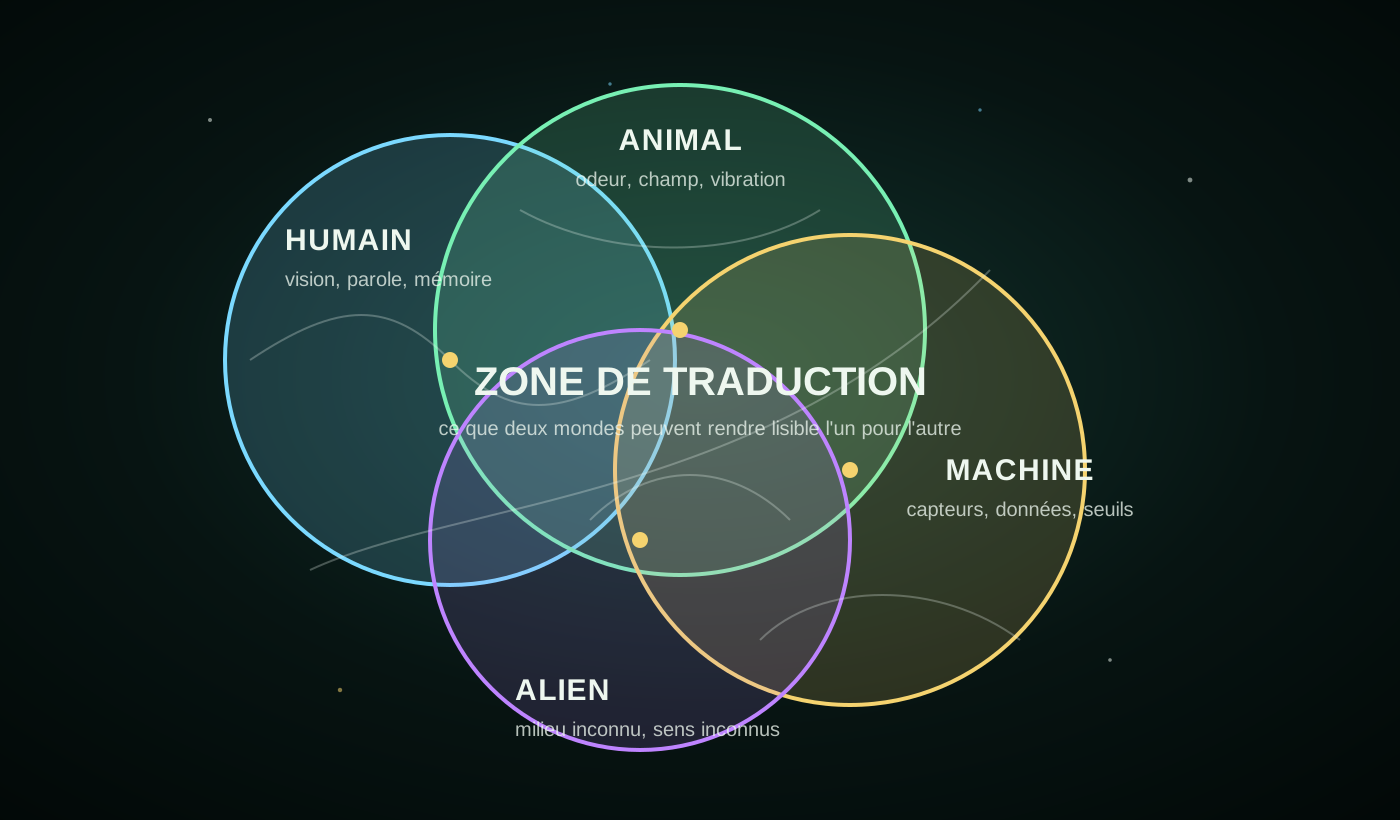
At the center, an interface would show zones of overlap: what the human, the machine, the animal and the hypothetical alien may share. The artistic question becomes: how much of ourselves must we abandon for another world to begin answering?
8. Consequences for contact
- A universal message is not necessarily an image. It must first be perceptible.
- Language begins before words. It begins in attention, difference and repetition.
- An alien intelligence might not recognize our objects. It might recognize gradients, cycles or transitions.
- Translation is embodied. Translating a message also means translating a world of sensations.
- AI could act as mediator. It can explore several channels and search for correspondences without immediately imposing human language.
9. Perspective
Umwelt offers A.L.I a strong direction: to think contact as a meeting between perceptual worlds. Before asking “what does this sign mean?”, we must ask “in what world can this sign appear?” A very different civilization might fail to answer not because our message is false, but because it is simply outside its sensible world.
Inventing an interstellar language may therefore mean inventing a method for making something perceptible between worlds that share neither body, nor senses, nor scale. The true first contact would not be a sentence. It would be an overlap.
Sources and paths
- Jakob von Uexküll, A Foray into the Worlds of Animals and Humans
- Thomas Nagel, What Is It Like to Be a Bat?, The Philosophical Review, 1974
- Stanford Encyclopedia of Philosophy - Animal Consciousness
- Frontiers - sensory ecology and animal communication
- Royal Society - magnetoreception and animal navigation
- Annihilation - cultural reference around a transformed Umwelt
Artistic reference: Umwelt at GMEM
The project Umwelt, presented by GMEM — Centre national de création musicale de Marseille, is a direct artistic reference for A.L.I. The piece is described as a mixed work for electronics, two percussionists and six vibratory loudspeakers. It explicitly starts from Jakob von Uexküll's concept and applies it to a sonic field: each instrument, loudspeaker and resonating body produces its own perceptual milieu.
What matters here for A.L.I is the way sound becomes a model of a proper world. Vibratory loudspeakers applied to cymbals or drum skins make the instruments resonate beyond the direct human gesture. Listening becomes an experience of sensory ecology: the same event can be perceived as gesture, vibration, matter, space, dilated time or relation between milieus.
This reference shifts the question of extraterrestrial language toward the coexistence of several acoustic worlds. Before translating a sentence, we may first have to learn how to make heterogeneous regimes of perception coexist: human, instrumental, electronic, vibratory, non-human.