Initial hypothesis: language is not only a tool for description. It is also a force that organizes reality. It can name, order, promise, condemn, declare, comfort, program, mobilize, heal, wound, command obedience, create belief and trigger action. But how far does this power go? Can we imagine a language that no longer acts only on humans, institutions or machines, but has a direct grip on matter?
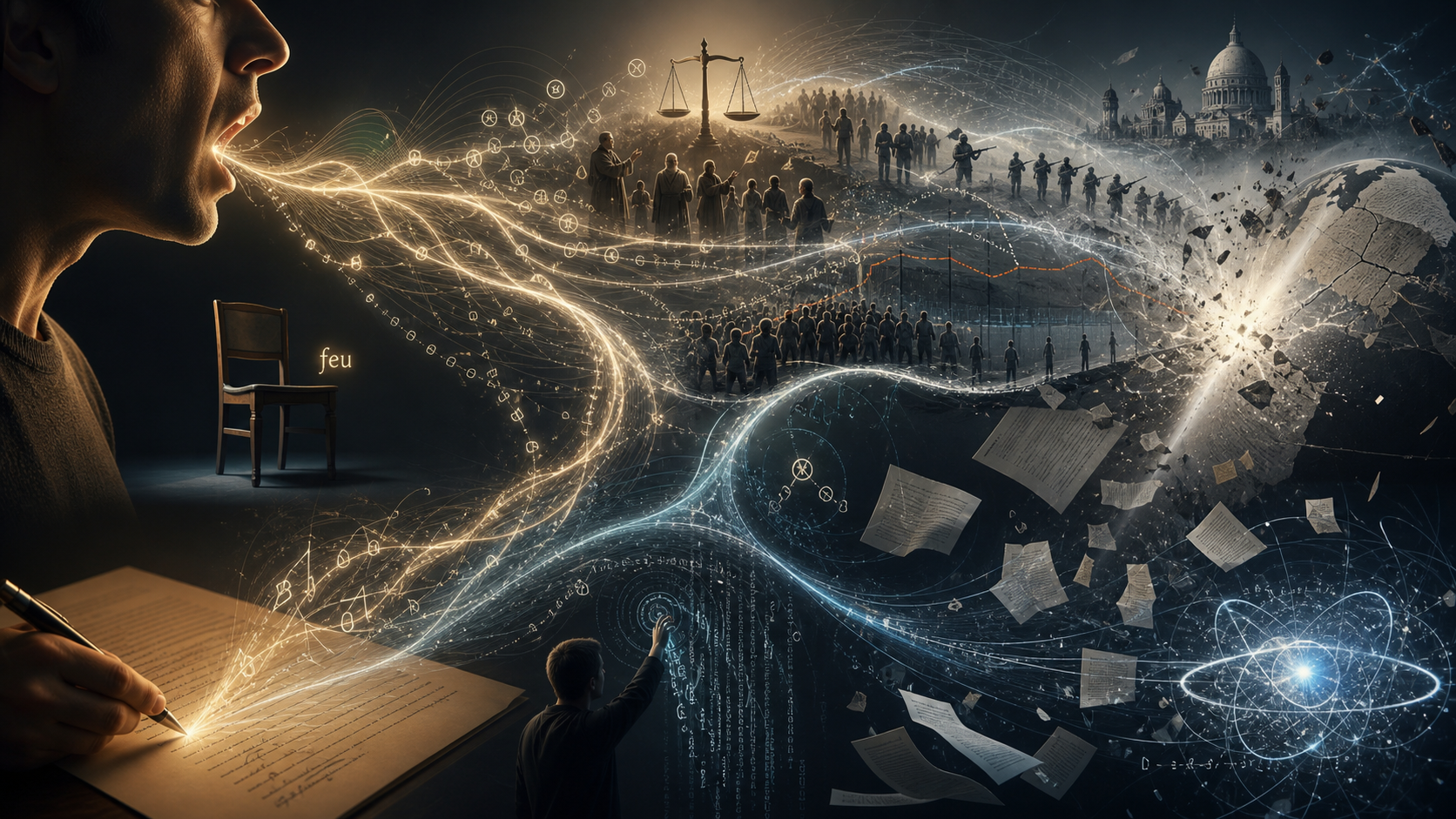
1. The Chair and War Paradox
If I look at a chair and say "fire", the chair does not catch fire. The word does not magically act upon the object. It can evoke fire, represent it, command it in fiction, but it does not directly modify the molecular structure of wood.
Yet if a head of state publicly says "I declare war", this sentence may produce a cascade of material effects: troop mobilization, weapons production, population displacement, destruction and death. In this second case, language has not changed the laws of physics, but it has modified the organization of the world through institutions, beliefs, chains of command, technical systems and obedient bodies.
The question is therefore not whether language acts. It does. The question is: through which relays does it act, at what scales, with what limits, and could one conceive a language able to reduce the distance between speech and physical transformation?
2. The Spectrum of Linguistic Power
Naming. Giving a name changes the place of a thing in the human world. A star, a disease, a species, a border or an artwork does not exist in the same way before and after being named.
Describing. A description orients action. Calling a situation a crisis, threat, miracle, accident, discovery or invasion already prepares certain behaviors.
Prescribing. A medical prescription, safety instruction, scientific protocol or military order are sentences aimed at action. Their efficiency depends on authority, trust and execution.
Declaring. Some sentences do what they say: "I now pronounce you married", "the session is open", "you are sentenced", "we declare independence". Philosophy of language calls these performative speech acts, especially in the work of J. L. Austin and John Searle.
Programming. With computer code, language becomes executable. An instruction opens a door, moves a robot, transfers money, generates an image, pilots an antenna. Language becomes operational.
Ritualizing. In religious, magical and political traditions, certain formulas are understood as producing symbolic or ontological transformations: blessing, cursing, consecrating, initiating, exorcising, swearing an oath.
Commanding matter through technology. A voice command can turn on a lamp; software can drive a 3D printer; a genetic sequence can produce a protein. Language acts on matter through translation systems.
3. What Language Cannot Do Directly
Ordinary human language does not violate physical laws. Saying "levitation" does not lift a stone. Saying "light" does not create photons unless this word activates a device that produces them.
This limit matters. It prevents confusion between performativity, magic and material causality. Language always acts in a medium: a body, an institution, a machine, a collective memory, a nervous system, a society, a technical protocol.
4. Speech Acts: When Saying Is Doing
J. L. Austin showed that some sentences do not describe a state of the world but perform an action. Saying "I promise" is not reporting a promise that already exists: it is the act of promising. But this act depends on felicity conditions: who speaks, in what context, according to which conventions, with what recognition from others.
The power of language is therefore not only in words. It lies in the combination of a linguistic form, an authorized body, a scene, a shared belief and a system of effects.
5. Propaganda, Narrative and War
Modern wars do not begin with weapons alone. They also begin with narratives: naming an enemy, simplifying a threat, fabricating urgency, naturalizing violence. Language prepares bodies to accept the unacceptable.
A political speech can therefore produce destroyed matter without directly touching matter. It acts through chains: sentence, belief, institution, order, logistics, weapon, explosion. The causality is long, but it is real.
6. Ritual and Incantation: Speech as a Transformative Device
Long before analytic philosophy described speech acts, societies treated certain forms of language as operations: prayer, oath, blessing, curse, magical formula, funeral chant, declaration of alliance, healing speech, invocation. In ritual, language is never merely informational. It is situated, repeated, addressed, accompanied by gestures, objects, rhythms, costumes, places and assembled bodies.
Incantation reveals an essential dimension of active language: a phrase does not draw its force from itself alone, but from an arrangement. A word spoken alone in an empty room does not have the same effect as a word spoken at the right moment, by the right person, before a community, with the right gestures and objects. Ritual is an ancient technology for amplifying language.
For A.L.I, this is decisive. Interstellar communication may not be an isolated message but a complete protocol: frequency, repetition, orientation, duration, listening threshold, state of the receiver, spatial arrangement. Active language would then be less a sentence than a scene of apparition.
7. Psychology, Body and Parapsychology: When Words Modify Internal States
Language also acts on the body. A sentence can accelerate heart rate, trigger fear, calm pain, modify posture, produce shame, confidence, trance or mobilization. Psychotherapy, hypnosis, suggestion, mantras, political slogans and athletic instructions show that words can reorganize attention, memory, breathing and action.
The link between mind and body does not mean that language abolishes physical laws; it reminds us that the human body is itself a medium sensitive to signs. Speech transforms representations, and representations modify behavior, hormones, muscular tensions and perceptual expectations. Body language responds to verbal language.
Parapsychology and research into so-called extrasensory perceptions approach this zone in a more controversial way: telepathy, mental influence, distant intuition, altered states of consciousness. Even when these phenomena remain scientifically debated, they matter for A.L.I as an experimental imaginary: they ask what would need to be measured if information passed through channels other than classical sensory pathways.
8. Physics and Metaphysics: Can One Speak to the Laws of the World?
From the point of view of physics, a word is first a material phenomenon: air vibration, sound wave, graphic inscription, electrical impulse, light signal. It can act on matter if it carries energy or if it is connected to a device that translates it into action. A voice command turning on a lamp is not magical: it passes through microphone, recognition, code, relay and electric current.
Metaphysics asks a more radical question: are the laws of the world independent of all language, or do certain forms of description participate in the constitution of what we call reality? Mathematics, for instance, does not directly change gravity, but it allows us to predict, build, launch satellites and transform the planet. It is a language that does not act on physical law, but on our ability to enter that law.
The most speculative hypothesis would be a language tuned to the deep structures of reality: a language able to produce effects not because it commands matter from outside, but because it is written in the same grammar as fields, particles, symmetries and resonances. A.L.I can treat this as an operative fiction: not searching for a universal language, but for syntaxes compatible with the modes of existence of matter.
9. Embodied AI: From LLMs to the Physical World
Large language models have revealed a new form of linguistic power: a sentence can produce a text, an image, code, a plan, an analysis or a simulation. But as long as the model remains enclosed in symbolic space, its action on the world depends on external interfaces: humans, APIs, robots, sensors, tools and control systems.
Yann LeCun has repeatedly emphasized the limits of LLMs when they lack a robust world model. His work on objective-driven AI and JEPA-like architectures argues that an artificial intelligence must learn to predict, plan and act in the world, not only produce the next linguistic unit. In other words, the decisive passage is not only speaking better, but linking language, perception, action and physical modeling.
For A.L.I, this transition is central: an LLM is already a laboratory of language, but embodied AI would become a laboratory of active language. It could transform a sentence into an experiment, a robotic gesture, a measurement, a laboratory protocol, a radio signal, a material fabrication. Language would cease to be merely generative; it would become operational.
10. Art, Language and Representation: When the Utterance Becomes the Work
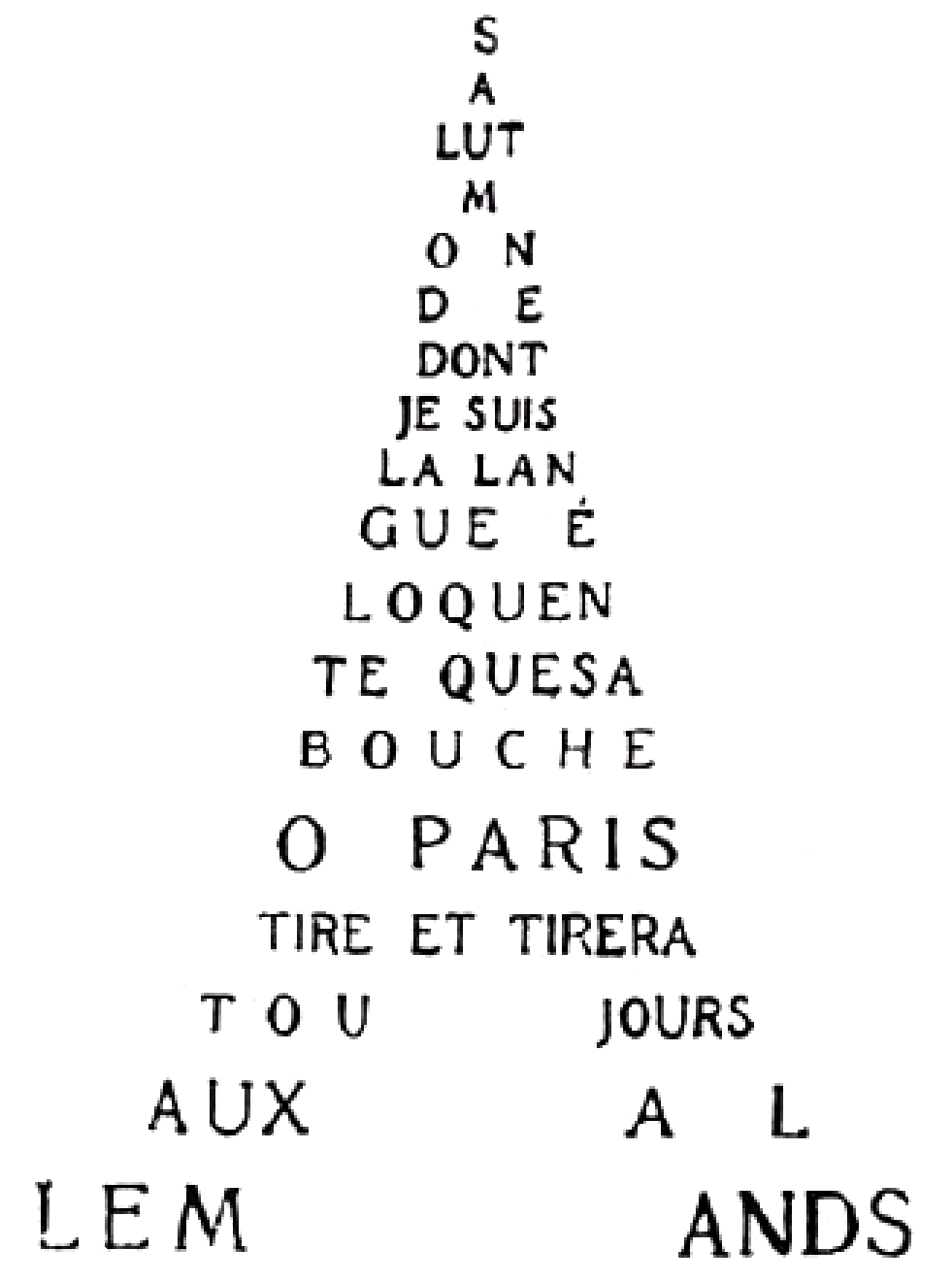
Art has already explored the idea of a language that does not merely represent the world but organizes a situation. Visual poetry, Lettrism, concrete poetry and calligrams have treated language as a plastic form: the sentence becomes drawing, architecture, typographic rhythm, reading score. Mallarmé, Apollinaire, Isidore Isou, Henri Michaux and concrete poets show that language is not only linear: it can become space.
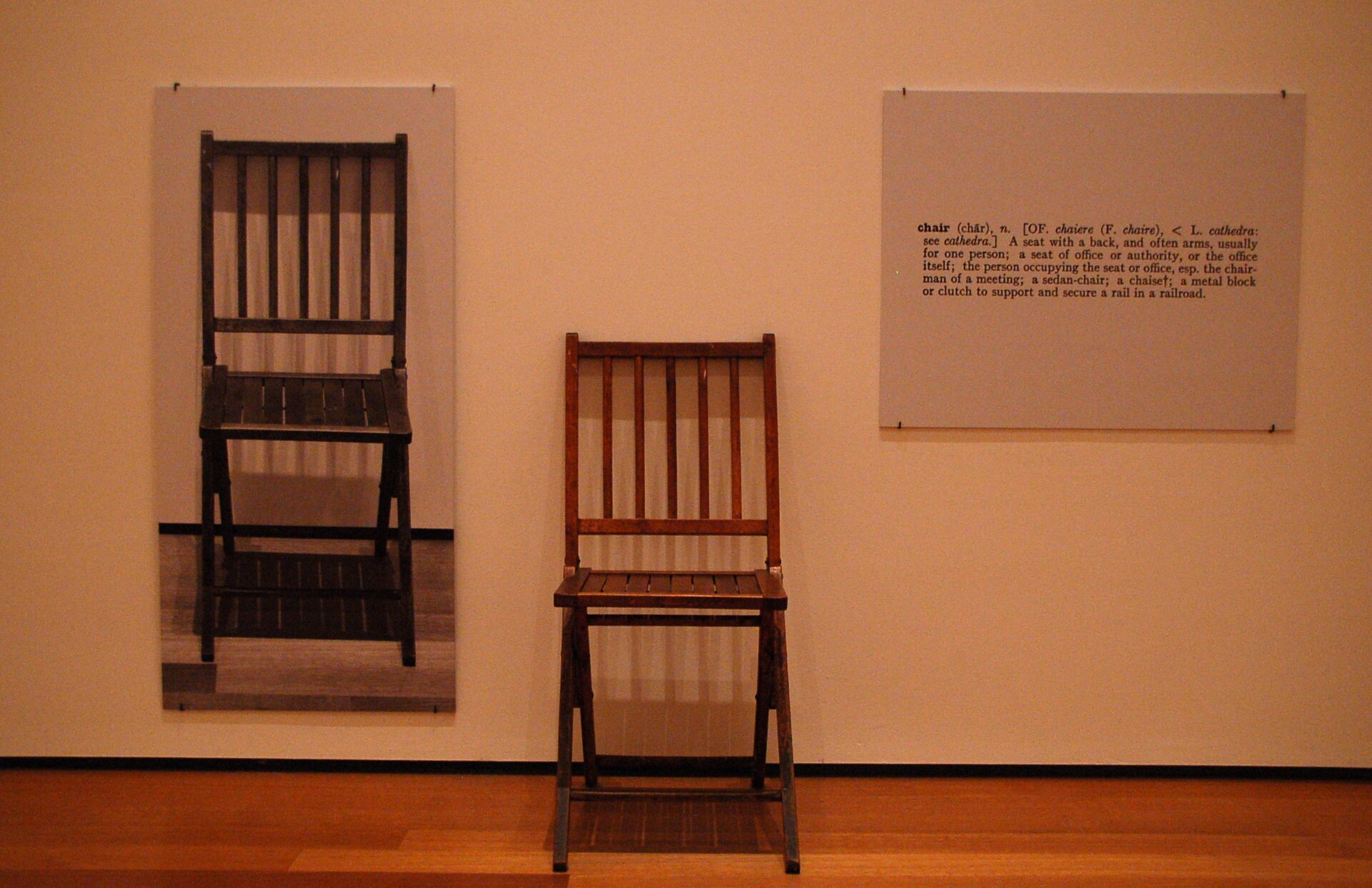
Conceptual art radicalized this shift. In Joseph Kosuth's One and Three Chairs, the object, its image and its linguistic definition coexist: the real chair, the photograph of the chair and the text defining the chair. The work is no longer only the visible object, but the system of relations between thing, image and word. For A.L.I, this structure is essential: an extraterrestrial message may also appear as a triangulation between object, signal and definition.
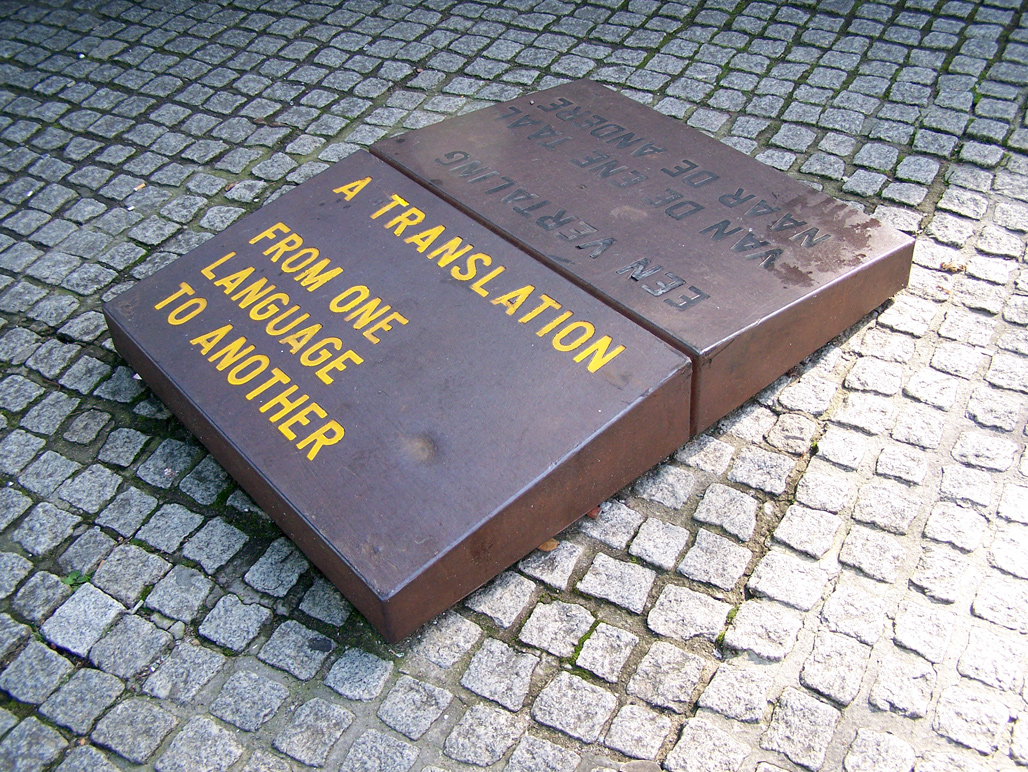
Lawrence Weiner pushed further the idea of the artwork as statement. His wall texts exist as works even if the action they describe is not materially carried out. The utterance becomes a proposition for an event. It can be read, imagined, executed or left in potential. This directly concerns active language: a sentence can be an artwork because it contains a possible action.
The Art & Language group made language the material of conceptual art itself: texts, discussions, protocols, definitions, critical systems. The artwork becomes a discursive field, an operation of thought, sometimes closer to a philosophical laboratory than to a traditional aesthetic object. Language no longer accompanies the work; it is the work.

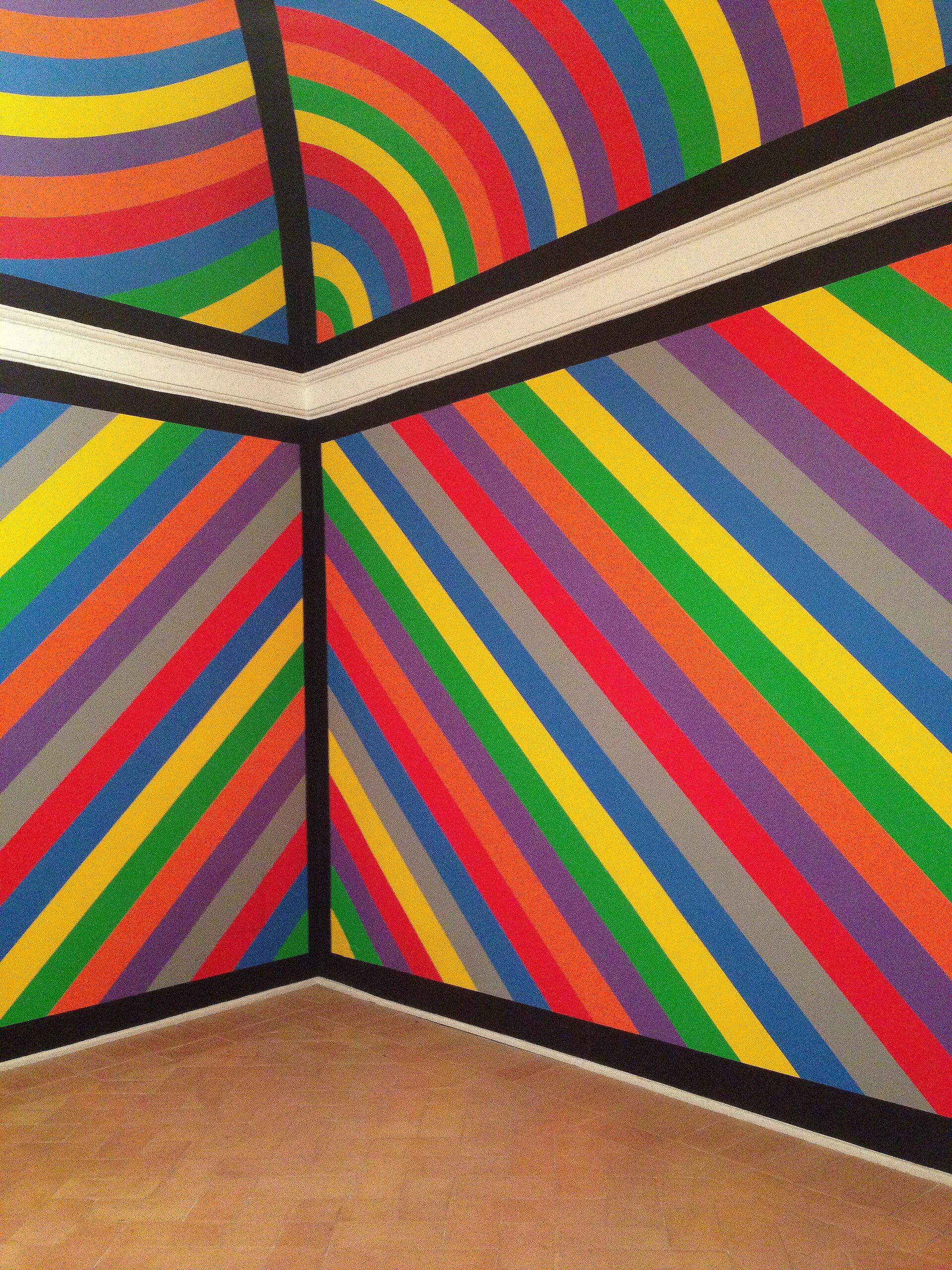
In instruction art, Yoko Ono's Grapefruit proposes works as instructions: imagine, listen, cut, wait, dream, perform or not perform an action. Sol LeWitt showed that an idea or rule can generate the work, even when executed by other hands. The sentence becomes program, score, protocol. This is a clear form of active language: the utterance produces reality as soon as a body or system accepts to execute it.
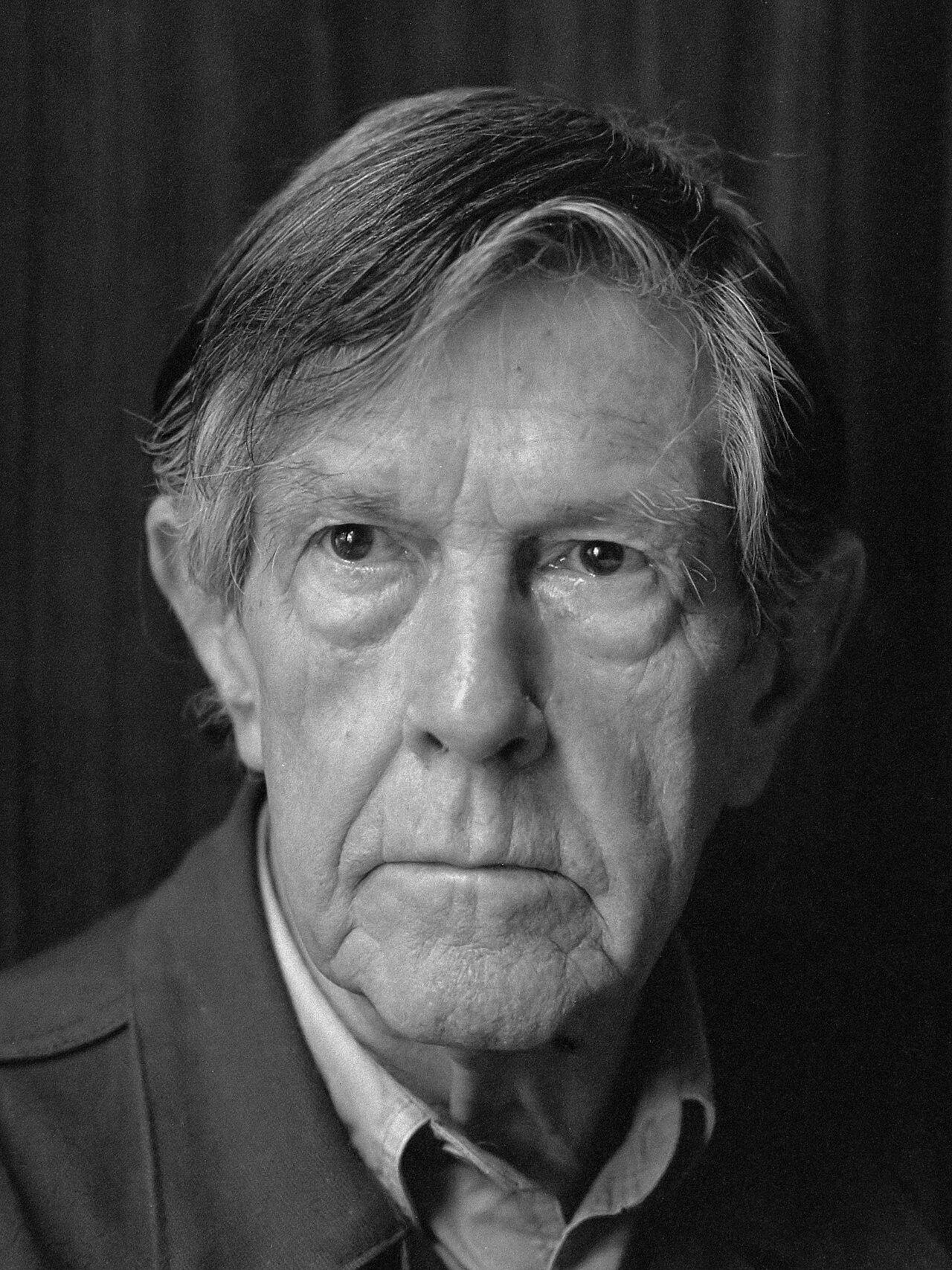
Graphic scores by John Cage, Cornelius Cardew or Cathy Berberian, as well as Fluxus practices, move musical notation toward open action. The sign no longer commands a precise note; it proposes a field of possibilities. Language acts by orienting a performance. It does not describe a sound: it makes a sound situation possible.
Finally, digital art, generative art and live coding make this question literal: to write is to make a form, a sound or a movement appear. Code becomes a performative language, readable by a machine and visible in the world. Art has already prepared several models for A.L.I: language-image, language-object, language-protocol, language-score, language-code, language-ritual.
11. Code, DNA, Algorithms: Toward Material Language
Programming languages show another path. Code is not merely understood: it is executed. It moves electrons, triggers machines, controls robots, generates sounds and images. Language becomes matter through an architecture able to read it.
Biology adds an even more vertiginous layer: DNA can be described as a coding system whose reading produces living forms. A sequence does not look like an arm, a wing or an enzyme; yet, through cellular machinery, it participates in their production.
This opens an A.L.I hypothesis: an extraterrestrial civilization might not send a message to interpret, but a language to execute. Not a sentence meaning "we are here", but a syntax able to produce an object, a reaction, a memory or a measurable transformation.
12. Hypothesis: A Language with Real Grip
Let us call active language a language in which every utterance is linked to a verifiable effect in the world. This is not magical speech, but a system in which sign, reading device and physical environment are designed together.
Electromagnetic language. Light or radio sequences capable of triggering precise states in a material, sensor or organism.
Chemical language. Molecular sentences acting as instructions for cells, crystals, bacteria or polymers.
Gravitational or geometrical language. More speculative: forms of information inscribed in fields, curvatures, resonances or topologies.
Total social language. A system in which a sentence instantly modifies a collective organization, as a protocol shared by thousands of human or artificial agents.
13. The Extraterrestrial Hypothesis: What If the Message Is an Action?
The search for extraterrestrial signals often assumes that a message is information to decode. But an advanced intelligence might conceive the message as a minimal intervention: a sequence that, when received by the right medium, produces something.
The message would not say "hello". It would make a pattern appear. It would not describe a technology. It would trigger an experiment. It would not transmit a cosmology. It would create a situation in which that cosmology becomes observable.
14. Risks: Language as Weapon
A language able to act on reality would be immediately ambivalent. Any active language is also potentially a weapon. A political formula can trigger war; code can shut down an electrical grid; a genetic sequence can modify an organism; an image can provoke panic; a rumor can move a crowd.
The power of language therefore requires an ethics of triggering: who has the right to speak? Who verifies the effect? Who stops the chain? Who assumes the material consequences of a sentence?
15. Possible A.L.I Devices
The Performative Spectrum. An installation where visitors pronounce different words in front of objects. Some words do nothing, others trigger sound, light, movement, archives, conflict statistics or chains of command.
The Chair and War. Two opposite scenes: a chair remains still before the word "fire", while an institutional sentence triggers maps, documents, military sounds and testimonies.
Executable Language. A program where poetic sentences are translated into physical instructions: light, frequencies, micro-movements, 3D printing, sound synthesis, relays.
Contact Grammar. An A.L.I protocol: create messages that do not merely represent an idea, but produce a measurable experience in the receiver.
16. Conclusion: To Speak Is Already to Move the World
Language does not directly burn a chair. But it can organize crowds, move armies, write laws, program machines, produce beliefs, transform bodies and orient history. Its power is not supernatural; it is relational, technical, social and biological.
The A.L.I hypothesis extends this power: imagine a language whose structure is designed from the beginning as action. A language that is neither only speech, nor only code, nor only ritual, but a grammar of effects. In an interstellar encounter, understanding a message may mean observing what it does to the world.
Sources and References
J. L. Austin, How to Do Things with Words, 1962.
John Searle, Speech Acts, 1969.
Ludwig Wittgenstein, Philosophical Investigations, 1953, for the idea of language-games.
Michel Foucault, The Order of Discourse, 1971, for the relation between speech, institution and power.
Judith Butler, Excitable Speech, 1997, for performativity and the social power of utterances.
Yann LeCun, A Path Towards Autonomous Machine Intelligence, 2022, and Meta AI research on JEPA architectures and world models.
Joseph Kosuth, One and Three Chairs, 1965; Lawrence Weiner, statement works; Art & Language; Yoko Ono, Grapefruit, 1964; Sol LeWitt, writings on conceptual art; John Cage, Fluxus, graphic scores and instruction art.
Claude Shannon, A Mathematical Theory of Communication, 1948, for information, signal and noise.