Comics possess a decisive property for A.L.I: they never fully separate language from space. A word occupies a panel, a voice takes the shape of a balloon, silence becomes a white gutter, duration contracts into a drawing, and an entire planet can fit on a page. Graphic narrative can therefore test an essential hypothesis: a message intended for a non-human intelligence may be less a sentence than a reading device.
From science-fiction comics to the experiments of Marc-Antoine Mathieu, the medium has invented species, alphabets, translators, interstellar diplomacy and worlds in which the page itself changes its laws. This history does not prove that images are a universal language. On the contrary, it reveals how seeing, ordering and connecting are already cultural operations.
1. The panel: a unit of perception before it is a unit of narrative
Comics rely on a small number of operations: framing, isolating, juxtaposing, repeating, varying and asking the reader to reconstruct what is missing. Between two panels no one actually sees movement; the brain infers it. Scott McCloud calls this operation closure in Understanding Comics. Thierry Groensteen, in The System of Comics, emphasizes the spatial solidarity of images: each panel acts locally and also at a distance with all the others.
For A.L.I, this mechanism is more fundamental than an alphabet. It suggests an initial contact protocol: show two separate states, then observe whether the receiver assumes continuity, causality, transformation or coincidence. The gutter becomes an experimental instrument measuring what an intelligence spontaneously adds to discontinuous data.
2. Little Nemo: changing the laws of the world by changing the page
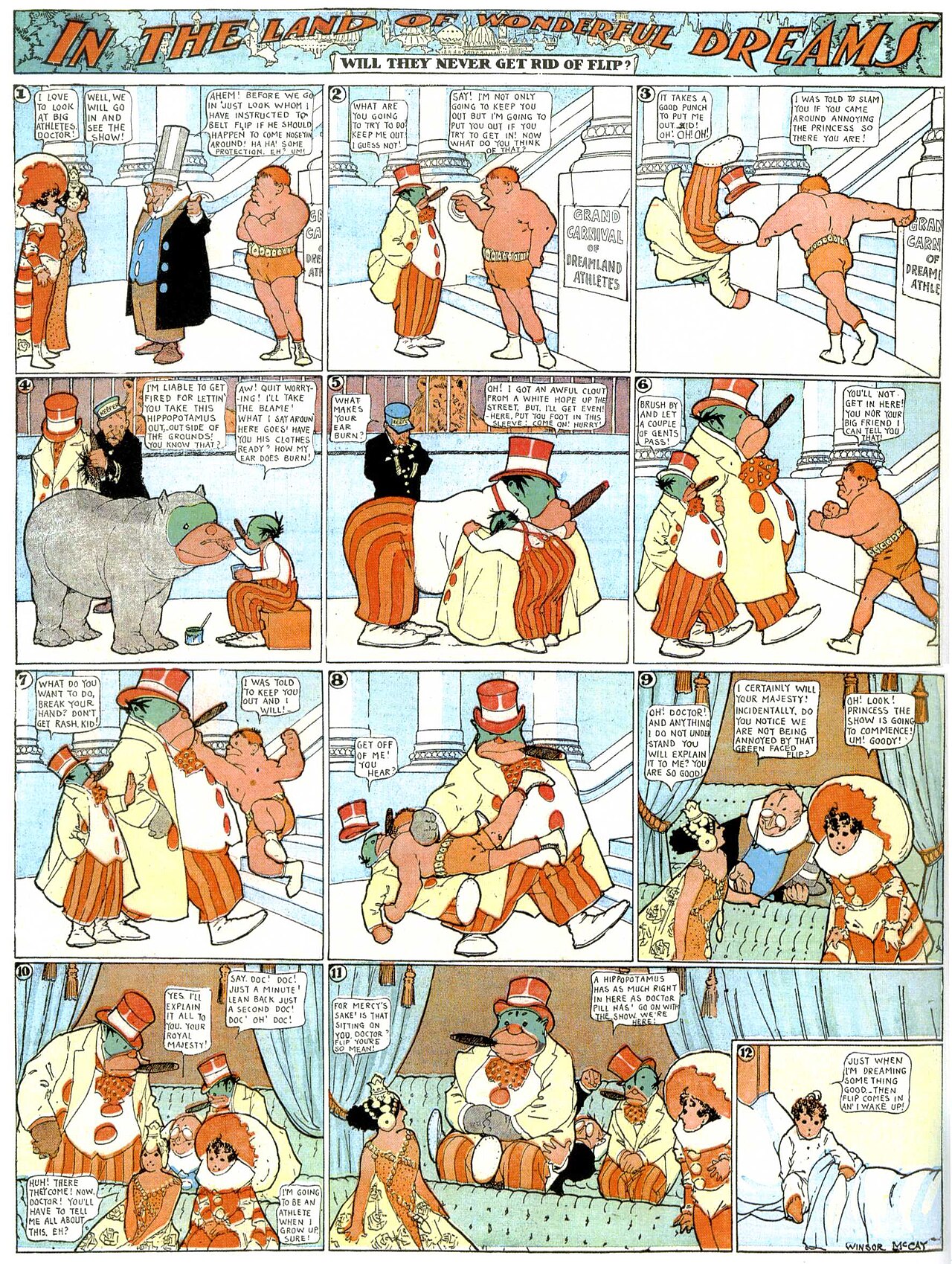
In the early twentieth century, Winsor McCay turned the Sunday page of Little Nemo in Slumberland into an elastic space. Architecture grows, panels stretch, bodies change scale and dreams alter the geometry of the support. The page no longer merely records an adventure: it becomes Slumberland’s local physics.
This invention anticipates a major branch of speculative comics. If the shape of a frame can change the represented world, an alien intelligence might encode information not only in signs but in transformations of their container. Edge, margin, format and reading order could all be part of the message.
3. From pulps to superheroes: the alien as a social mirror
Buck Rogers, Flash Gordon and comic books established space as a field for popular adventure. Yet their aliens are often transformed humans: different skin, amplified anatomy, advanced civilization or threatening empire. Superman embodies this ambiguity. Kal-El is a child of Krypton, a cosmic migrant raised by an Earth family; his identity depends on two languages, two memories and a continuous passage between otherness and assimilation.
Kryptonian alphabets, universal translators and galactic maps form an immense graphic repertoire. Yet they are generally designed to remain readable by human audiences. Their strangeness is domesticated. This is a critical lesson for A.L.I: inventing an unknown typeface is not enough to invent non-human thought. A decorative alphabet may preserve our syntax, chronology and model of the individual subject unchanged.
4. Valerian: Point Central and translation as an institution
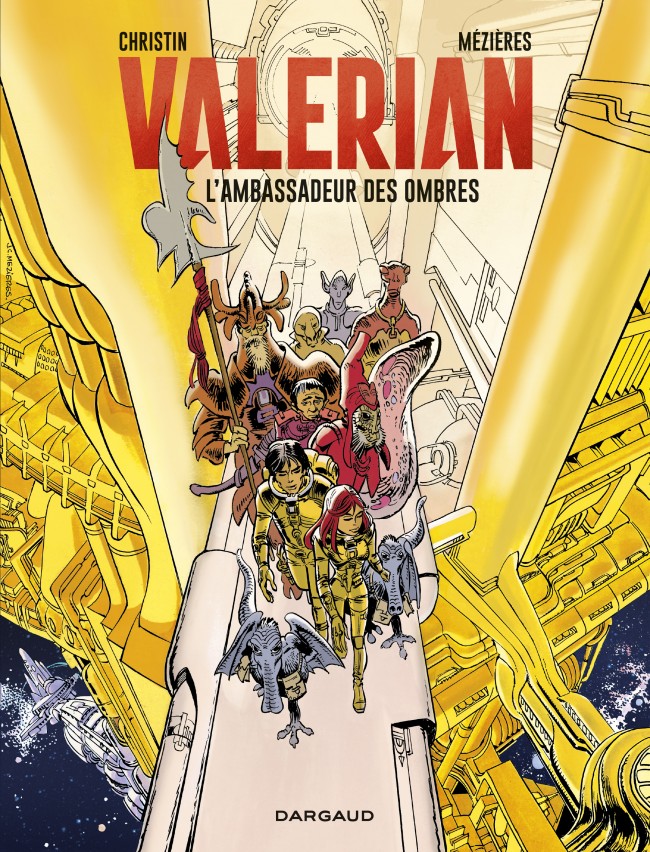
In Ambassador of the Shadows by Pierre Christin and Jean-Claude Mézières, Point Central is not a homogeneous planet but an artificial structure to which populations from across the universe attach their own sectors. Coexistence does not erase difference; it organizes it spatially. Each species keeps its environment, interests and regimes of signs.
Point Central suggests diplomacy without a single cultural center. Translation is political: who speaks for whom? What common environment can accommodate incompatible organisms? How can an assembly function when participants share neither body, lifespan nor senses? For A.L.I, the station is less a backdrop than an interface model: an architecture able to juxtapose worlds without reducing them to a norm.
5. Watchmen: manufacturing an extraterrestrial message that acts on reality
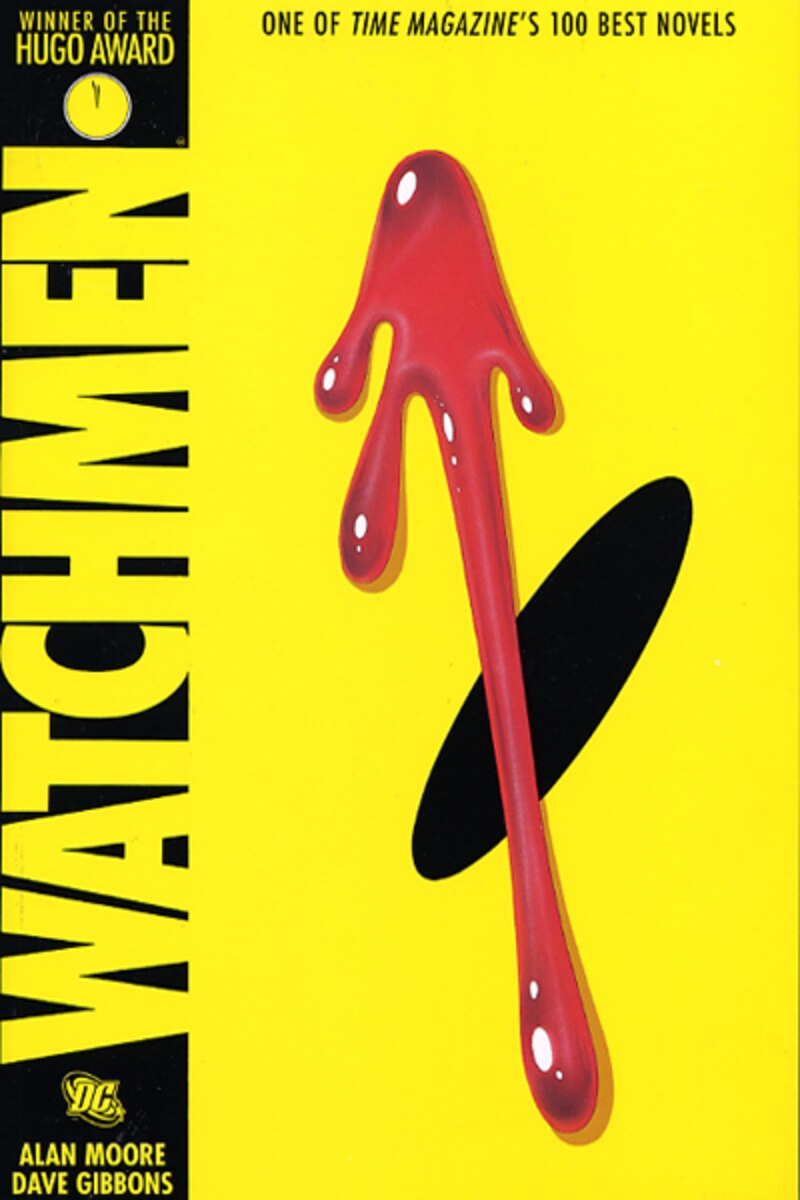
In Watchmen by Alan Moore, Dave Gibbons and John Higgins, the final alien is manufactured. Ozymandias mobilizes scientists, artists, writers and engineers to produce a credible psychic creature teleported into central New York. Its death causes catastrophe and forces humanity to believe in an external threat.
The device is monstrous yet theoretically exact: false contact works because it coordinates image, biology, narrative, psychic shock and geopolitical context. It does not transmit neutral information; it violently reprograms the world’s interpretation. The sequence raises a central ethical question for METI and A.L.I: can a message powerful enough to be understood remain politically inert? Interstellar communication may create a situation before its content is translated.
6. Moebius, Druillet and Bilal: making the image genuinely alien
With Métal Hurlant, European science-fiction comics often stopped explaining their worlds before showing them. In Arzach, Moebius built four almost wordless stories image by image, without a predetermined script. Readers receive neither instructions nor translation; they learn to detect regularities in a world that remains partly opaque.
Philippe Druillet explodes the grid: his architecture, symmetries and double-page spreads give reading a cosmic scale. Enki Bilal blurs the borders between human, animal, god, machine and political memory. These works shift otherness from the character to the form itself. The alien is no longer only what is drawn; it becomes an unfamiliar distribution of attention.
7. Shaun Tan: making the absence of translation tangible
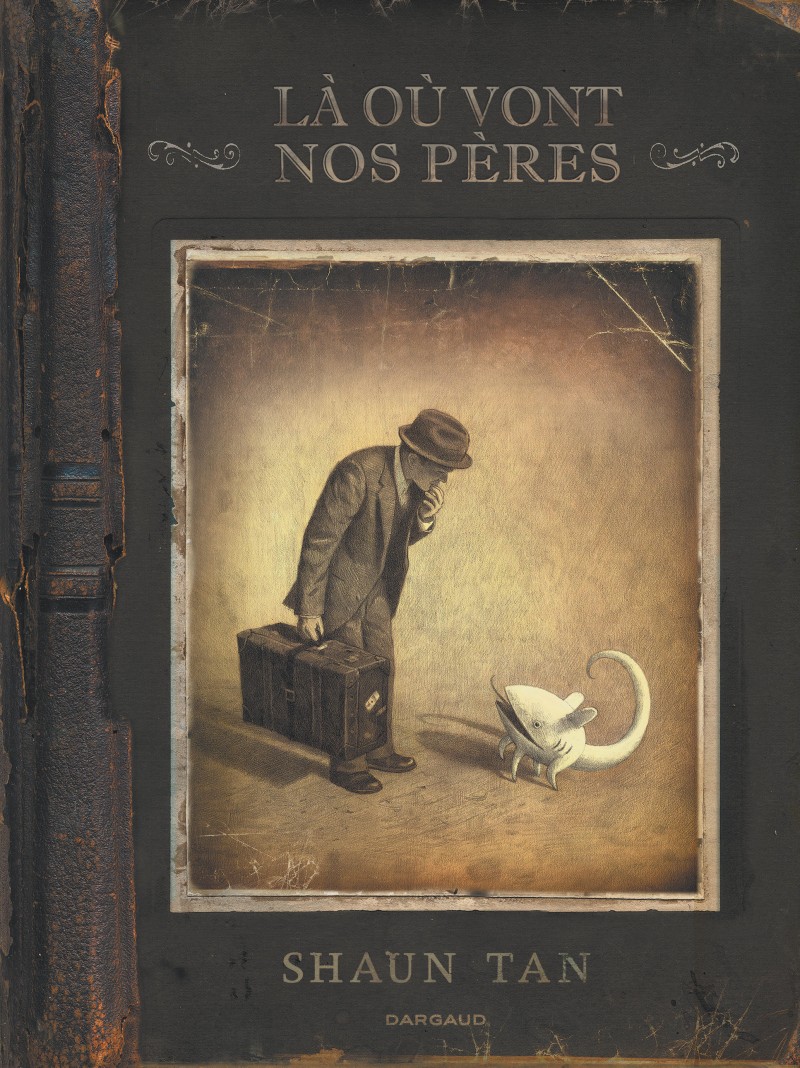
The Arrival by Shaun Tan is a wordless graphic novel about migration. The host country’s writing is invented, its animals unknown, and its food and machinery unexplained. Readers therefore share the protagonist’s uncertainty instead of observing it from the outside.
Tan originally imagined text and then removed it. This decision does not abolish language; it redistributes it among gestures, objects, glances, repetitions and sequences. For A.L.I, the book suggests a method: do not immediately translate the unknown, but build a situation in which two intelligences learn together through demonstration, imitation, hospitality and correction.
8. Marc-Antoine Mathieu: the support becomes an interlocutor
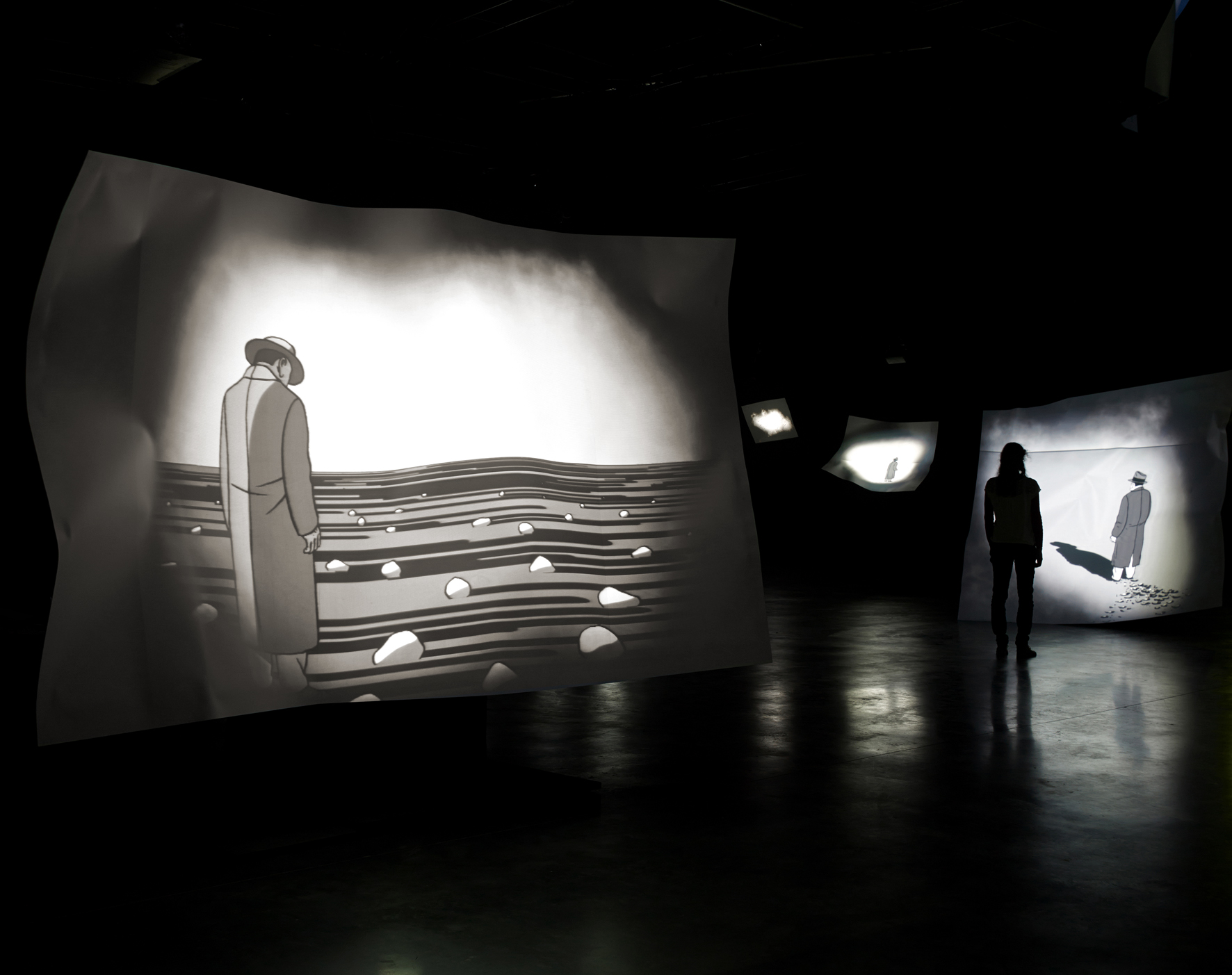
Since L’Origine, Marc-Antoine Mathieu has made the book-object an actor. Julius Corentin Acquefacques receives pages from the story in which he exists; a missing panel becomes a physical hole; perspective, pagination and the reversal of the album alter the world’s laws. The French National Centre for Visual Arts describes this practice as a continuous effort to exceed the limits of the book-object.
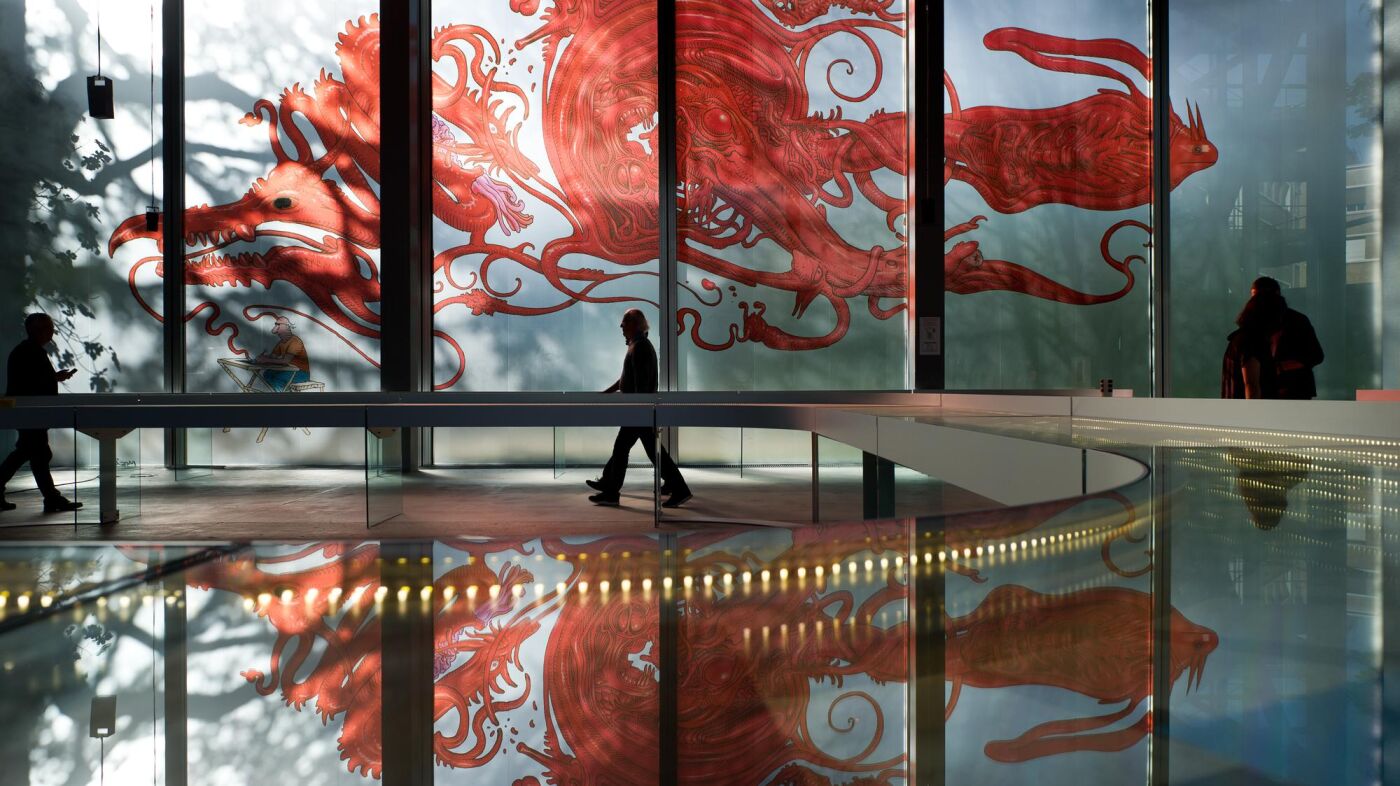
Le Début de la fin / La Fin du début organizes two head-to-tail narratives that meet. 3 secondes unfolds a continuous zoom through reflections, screens and clues, making scale a syntax of causality. Mémoire morte, discussed by the French National Library, transforms a city and its library into an allegory of a computer attacked by a virus. Finally, S.E.N.S. removes words, multiplies arrows and became a LiFE installation in which the visitor’s body reads by walking.
Mathieu brings a major idea to A.L.I: the medium is never neutral. A civilization may not separate message, reader and environment. Its “text” could be a space that changes when crossed, matter that reveals its syntax only when manipulated, or an object that observes how we try to understand it.
9. Aâma: when the message becomes a living environment
In Aâma by Frederik Peeters, an experimental substance overflows the categories of program, organism and ecosystem. Intelligence is no longer located in a character speaking from outside; it reconfigures bodies, environment and evolution. Contact becomes contamination, symbiosis and reciprocal transformation.
This perspective corrects the classic transmitter-receiver model. An extraterrestrial language might not represent the world but act as a growth protocol. Understanding it would mean being changed by it. Comics, able to show multiple biological and temporal scales simultaneously, are especially suited to thinking about this language-environment.
10. Images are not a universal language
An arrow, central perspective, a frontal portrait or left-to-right reading seem obvious because we have learned them. Even recognizing an image presupposes perception, memory and the ability to isolate forms. A species based on echolocation, chemistry, electric fields or distributed cognition might not divide reality into visible objects.
Comics are useful precisely because they make these conventions manipulable. Reading order can be reversed, outlines removed, scale altered, characters replaced by relations, or a sequence distributed through physical space. Each variation becomes a test of the minimal conditions for shared reading.
11. A.L.I hypothesis: the self-teaching comic
We can formulate the hypothesis of a self-teaching comic: a visual message that requires no prior language but progressively teaches its own rules. It would begin with observable differences, introduce repetition, quantity, transformation and reversibility, then test the reader’s inferences. Each response would modify the next page.
Such a system would not immediately try to tell the story of humanity. It would first establish a space for semiotic negotiation. Artificial intelligence could generate several versions of one sequence, measure interpretations, identify overly human conventions, and retain structures understood by different observers: people, trained animals, multimodal models or collectives.
12. Six laboratory experiments
The experimental gutter. Present two images to human, animal and artificial observers; record the relations they infer; build a comparative map of causality.
The directionless page. Build a sequence readable from several edges, without fixed top or bottom. Meaning must survive rotation, like an object sent into space with no guaranteed orientation.
Graphic Point Central. Invite several authors, disciplines and AI systems to each produce one sector of a shared page. Contact zones are not translated in advance; they must invent their interfaces.
The contact zoom. Following the principle of 3 secondes, create a continuous narrative from the molecular to the galactic scale. Identify which relations remain recognizable despite changes in magnitude.
The comic as environment. Print signs on materials sensitive to light, humidity or touch. Syntax appears through the way the reader inhabits the object.
The simulated alien reader. Train artificial agents with different perceptual regimes—fragmentary vision, nonlinear time, no concept of discrete objects—then observe which comics they can learn to read and produce.
13. Projection: from book to encounter protocol
For A.L.I, comics could become a test bench connecting art, semiotics, cognition and computation. They can make messages simple enough to analyze yet complex enough to contain space, time, causality, emotion and point of view. Unlike an isolated sentence, they also expose their own operations: what is separated, repeated, missing or transformed.
The goal would not be to create “the” comic that extraterrestrials could understand. It would be to build a collection of comparable devices, identify their assumptions and discover which forms produce the beginning of a shared reading. Contact would then begin not with a successful translation, but with mutual recognition of an act: someone, somewhere, is trying to organize differences so that another can connect them.
14. Sources and further reading
Library of Congress — Winsor McCay and Little Nemo
BnF — Moebius and Arzach
Fondation Cartier — Moebius-Transe-Forme
Dargaud — Ambassador of the Shadows
DC — Watchmen
Shaun Tan — The Arrival
CNAP — Marc-Antoine Mathieu
LiFE Saint-Nazaire — S.E.N.S. installation
BnF — Mémoire morte
Gallimard — Frederik Peeters, Aâma
Scott McCloud, Understanding Comics, 1993.
Thierry Groensteen, The System of Comics, University Press of Mississippi, 2007.