A language can be born before its people. A linguist selects sounds, decides how words combine, imagines what a community would name frequently and what it would leave implicit. Actors embody it, then audiences learn it. Klingon, Na’vi, and Dothraki followed this path: initially tools of fiction, they became usable systems in the real world.
For A.L.I, they form an extraordinary laboratory. They do not come from extraterrestrial intelligence, yet they attempt to produce the impression of another mind using human linguistic materials. They let us observe the boundary between code, language, culture, and embodiment: when does a sequence of sounds stop being scenery and become a medium in which one can think and converse?

1. Building a language is not the same as designing an alphabet
A constructed language, or conlang, is deliberately designed. It may facilitate communication, as Esperanto does; test a logical or political hypothesis, as Lojban or Láadan do; simplify expression, as Toki Pona does; or give historical depth to an imaginary world. Klingon, Na’vi, and Dothraki belong to the last group: artlangs.
An alphabet is not enough. A language needs an inventory of sounds or gestures, combinatory rules, morphology, syntax, and ways to ask, negate, locate events in time, and repair misunderstanding. It also needs irregularities and historical traces. A perfectly regular language resembles a form; a living language appears worn by generations.
2. A tradition older than cinema
Language invention ranges from Hildegard of Bingen’s Lingua Ignota and John Wilkins’s philosophical language to Solresol, Volapük, and Esperanto. These projects pursued sacred, universal, logical, or poetic goals. J. R. R. Tolkien transformed the practice into glossopoeia: language families gained migrations, sound changes, and kinships. Stories provided a world in which languages could live.
Screen artlangs add three constraints: preserve previously written fragments, remain pronounceable by actors, and fit the timing of a scene. Language creation becomes a negotiation between linguistics, dramaturgy, performance, and editing.
3. Klingon: making human order unfamiliar
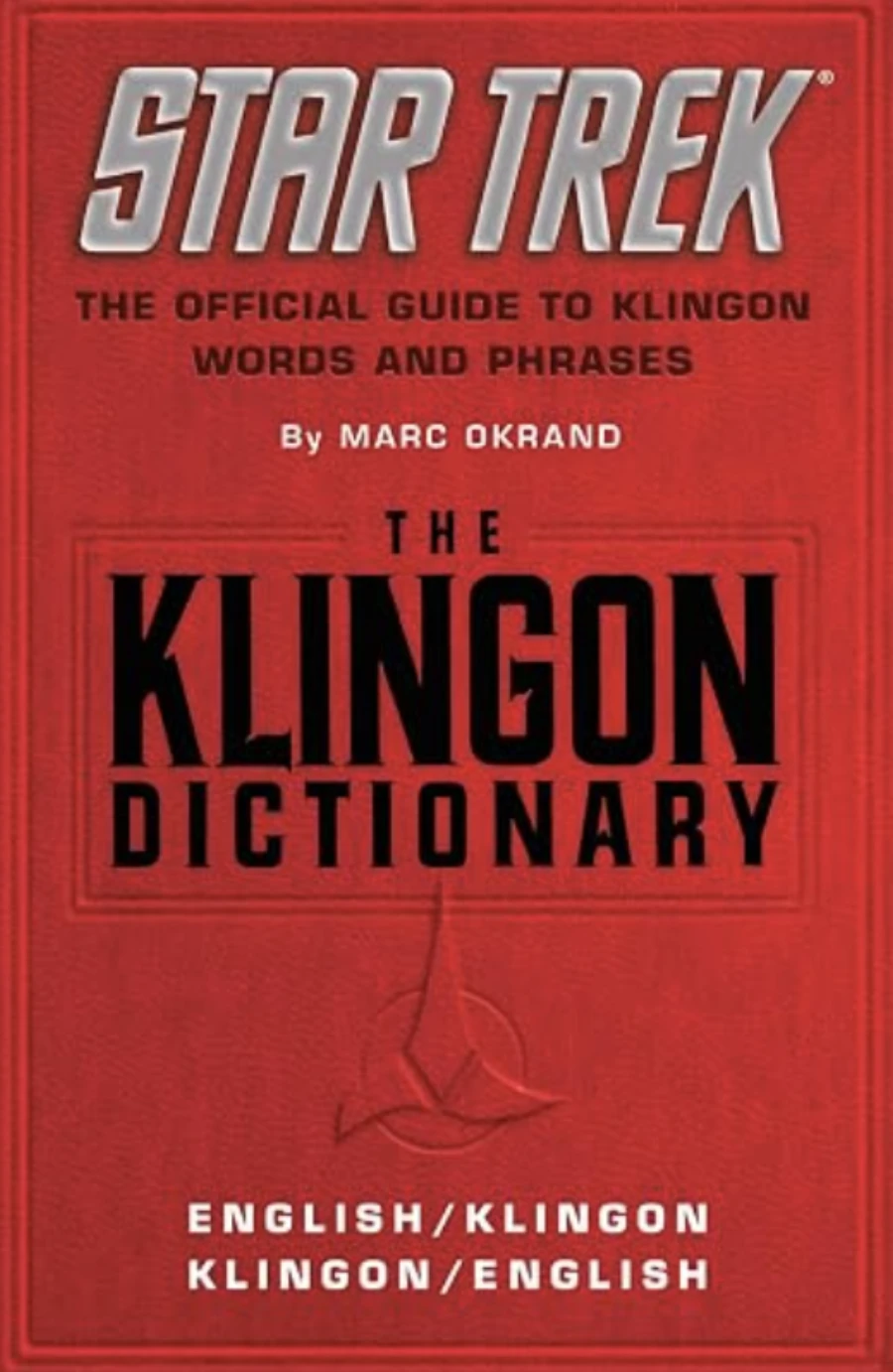
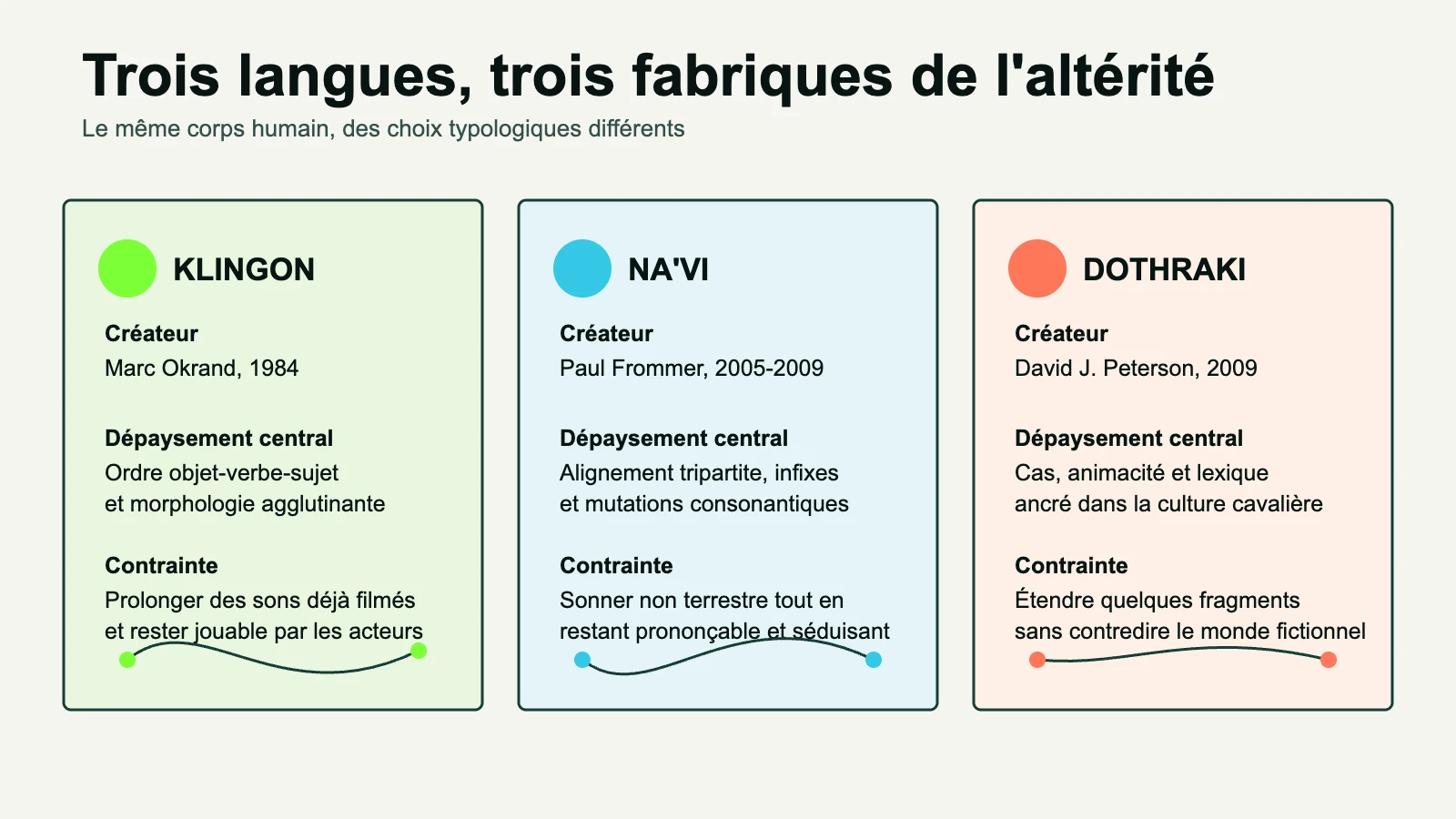
Marc Okrand developed Klingon for Star Trek III in 1984 from earlier sounds and lines. He adopted an object–verb–subject order, rare among terrestrial languages, and an agglutinative morphology. The alien effect comes not from impossible sounds but from combining attested sounds in ways unfamiliar to English speakers.
The celebrated greeting nuqneH, “what do you want?”, condenses a fictional culture of direct confrontation. Yet grammar does not mechanically create warriors. Linguistic choices produce a cultural effect together with script, performance, and image. The Klingon Language Institute and speaker communities later carried the language beyond its initial dramatic purpose.
4. Na’vi: otherness calibrated to the actor’s body
Paul Frommer began with roughly thirty names coined by James Cameron. He designed three sound palettes and had to make the chosen system sound novel while remaining pronounceable. As USC Dornsife recounts, the actors’ voices were not digitally altered: the human body remained the synthesiser.
Na’vi combines relatively free word order, case marking, verb infixes, consonant mutation, and a tripartite alignment distinguishing transitive agent, transitive patient, and intransitive participant. These features exist separately in human languages; their arrangement creates unfamiliarity. Film timing also matters: a translation cannot greatly exceed its English line. No language is independent of its channel.
5. Dothraki: constructing history from fragments
George R. R. Martin had scattered a small number of words and names through his novels. In 2009, David J. Peterson was selected through a Language Creation Society competition to turn them into dialogue. Existing forms became fossils the new grammar had to explain.
Peterson devised roots, derivations, semantic change, case, and animacy. His handout Like Spinning Plates shows that every new word undergoes tests: is there an existing root, is the concept culturally relevant, can it be derived? Vocabulary becomes an archive of the fictional world.
6. From authored language to community language
A conlang often begins in one person’s files. It changes when speakers request unexpected words, write poetry, teach lessons, and import their accents. The boundary between planned construction and collective evolution becomes porous. A word written for a scene can eventually support a friendship between speakers.
7. What the brain recognises as language
Evelina Fedorenko’s MIT team compared brain activity in speakers of Esperanto, Klingon, Na’vi, Dothraki, and High Valyrian. Results reported in 2025 showed that these languages recruit the human language network, as English or Mandarin do, rather than the networks primarily engaged by mathematics or programming.
Conscious invention therefore does not prevent the brain from treating a system as language. What matters appears to be its capacity to express objects, events, internal states, and relations. This does not prove that an extraterrestrial signal would engage our language system. It identifies our bias: we readily recognise as language what our brain can already learn as human language.
8. The blind spot: these alien languages remain deeply human
Klingon, Na’vi, and Dothraki use the voice, segment units in time, assume sequential memory, and draw on categories attested somewhere on Earth. Their otherness is typological, not biological. An organism communicating through slow chemistry, polarised light, pressure, electric fields, or distributed patterns might begin with neither phonemes nor words.
A genuinely non-human language should begin with the sender’s body: what can it sense, which durations can it discriminate, where does its individual begin and end? A mycelium, an octopus, and a swarm might not assign the same grammatical status to a subject. Grammar might encode gradients, transformations, or collective agreements instead of stable objects.
9. A.L.I hypothesis: a contact language must contain its own pedagogy
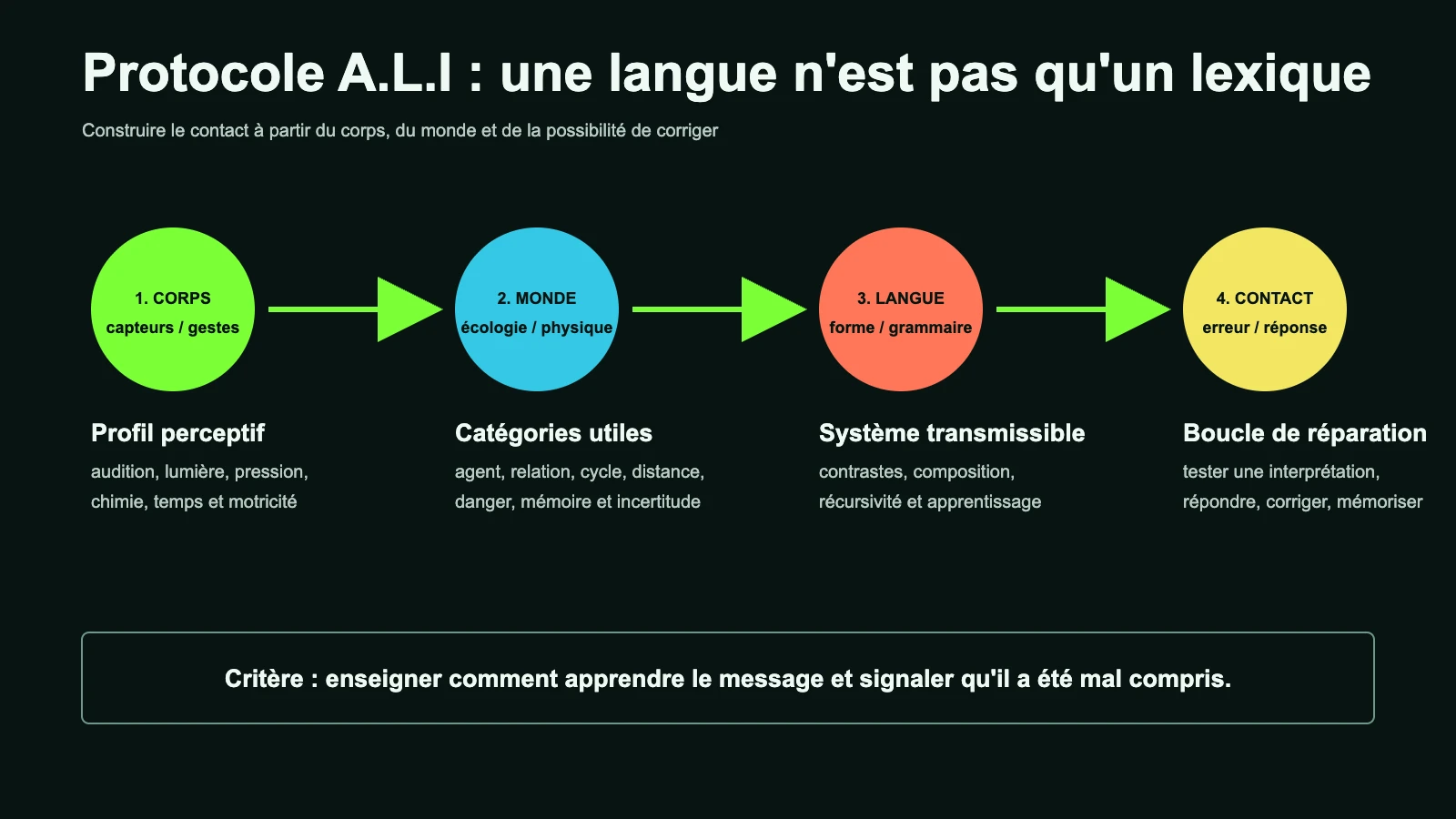
Artlangs are learnable because dictionaries, creators, and fictional worlds explain them. An interstellar message would lack this paratext. It would need to introduce its own contrasts, demonstrate rules, provide examples, and make error visible.
We propose a criterion: a contact language is complete only when it encodes not just messages, but also how to learn them, request repetition, and signal an incorrect interpretation. Its first sentence should be less “this is who we are” than “this is how to test what you think you understood.”
10. Four possible experiments
The bio-typological generator
Users define a hypothetical organism—sensors, temporal range, mobility, individual or collective organisation. The program generates only units compatible with that body and proposes a grammar adapted to its ecology.
The language-without-translation test
Two groups share situations but no lexicon. One invents a system; the other learns through examples and responses. Ambiguity, acquisition speed, and repair strategies are measured.
The theatre of impossible mouths
An installation transforms one utterance into voice, light, vibration, gesture, and spatial movement. Each medium reveals certain relations and destroys others.
The language that escapes its author
Humans and AI agents use a minimal language over several days. Changes survive only when several partners understand them. The final work is the measurable gap between designed and lived systems.
11. Critical position
Constructed languages do not prove that grammar imprisons thought. They show something subtler: changing categories, sounds, and habits temporarily redirects attention. Grammar is less a cage than a framing device.
For A.L.I, their lesson lies in a tension. Contact language must be alien enough not to silently reproduce our world, yet redundant and regular enough to be learned. Between pure mystery and instant translation is a productive zone where two intelligences progressively transform how they make signs.
LABO question: if the human brain treats an invented language like a natural one as soon as it speaks about the world, how will we recognise a language made by a being whose perceptual world resembles ours in no way?
References and further reading
- Marc Okrand — “Klingon: The Evolution of a Constructed Language”.
- Klingon Language Institute, language resources and speaker community.
- USC Dornsife — Paul Frommer on creating Na’vi.
- David J. Peterson — Like Spinning Plates.
- David J. Peterson — The Art of Language Invention.
- MIT McGovern Institute — constructed languages in the brain.