LAB — What this plaque would try to correct
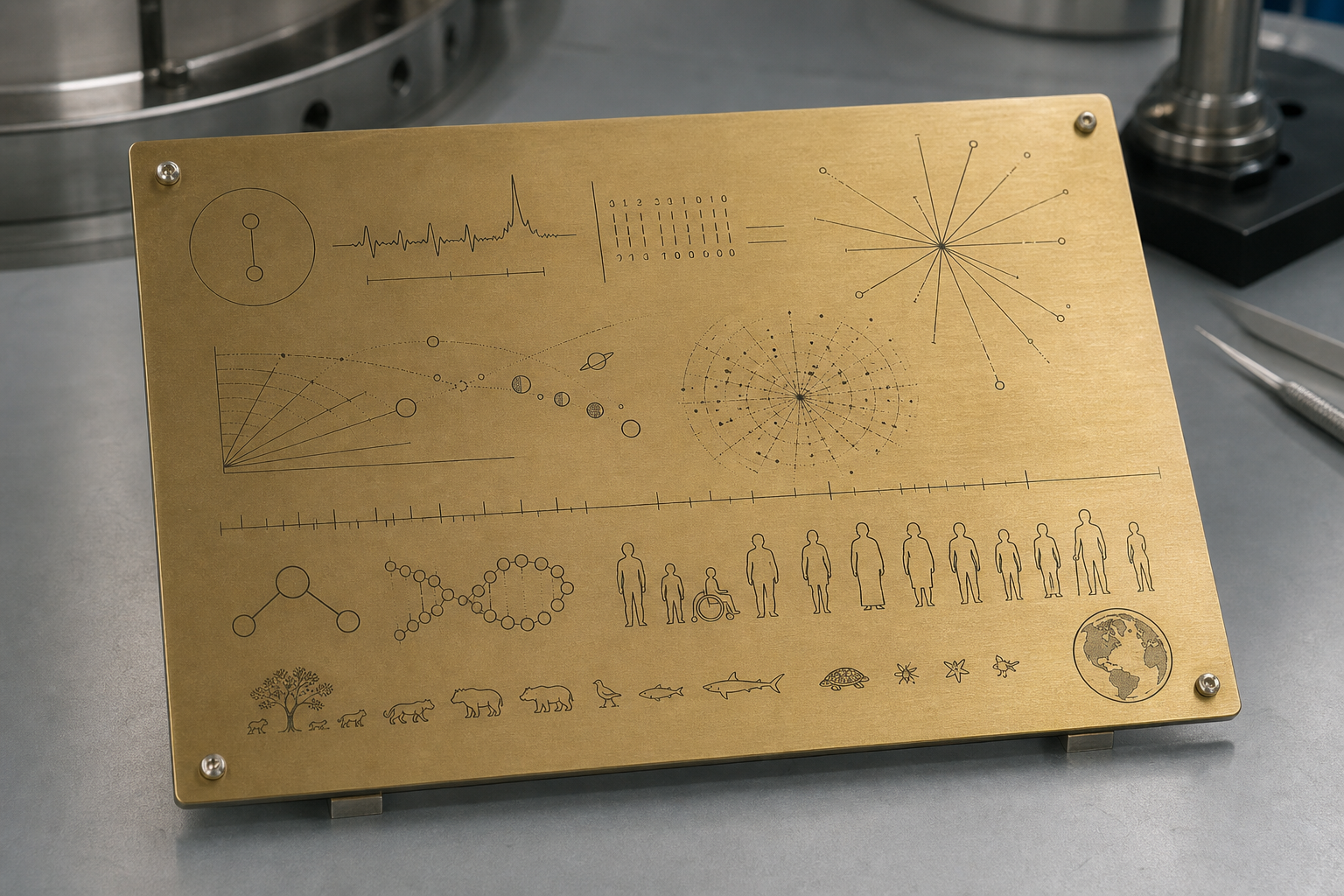
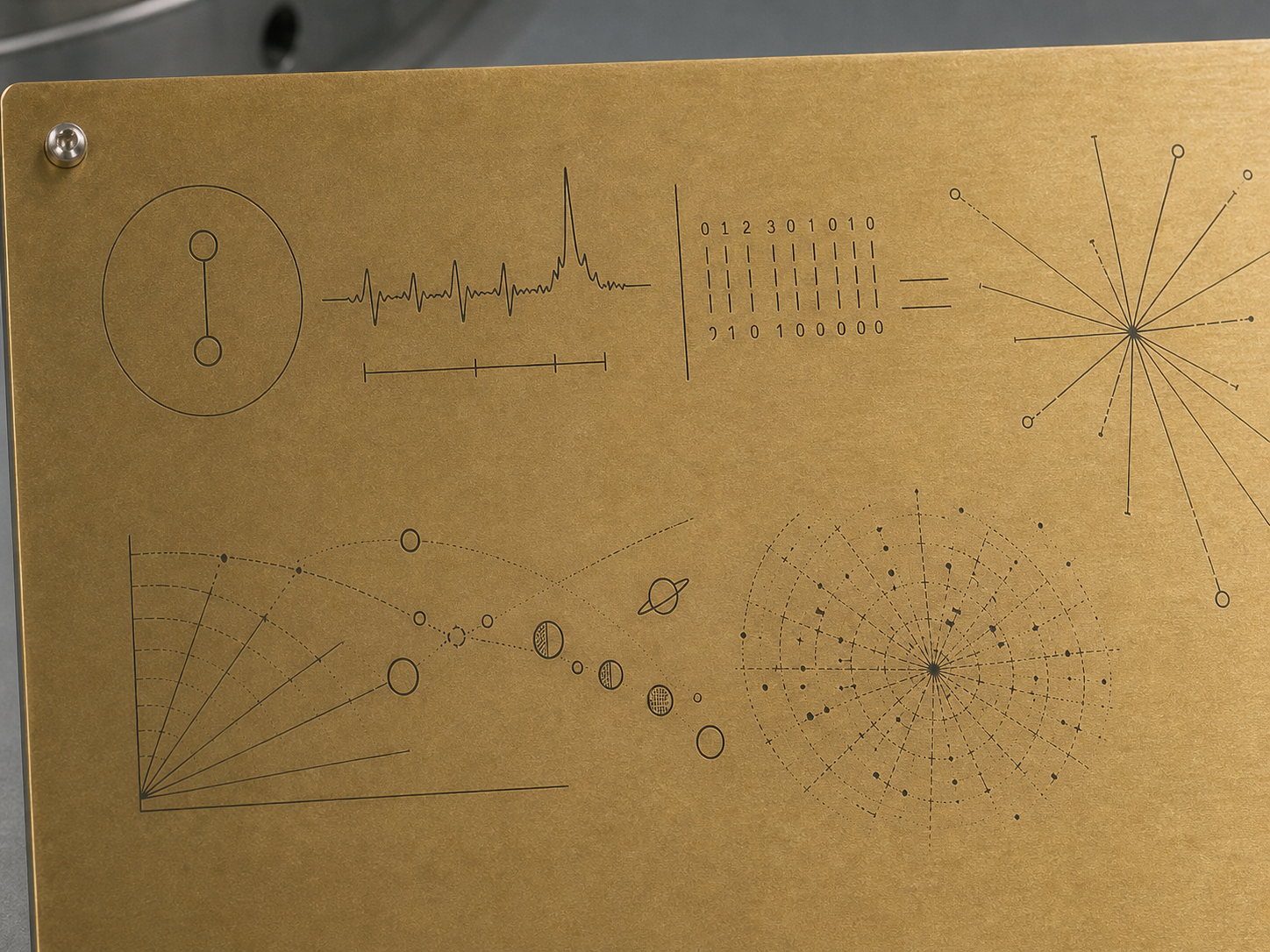
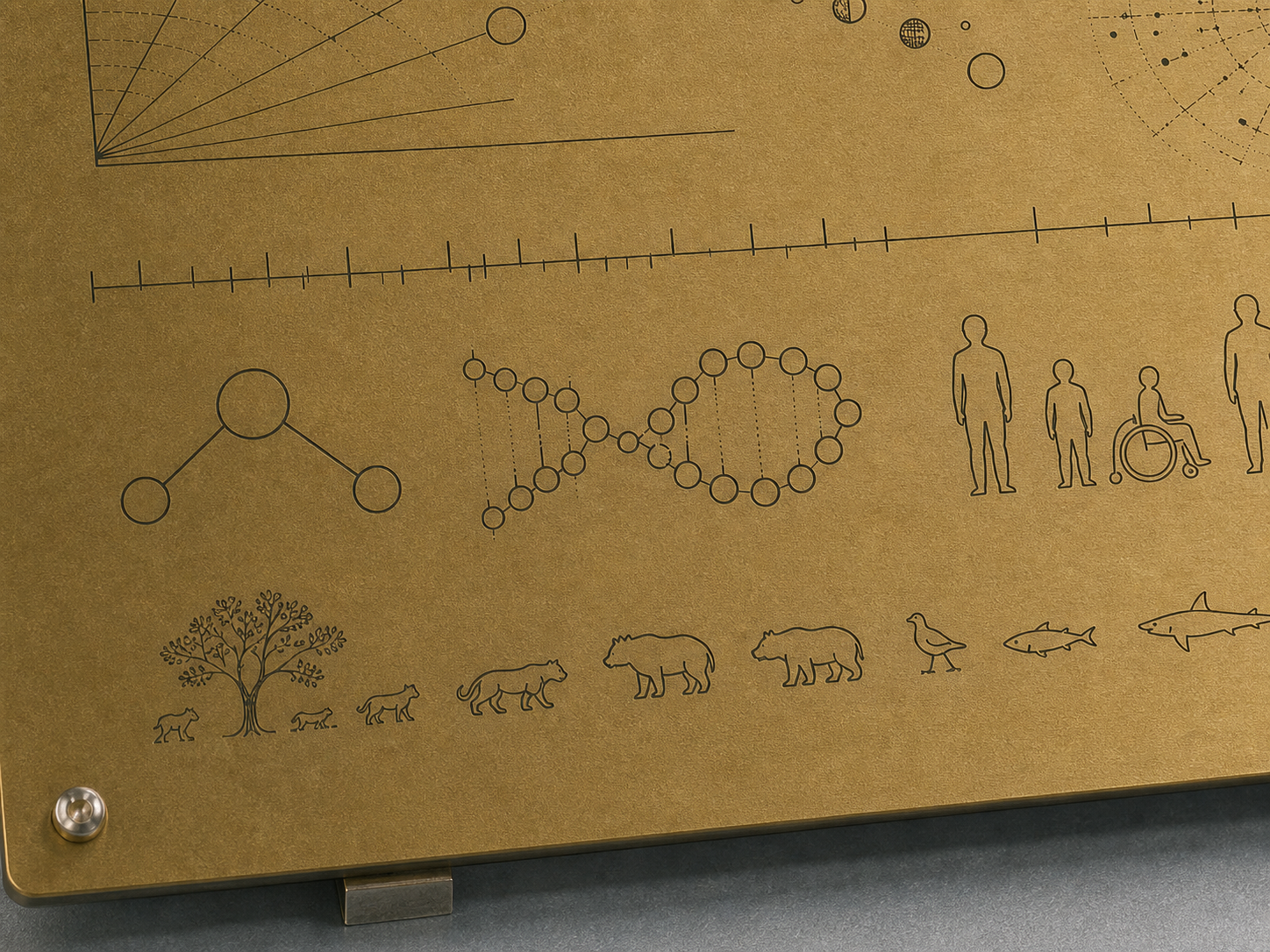
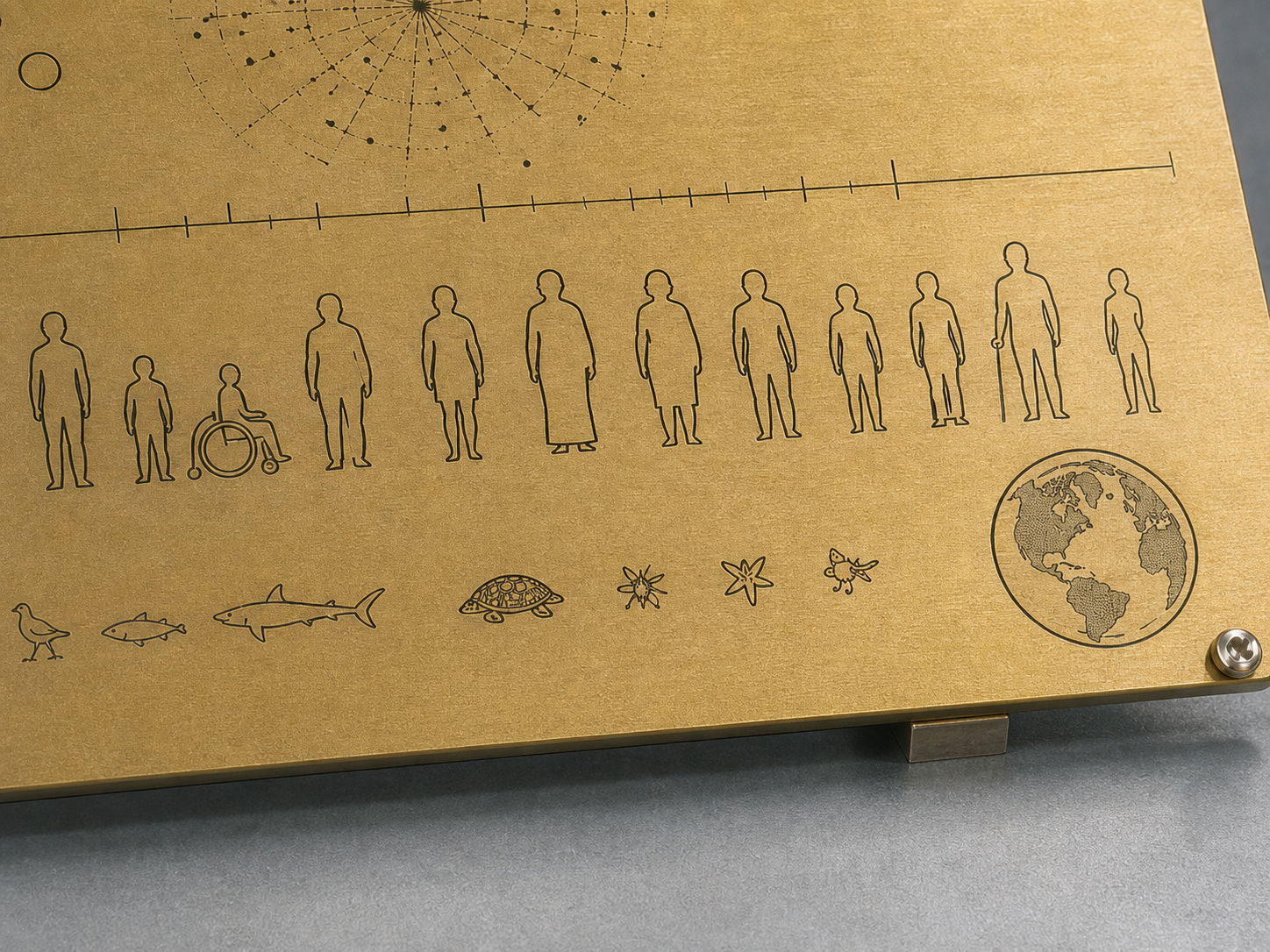
This projection preserves Pioneer’s most robust principle: begin with a reproducible physical unit, then progressively teach a scale, a location and a reading order. Yet it replaces the single human couple with a plurality of bodies, places humanity among other living forms and repeats information through several representations. It does not claim to be a finished universal message. Like the 1972 plaque, it makes the norms and questions of its own period visible.
An identity plate for an almost eternal object
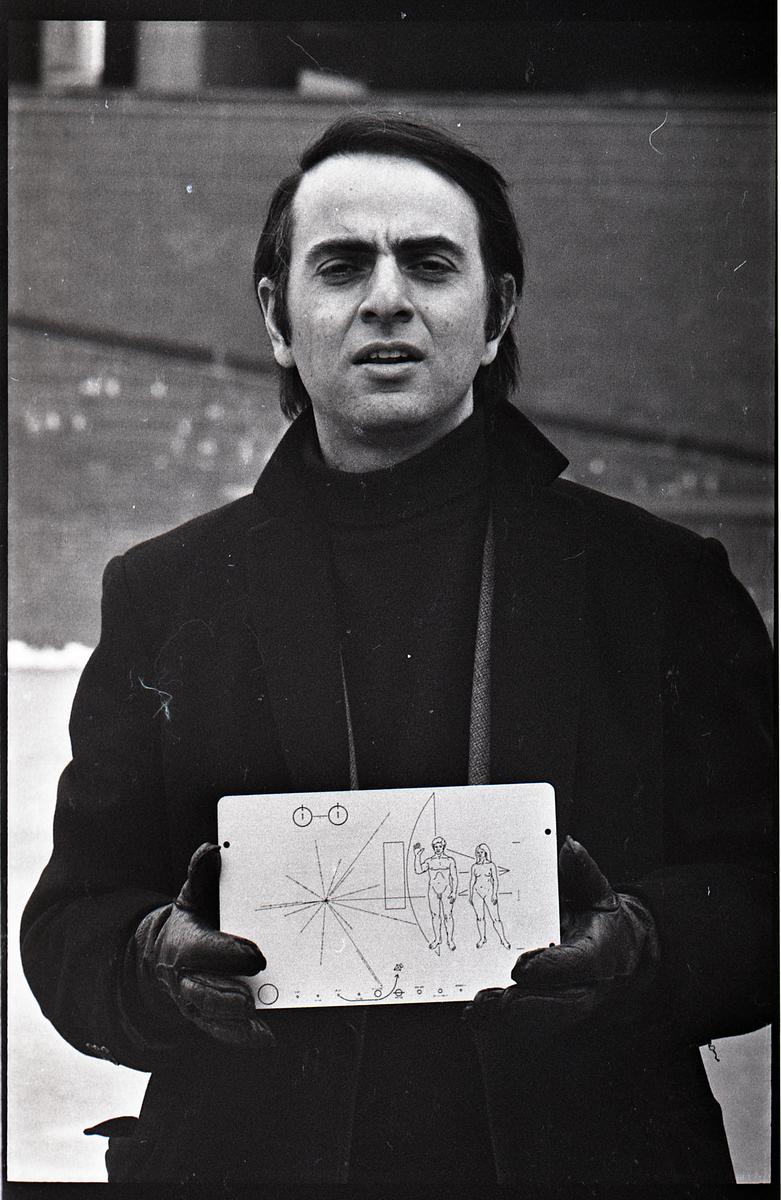
Pioneer 10, launched on 2 March 1972, and Pioneer 11, launched on 5 April 1973, became the first probes placed on Solar System escape trajectories after exploring the giant planets. The proposal to attach a message to Pioneer 10 was approved late: Carl Sagan, Frank Drake and Linda Salzman Sagan had only three weeks to move from idea to engraving.
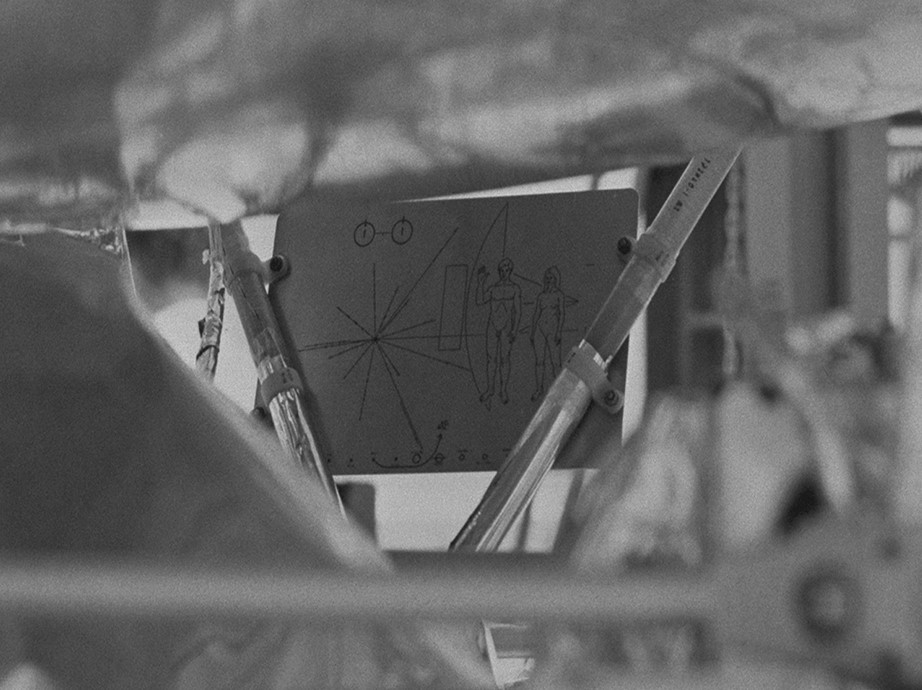
The result was a 6 × 9 inch gold-anodised aluminium plate, 0.05 inches thick. Shielded behind the antenna supports, it transmits nothing and requires no power. It waits. Its authors considered the chance of Pioneer naturally entering an inhabited planetary system negligible; the imagined recipient would need to be advanced enough to detect, intercept and inspect a tiny spacecraft in interstellar space.
This already reverses the familiar story. The plaque is not really a letter sent to an address. It is an archaeological label attached to a technical object, readable only if somebody first finds the object.
Begin by making a ruler
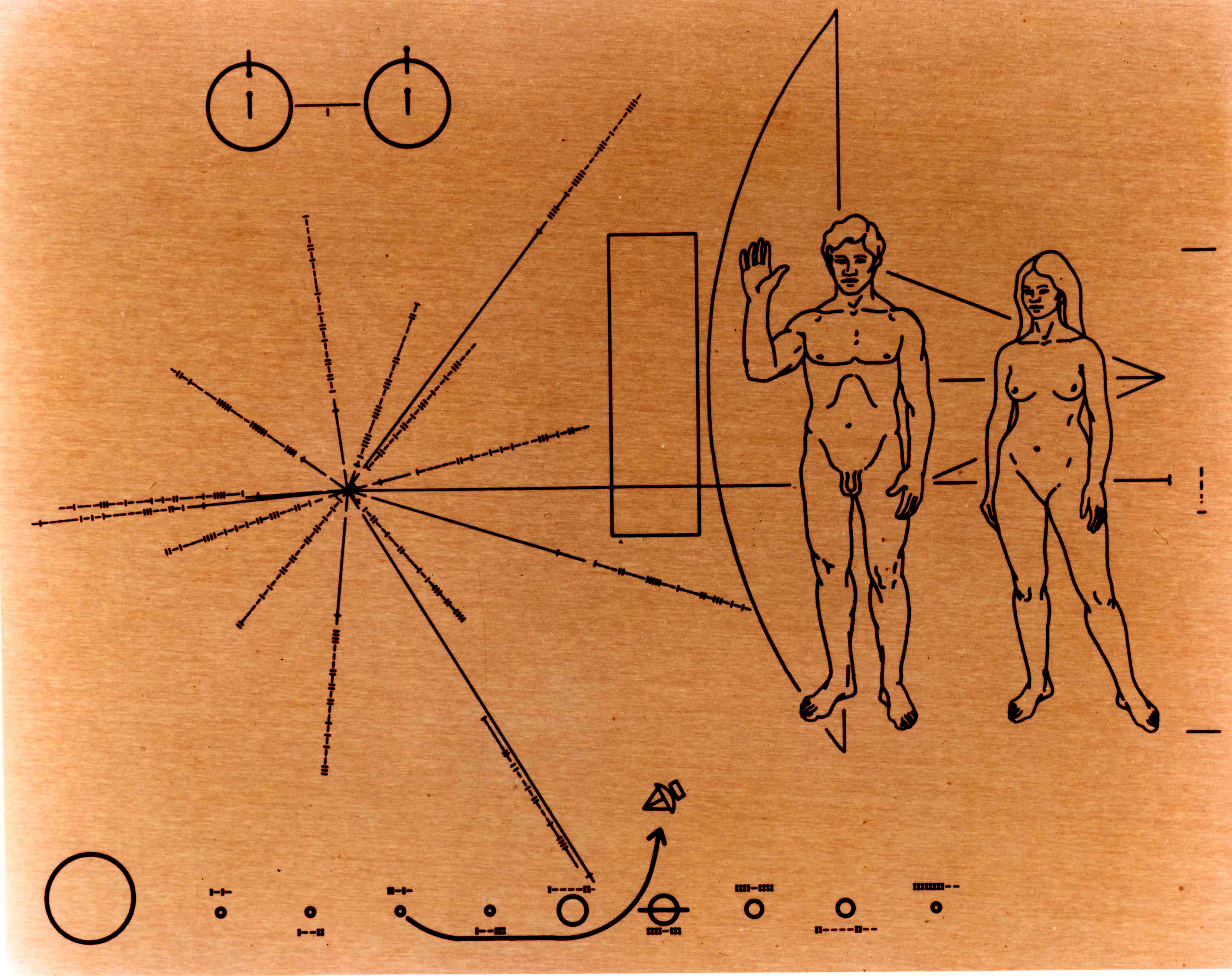
At the upper left, two states of a hydrogen atom represent the hyperfine transition of neutral hydrogen: the relative orientation of the proton and electron spins changes and a photon is emitted. The transition corresponds to a frequency of about 1,420.4058 MHz, a period of about 0.704 nanoseconds and a wavelength of about 21.106 centimetres.
The short stroke beneath the diagram means “one”. It establishes two standards presumed reproducible anywhere: one unit of time and one unit of length. The woman's height is labelled with the binary number 8: eight hydrogen wavelengths equal about 1.69 metres. The outline of Pioneer behind the two bodies supplies a second scale check.
This opening is the plaque's most robust layer. It does not claim that mathematics alone can speak; it shows that before stating a measurement, one must provide the rule that produces it. It connects directly with A.L.I articles “Mathematics as a Universal Language?” and “Rosetta Stone, Binary Stele”.
Where and when: an address written with dead stars
The radial figure begins at the Sun. Fourteen lines point towards pulsars; a fifteenth points to the Galactic centre. Each pulsar carries its period in binary, expressed through the hydrogen time unit. Because pulsars slow at measurable rates, those periods provide both an address and a date: a reader able to identify several of them could triangulate the system of origin and estimate the launch epoch.
At the bottom, the Solar System shows the probe leaving the third planet. Yet the trajectory arrow introduces a far less universal convention. Art historian Ernst Gombrich observed that an arrow descends from the terrestrial projectile: an intelligence without bows, graphic writing or vision might read nothing in it. The plaque therefore moves from the relatively robust — an atomic transition — towards the openly cultural — a map, an outline, a gesture.
The message Earth first read as a mirror
The supposedly most immediate part of the design caused the controversy. The pair were shown naked so that no particular clothing would be mistaken for human anatomy. Yet in 1972 some American newspaper editors erased the male genitals and female nipples; others received letters accusing NASA of sending obscenity into space.
The asymmetry went deeper. The man raises his hand, supposedly demonstrating limb movement and the opposable thumb; the woman remains still. Male genitals are drawn while the vulva is omitted. Intended as “panracial”, the figures were often perceived as young and white. Finally, the plaque reduces the biosphere to two adult humans: no child, old age, bodily diversity, other animal, plant or environment.
This criticism is not merely a later judgement imposed from outside. In their 1972 scientific paper, Sagan, Drake and Salzman Sagan themselves acknowledged that the message inadvertently contained anthropocentric content and remained constrained by human perceptual and logical processes. The plaque therefore performs two transmissions: to a hypothetical recipient it describes our origin; to us it reveals what a small group in 1972 considered self-evident.
From Pioneer to Europa Clipper: more data, more authors
The plaque founded a family of devices rather than a final model. The 1974 Arecibo message turned a presentation of Earth into 1,679 radio bits: fast travelling, but without a durable carrier and aimed at a target that will move during the journey. The 1977 Voyager Golden Records reused the hydrogen standard and pulsar map while adding playback instructions, pictures, voices, living sounds and music. Representation became multimodal and more collective without becoming neutral.
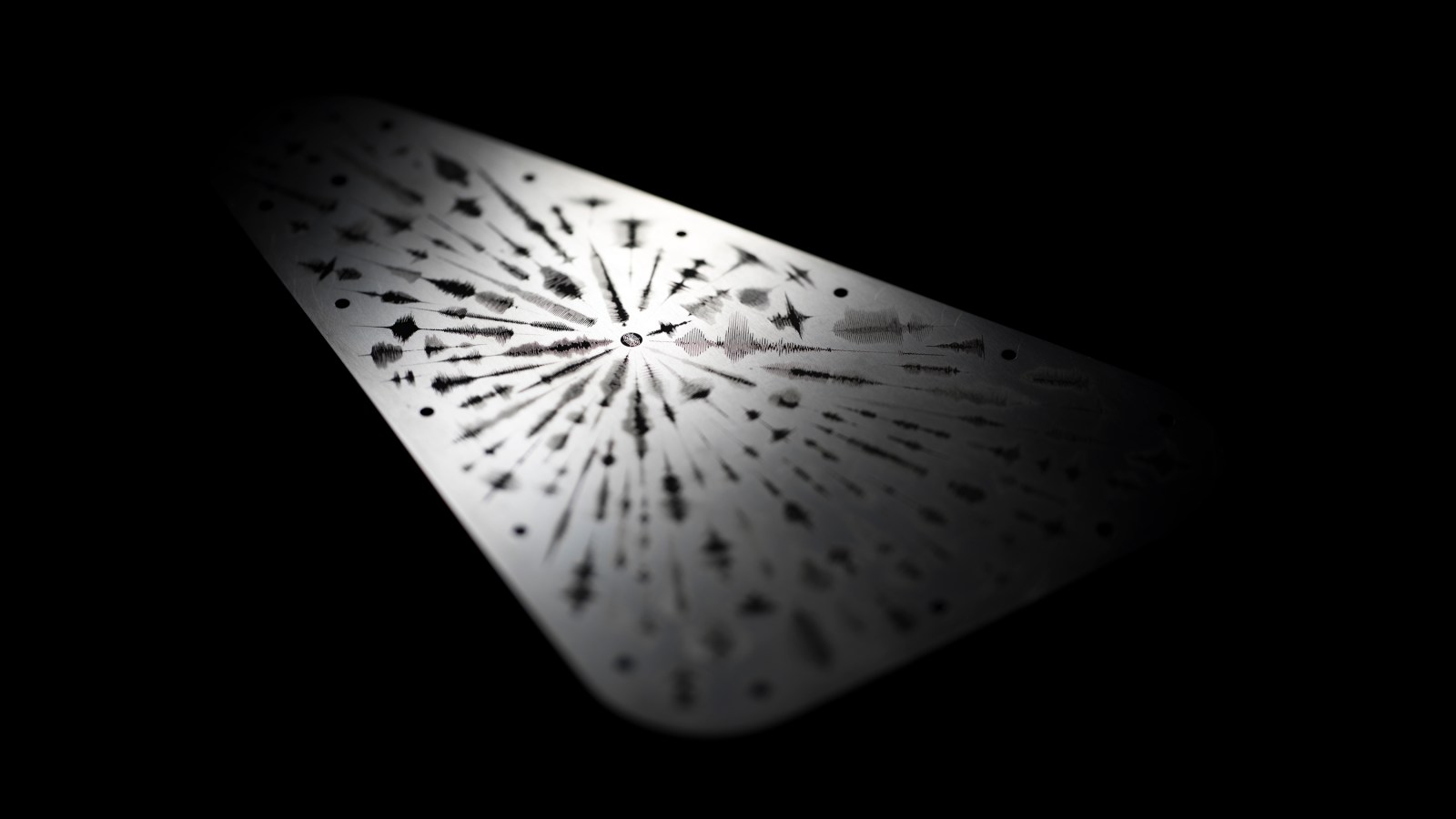
Not all later plaques address extraterrestrials. Lucy, launched towards the Trojan asteroids in 2021, carries words intended for future humans who might retrieve the probe. Europa Clipper, launched in 2024, carries a tantalum plate on which waveforms of the word “water” in more than one hundred languages radiate around the American Sign Language sign; it also includes a poem by Ada Limón, the Drake Equation and more than 2.6 million names engraved on a chip.
The direction is clear: from a pictogram designed by three people towards polyphonic, participatory archives connected to the mission. But quantity does not solve everything. The more a message depends on a reader, digital format or playback machine, the more carefully it must explain its own conditions of access. This is the problem of the message and its key.
The inverse hypothesis: what if we found their plaque?
Pioneer supplies a minimal existence proof: a technological civilisation can release an object that remains silent for immense spans of time while carrying information. The question can therefore be reversed. Might another civilisation have sent not a radio signal but a probe, beacon or material archive towards our system? This approach is known as artifact SETI, SETA or xenoarchaeology.
Such a device need not resemble a plaque. Several forms are conceivable:
- A passive stele made from stable material whose crystalline, isotopic or geometric regularities signal manufacture before revealing content.
- A Bracewell probe able to listen for long periods, learn local sign systems and adapt its answer to the recipient.
- A miniature swarm distributing redundancy among many simple objects rather than one vulnerable machine.
- A deposited archive placed on a geologically quiet surface, in a lunar crater, at a Lagrange point, in a co-orbital path or on a stable small body.
- A dual-reading object apparently natural but containing, in its composition or internal structure, a clearly artificial layer.
The final possibility demands the greatest discipline. An unusual trajectory, shape or isolated signal is not enough. Recognition would have to combine provenance, composition not explained by known processes, non-random patterns, redundancy, error correction, manufacturing traces, energetic behaviour and independent confirmation. The programme is not to declare an interstellar object a probe; it is to define in advance what could distinguish an artefact from a natural phenomenon.
This inversion extends “Archaeology of the Unknown” and shifts the logic of technosignatures: instead of observing a civilisation at a distance, we would need to establish the chain of custody of an object from elsewhere.
A.L.I projection: design a plaque that teaches how to read it
For A.L.I, Pioneer's central lesson is methodological. A future interstellar message should be layered:
- signal its artificial presence through robust regularities;
- establish units from reproducible physical phenomena;
- teach its numbers, relations and reading order;
- repeat the same content across several material and sensory forms;
- describe instruments, uncertainties and transformations applied to data;
- present not one supposedly representative body but a plurality of organisms, environments and viewpoints;
- include a response protocol that does not require sharing our perception.
The Pioneer plaque remains valuable precisely because it is imperfect. It understood that a message must begin with its measurement, but also demonstrated that no picture of “us” escapes its period. The future plaque will not be the one that accumulates the most information. It will be the one that best exposes its conventions, limits and capacity for correction.
English references
- NASA Science — Pioneer Plaque.
- NASA History — 50 Years Ago: Pioneer 10 Launches to Explore Jupiter.
- Sagan, Salzman Sagan & Drake — “A Message from Earth”, Science, 1972.
- TIME — “Rorschach in Space”, 1972.
- Frontiers — Introducing Humans to the Extraterrestrials.
- NASA Science — Europa Clipper Vault Plate.
- Keck Institute for Space Studies — Data-Driven Approaches to Technosignatures.
- James Benford — A Drake Equation for Alien Artifacts.