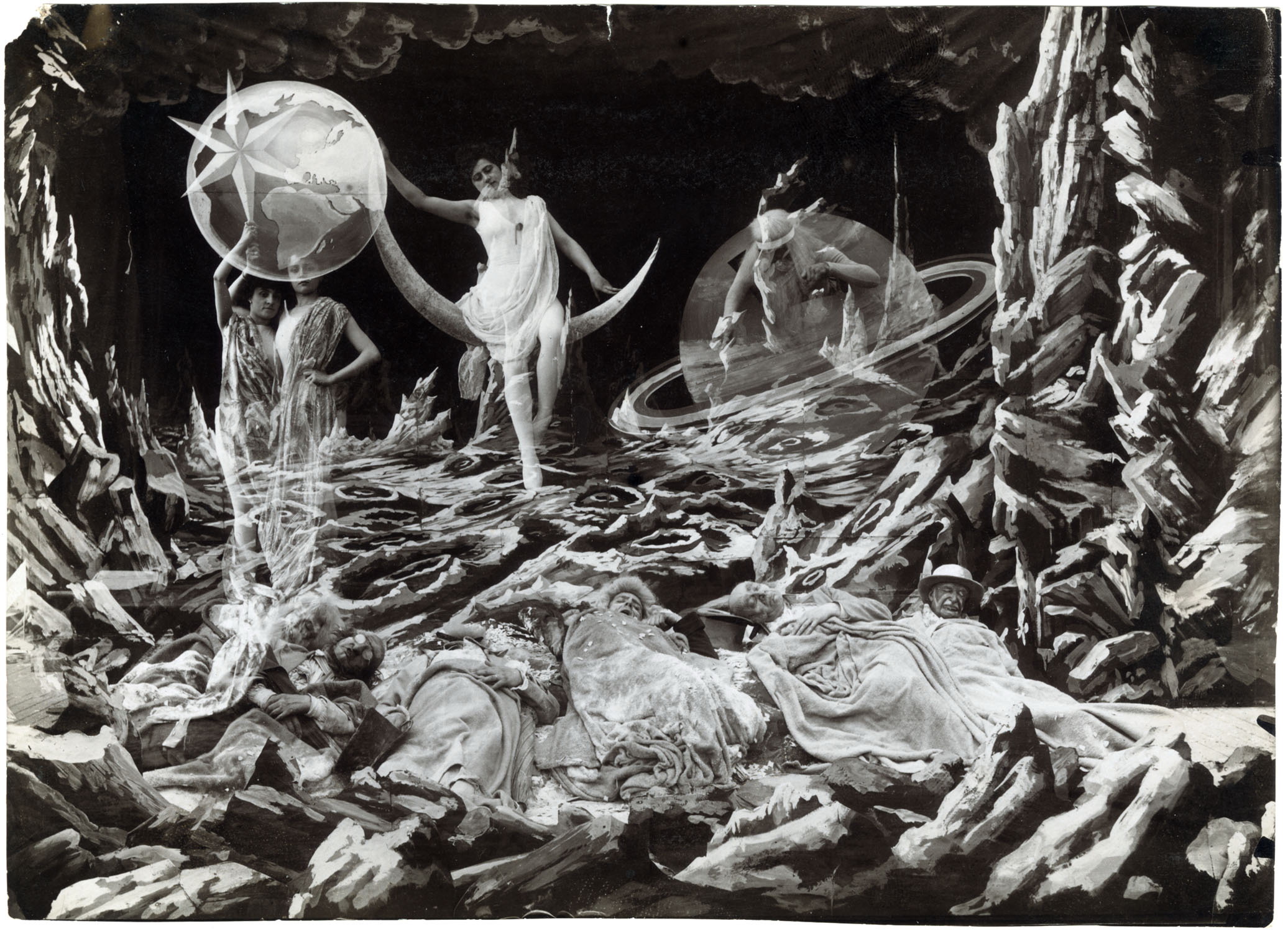
Two centuries before Wells, Savinien de Cyrano de Bergerac sent an Earthman to the Moon, where he was taken for an animal, exhibited, and forced to prove that he could think. His narrative does not yet describe the extraterrestrial in the modern biological sense. It constructs something more useful for A.L.I: a world from which humans lose the privilege of defining intelligence.
The Real Cyrano, Before the Character
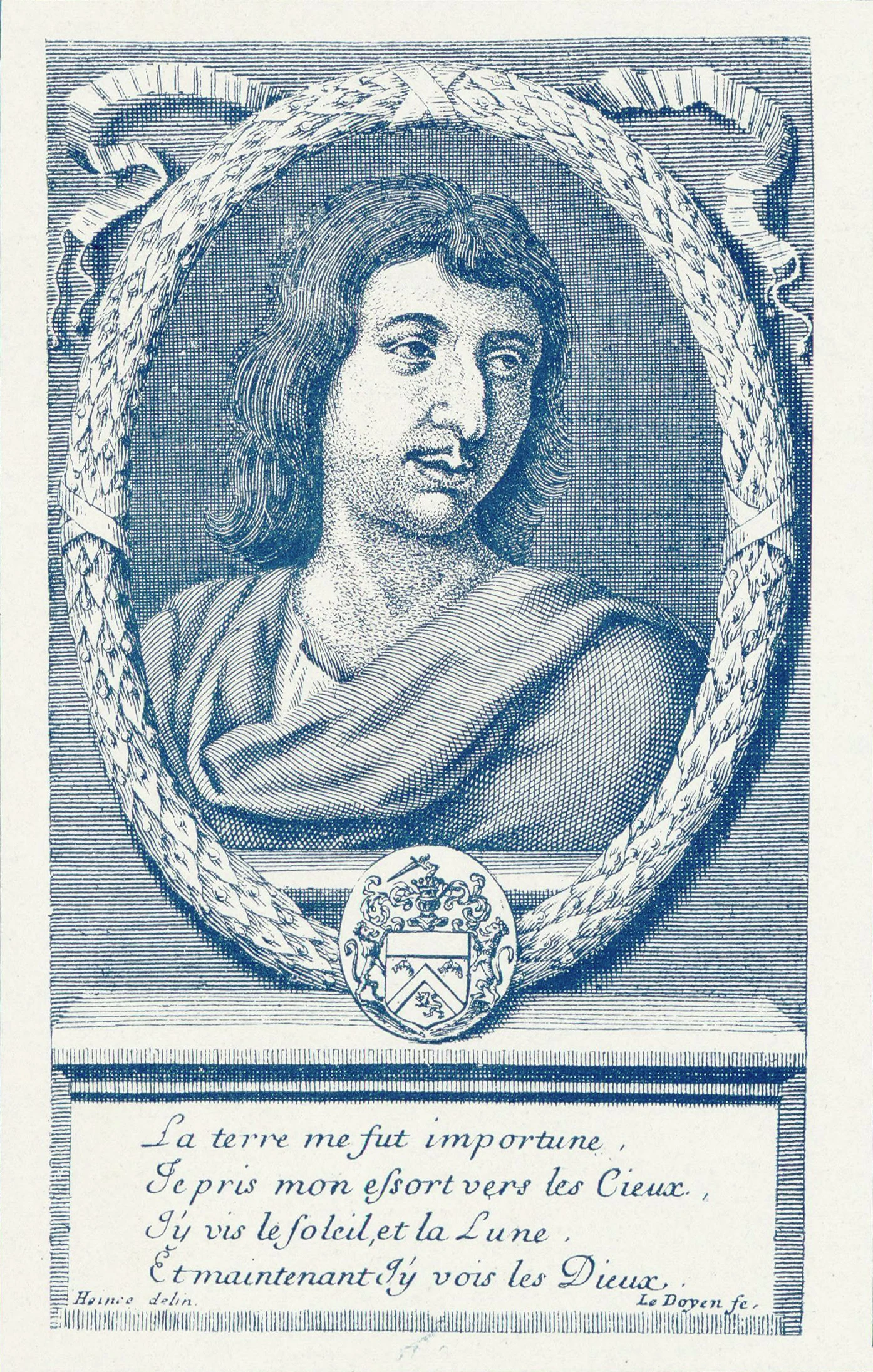
The Cyrano at stake here is not Edmond Rostand's romantic hero of 1897. Savinien de Cyrano de Bergerac, born in 1619, was a seventeenth-century libertine writer. His two imaginary voyages appeared after his death: The States and Empires of the Moon in 1657 and The States and Empires of the Sun in 1662.
These works do more than move an adventure into the sky. They test laws, religions, species hierarchies, language and criteria of truth. The Bibliothèque nationale de France places Cyrano among the major precursors of imaginative literature leading toward science fiction.
One Sentence Is Enough to Displace Earth
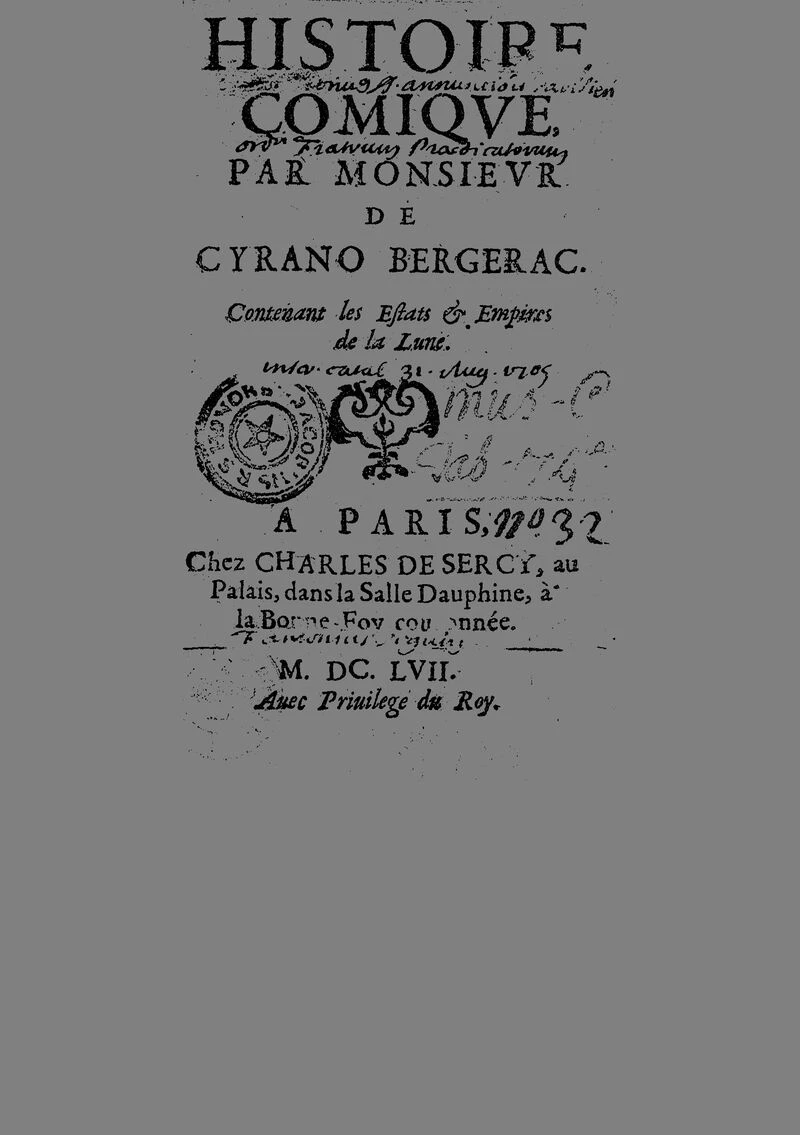
The voyage begins with a vertiginous proposition: the Moon is a world like ours, and our world serves as its moon. Earth immediately ceases to be the centre. Before any creature appears, contact has begun through a change of viewpoint. The first edition is preserved by Gallica.
Before Cyrano: Learning to Leave the World
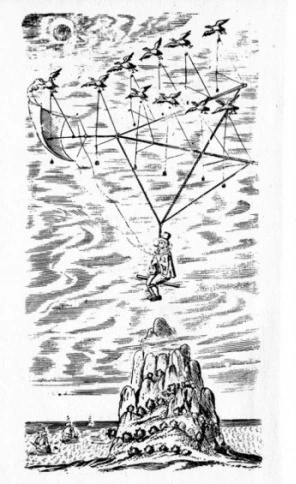
Cyrano belongs to an older genealogy. Lucian of Samosata had imagined a satirical voyage to the Moon. Johannes Kepler made his Somnium, published in 1634, a change of astronomical perspective. In 1638 Francis Godwin published The Man in the Moone, whose traveller reaches the Moon with migrating birds.
Cyrano multiplies techniques in turn: bottles of dew drawn upward by the Sun, mechanical devices, rockets and failed attempts. Literary invention becomes a laboratory in which uncertain science can be tested.
On the Moon, the Human Becomes an Animal
The traveller discovers a society of large four-legged beings. Because he walks on two legs, wears clothes and produces incomprehensible sounds, he is classified as an animal. He is confined, examined and exhibited. His speech first resembles learned noise; even his reasoning may be interpreted as imitation.
Cyrano formulates a central A.L.I problem: being intelligent is not enough to be recognised as intelligent. The other must identify our signs as intentional. A complex message can remain indistinguishable from a cry, a natural event or an automatism. This inversion connects directly to Animal Language, Human Language and the Interstellar Turing Test.
Languages Made of Music and Bodies
The Moon's inhabitants do not all share the same language. Elites communicate through variations of tone resembling music. Common people use movements of the body: a posture or articulated limb can carry an utterance. Cyrano imagines several cognitive media. Pitch, rhythm and intervals produce meaning in one; the whole body becomes grammar in the other.
The narrative also describes books that are heard rather than read. Their mechanism restores the voice and makes a portable sound library possible. Long before the phonograph, audiobook and podcast, Cyrano was already asking whether a book is a printed object or a structure transferable between media.
The Trial of the Human Species
In The States and Empires of the Sun, birds judge humankind for its violence toward other species. Humanity is no longer the judge of life: it must answer before it. Animal speech connects species domination, political power and the human claim to occupy the summit of creation.
An interstellar civilisation might perform the same reversal. It might ask not only what we can build, but how we treat beings unable to speak our language. Our farms, laboratories, nature reserves and automated systems could prove more revealing than messages carefully prepared for its attention.
A Message Altered by Its Own Transmission
Both narratives were published after Cyrano's death. Surviving manuscripts and early editions differ, and the 1657 text was altered and expurgated. What reaches us is already a message crossed by copyists, editors and political or religious constraints.
This material history resembles a problem of interstellar communication: an old signal may be incomplete, censored, damaged or recomposed. Understanding its content also requires reconstructing what happened during transmission.
From Mirror World to Modern Extraterrestrial
After Cyrano, each period reorganises the encounter. Fontenelle makes the plurality of worlds accessible through conversation. Voltaire uses differences of scale in Micromégas to ridicule human self-importance. Jules Verne turns lunar travel into an engineering problem.
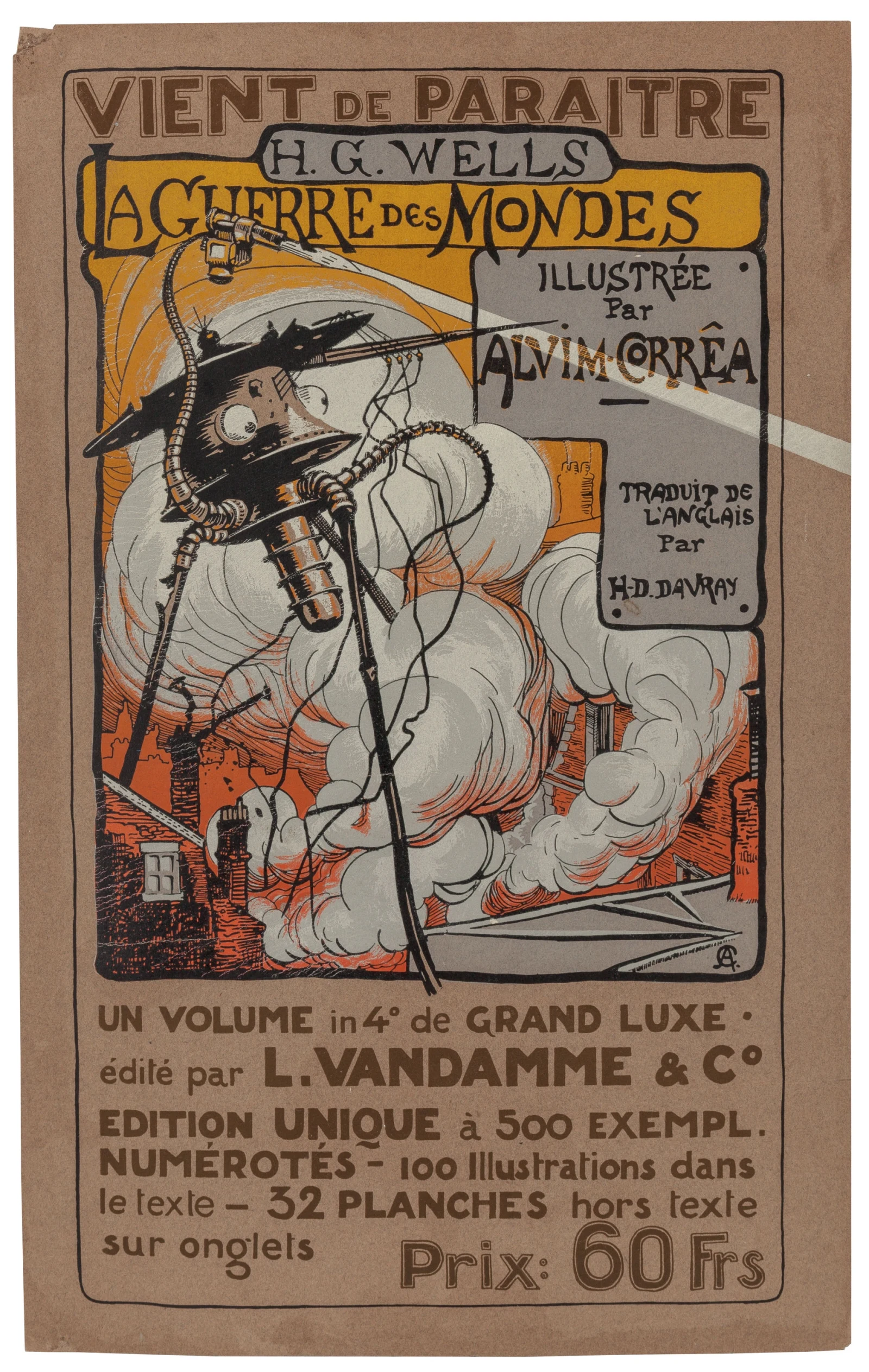
With The War of the Worlds, H. G. Wells reverses colonial power: Europe becomes the territory invaded by superior technology. In the twentieth century Stanisław Lem crosses another threshold with Solaris. Encountered intelligence is no longer necessarily an individual with a body and a language, but may be a planetary entity whose manifestations remain ambiguous after years of observation.
Contemporary Poetries and Literatures of Contact
Recent literature moves the problem again. In Ted Chiang's Story of Your Life, learning the heptapods' non-linear writing transforms the perception of time. In China Miéville's Embassytown, an alien language requires two perfectly synchronised voices and initially resists lies and metaphor. A human woman literally becomes a living figure of speech.
With Christian Bök's The Xenotext, poetry leaves paper: a poem is encoded in a bacterium's DNA, and the resulting protein encodes a second text in response. Life becomes author, reader, archive and transmission channel. The project is conceived to outlast civilisation and potentially communicate our presence to distant intelligence.
Tracy K. Smith's Life on Mars turns the cosmos into an echo chamber for grief, love and the desire not to be alone. Octavia E. Butler's Xenogenesis trilogy makes contact a genetic hybridisation in which consent, survival and the possible end of autonomous humanity cannot be separated.
Two further works move contact beyond the classic extraterrestrial. Alain Damasio's Les Furtifs invents beings of flesh and sound that metabolise their environment and demand a typographic, physiological language. Ursula K. Le Guin's Always Coming Home transmits a future civilisation through fictional ethnography made of narratives, songs, poems, drawings and sound archives. These works extend Cyrano in three directions: alternative language, transformative language, then living language.
The Four Operations of Literary Contact
Projection. We imagine the other through our technologies, fears and social structures.
Classification. Each civilisation places the unknown in its own categories: animal, god, machine, natural event or enemy.
Translation. Interlocutors search for regularities in sounds, gestures, numbers, images or behaviour.
Judgement. The encounter evaluates not only the other's intelligence, but also its way of inhabiting its world.
Contact fails when one operation is mistaken for proof. Classification is not understanding. Translating a sign does not reveal its intention. Detecting technology is not meeting the civilisation that produced it.
A.L.I LAB: The Lunar Translator
An experiment called The Lunar Translator could encode one proposition through three Cyrano-inspired channels: a musical composition of intervals and repetitions; a gestural sequence performed by a real or synthetic body; and a luminous diagram in which durations, positions and intensities form a syntax.
Three groups would receive one unexplained channel. They would identify units, repetitions, relations and possible intention. A second phase would superimpose all three versions to measure what redundancy makes intelligible. The experiment would not claim to make a universal language. It would show how recognition depends on body, medium, context and the observer's expectations.
No Longer Controlling the Definition of the Human
Cyrano turns extraterrestrial encounter into a critical machine. The Moon and Sun do not describe scientifically plausible civilisations. They let us look back at Earth from a position where its certainties no longer work.
This may be one of literature's essential roles within A.L.I. Before translating an interstellar language, it trains us to endure a harder situation: no longer being the only ones who decide what counts as intelligence, speech, animal or person.
First contact does not begin when we understand the Other. It begins when we discover that we no longer control the definition of the human.