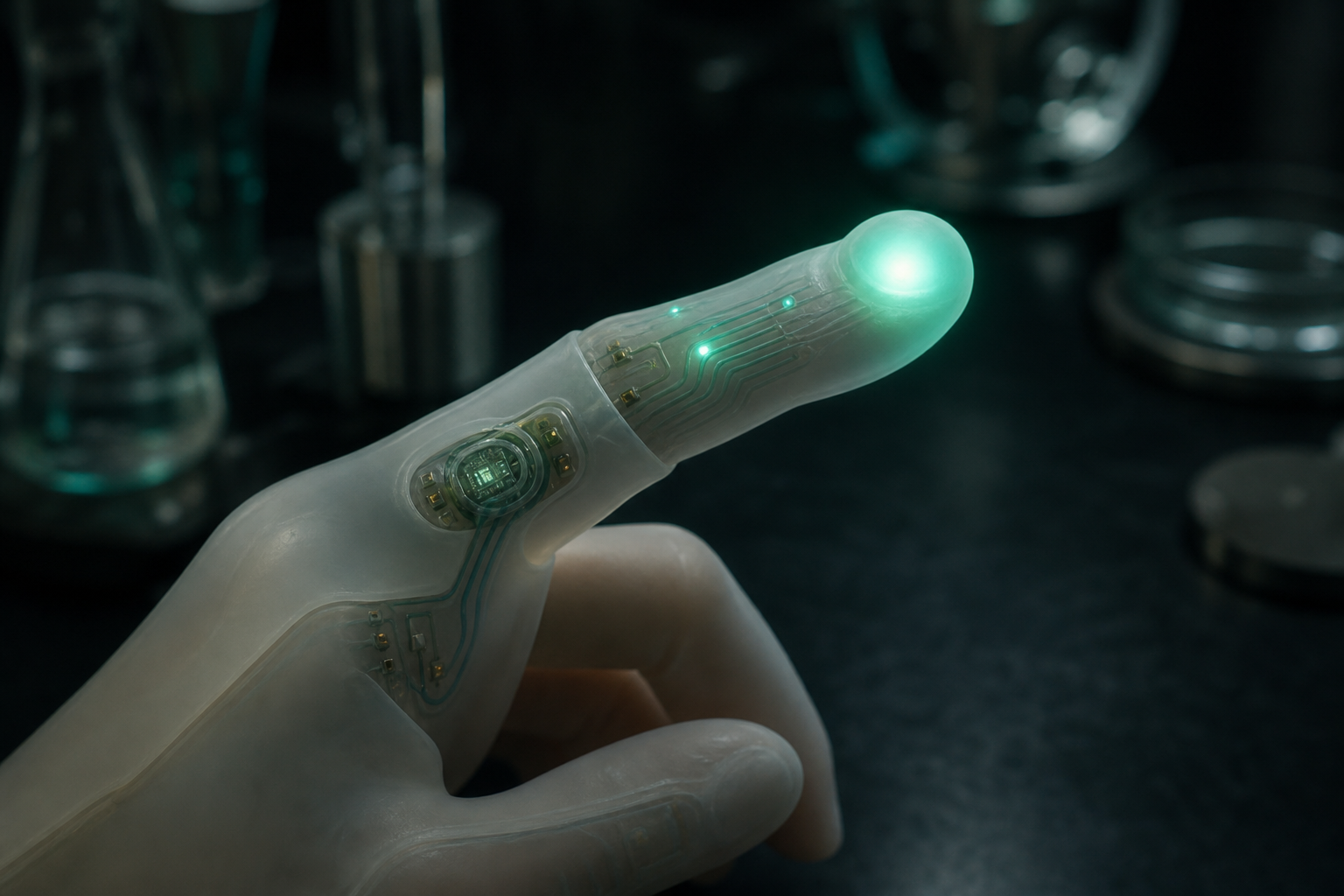
Hypothesis: the raised finger can become a tiny communication terminal. Instead of imagining a large device, the project begins with a very small gesture: light, touch, pulse and code at the fingertip.
Starting Point
The first image is deliberately simple: a finger that glows like a signal. It could be a toy-like object, a thimble, a ring, a plastic fingertip, a glove extension or a small wearable shell. The object does not need to imitate cinema literally; it can translate the fantasy of contact into a usable interface.
The most realistic first prototype is not a full Bluetooth translator. It is a luminous Morse finger: press a button, and the fingertip emits dots and dashes with an LED. This version can be built cheaply, tested quickly, and used as an installation object.
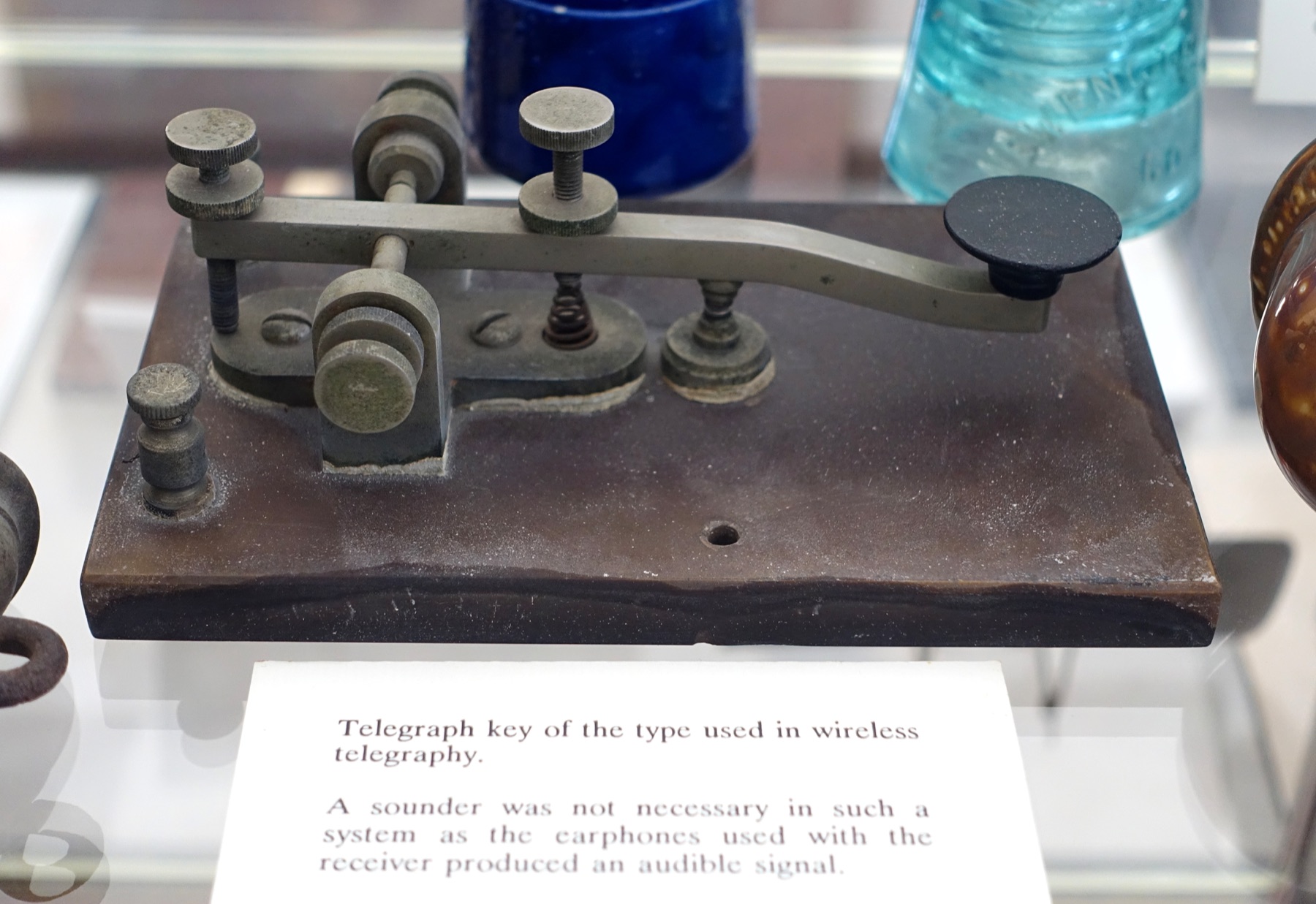
Minimal Version: Light Morse
- a finger ring or thimble-like shell;
- one bright LED or addressable RGB LED;
- one push button;
- a tiny battery;
- a small microcontroller, or a very simple pre-programmed blinking circuit.
The user presses once for a dot, holds longer for a dash, or selects a stored message. The fingertip blinks a greeting, a name, a coordinate, or a short A.L.I message.
Connected Version: Two Fingers Talking
A second stage uses two connected fingers. Each object can send a message to the other via Bluetooth Low Energy. One finger records a spoken sentence or receives typed text from a phone, converts it into Morse, sends the pattern, and the receiving finger decodes it back into text or sound.
- Input: button, phone text field, or voice-to-text.
- Encoding: text transformed into Morse timing.
- Transmission: Bluetooth BLE between two modules or via a phone relay.
- Output: light flashes, vibration, small buzzer, or phone voice synthesis.
Electronics Without Soldering
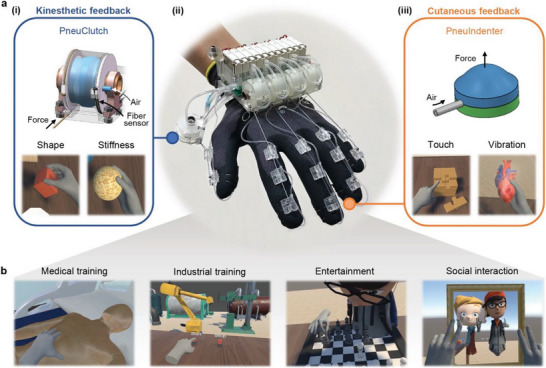
For a proof of concept, a no-solder path is possible with M5Stack or Adafruit boards using Grove/STEMMA connectors. M5StickC Plus, M5Atom, Seeed XIAO nRF52840 Sense, Adafruit Circuit Playground Bluefruit, or micro:bit can provide buttons, LEDs and BLE with minimal wiring. The trade-off is size: these boards are often too large for a pure fingertip, but acceptable for a glove, wrist module or theatrical prototype.
Rings, Gloves and Thimbles
Commercial LED finger rings already exist as toys. They are cheap, visible and useful for testing gesture and light language, but they are generally not programmable. A thimble or full-finger ring, sometimes called a finger cot, claw ring, articulated finger armor or gothic finger ring, can become the physical shell for the prototype.
NFC LED nail stickers or NFC LED rings are not a good solution for programmable Morse: the phone can power the LED briefly through NFC, but the LED itself usually has no memory or programmable controller. NFC can trigger an action on the phone, but it cannot easily make the passive LED blink a custom Morse sequence by itself.
Difficulty Levels
- No solder: LED toy or M5/micro:bit board in a glove. Difficulty: easy.
- Light soldering: small LED, button, battery and microcontroller in a finger shell. Difficulty: medium.
- Connected pair: BLE messaging, Morse encoder/decoder, mobile interface. Difficulty: advanced software plus careful miniaturization.
A.L.I Prototype
The most elegant object may be a hybrid: the finger itself only emits light and vibration, while the phone handles text, speech recognition and decoding. The artifact remains magical and tactile, but the complex intelligence stays in software.
LABO question: can a finger become a language instrument before it becomes a technological gadget?