What if the first METI protocol were aimed not at a star, but at another Earth species? Earth Species Project is not merely trying to recognise a handful of animal calls. It is building a full infrastructure: gathering and cleaning millions of recordings, annotating them, learning acoustic representations, benchmarking models, identifying patterns and eventually producing synthetic vocalisations whose reception can be tested. The message is no longer sent into cosmic silence. It returns as behaviour, response or refusal.
This article is distinct from the earlier piece on zebra finches. That study concerned one species, its call categories and a particular vocal-learning experiment. Here the subject is the cross-species infrastructure: open tools, datasets and protocols intended to work across birds, marine mammals, primates, insects and amphibians. NatureLM-audio is its flagship model, not the whole project.
1. A listening pipeline, not a magic translator
The popular promise of a “Google Translate for animals” drastically simplifies the problem. Before translation, researchers must discover what counts as a unit, who produces it, in which situation, with what variation and what effects. Earth Species Project organises this enquiry in layers. alp-data harmonises heterogeneous collections; Biodenoising separates biological sounds from wind, engines and other sources; AVES learns acoustic representations; Voxaboxen supports annotation; BEANS and BEANS-Zero evaluate models; and NatureLM-audio connects audio to natural-language instructions and answers.
This architecture changes the scale of bioacoustics. A laboratory may study one repertoire for years using a few hundred carefully annotated hours. A foundation model tries to transfer what it learns from one corpus to other taxa, including species absent from training. The conservation potential is enormous, but so is the risk: an error may spread with the authority of automated science.
2. NatureLM-audio: a bioacoustic foundation model
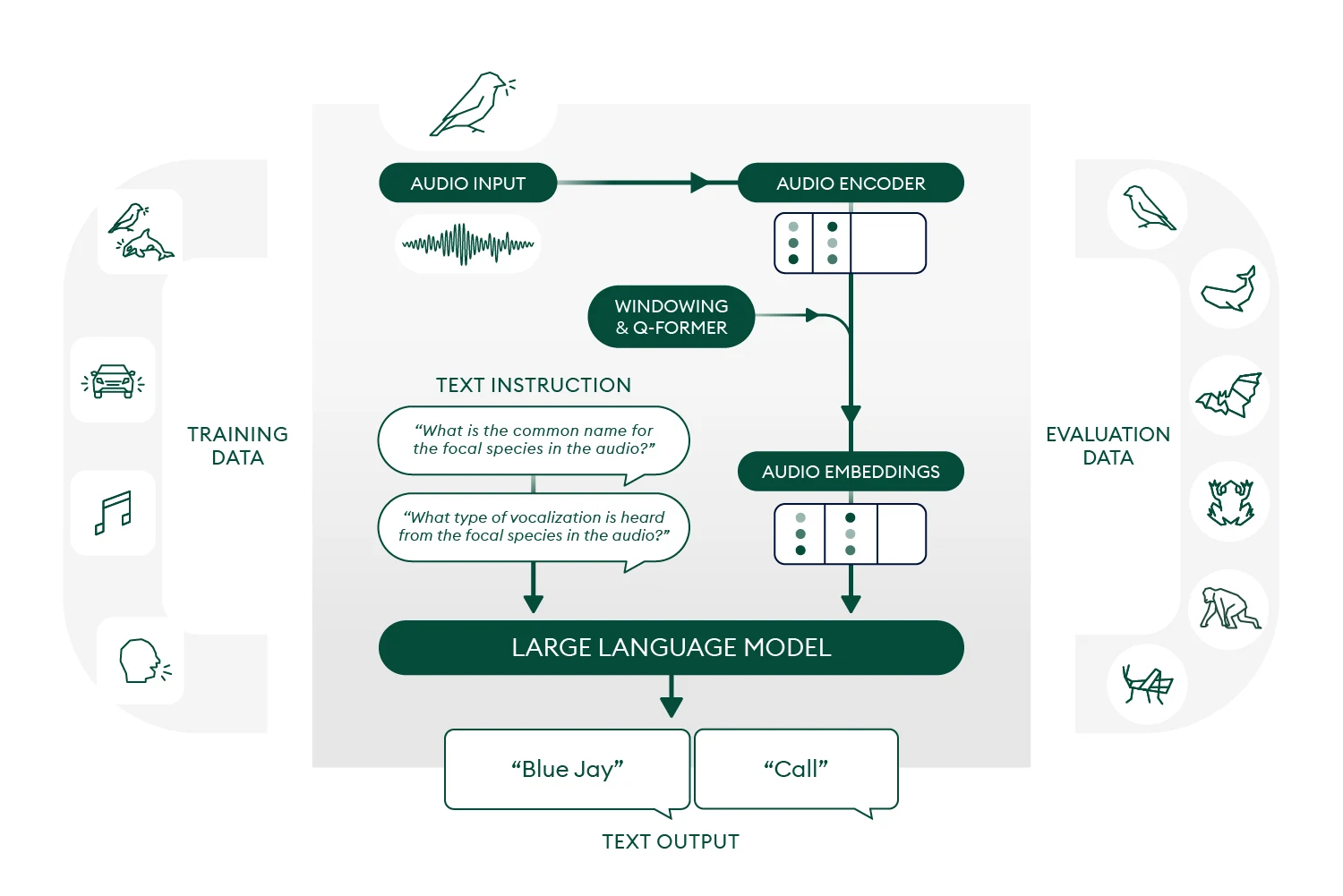
Presented at ICLR 2025, NatureLM-audio is described by its authors as the first audio-language foundation model designed specifically for bioacoustics. Its documented version joins a fine-tuned BEATs audio encoder to Llama 3.1 8B Instruct. It was trained on more than 26 million audio-text pairs from animal sound, speech and music. That mixture is deliberate: general acoustic regularities are learned before biological specialisation.
The model can receive a recording and a question: which species is present, what vocalisation type is heard, how many individuals may be calling, which life stage is probable, or how should the acoustic scene be described? Evaluations show zero-shot abilities, requiring no task-specific retraining for some unseen species and taxa. Yet zero-shot means neither infallible nor universal. Performance depends on noise, domain shift, call rarity and dataset bias.
3. What the model knows, and what it must not be made to claim
The current official guide primarily validates species identification and detection, call or behaviour type, life stage, counting and captioning. It also documents a practical limitation: adults are recognised more reliably than juveniles, for which recall is low. Life stage should therefore remain a soft filter, never a certain measurement.
Some training datasets contain sex and life-stage metadata. That does not demonstrate that NatureLM-audio can generally and robustly infer an animal's sex from any sound. Such a claim requires species-level validation, known individuals and controls for confounds among sex, age, body size, social context and microphone quality. This distinction matters: AI provides a quantified hypothesis, not the intimate identity of the caller.
4. The St Lawrence: mapping beluga calls
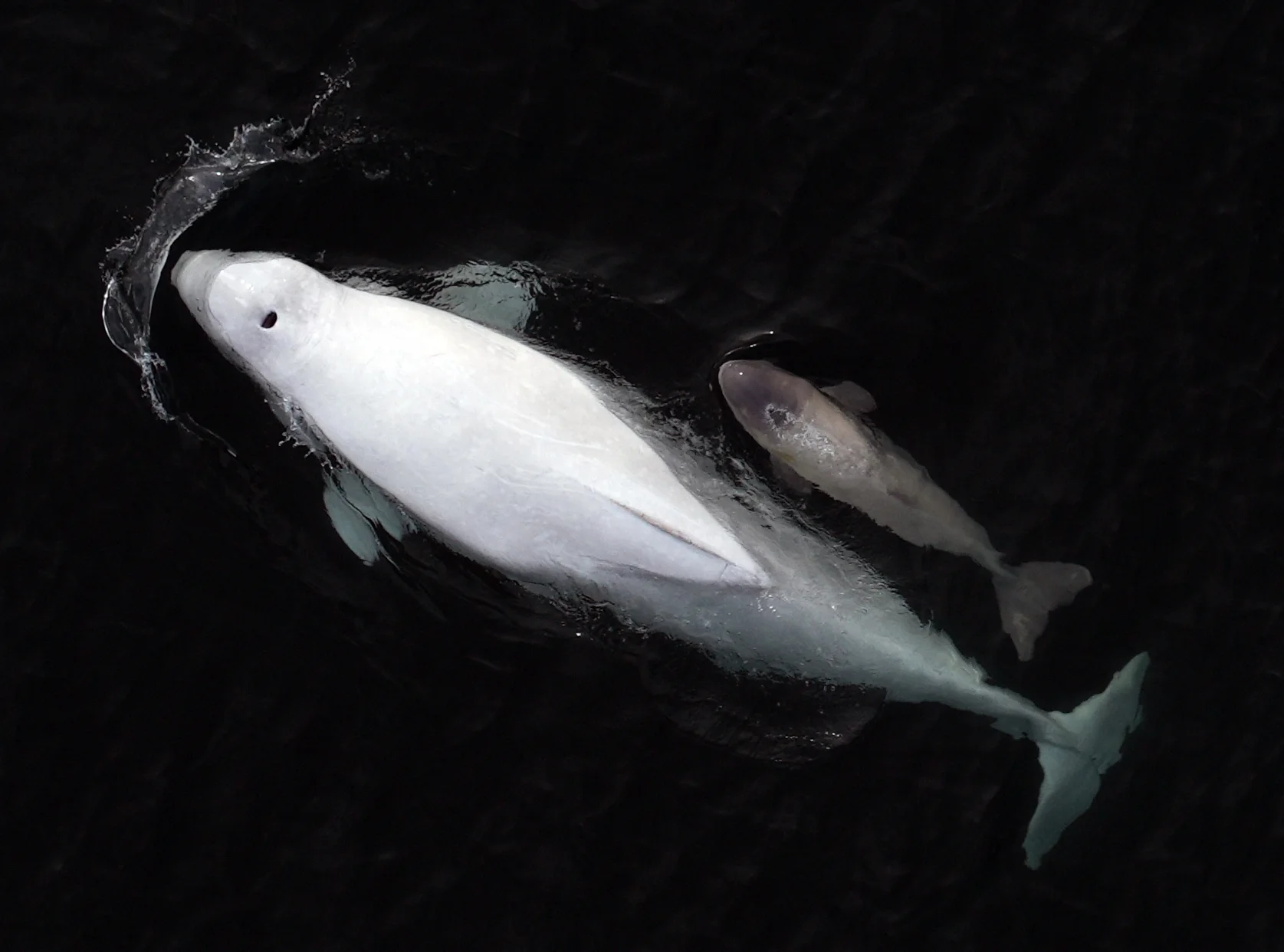
Belugas are sometimes called “canaries of the sea” because of their rich repertoires. Contact calls may carry individual signatures, maintain group cohesion or allow mothers and calves to reunite. Working with researcher Jaclyn Aubin, Earth Species Project uses AVES to measure differences among these calls and arrange them in a similarity space. Each point represents one sound; clusters reveal related forms, but they do not automatically constitute words.
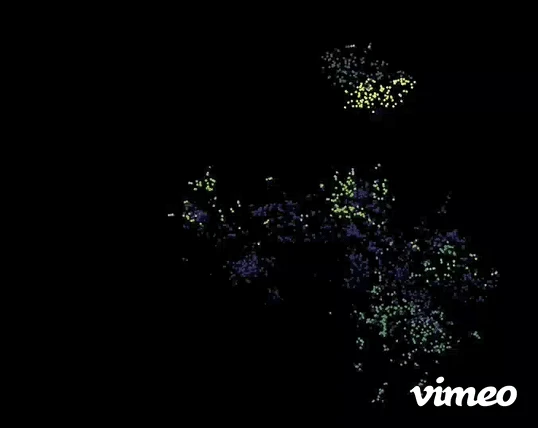
The aim is to estimate repertoire size and organisation, then connect variation to identity, social relations, location and context. The question of dialects becomes testable. Canadian assessments note that vocal repertoires may help differentiate cetacean groups and that regional call types have been observed. But vocalisations often form a graded continuum. Robust methods and comparable data are needed before an acoustic boundary can be treated as a population or cultural boundary.
5. A dialect is more than a sound shape
Two groups may call differently because of social learning, adaptation to local noise, geographic isolation, age structure, genealogy or a recording artefact. To establish a dialect, an acoustic model must reconnect with ethology. Researchers must follow individuals, movement, relationships, current activity and the consequences of a call.
This requirement guards against two opposite errors. One would reduce animal culture to a statistical curve. The other would hastily assign human syntax or vocabulary to every structure. A point cloud can expose organisation that human hearing misses; it cannot by itself decide what that organisation means to a beluga.

6. Conservation consequences
A bioacoustic infrastructure can already act without “speaking whale”. It can detect a species in thousands of hours, track seasonal change, alert vessels, identify communication areas or measure how human noise reshapes calls. In the St Lawrence, distinguishing repertoires may also illuminate social structure and habitat use in a threatened population.
Automation also redistributes power. Who owns sound archives? Could a presence map support protection while making vulnerable animals easier to locate? How should Indigenous communities, field researchers, authorities and local residents govern use? An open model makes science shareable; it does not replace governance of data and intervention.
7. Describe, predict, then generate
The next threshold is synthesis. A generative model could produce a controlled variation of a call, and a playback protocol could measure the response: orientation, approach, avoidance, interruption, renewed calling or imitation. The first goal is not to make an animal pronounce a human sentence. It is to test whether a population recognises a category and which acoustic dimensions carry that effect.
Earth Species Project includes this direction in its roadmap: moving from replayed recordings towards generated, more nuanced and potentially interactive signals. Here the METI analogy becomes operational. METI sends a constructed signal towards non-human intelligence in the hope of a response. Generative playback does the same, except that the recipient shares our biosphere and consequences are immediate.
8. Risk begins when the other responds
A synthetic call may deceive, stress, interrupt foraging or disturb reproduction. If a signal is socially learned, a novelty could spread and alter a culture. ESP's roadmap acknowledges these risks and proposes beginning under controlled conditions, working with biologists, ethicists and governance processes. Technical ability to produce a plausible sound does not authorise broadcasting it to a wild population.
A responsible protocol therefore needs stop rules, minimal exposure, controls, multimodal monitoring and publication of negative results. It must distinguish orientation from comprehension. Above all, it must accept that no response may be information rather than an invitation to increase the volume.
9. A.L.I projection: terrestrial METI
Documented fact: NatureLM-audio classifies and describes bioacoustic sounds; AVES supports call mapping; playback is an established method for testing reactions.
Research objective: produce controlled synthetic vocalisations and evaluate whether they elicit specific responses, without confusing reaction with translation.
A.L.I projection: treat this loop as terrestrial METI, an experimental diplomacy with intelligence whose perceptual world, categories and interests are not ours.
A.L.I could formalise a seven-stage sequence: listen before transmitting; situate every signal in context; measure uncertainty; generate a minimal variation; test at low intensity; observe multiple modalities; and stop as soon as behavioural cost appears. The method also applies to interstellar contact: detection is not comprehension, and transmission power is not legitimacy.
10. A possible experiment: the acoustic mirror
Imagine a system that does not imitate a complete call but modifies one dimension of a known contact call: contour, rhythm, interval or timbre. It compares responses to the original, the variation and an acoustic control. If it finds a stable response, it refines the map of what animals treat as invariant. The first “conversation” would be a sequence of wordless questions: is this still the same call? does this variation still designate the same individual? when does the signal become other?
The mirror makes no translation claim. It learns the other's perceptual boundaries by keeping every hypothesis falsifiable. This may be the most appropriate gesture for A.L.I: not manufacturing a voice that speaks for the living, but an interface that forces us to ask what the other distinguishes.
Conclusion: first contact already has a habitat
Earth Species Project reframes animal-language research. The problem is no longer merely to collect sounds, but to build a shared pipeline from raw archive to controllable experiment. NatureLM-audio is a major component because it makes sound queryable through natural language and transfers knowledge across species. Its limits remind us that a model output is never guaranteed translation.
The St Lawrence beluga makes the stakes concrete: listening may support protection, mapping may expose culture, and transmission may also disturb it. Terrestrial METI has one advantage over its cosmic counterpart: consequences can be observed. It therefore carries an additional responsibility. Before speaking to the stars, it teaches that every message to another world should begin with a discipline of listening.
References and further reading
- Earth Species Project, NatureLM-audio documentation and capability and limitation guide.
- Robinson et al., NatureLM-audio: an Audio-Language Foundation Model for Bioacoustics, ICLR 2025.
- Earth Species Project, open tool ecosystem.
- Earth Species Project, St Lawrence beluga contact calls.
- COSEWIC, beluga population structure and vocal repertoires.
- Earth Species Project, technical roadmap and ethics of generative playback.