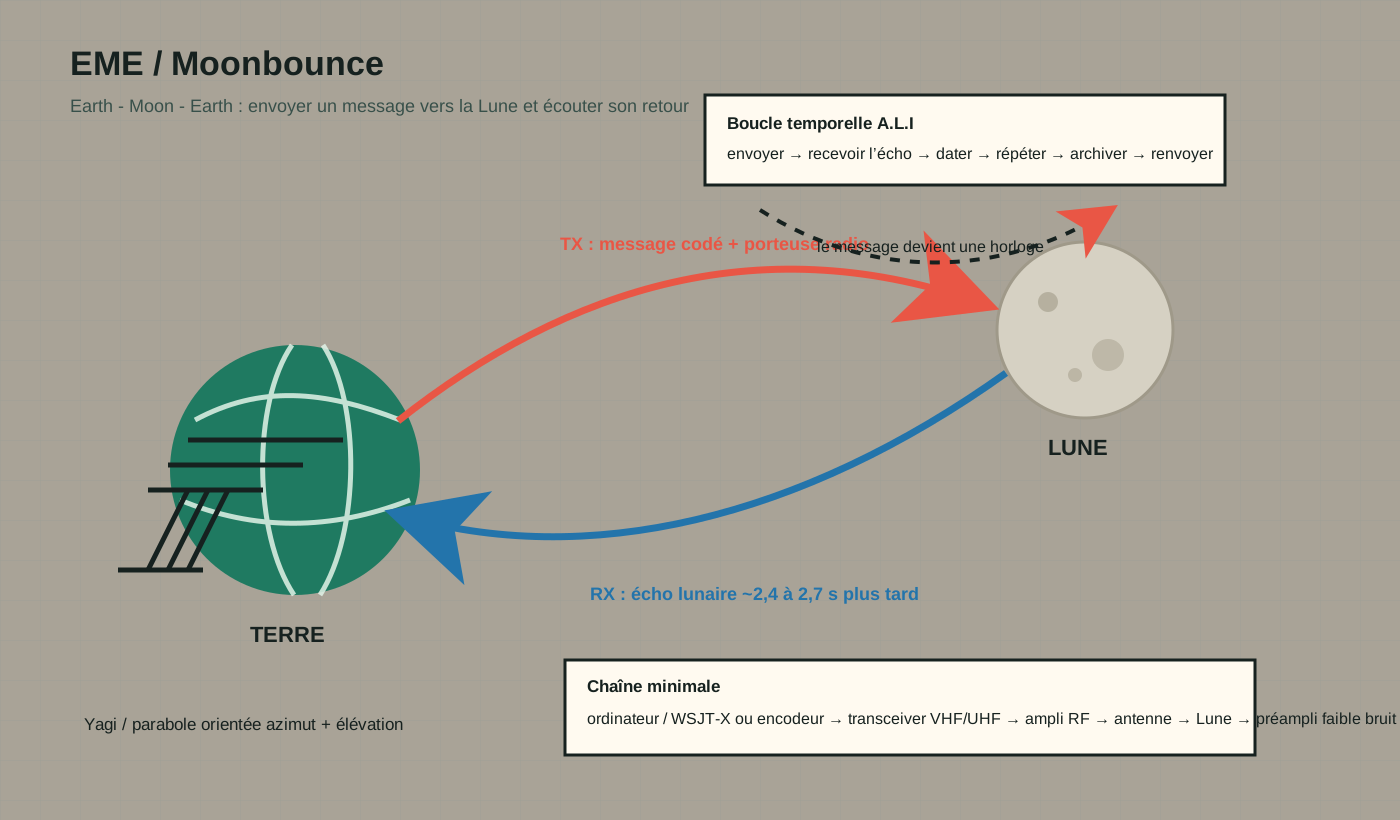
EME, for Earth-Moon-Earth, is a radio technique that uses the Moon as an imperfect mirror. A signal is transmitted from Earth toward the Moon; a tiny fraction is reflected by the lunar surface; that trace returns to Earth and can be received either by the original station or by another station that can also see the Moon.
Physical Principle
The Moon is not an active telecommunications satellite. It does not receive, understand or intentionally retransmit. It only reflects a small part of the radio energy that reaches it. This is exactly what makes EME fascinating: the message returns altered by distance, path loss, lunar roughness, Doppler shift, noise and time.
Earth transmission → radio path → lunar surface → weak reflection → Earth receptionThe round trip Earth-Moon-Earth delay is about 2.4 to 2.7 seconds, depending on the Moon’s distance. That delay can be perceived: one can send a short signal, wait, and hear one’s own lunar echo. In an A.L.I project, this delay becomes material. The Moon is no longer only a distant object; it becomes a temporary memory lasting a few seconds.
What an EME Station Needs
An EME station is not a simple walkie-talkie. The signal suffers enormous loss. A practical system combines several elements: a highly directional antenna, stable transmission, sometimes an amplifier, a sensitive receiver, a low-noise preamplifier near the antenna, and software able to decode extremely weak signals.
| Element | Role | Example / link | Cost range | Difficulty |
|---|---|---|---|---|
| Amateur radio license | Legally authorize transmissions on the relevant bands | National regulator / local radio clubs | varies | administrative + exam |
| All-mode VHF/UHF transceiver | Transmit and receive SSB/CW/digital modes | Icom IC-9700 | about 1,400 to 2,000 €/$ depending on market | configuration |
| Directional 144 MHz or 432 MHz antenna | Concentrate energy toward the Moon | M2 Antennas EME | 700 to 1,500+ $ per antenna, plus structure | mechanical |
| Azimuth / elevation rotator | Track the Moon across the sky | Yaesu G-5500DC | 700 to 1,000+ €/$ | installation |
| Low-noise preamplifier | Amplify the received signal before cable loss | SSB Electronic SP-2000 / SP-7000 | 250 to 500 $ depending on band | RF cabling |
| RF power amplifier | Increase useful power toward the antenna | VHF/UHF amplifier matched to the band | 500 to 2,000+ €/$ | technical + safety |
| Low-loss coaxial cables | Reduce losses between radio, amplifier, preamp and antenna | LMR-400, Ecoflex, Aircom, N connectors | 100 to 400 €/$ | connector care |
| Weak-signal software | Encode/decode messages below the noise | WSJT-X, Q65 mode | free | learning curve |
Three Possible Versions
Listening / learning version. Start without transmitting: track the Moon, listen to EME bands, understand the software, simulate messages. Low cost, no transmission, moderate difficulty.
Small experimental station. A directional antenna, stable transceiver, WSJT-X and possibly a preamp. Digital weak-signal contacts may be possible if the other station is powerful. Probable cost: 2,500 to 5,000 €/$ depending on used gear and fabrication.
Dedicated A.L.I station. Antenna or antenna array, computer-driven rotator, RF amplifier, mast preamp, coding/decoding scripts, echo archive, delay and phase visualization. Probable cost: 6,000 to 15,000+ €/$ depending on ambition.
Minimal Technical Diagram
A.L.I text
   ↓
encoder: text → short sequence / tones / Q65 / experimental CW
   ↓
computer + audio / CAT interface
   ↓
VHF/UHF transceiver
   ↓
RF amplifier → transmit/receive relay → motorized directional antenna
   ↓
MOON
   ↓
weak echo → low-noise preamp → transceiver
   ↓
decoding software + timestamp + archive
The Moon as Delay, Not Recipient
In classical EME, the Moon links two terrestrial stations. For A.L.I, the question can shift slightly: what if the Moon became a machine for delaying messages? One does not only send content to someone; one sends it into a circuit where it returns transformed, dated, weakened, almost spectral.
Loops: Send, Receive, Resend
The strongest A.L.I idea would be not a single transmission, but a loop. A message is sent to the Moon. When its echo returns, it is recorded, decoded, compared with the original, then sent again. At each cycle, the system adds a layer: date, time, Moon state, received power, errors, phase, noise, fragment of the previous message.
M0 = original message
M1 = lunar echo of M0 + date + errors
M2 = lunar echo of M1 + new date + new errors
M3 = lunar echo of M2...
The message becomes a sequence of survivals. It does not merely travel through space: it crosses a series of presents. Repetition creates a form of future, not because the signal remains in space for years, but because the protocol decides to relaunch it again and again.
Message to the Future
An A.L.I station could be programmed to retransmit the same message toward the Moon every night, then record its echo. After one month, the message would have thirty returns. After ten years, thousands. Each return would be almost identical and yet different: radio noise, weather, lunar position, clock drift, machine state, text evolution.
The future would not be a distant point where one deposits a capsule. It would be produced by a discipline of repetition. A sentence addressed to the Moon would become a technical ritual: if someone listens later, they receive not only a message, but proof that a system insisted.
Questions for A.L.I
- Does a message repeated for years become more intelligible or more mysterious?
- Should decoding errors be corrected, or preserved as part of the language?
- Can the Moon act as cosmic punctuation, each echo marking a beat between worlds?
- Could a protocol rewrite the message slightly after each reception before sending it again?
Sources and Equipment
- ARRL - Weak Signal / EME Moonbounce: general principle of lunar-reflection communication.
- WSJT-X User Guide: weak-signal modes, including Q65 for EME on VHF and above.
- Icom IC-9700: all-mode 144 / 430-440 / 1200 MHz transceiver.
- M2 Antennas EME Products: antennas and building blocks for EME stations.
- Yaesu G-5500DC: azimuth/elevation rotator for space communication antennas.
- SSB Electronic USA price guide: examples of VHF/UHF low-noise preamplifiers.
LABO question: if a message always returns with a little noise, should the noise be corrected, or listened to as the signature of the journey?