What would a tree of life look like if none of its branches were terrestrial? We can narrate the evolution of bacteria, plants, animals and humans because all belong to one history. We share a genetic code, cells, carbon chemistry and common ancestry. Yet this unity is also a trap: when we imagine life elsewhere, we often repaint Earthly forms in unfamiliar colours.
We propose exodarwinism as an A.L.I working hypothesis at the intersection of evolutionary biology, astrobiology and speculative evolution: if life emerges beyond Earth, what mechanisms of variation, transmission and selection might organise its history? The term is not the name of an officially established scientific field. It changes the question of contact: before asking “what would an alien say?”, we ask what selected its way of sensing, remembering and communicating.
1. From Darwin to a possible biology of the Universe
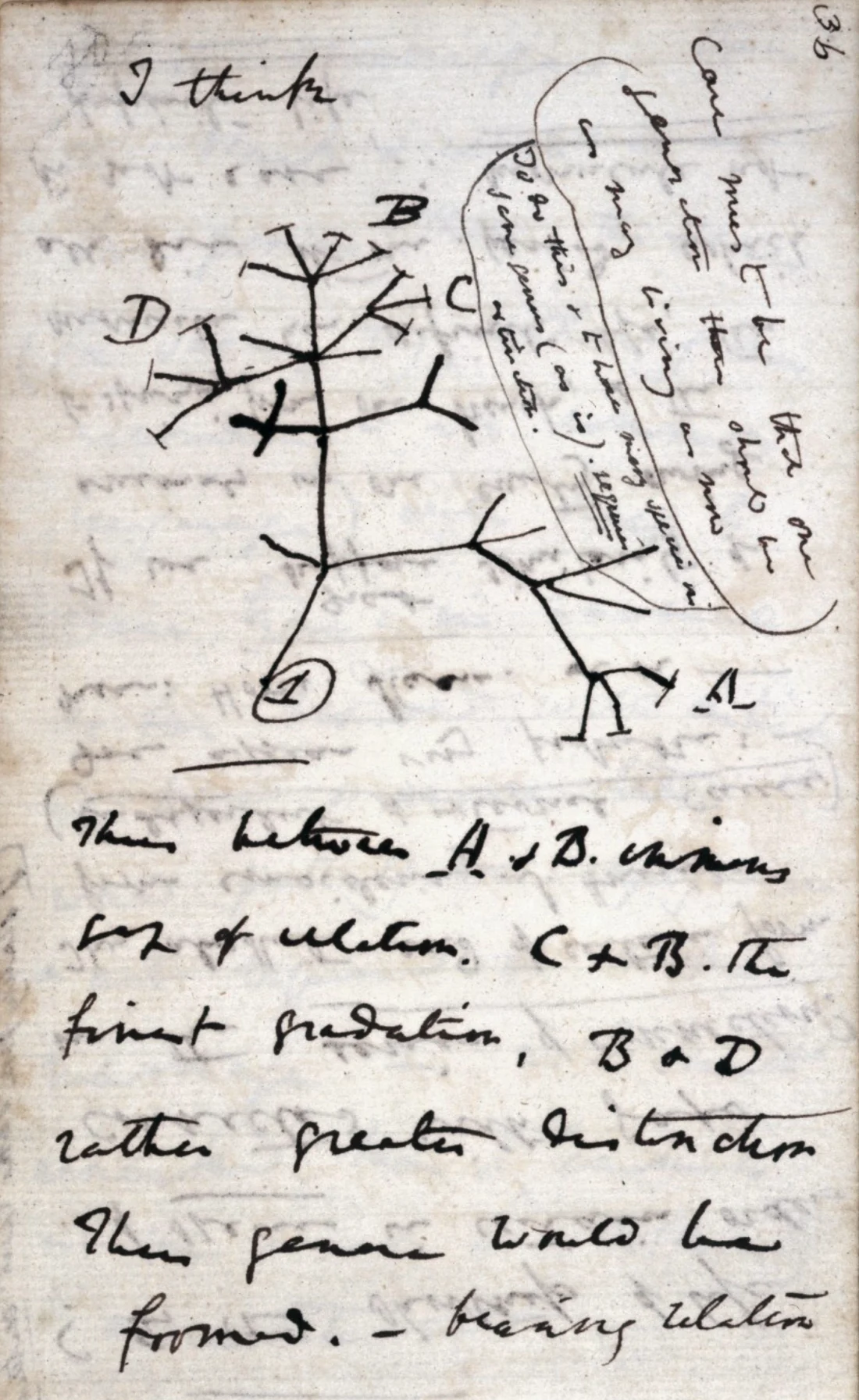
Darwin did not discover that living things change. His decisive contribution was a mechanism capable of producing adaptation without prior design. Individuals in a population vary; some differences are heritable; certain variants leave more descendants in a given environment. Across generations, the population changes. Natural selection does not anticipate, seek perfection or necessarily lead towards greater complexity.
Modern evolutionary theory has greatly expanded this framework through Mendelian genetics, mutation, genetic drift, gene flow, development, symbiosis, niche construction and multilevel selection. “Darwinism” can therefore mislead if it reduces all evolution to competition. Cooperation, endosymbiosis and microbial communities may also be selected when they increase the persistence or reproduction of a system.
2. The possibly universal core
Richard Dawkins used the expression universal Darwinism to argue that adaptive complexity anywhere should arise through a process akin to selection. The authors of Darwin’s Aliens, a scientific paper from an Oxford team, similarly use evolutionary theory to make structural predictions about extraterrestrial organisms without assuming eyes, limbs or DNA.
The minimal skeleton of a Darwinian process might require four conditions:
- Entities or patterns persist long enough to have consequences.
- They produce variants through imperfect copying, recombination, transformation or interaction.
- A memory transmits some differences through molecules, crystals, catalytic networks, cellular structures or an unknown medium.
- Variants do not persist equally in an environment with finite constraints and resources.
This framework is more abstract than Earth biology. It requires neither genes nor individual organisms nor animal reproduction. Its universality remains a hypothesis. We have observed one origin of life and one biosphere; it is difficult to infer necessity from a single example.
3. What may be only an Earthly accent
Known life uses liquid water as solvent, carbon as scaffold, DNA and RNA as memory, proteins as operators and ATP as an energy currency. None is guaranteed to be universal. Even NASA's widely used definition — “a self-sustaining chemical system capable of Darwinian evolution” — is a research tool, not a finally resolved boundary.
We must separate mechanism from medium. A biology may be Darwinian without using our molecules. It could employ another information chemistry, develop in other solvents, inhabit temperatures incompatible with cells, or distribute identity across an entire colony. Searching only for DNA, oxygen and animal silhouettes would be biological geocentrism.
4. Convergence or a history that cannot be replayed?
Two intuitions conflict. Stephen Jay Gould argued that replaying the “tape of life” would probably lead to a radically different world because history depends on accidents. Simon Conway Morris places greater emphasis on convergent evolution: distant lineages independently discover comparable solutions under similar physical and ecological constraints.
On Earth, powered flight evolved in insects, pterosaurs, birds and bats; echolocation in cetaceans and bats; complex eyes in several lineages; streamlined forms in fish, marine reptiles and mammals. Convergence does not produce copies. It produces analogies constrained by gravity, optics, fluids and available energy.
Exodarwinism must hold both forces together: physics limits possibilities, while history chooses one path among them. A planet is neither a blank page nor a machine destined to produce humans.
5. Every world is a selection machine
| Hypothetical environment | Major constraints | Possible forms or communications |
|---|---|---|
| High-gravity planet | Cost of vertical support, pressure, movement | Low, spread-out organisms and ground-borne signals |
| Ocean world | No fire, efficient sound propagation, pressure | Acoustic, chemical and bioluminescent languages; cultures without dry writing |
| Tidally locked planet | Permanent day and night, mobile twilight zone | Slow migrations guided by thermal and light gradients |
| Dense atmosphere, low gravity | Buoyancy, winds, three-dimensional habitat | Aerial ecosystems, pressure signals and cloud patterns |
| Cryogenic world | Slow reactions, scarce energy, long duration | Millennial individuals and messages whose unit is a season or century |
6. The individual may not be universal
Our imagination favours an alien bounded by skin, equipped with a brain and able to speak in its own name. Earth already offers other organisations: mycelia, clonal colonies, biofilms, siphonophores, ant colonies, microbiomes and symbiotic networks. The relevant unit of selection can shift among genes, cells, organisms, groups and ecosystems.
Extraterrestrial life might exist only as a collective process. Components would be replaceable, memory would reside in the circulation of matter, and decisions might appear as slow changes in a landscape. We might search for a speaker while the interlocutor is a forest, ocean or atmosphere.
7. Language is also an evolutionary product
Communication costs energy and can expose the sender. A signal persists when it provides an advantage: coordination, reproduction, warning, deception, learning, recognition or environmental modification. Available organs determine the channel; ecology determines what is worth signalling; lifespan determines the speed of conversation.
An extraterrestrial language may therefore be less an abstract representation than a selected action in the world. On an opaque planet, vision would have no value and communication might map pressure. In a distributed colony, “I” might have no equivalent. For extremely slow beings, a human sentence might resemble a structureless flash, while their reply could arrive after several human generations.
8. Detecting evolution without recognising its organisms
Astrobiology is developing agnostic biosignatures that do not assume a copy of terrestrial biochemistry. They examine unusually complex molecular distributions, persistent chemical disequilibria, patterns of energy transfer, repeated structures across scales and transformations difficult to sustain through geology alone.
A genuinely evolutionary signature would require more than one rare molecule. It would involve population or temporal dynamics: variants, inheritance, response to disturbance and selective retention. At interstellar distance this appears almost impossible. Yet long time-series of atmospheres, seasonal changes or repeated chemical maps might one day reveal not only metabolism but adaptation.
Caution remains essential. A crystal grows, a cyclone persists and an algorithm optimises without necessarily being alive. Complexity alone is not evidence of Darwinian evolution; imperfect transmission with differential persistence must be distinguished from physical self-organisation.
9. An Atlas of Projects That Have Tried to Picture Life Elsewhere
Representing extraterrestrial life is risky: imagination instinctively recycles eyes, limbs, predators and symmetries already familiar to us. The strongest projects do not begin with a portrait. They begin with an environment, an energy source, gravity, an atmosphere and an evolutionary history, then ask what forms might follow. The examples below are not a gallery of allegedly real aliens, but an atlas of methods for making the unknown thinkable.
9.1 Sagan, Salpeter and Schaller: building an ecology in Jupiter’s clouds
In 1976 Carl Sagan and Edwin Salpeter published a scientific study of possible ecological niches in the Jovian atmosphere. They distinguished descending photosynthetic organisms, “floaters” able to maintain their altitude through buoyancy, “hunters” capable of seeking other organisms, and forms living at greater depths. Their central contribution was not the organisms’ appearance, but the reasoning that generated them: pressure, convection, growth, metabolism and vertical circulation.
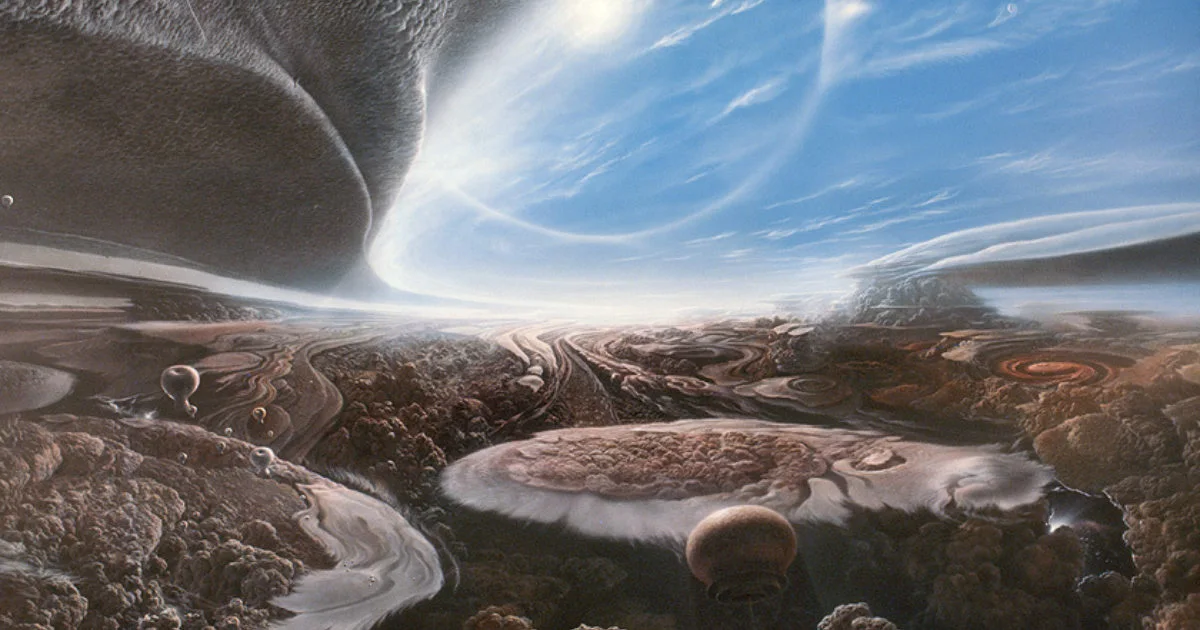
Astronomical artist Adolf Schaller later translated this ecology for the television series Cosmos. He did more than illustrate the paper: he explored aerodynamic properties, propulsion, defence, reproduction and communication across many species. This passage from calculation to drawing shows how a speculative image can act as an arguable model, provided every form is connected to an explicit constraint.
9.2 Darwin’s Aliens: predicting organisation before predicting bodies
In Darwin’s Aliens, Samuel Levin and colleagues at the University of Oxford derive expectations from evolutionary theory rather than analogies with terrestrial animals. Their model focuses on major transitions: formerly independent units can become a higher-level individual when their interests are sufficiently aligned. Alien intelligence might therefore be a colony, a federation of symbionts or a distributed system rather than a single organism.
This shift matters to A.L.I: before looking for a face or a vocal apparatus, we must ask where the individual begins and ends. A message made by a colony might have no central author, no “I”, and no precise moment of emission.
9.3 Aurelia and Blue Moon: two worlds built by a scientific team
The 2005 Channel 4 and National Geographic documentary Extraterrestrial asked a team of scientists to construct two biospheres. Aurelia is a tidally locked planet orbiting a red dwarf; Blue Moon is a large, dense-atmosphere moon orbiting a gas giant. Illumination, gravity, winds, atmospheric density and available energy shape the imagined species.
The project has considerable educational value because it makes the biological consequences of planetary parameters visible. Its limitation comes from television’s demand for readable, spectacular animals. The world becomes coherent, yet is still partly shaped by our expectation of fauna.
9.4 Wayne Barlowe: a field notebook from a planet that does not exist
Wayne Barlowe’s Expedition (1990) takes the form of a naturalist’s report written after a mission to Darwin IV. Anatomies, food webs, migrations and behaviours form a coherent natural history. Its documentary adaptation, Alien Planet (2005), adds another question: robotic probes must learn to observe without knowing in advance what counts as organism, threat or signal.
Barlowe demonstrates the value of a relational bestiary. An isolated creature can be arbitrary; a creature embedded in flows of food, predation, reproduction and information becomes a hypothesis about a world.
9.5 Wanderers: making bodies for another planet
Wanderers: An Astrobiological Exploration, by Neri Oxman and MIT’s Mediated Matter group, does not claim to depict native alien species. It imagines 3D-printed wearable structures filled with capillary networks designed to host engineered microorganisms. These organisms would produce oxygen, light, biomass or materials suited to different destinations in the Solar System.
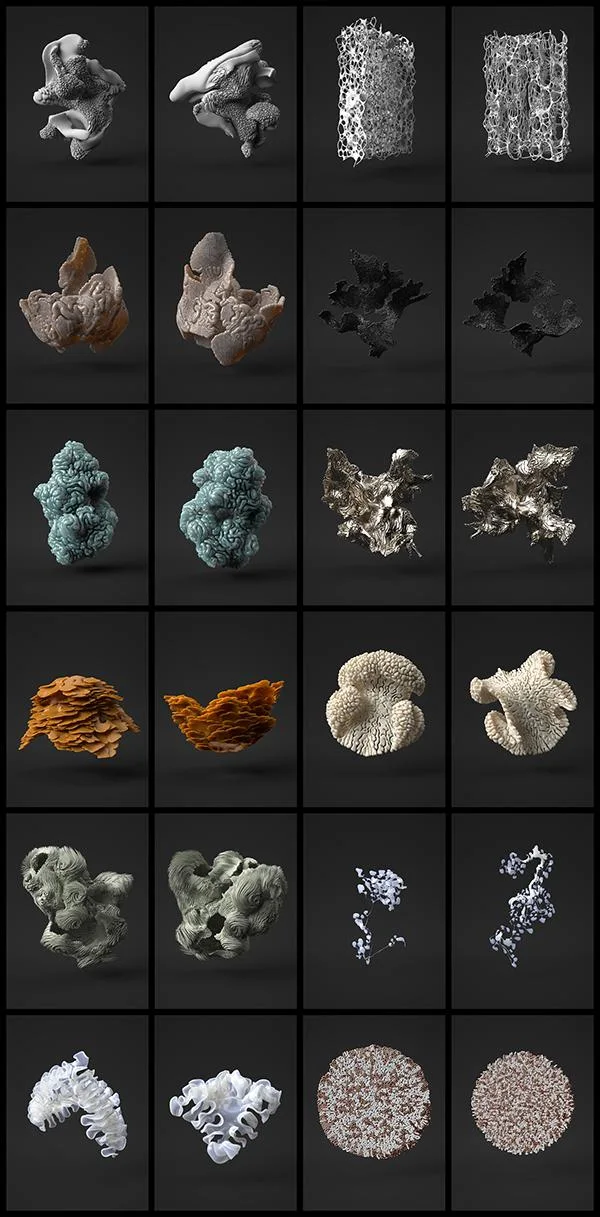
Wanderers changes the question: the extraterrestrial may also be a hybrid assemblage made by humans together with terrestrial organisms. The project stages directed evolution, technical symbiosis and a body whose functions depend upon the environment it encounters.
9.6 Alexandra Daisy Ginsberg: allowing Mars to transform plants
In The Wilding of Mars (2019), Alexandra Daisy Ginsberg runs parallel simulations of terrestrial plants introduced to Mars. Plants disperse, compete and change under local parameters of water, temperature and nutrients. This is not a proposal for terraforming, but a critical experiment: what might life become when it is released from the requirement to serve humans?
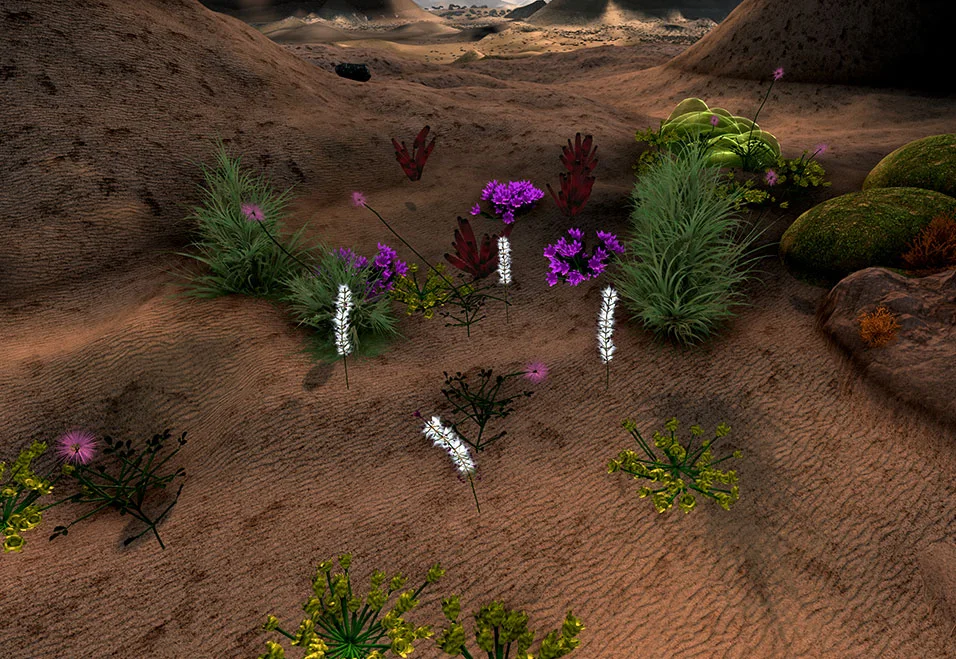
The installation reminds us that transplanted life would not remain simply terrestrial: it would be rewritten by another climate, geology and timescale. It also introduces a political question into exodarwinism: do humans have the right to initiate evolution on a world that does not belong to them?
9.7 Pinar Yoldas: inventing organs for a plastic ocean
Pinar Yoldas’s An Ecosystem of Excess imagines a post-human ecology born in the Pacific plastic “soup”. The artist designs organs, species, taxonomies and perceptual worlds adapted to an industrially produced extreme environment. The project asks what forms of life might emerge if a contemporary plastic ocean replaced the primordial soup.
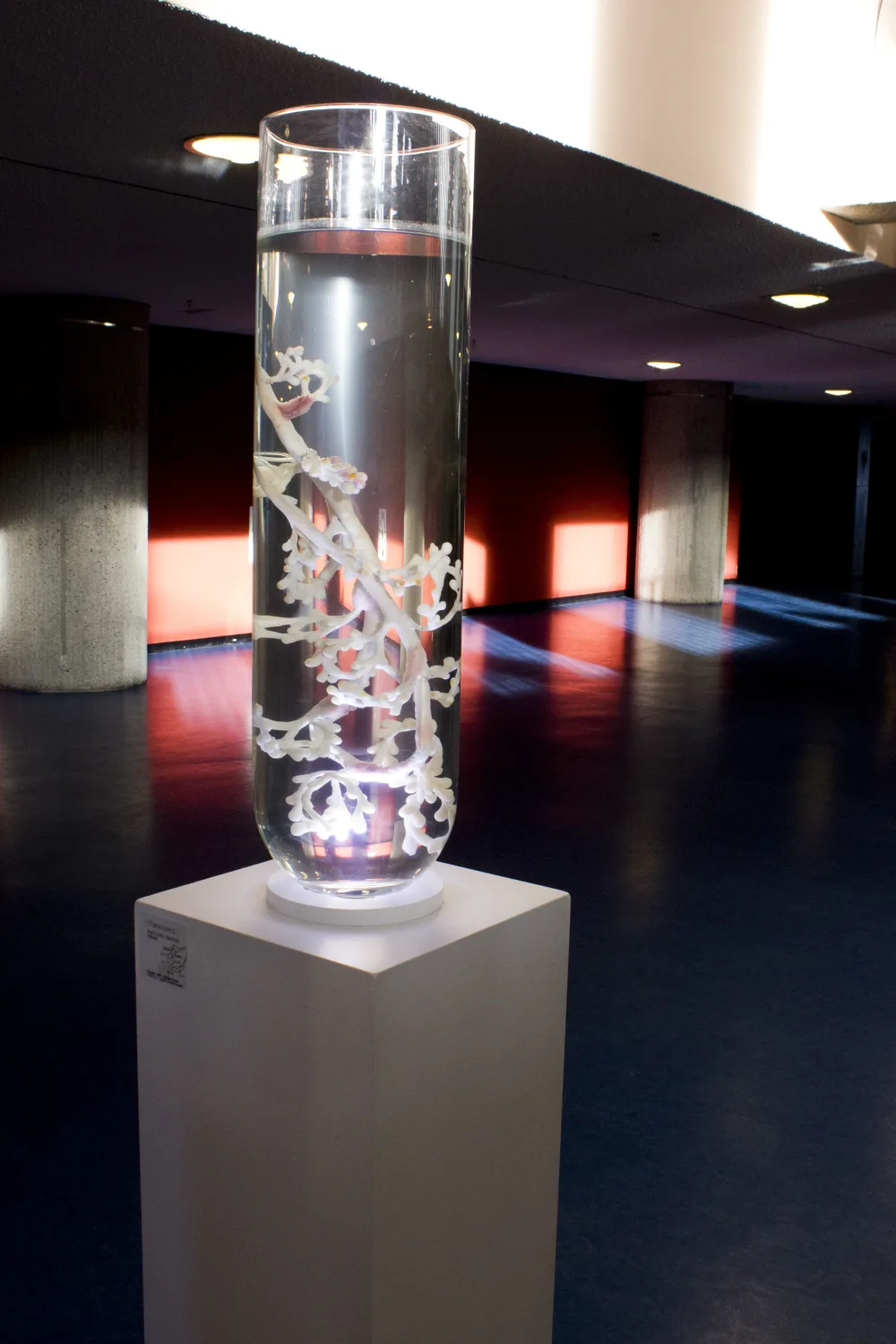
The work is not directly about exoplanets, but its method is crucial: begin with an unprecedented chemical environment, construct each organism’s Umwelt, then imagine the senses and organs that would let it live there. It functions almost as an artistic manual for speculative exobiology.
9.8 Institutions where art and astrobiology work together
The SETI Artist in Residence programme now directly connects artists and researchers. Its Speculative Life residency combines bioart, astrobiology, synthetic biology and ethical reflection on how life is defined. Artists including Amy Karle, Eduardo Kac, Dorotea Dolinšek, Joel Ong, Liquifer/Barbara Imhof and Marta de Menezes have been invited to develop research-creation proposals.
This signals an important change: the artist no longer arrives only after science to illustrate a result. Artists enter the research process, formulate experiments, materialise hypotheses and expose the cultural assumptions hidden inside our definitions of life.
9.9 What this atlas contributes to A.L.I
- Begin with the environment: a form becomes credible when gravity, energy, chemistry and time constrain it.
- Build relationships: food webs, symbiosis and communication matter more than an isolated silhouette.
- Make assumptions visible: every colour, organ or behaviour should connect to a testable or explicitly speculative proposition.
- Vary the scale of the individual: a being may be a cell, colony, cloud, ecosystem or living architecture.
- Include the observer: instruments, narrative habits and the desire for a humanoid interlocutor distort what we are prepared to recognise.
A.L.I should therefore not seek to produce “the correct image” of an alien. It should create a workshop of comparable worlds in which each representation preserves the trace of its constraints, sources and uncertainties.
10. A.L.I hypothesis: an evolutionary grammar before words
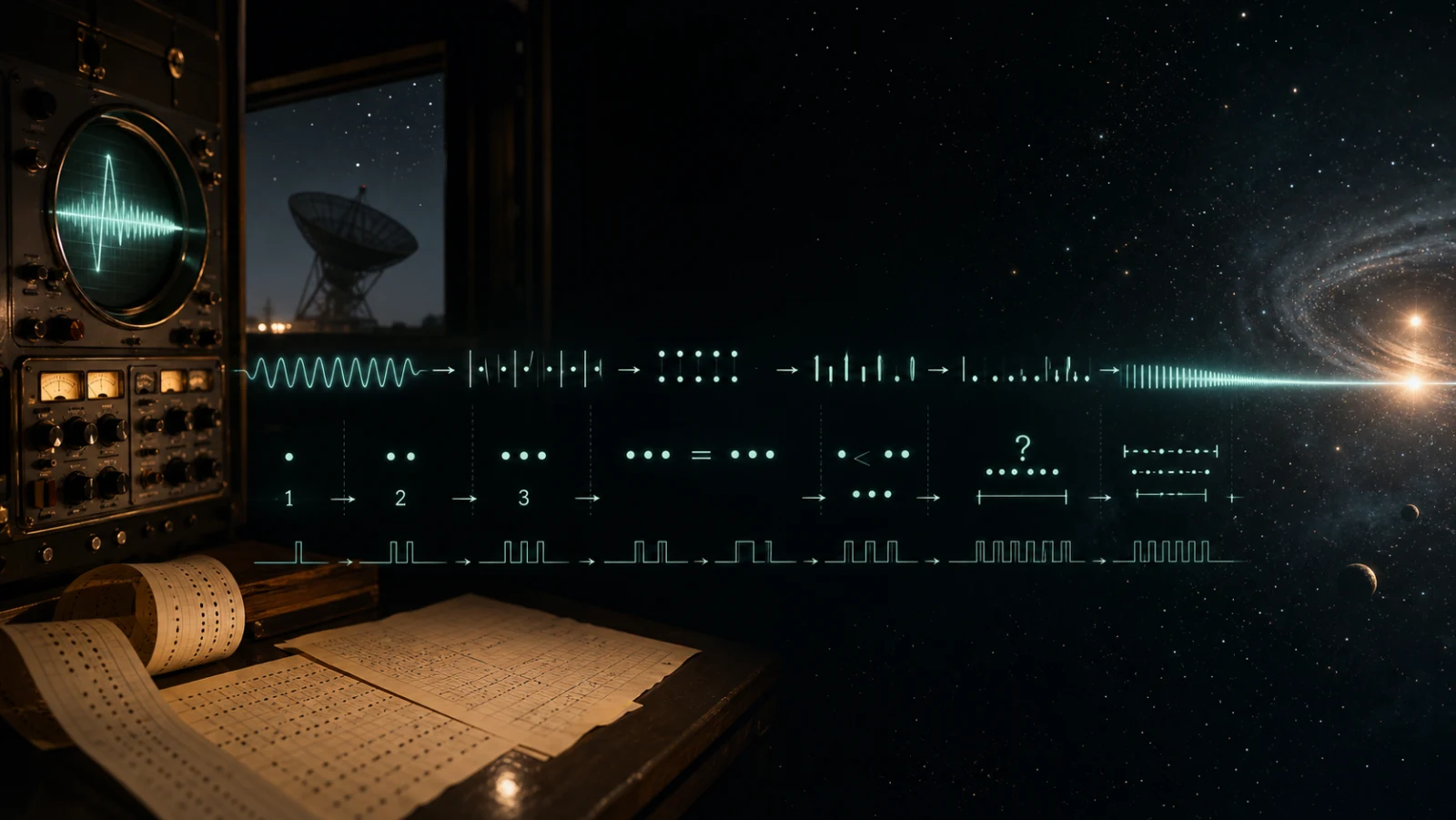
If two civilisations share neither senses, bodies nor references, they may nevertheless recognise a process of variation and selection. A.L.I proposes an evolutionary grammar composed not of nouns but transformations:
- transmit several similar but non-identical patterns;
- allow the receiver to select or amplify some patterns;
- transmit modified descendants of retained patterns;
- gradually change the constraints;
- observe whether a stable convention emerges without a prior dictionary.
The message would not yet say “hello”. It would demonstrate: I can vary, retain, learn and alter my response according to yours. Mutual recognition would begin with a capacity to adapt.
11. Project: The Exodarwinian Garden
This hypothesis can become an installation and an artistic research programme. A room contains several simulated “planets”. Each has its own laws: gravity, medium viscosity, available energy, speed of time, sensory range and cost of signalling. Simple digital organisms emerge with sensors, transmissible memory and the capacity to produce light, vibration or movement.
Visitors do not command the organisms. They alter the environment by darkening an area, reducing a resource, creating a current or slowing time. Populations evolve, and signals that improve coordination spread. The same problem is launched on several planets to test whether solutions converge.
| Module | Function | Stored data |
|---|---|---|
| Physics | Defines space, energy, gravity, fluids and time | Constraints of each world |
| Abstract genome | Encodes sensors, behaviour and signals without imitating DNA | Lineages and mutations |
| Ecology | Distributes resources, risks and relationships | Networks of cooperation and predation |
| Translation | Turns signals into light, sound and vibration | What each translation loses |
| Archive | Replays a world with one changed parameter | Convergences and bifurcations |
One rule is essential: preserve extinct lineages and failed signals. Without this negative memory, the installation would retrospectively tell a triumphal march towards intelligence. Evolution is made of dead ends, catastrophes, makeshift solutions and perfectly viable forms that produce no technology.
12. Four thought experiments
Replay the same world
Launch identical initial conditions one hundred times with a minute random difference. If the same channels recur, constraints dominate; if they diverge, history dominates.
Life without individuals
Forbid permanent boundaries between organisms. Memory circulates through a network and units continually merge. What do address, intention and deception mean then?
A message slower than civilisations
Every exchange lasts longer than the sender's life. Conversation can be carried only by an institution, genome, archive or transmissible ritual. The real interlocutor becomes a lineage.
The receiver is the ecosystem
A signal is not decoded by a brain but slightly changes ecological relations. Years later, the reply appears as a new species distribution. Could we recognise this as language?
13. Limits and objections
- One example: every universal claim begins from Earth life.
- Selection does not explain origin: it acts only once variation and transmission exist.
- Not all change is evolution: a dynamic can be complex without inheritance and differential reproduction.
- Progress is retrospective: adaptation is local and can lead to simplification.
- Vocabulary can colonise the unknown: “individual”, “species”, “intelligence” and “message” may be excessively terrestrial categories.
Conclusion: looking for verbs before forms
Exodarwinism cannot tell us with certainty what another planet's inhabitants look like. It offers a more demanding method: identify the constraints, inheritances, variants and relationships that make a form possible. It replaces the monster gallery with a hypothetical natural history.
For A.L.I, its principal lesson is that language never evolves without a medium. It is shaped by bodies, environments, partners, dangers and durations. Before translating another world's words, we may need to recognise its oldest verbs: persist, vary, transmit, cooperate, deceive and learn. The first universal language might be neither mathematics nor music, but the ability of a form to become other without losing every memory of itself.
Scientific sources and further reading
- Darwin Correspondence Project, the development of the theory of natural selection.
- Levin et al., “Darwin’s Aliens”, Oxford University Research Archive.
- Richard Dawkins, “Universal Darwinism”, Cambridge University Press.
- Tim Lewens, The Scope of Evolutionary Thinking, open access.
- NASA Astrobiology, the origin, evolution and distribution of life.
- NASA Exobiology programme.
- NASA Astrobiology, agnostic biosignatures.
- Nature Astronomy, “Using exoplanets to test the universality of biology”.
- Carl Sagan and Edwin Salpeter, “Particles, Environments, and Possible Ecologies in the Jovian Atmosphere”.
- Arik Kershenbaum, The Zoologist’s Guide to the Galaxy.