Twelve billion detections, then one million, one thousand, and finally roughly one hundred sky positions to revisit. For twenty-one years, SETI@home turned domestic computers into a planetary scientific instrument. Since 2025, FAST, China’s giant radio telescope, has been returning to the strongest candidates inherited from Arecibo. None has yet delivered what the search requires above all: independent repetition. Yet this provisional null result says something decisive. To hear a possible signal, silence must first be manufactured on Earth.
1. An observatory made of millions of homes
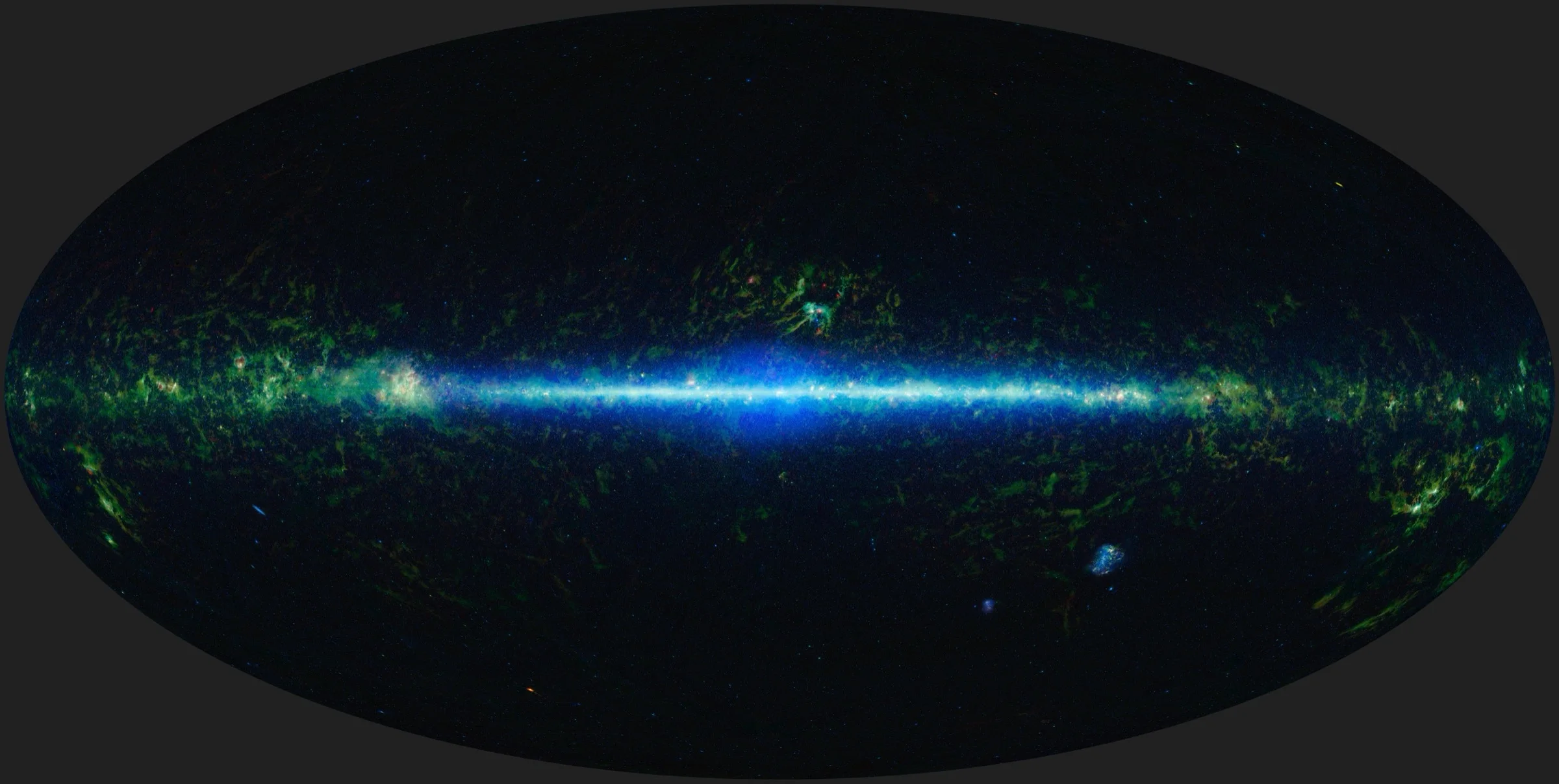
Launched at the University of California, Berkeley in 1999, SETI@home distributed small fragments of Arecibo recordings to volunteers. A screensaver computed spectra, corrected many possible Doppler drifts and searched for narrow spikes, pulses and repeating patterns. The experiment did not add another antenna to the world; it added computing time to an existing antenna.
Data were collected over fourteen years, much of it near the 1,420 MHz hydrogen line. More than one hundred thousand computers performed work according to the final technical paper, while millions of people participated over the project’s lifetime. When new work units stopped in March 2020, the problem was not over: an enormous accumulation of detections still had to be turned into an astronomically credible target list.
2. “Twelve billion” does not mean twelve billion messages
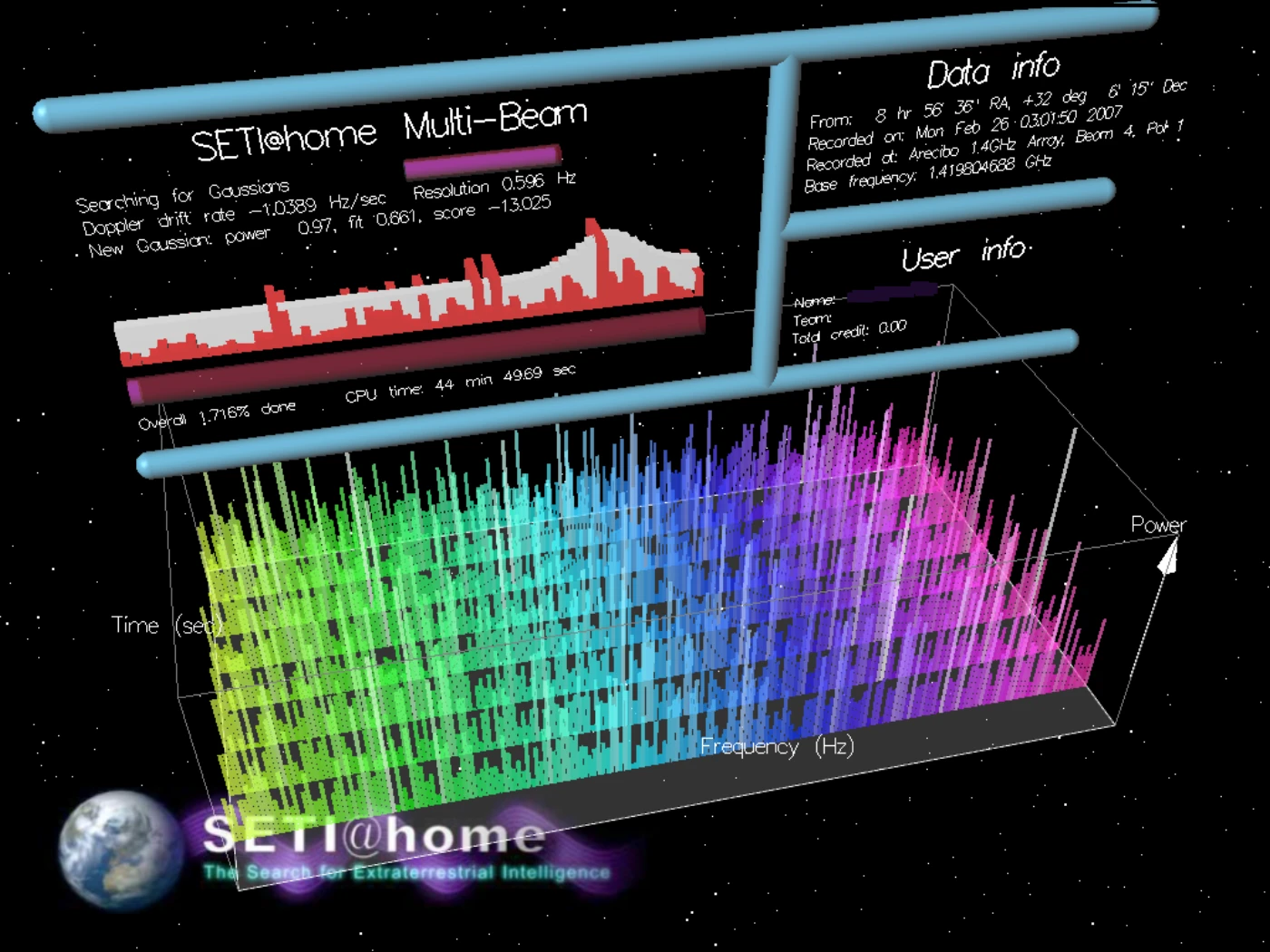
The figure changes slightly with the counting boundary: 2026 reports describe about 12 billion signals of interest, while the SETI Institute summarises the database as nearly 14 billion candidate signals. Neither figure means billions of extraterrestrial messages. A detection is a brief excess of energy at a frequency and sky position; it may come from thermal noise, radar, satellites, ground equipment or an instrumental event.
The final backend, Nebula, looked for coherent groups of detections called multiplets and rejected signatures characteristic of radio-frequency interference. Secret synthetic test signals, or “birdies”, were injected into the archive to ensure that filtering could still recover a persistent beacon. Algorithmic ranking and human inspection retained a few hundred cases, then roughly one hundred — 92 targets in the detailed scientific count — for reobservation.
3. The simplest and hardest rule: come back
A candidate becomes valuable only if it reappears from the same sky region with a compatible structure. FAST is testing this repeatability. Berkeley’s analysis paper describes scanning each position at 0.7 times the sidereal rate with all 19 telescope beams. Multibeam geometry helps distinguish a celestial source localised on the sky from terrestrial interference entering several beams together.
Reobservations began before mid-2025 and the campaign was publicly reported from July. Analysis remained under way in early 2026; the SETI Institute then stated that none of the candidates had met the repetition threshold. This is a provisional finding, not an absolute negative detection: an intermittent, moving, silent or differently structured transmitter could escape the protocol.
4. FAST: a moving ear above a fixed mirror
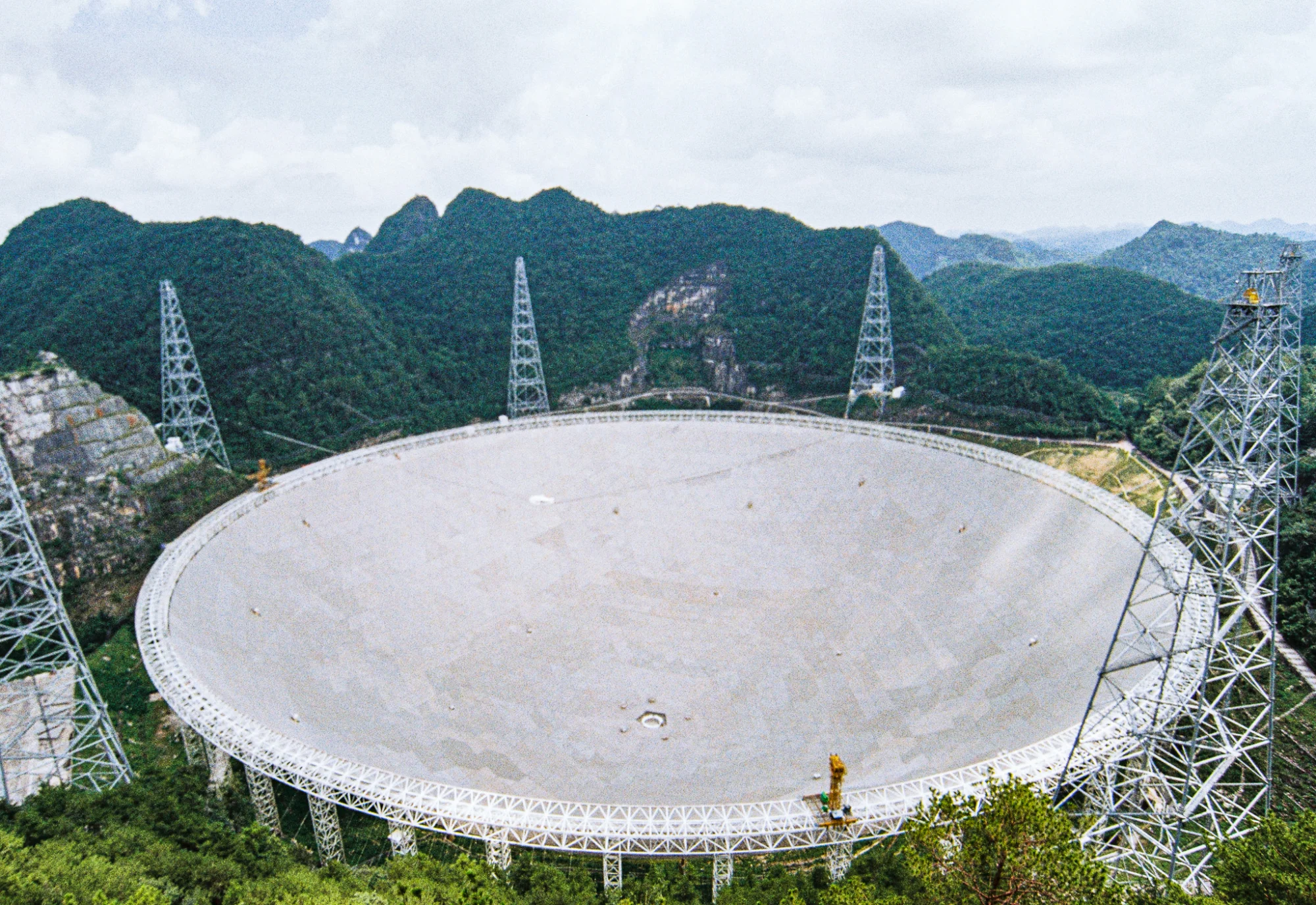
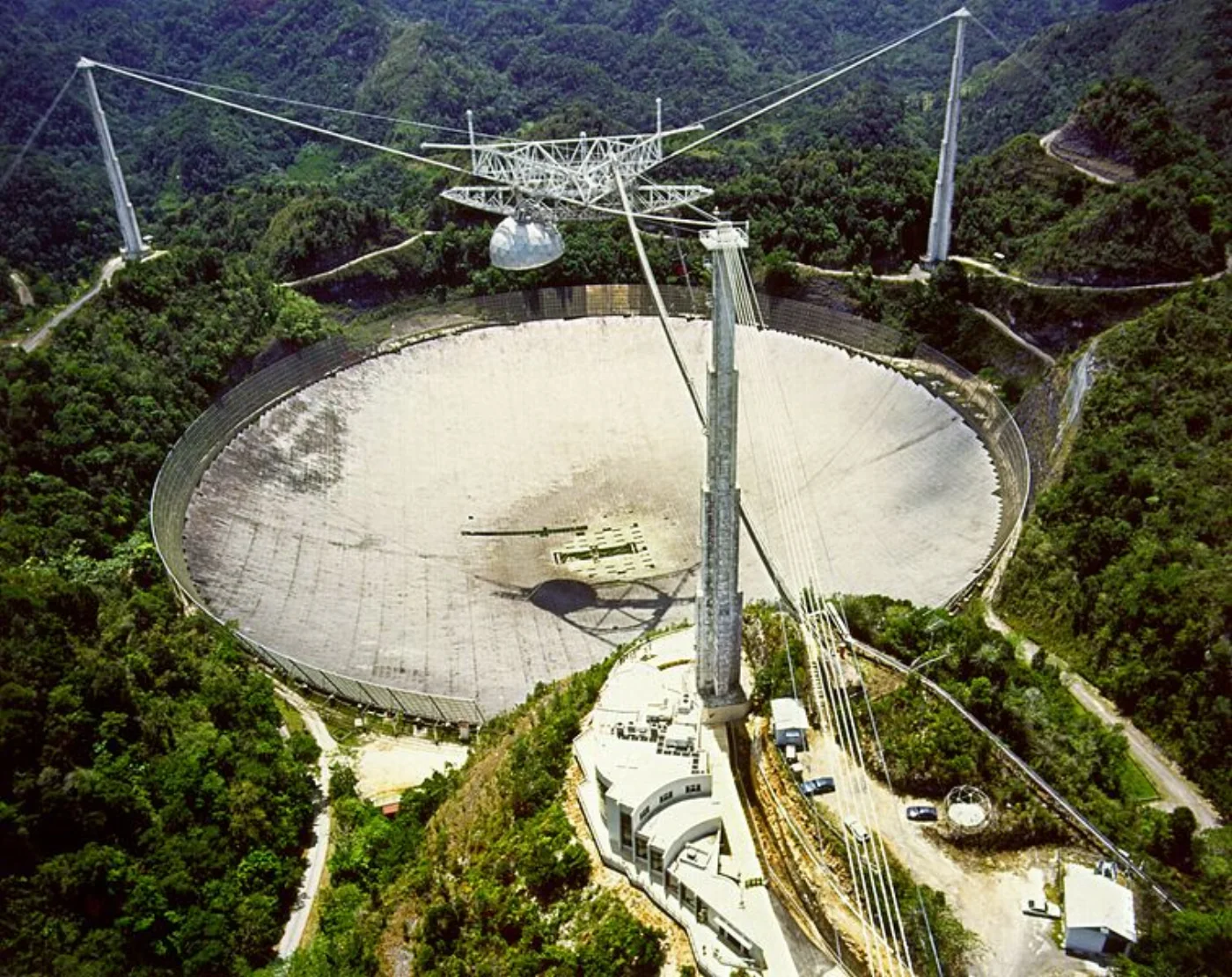
FAST occupies the natural Dawodang depression in Guizhou. Its 4,450 panels do not form a single immobile parabola. Actuators deform part of the spherical reflector to track a source while a suspended feed cabin moves above the dish. The L-band receiver covers 1.05 to 1.45 GHz with 19 beams.
This combination provides a vast collecting area and spatial control over interference. It does not make the telescope omniscient. Every search chooses a frequency band, resolution, signal-to-noise threshold, Doppler drift range and duration. Its conclusion is valid only inside that experimental volume.
5. Seven nearby stars, one measurable limit
A separate FAST study published in The Astronomical Journal in February 2026 targeted seven nearby active planet-hosting stars. Two acquisition backends searched both narrowband signals drifting by up to ±4 Hz/s and periodic pulses. No event survived the coherence and interference tests.
The authors therefore rule out, at 95% confidence and within the observed band, narrowband transmitters with an equivalent isotropic radiated power above 3.98 × 10⁸ W. For the periodic signals studied, the limit is 1.80 × 10¹⁰ W. EIRP does not necessarily describe consumed electrical power: it states the all-direction power that would produce the same flux as a directed antenna.
“No credible technosignature” therefore means nothing compatible with these forms, frequencies, drifts, periods, observing times and sensitivity. It excludes neither weaker emission, another spectrum, a laser, radio-silent technology nor a beam that did not cross Earth during the observation.
6. Listening to the sky by organising terrestrial silence
FAST’s sensitivity moves part of the problem from instrument to environment. In 2016 authorities announced the relocation of 9,110 residents within five kilometres, both to protect the site and as part of local resettlement policies. The administrative phrase “sound electromagnetic environment” should not erase the human scale: homes, habits, neighbours and memories were moved to protect a scientific capacity to listen.
Regulations implemented in 2019 distinguish a 0–5 km core, an intermediate zone to 10 km and a peripheral zone to 30 km. Phones, digital cameras, speakers, connected devices and drones are prohibited or tightly controlled in the core. Karst topography naturally shields the site; regulation attempts to stop our own radio world from covering what arrives from farther away.

7. The microwave oven and the misleading image of blindness
A poorly shielded device can indeed be extraordinarily bright to a radio telescope. Microwave ovens produced false bursts at Parkes when their doors were opened before the heating cycle had fully stopped. But saying that one oven would simply “blind FAST” is too broad: the effect depends on frequency, distance, relief, orientation, shielding and observing time.
A better image is a contaminating inscription. A nearby terrestrial emitter can draw a bright line across part of the spectrum, saturate a channel or mimic drift. It does not necessarily switch off the whole instrument. Scientifically, it can do something worse: create a form credible enough to consume observing time, or cause a filter to reject a rare signal alongside the interference.
8. An echo of the disappearance hypothesis
In “The Disappearance Hypothesis: Contact Only Happens Through Absence”, A.L.I proposed that contact might appear through withdrawal, gaps or organised emptiness rather than a spectacular message. FAST materialises this intuition at territorial scale: to recognise a non-human signal, part of human activity must become absent.
This absence is neither neutral nor empty. It is regulated, funded, monitored and socially distributed. The telescope’s silence has infrastructure and cost. It exposes a central SETI contradiction: as our civilisation becomes more detectable through emissions, it also becomes less able to hear the faint emissions it seeks elsewhere.
9. A.L.I projection: a negative observatory
Documented fact: FAST revisits SETI@home’s strongest targets, controls interference through multiple beams and operates inside an extensive radio quiet zone.
Scientific limit: failure to repeat or confirm a candidate applies to a defined protocol. It narrows a possibility space; it does not prove that space empty.
A.L.I projection: treat the observatory not as a machine accumulating signals but as a machine manufacturing qualified absences. Every switched-off phone, cleaned frequency band and mapped interference source becomes a negative component of the instrument. Listening begins with an exact account of what has been successfully removed.
A future SETI system might publish twin archives: one for celestial candidates and one for everything excluded to make them visible. Satellites, radars, mobile networks, software errors and test signals would form an electromagnetic autobiography of humanity. An external civilisation might be recognisable less by one isolated signal than by the coherent way it, too, manages noise.
10. After the hundred candidates
If none repeats, SETI@home will not have failed. It will have measured sensitivity, tested filters against a fourteen-year archive and shown that a civilian network could sustain massive scientific computation. It also exposed a harder problem: we can find what resembles transmitters imagined in the late twentieth century, but we do not know how many unexpected forms are removed with the noise.
The next stage will combine more telescopes, simultaneous observations, models able to identify less conventional morphologies and, above all, more precise records of exclusion decisions. Geographically separated instruments can require a candidate to appear at the same instant in several stations while archives preserve the filter’s reasoning. The threshold of discovery will not only be a stronger signal; it will be a more transparent chain of evidence.
Conclusion: a signal is also what silence makes possible
SETI@home’s hundred candidates condense twenty-one years of computation, fourteen years of observations and billions of rejected events. FAST does not ask them to be strange; it asks them to return. So far, none has. This null result sharpens the search and reminds us that the universe is never heard directly. It is heard through bandwidths, algorithms, territories and political choices.
Around FAST, silence was constructed into the lives of thousands of people. That may be the most certain technosignature in this story: not one from a distant civilisation, but one from a humanity willing to reorganise a landscape to hear something that may never have spoken.
References and further reading
- SETI Institute, “SETI@home Update: 21 Years of Citizen Science — and 100 Signals to Investigate”, February 2026.
- Anderson et al., SETI@home: Data Analysis and Findings, 2025–2026.
- Anderson et al., SETI@home: Data Acquisition and Front-End Processing.
- Li et al., Dual-Backend Multibeam Position-Switching Targeted SETI Observations toward Nearby Active Planet-Hosting Systems with FAST, The Astronomical Journal, 2026.
- Chinese Academy of Sciences, electromagnetic restrictions around FAST, 2019.
- Physics Today, relocation of residents within FAST’s five-kilometre zone, 2016.
- A.L.I, “The Disappearance Hypothesis: Contact Only Happens Through Absence”.
- A.L.I, “The Wow! Signal: 6EQUJ5 and the Call That Never Repeated”.