First contact is usually imagined as an exchange of messages: a signal is received, decoded and answered. This picture assumes that communication begins as soon as a code becomes intelligible. Yet recognising a sign may not be enough. We must still identify whoever is speaking, consent to a relationship and transform two foreign presences into interlocutors.
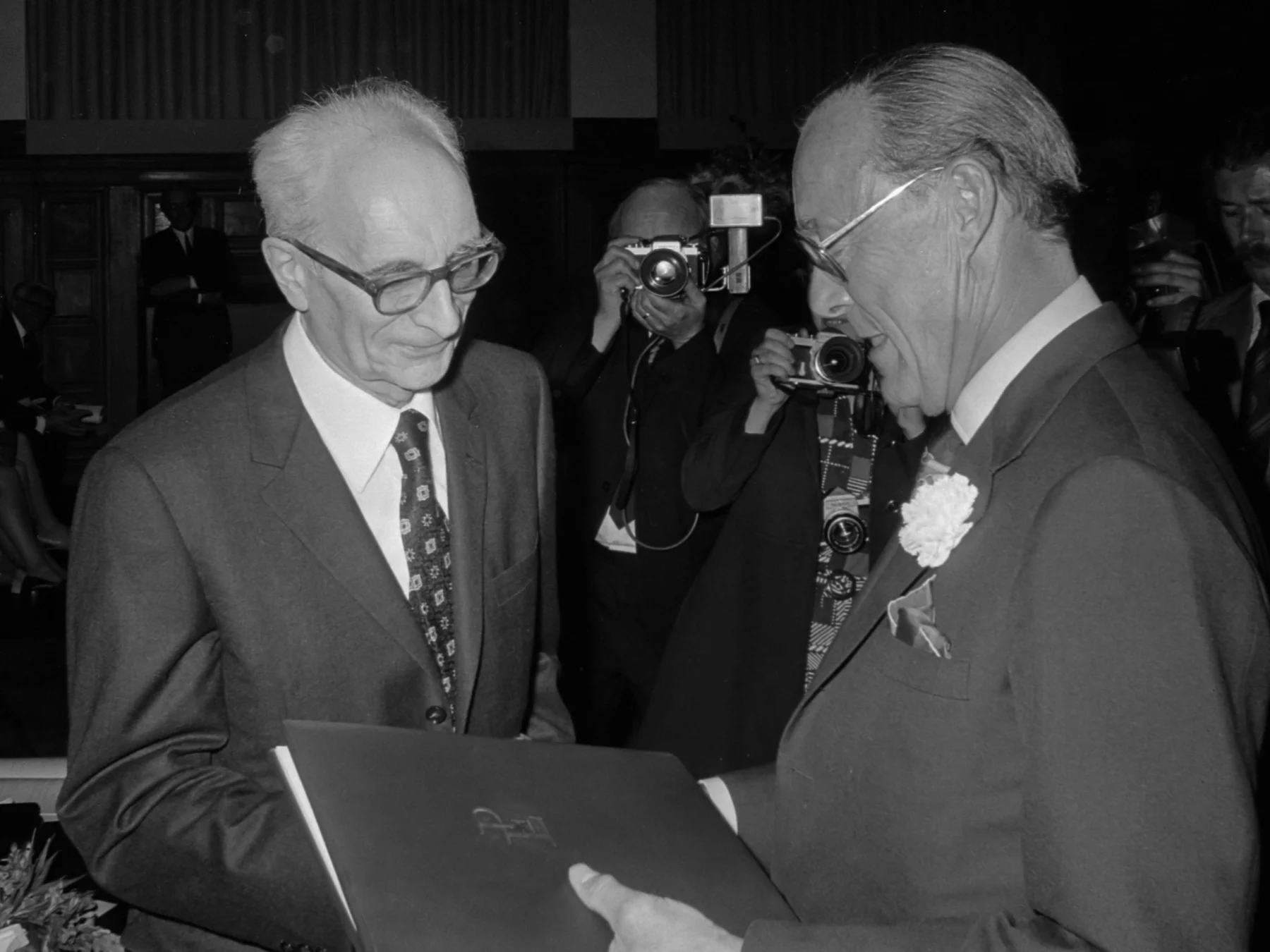
Contact would then be more than a translation problem. It would constitute a change of status, comparable to a rite of passage. The structural anthropology of Claude Lévi-Strauss and the model developed by Arnold Van Gennep suggest another hypothesis: before searching for an interstellar vocabulary, we may need to build a grammar of relationship.
1. Structure before vocabulary
Lévi-Strauss was not looking for a secret language spoken by every society. Shaped by structural linguistics, he studied relations organising kinship systems, classifications and myths: opposition, inversion, reciprocity, equivalence and transformation. The Collège de France describes this founding intuition as a search for combinatorics and logics of transformation rather than an inventory of isolated meanings.
An element means little on its own. It becomes intelligible through its position within a set. In a kinship system, people matter, but relations among generations, alliances and prohibitions matter more. In a myth, a character may change name, species or function without the deeper organisation of the narrative disappearing.
For A.L.I, this distinction is crucial. A contact language may not begin by showing an object and assigning it a name. It could present several states of the same relation: a form and its transformation; a sequence and its inversion; a rule, its application and its exception; a pattern transmitted as image, sound and number. The recipient would receive more than signs. It would observe what remains stable while those signs change.
2. Kinship as a network of relations
In The Elementary Structures of Kinship, Lévi-Strauss analyses kinship as an organisation of relations, alliances and reciprocal obligations. In his model, the incest prohibition marks a passage from nature to culture by transforming a constraint into a social rule. His Collège de France lectures later pursued this work through the concept of the “kinship atom”, documented in the chair's annual summaries.
The theory was enormously influential, but some formulations, notably the “exchange of women”, were criticised by feminist anthropology. It would therefore be absurd to turn a human kinship model into a cosmic template. Its value for A.L.I lies elsewhere: the identity of a being might be relational rather than individual.
An interstellar civilisation might grant no stable personhood to its members. It could be distributed among organisms, machines, archives and environments. “Who are you?” would then be less useful than: which relationships hold you together, and which can you transform without disappearing? Contact would begin by describing a network, not an individual.
3. Myth as a transformation machine
For Lévi-Strauss, a myth does not necessarily have an original version of which all others are degraded copies. It exists through its variants. A human character becomes an animal, birth becomes death, raw becomes cooked and near becomes far. Meaning emerges from the transformations connecting these versions.
The four volumes of Mythologiques follow such passages through hundreds of Indigenous American narratives without reducing them to a single message. Myth becomes a machine for making contradictions thinkable: nature and culture, life and death, identity and otherness. An interstellar message could use the same principle. Instead of sending one supposedly universal picture of humanity, we would transmit a family of variants. Repetition would not be duplication but controlled transformation. An unknown intelligence could infer the rule from the differences between versions.
4. “Wild thought” is not primitive thought
Lévi-Strauss's wild thought does not mean inferior or irrational thought. It describes an intelligence attentive to the sensible qualities of the world: forms, species, colours, sounds, similarities and differences. This “science of the concrete” classifies and combines what is at hand. It works through bricolage, reassigning new functions to elements from a limited repertoire.
Its operations of classification, hierarchy, causality and analogy are not fundamentally foreign to scientific thought. This opens one possibility for contact: mathematics may not be our only route towards universality. Sensible regularities, rhythms, changes of state and ecological classifications might also form bridges.
But nothing guarantees that an extraterrestrial intelligence shares our senses, categories or distinction between living and inert matter. Structural method therefore supplies no universal language. It teaches us to look for invariants beneath differences, while accepting that some invariants may exist only in our own gaze.
5. Van Gennep: the grammar of the threshold
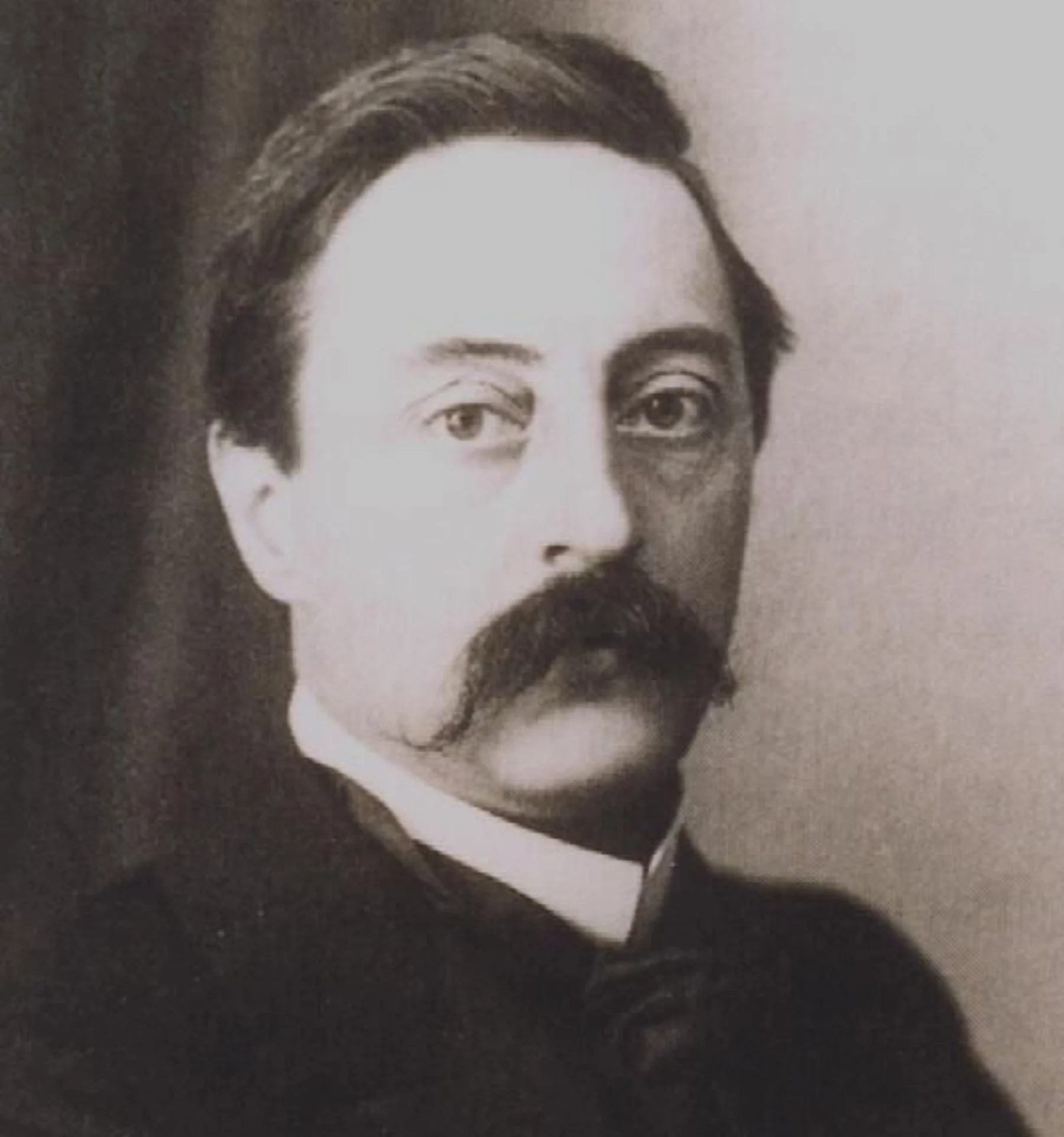
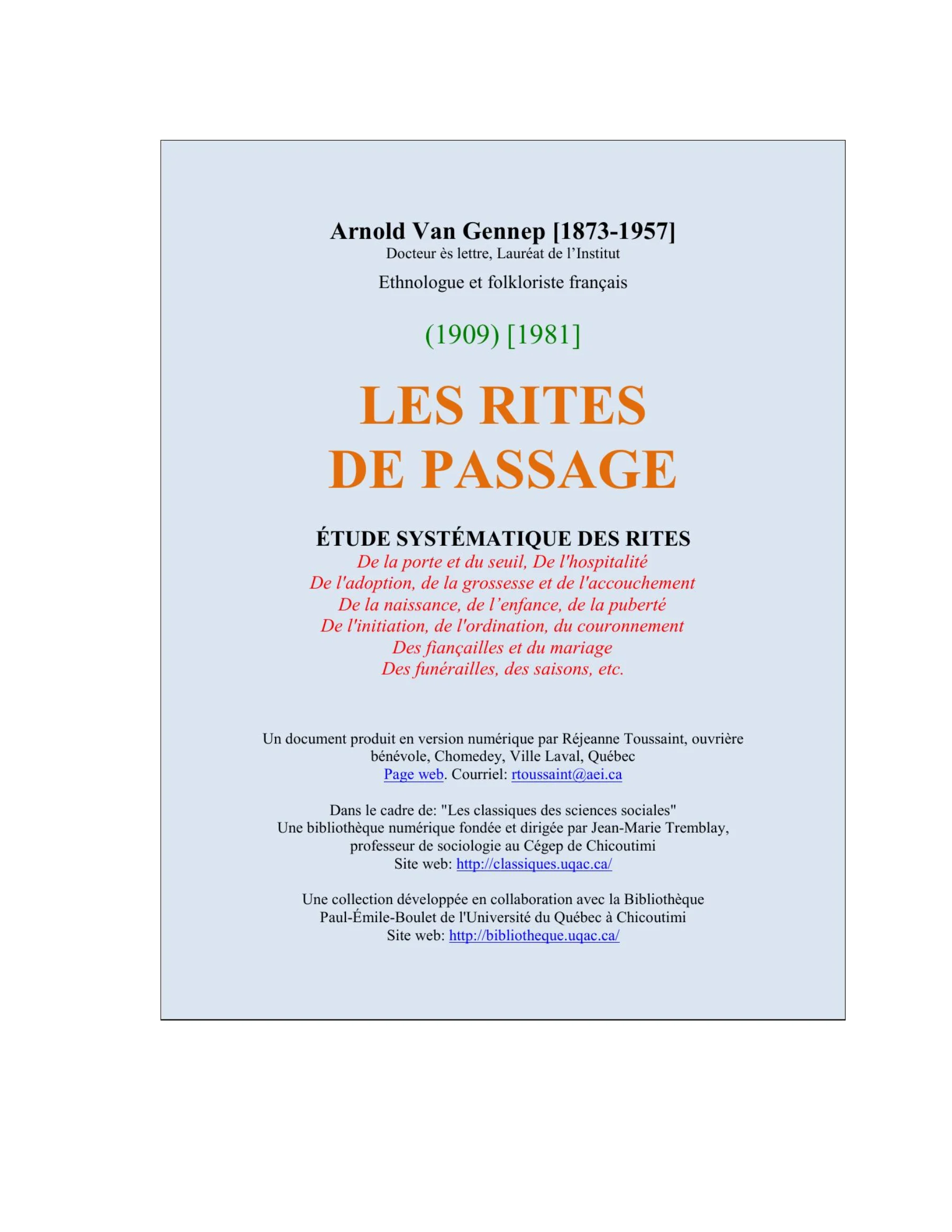
In The Rites of Passage, first published in 1909, Arnold Van Gennep identifies a recurrent organisation in ceremonies surrounding birth, initiation, marriage, travel and death. He distinguishes three phases: separation, in which a person leaves a former state; transition or margin, where they stand between statuses; and incorporation, which integrates or reintegrates them under a new identity.
Van Gennep calls these preliminal, liminal and postliminal rites. The marginal period is not a mere wait: ordinary rules are suspended and identity remains provisional. Victor Turner later developed the concept of liminality, but the sequence separation–margin–incorporation belongs to Van Gennep's original model.
First contact could constitute precisely such a situation. Once an artificial signal is recognised, humanity is no longer alone but is not yet engaged in a relationship. It occupies an intermediate space. As in the semiology of a sign changing worlds, physically recognising a signal guarantees neither its meaning nor its status.
6. A.L.I laboratory: a contact protocol in three passages
Separation: isolating the signal
The first stage separates the message from noise while suspending immediate interpretation. The signal must be repeated, localised and compared. Its artificial origin must be tested without prematurely assigning intention. A safety zone protects both parties: no irreversible command, no biological transmission and no direct access to critical systems. The message becomes a distinct object, but its sender remains unknown.
Liminality: constructing common ground
The second stage is the threshold. Neither we nor the other can yet impose a language. Exchanges first concern verifiable transformations: repetition, permutation, scaling, rhythm and error correction. Each party proposes an operation that the other reproduces, modifies or refuses.
Identities remain provisional. A signal may originate from an individual, a collective, a machine or an automated device abandoned millennia ago. The relationship must work before its participants are defined. This liminal period could last seconds or centuries.
Incorporation: becoming interlocutors
Incorporation begins when both parties recognise a minimal set of rules. They do not yet understand each other's cultures, but they accept a shared status: interlocutor. This status entails permissions, limits, a memory of exchanges, the ability to correct an error and the right to leave the relationship.
The first genuine message would not be “This is who we are”, but: “We recognise that something connects us, and we agree to test its rules.”
7. From rite to verifiable protocol
Transposing Van Gennep does not mean artificially ritualising science. The model must become a testable protocol. Separation corresponds to independent detection, provenance and containment. The margin becomes reversible calibration: shared units, redundancy, transformations and a right to silence. Incorporation corresponds to a durable channel, explicit permissions and shared memory.
This proposal extends the interstellar Turing test hypothesis: evidence of intelligence would reside less in a brilliant answer than in the reciprocal construction of stable rules. It also meets nuclear semiotics, where transmission requires anticipating the disappearance of context, and the work on radical alterity, which prevents us from reducing the other to an incomplete version of ourselves.
8. What the model does not solve
Structural thought often privileges oppositions: nature and culture, raw and cooked, life and death. Nothing proves that an extraterrestrial intelligence organises reality in binary form. It might use gradual, ternary, quantum or multidimensional logics. It might know no stable identity, precise beginning or boundary between sender and message.
The rite model also assumes a before, a threshold and an after. An intelligence distributed across time might regard contact as a continuous state. An artefact found on Earth could have started communicating long before we recognised it. Structures may also be produced by the analyst: finding an opposition does not prove that it governs the observed world.
Lévi-Strauss and Van Gennep therefore provide no anthropological law exportable into space. They offer a critical scaffold for separating three problems too often confused: decoding a sign, establishing a relationship and changing status.
9. Contact as reciprocal transformation
No civilisation would emerge intact from first contact. Even a silent contact would alter its sciences, religions, institutions and definition of life. The other would also be transformed if it agreed to answer. First contact would therefore be neither the reception of a message nor the discovery of an object. It would be a rite without an officiant, performed by two worlds inventing the conditions of passage together.
The decisive question would no longer be only “How can we speak to an extraterrestrial intelligence?”, but: what protocol would allow two forms of existence to become interlocutors gradually, without destroying one another?
References
- Collège de France — Claude Lévi-Strauss, Social Anthropology chair.
- Collège de France — Claude Lévi-Strauss: Thinking about the world differently.
- Harry Ransom Center — Lévi-Strauss's kinship theses and alliance theory.
- University of California, Berkeley — Claude Lévi-Strauss, “Mythical Thought and Social Life”.
- Arnold Van Gennep — The Rites of Passage, University of Chicago Press.
- NASA — Archaeology, Anthropology, and Interstellar Communication, 2014.