This hypothesis is extended by Ghostbook Reader, a web application designed by David Guez to experiment directly with the passage of a ghost book through a host book. It lets users select or import two works, test linear or cyclic reading, and visualise the selected letters, their indices and the complete trajectory of the hidden text.
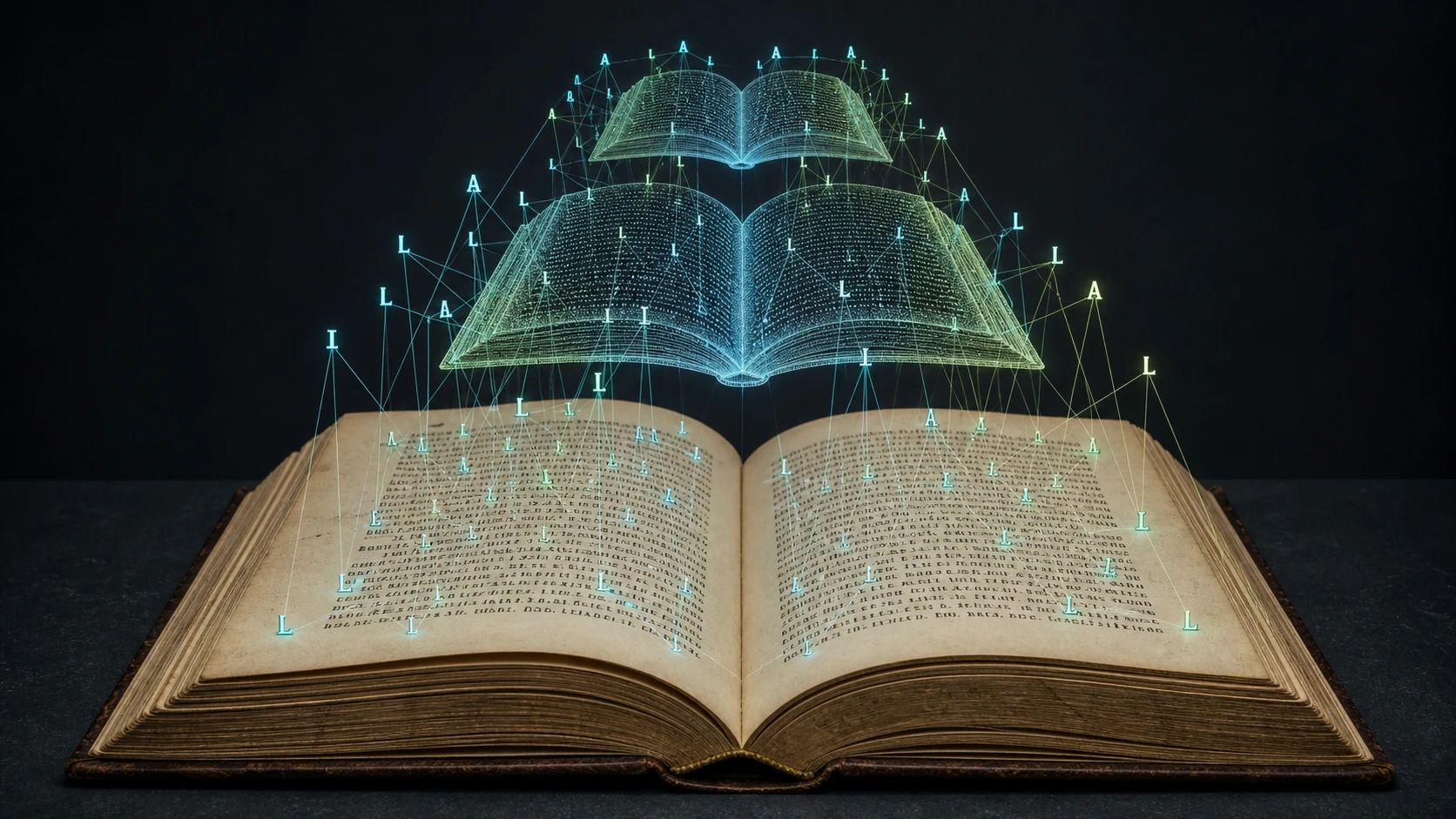
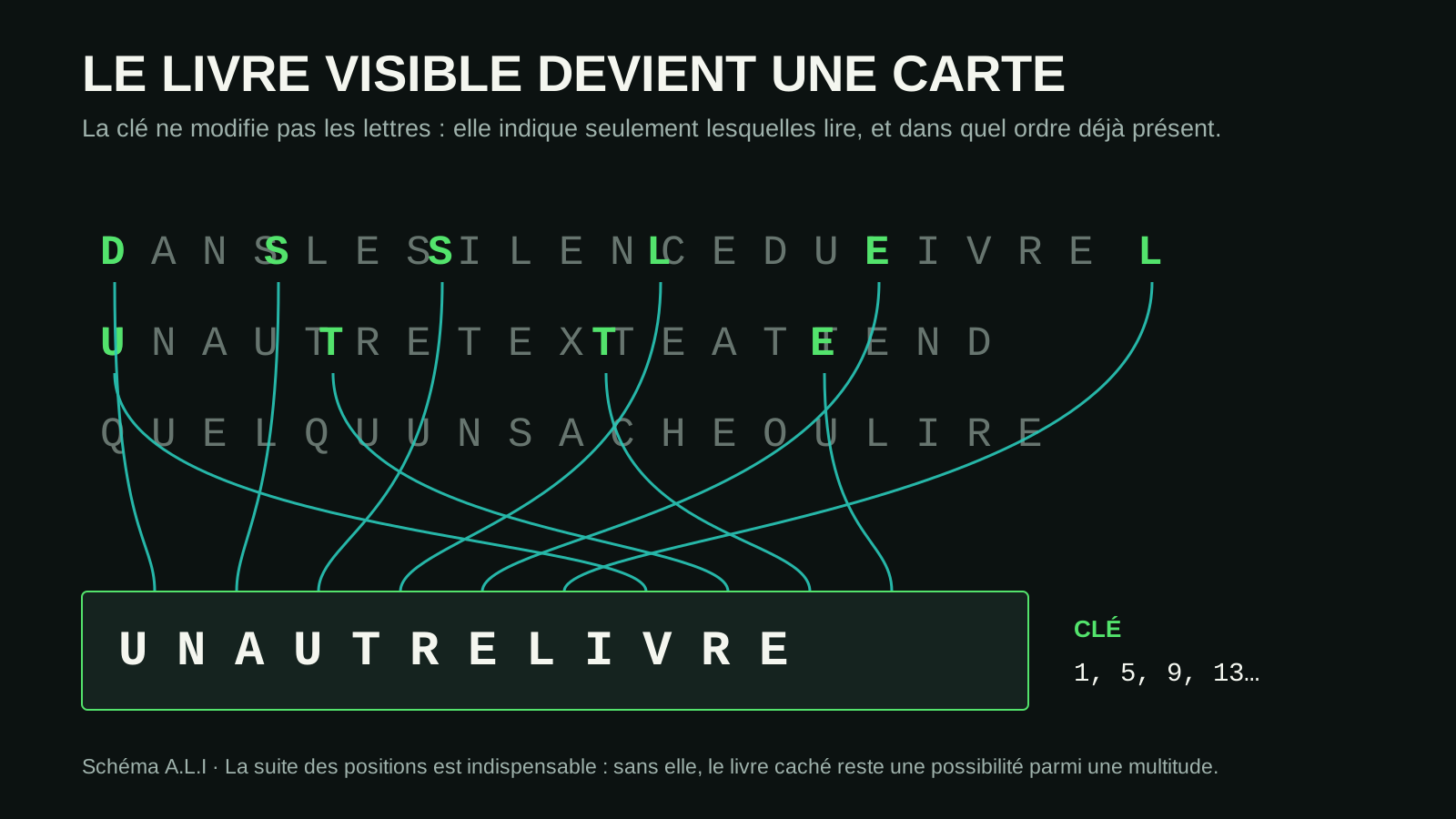
Imagine that one visible book contains a second book. The hidden text would not be printed between the lines or written in invisible ink. It would appear by selecting particular letters from the first book, from left to right, without ever moving backwards. The first chosen letter might be on page 2, the next on page 17, the third on page 18, and the reading would continue until another work emerged.
Let us call this device a Ghostbook: a ghost text present within a host book but invisible without a reading rule. Could that second book contain a third? Could Shakespeare fit inside the Bible, a film inside a novel, or even all existing books inside one finite volume?
The intuition is powerful, but it forces us to distinguish several meanings of contain. This study combines potential literature, combinatorics, information theory, steganography and artistic practice. It also includes a reproducible experiment using real texts.
1. Four ways for one book to hide another
| Model | Rule | What must be transmitted |
|---|---|---|
| Contiguous substring | The hidden text appears word for word in one continuous region. | Its starting point and length. |
| Subsequence | Letters are selected in order, with any number of gaps. | The positions or a rule for recovering them. |
| Anagram | Letters in the host book may be freely reordered. | A permutation, often enormous. |
| Binary storage | The book's material actually represents the file's zeros and ones. | The format, reading system and data themselves. |
The Ghostbook studied here mainly uses the subsequence. In theoretical computer science, a string T is a subsequence of H when characters can be removed from H, without changing the order of those retained, to obtain T. It is therefore neither a hidden contiguous excerpt nor an anagram.
2. The simplest algorithm
To determine whether a target text is contained in a host text, a mechanical reader needs only one forward pass through each:
position = 0
for each letter in the ghost book:
    move through the host until that letter is found
    if the end of the host is reached: fail
    store the position
success: the stored positions are the key
This greedy method is optimal for the question: selecting each letter as early as possible leaves maximum room for the remaining letters. Its cost is linear in the host's length, so an application can rapidly test thousands of text pairs.
3. How many pages are needed on average?
First assume an alphabet of k equally frequent, independent symbols. Finding a particular letter requires scanning k characters on average. A hidden text of m symbols therefore needs approximately:
average host length ≈ k × m
With 26 letters, a 2.6-million-character host can hold a target subsequence of roughly 100,000 letters on average. Real languages are different: e appears quickly, whereas z or q may require a long wait. If a target contains ni occurrences of a letter whose host frequency is pi, a better estimate is:
expected host length ≈ Σ ni / pi
Spaces, punctuation, capitals, ligatures and diacritics also change the answer. Every Ghostbook must state its normalisation protocol. For our calculations, texts were lowercased, accents reduced to base letters and only a through z retained.
4. Alphabet size changes capacity
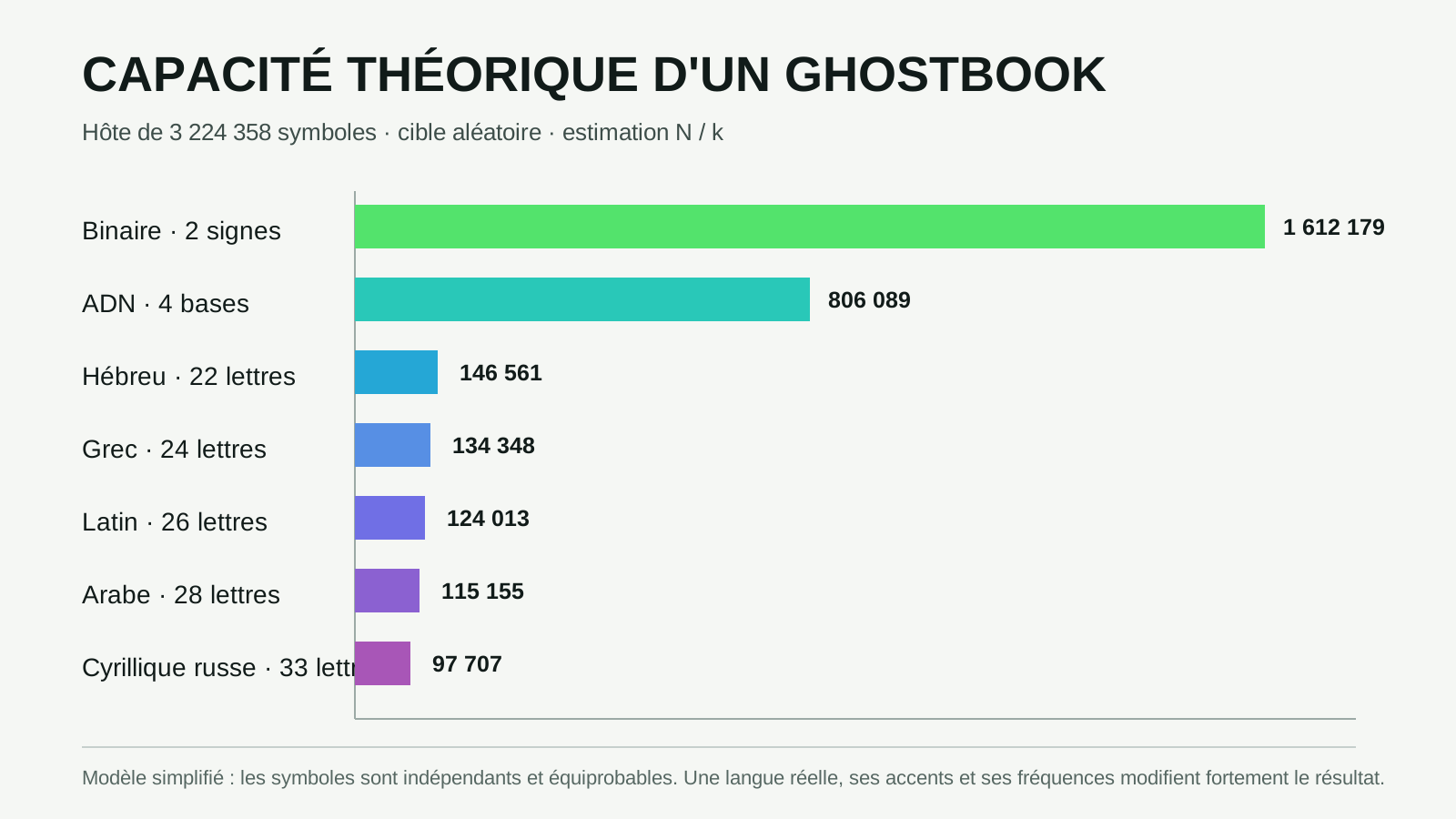
The following chart applies the uniform N/k rule to a host of 3,224,358 symbols, the normalised length of the King James Bible used in our experiment. Alphabet counts are minimal models: real writing systems add variants, diacritics, punctuation, numerals and composition rules.
| Simplified repertoire | Symbols | Average target capacity |
|---|---|---|
| Binary | 2 | 1,612,179 bits |
| DNA | 4 | 806,089 bases |
| Hebrew | 22 | 146,561 letters |
| Greek | 24 | 134,348 letters |
| Latin | 26 | 124,013 letters |
| Arabic | 28 | 115,155 letters |
| Russian Cyrillic | 33 | 97,707 letters |
| 3,000-symbol repertoire | 3,000 | 1,074 symbols |
This comparison does not rank languages. It measures one combinatorial property of a uniform model. Syllabic, morphographic or contextual scripts require different units from the Western “letter.” The Ghostbook therefore reveals that a hidden message already depends on a theory of what counts as a sign.
5. Experiment: Is Shakespeare in the Bible?
We downloaded four texts from Project Gutenberg: the King James Bible, the Sonnets, Hamlet and the complete works of Shakespeare. Gutenberg's editorial headers were removed and the texts normalised using the rule above.
| Target | Letters | Result in the Bible | Matched |
|---|---|---|---|
| Sonnets | 73,420 | Complete success; final letter after 3,106,608 biblical letters | 100% |
| Hamlet | 134,352 | Failure after 74,461 letters of the play | 55.4% |
| Complete Works | 4,057,221 | Failure after 98,085 letters | 2.4% |
Shakespeare's Sonnets are genuinely present in this edition of the Bible as an ordered subsequence. This striking result does not imply that Shakespeare was intentionally written into the Bible. A host containing millions of letters necessarily has an immense number of subsequences.
Hamlet is only slightly longer than the uniform-capacity estimate, but its letter distribution does not match the Bible closely enough. Using actual host frequencies, it would require about 4.44 million biblical letters on average. The estimate for the complete works exceeds 125 million letters.
The test is reproducible, but edition-dependent. Changing a translation, removing speaker names or retaining punctuation changes both the result and the key.
6. The key paradox: Where is the information?
Extracting the 73,420 letters of the Sonnets means specifying their path through 3,224,358 possible positions. A naïve list uses 22 bits per position, around 202 kilobytes. Even an ideal combinatorial code has a lower bound close to 63 kilobytes. The normalised Sonnets themselves occupy roughly 73 kilobytes in ASCII.
The host book does not store Shakespeare for free: the reading key carries almost as much information as Shakespeare.
The Ghostbook resembles a book cipher, in which coordinates point into a shared work. Its value is not miraculous compression but a displacement of support: the visible text becomes a map and the hidden work becomes a route.
7. Can one short book contain every book?
Here is the combinatorial vertigo. Write the 26-letter alphabet in order and repeat it m times. The resulting sequence has only 26m characters, yet it contains every possible length-m text over that alphabet as a subsequence: choose one letter from each block.
For m = 1,000, a 26,000-character book potentially contains:
261000 ≈ 101415 different 1,000-letter books
This dwarfs the number of works ever written. The paradox remains: selecting one of those books requires a key of about 4,700 bits, precisely the sequence of 1,000 choices among 26 letters. The content does not emerge from nothing; it travels in the selection.
A finite host cannot contain a longer subsequence or all books of every length. It can, however, be designed as a bounded universal supersequence containing every text up to a fixed length. Moreover, a host with N positions offers at most 2N positional selections, and repeated letters make many selections produce the same result.
This distinction echoes Kurd Lasswitz's The Universal Library and Jorge Luis Borges's The Library of Babel: a total library may contain every possible book while making it nearly impossible to distinguish text, variant, error and revelation.
8. Nested Ghostbooks
The second book can serve as host for a third, producing a chain:
Visible book → key A → ghost book → key B → another book → …
At every layer, available length decreases and another key must be preserved. To extend the chain, key B might be hidden in the first book or derived from a date, astronomical sequence or cultural object. The system becomes less a hard drive than an architecture of dependencies.
A compelling variation would make every extracted book provide the instructions for the next. The reader receives only the initial book and first rule. The work becomes a tunnel of libraries in which every exit produces the next lock.
9. Paper Hard Drive: When a book truly stores a film
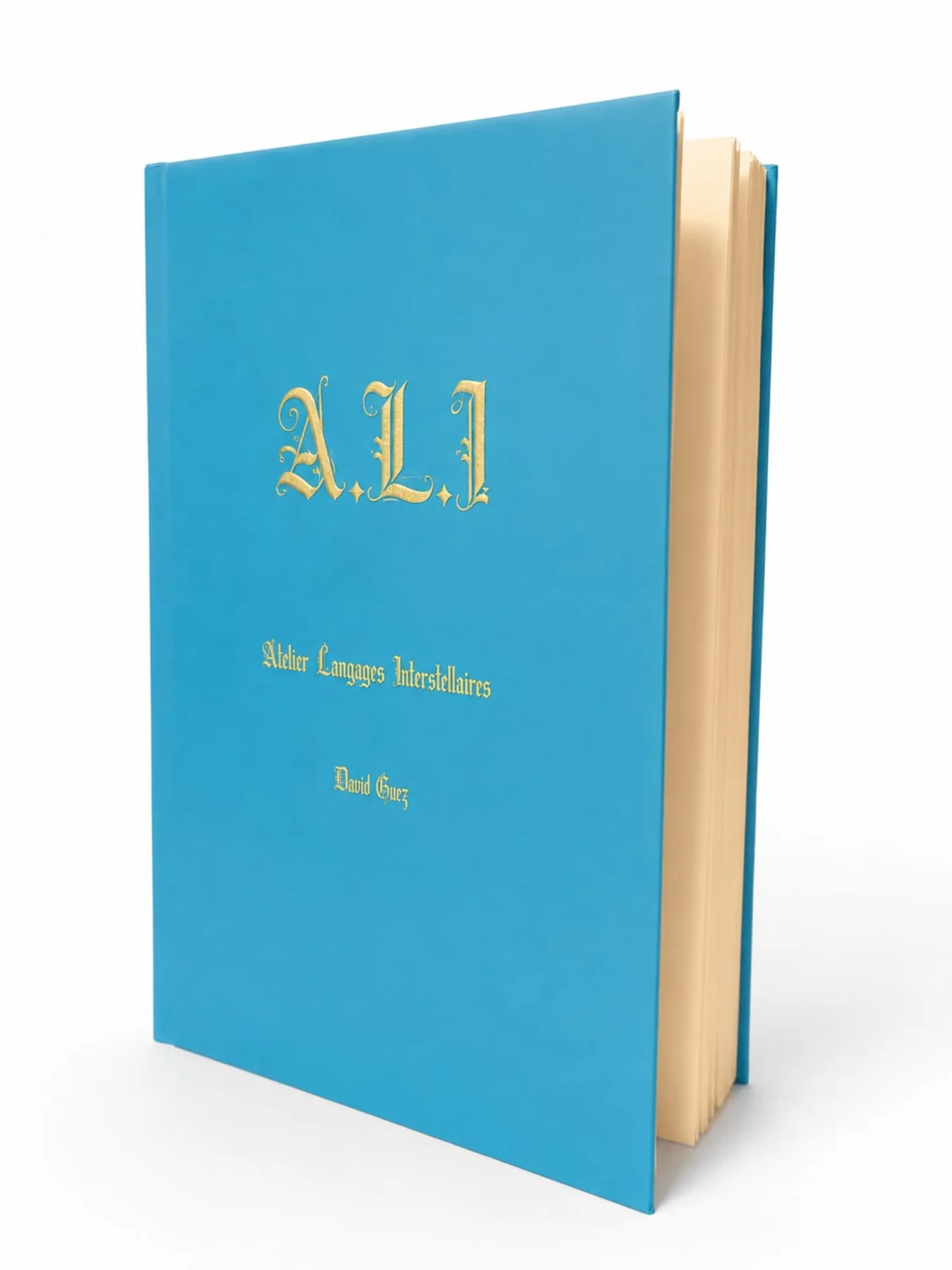
This hypothesis meets a direct precedent in the work of David Guez, artist and author of A.L.I. In 2012 he created the Paper Hard Drive: a digital file's binary code is miniaturised and printed so that a scanner and software can, in principle, reconstruct the file.
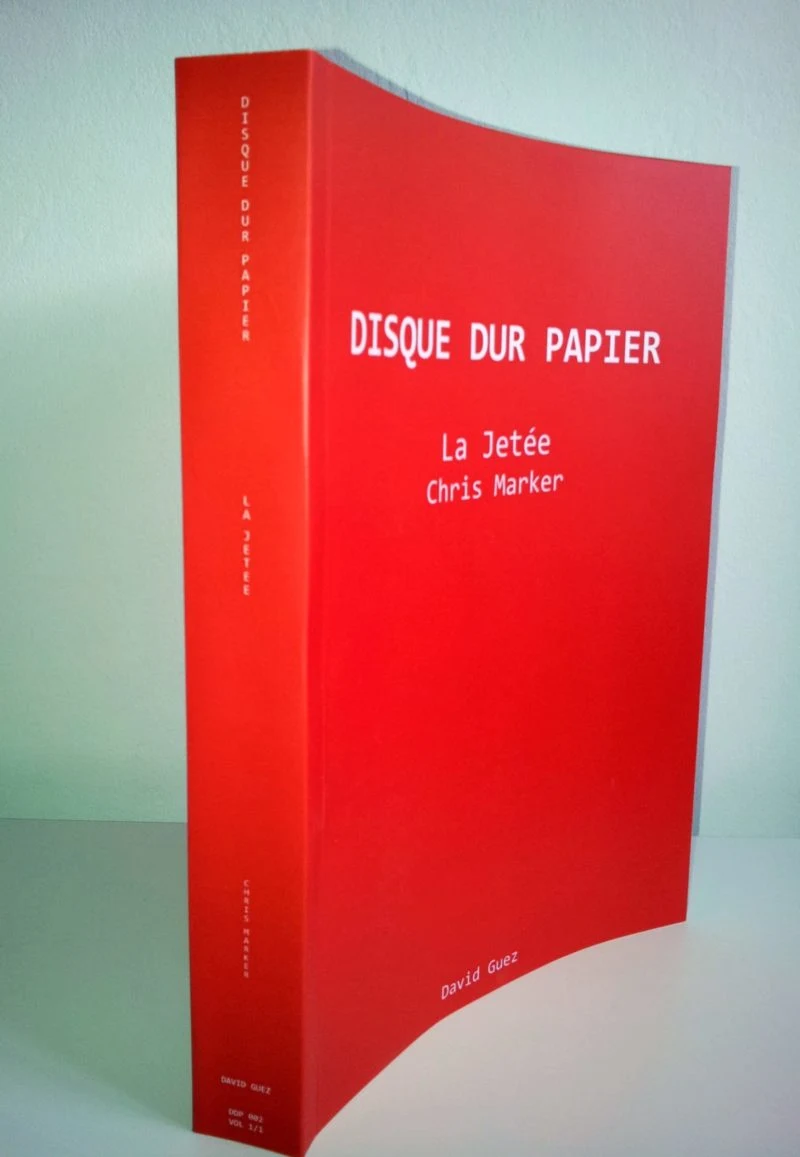
For Chris Marker's La Jetée, project documentation reports a file of about 36 MB, hundreds of millions of binary signs and 625 pages set in 1.26-point type. The work was shown at the Centre Pompidou during Hors Pistes 2013. A second edition encoded Georges Méliès's A Trip to the Moon.
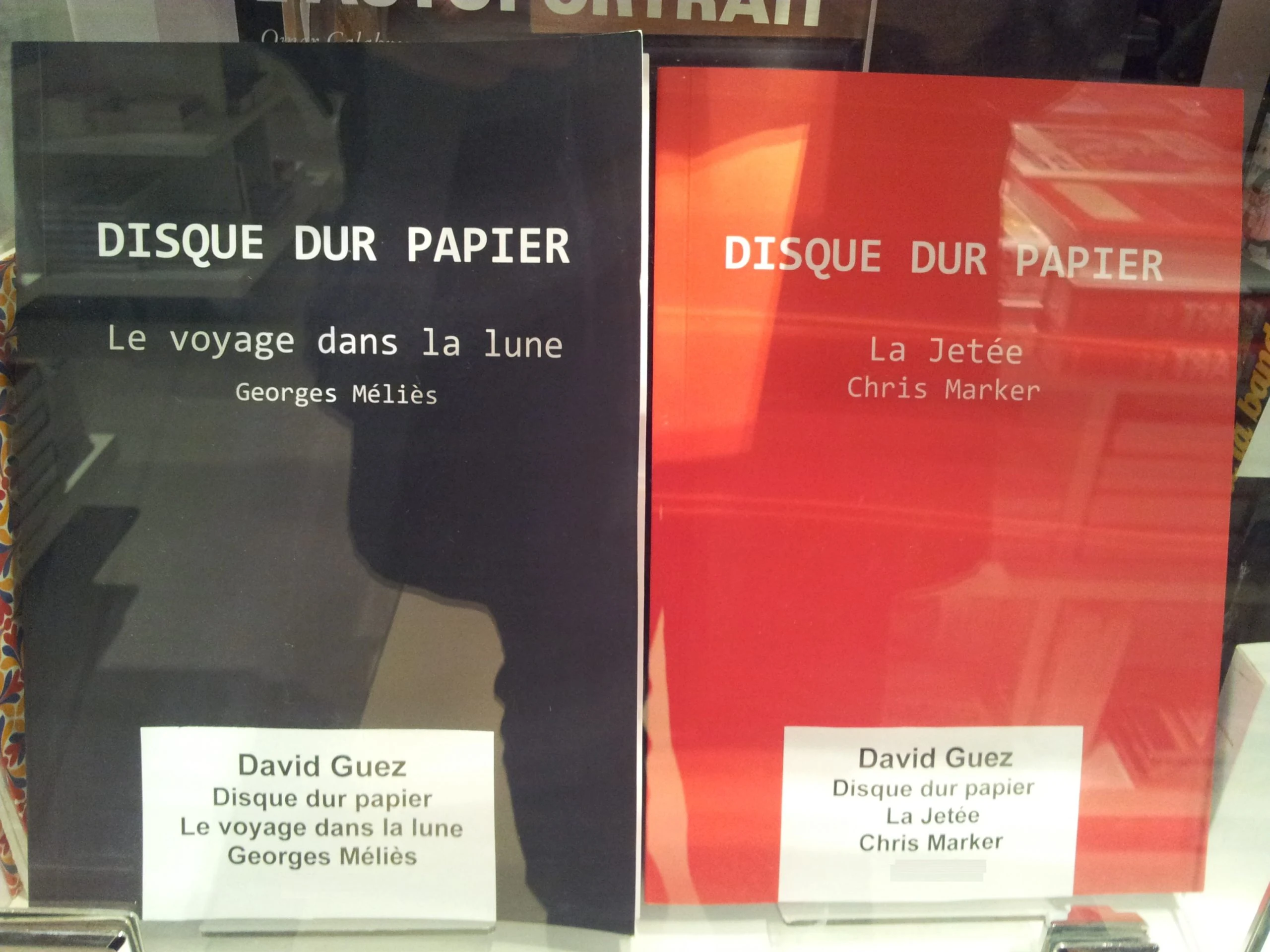
The difference from the Ghostbook is fundamental:
- Paper Hard Drive: the film's bits are physically present; material density and scanning reliability determine capacity.
- Ghostbook: the host letters already exist; a key selects a path that gives them a second meaning.
The first is material memory. The second is relational memory. One prints data; the other prints, or conceals, the possibility of a reading.
10. From the book to binary: A ghost film
Every text, sound, film or program can be converted to bits. With a balanced binary alphabet, finding one target bit requires two host bits on average. A random stream of two million bits can therefore contain a target subsequence of roughly one million bits.
Yet the key must still say which bits to keep. For a film, that key becomes as large as the film. A binary Ghostbook does not defeat compression theory. It can nevertheless create a powerful artwork: one film watches another film that exists only through the images, colours or binary values the viewer chooses to retain.
A feature film could become the host stream. Every frame would be converted into bits and a second film extracted through a visual route: centre pixel, detected face, brightest zone or viewer's gaze. The “hard drive” would no longer be inert storage but an editing rule.
11. Applications and artistic experiments
Ghostbook Reader
An application receives two texts, normalises their alphabets, tests the subsequence relation and displays the route letter by letter and page by page. It calculates the key's minimum size and compares it with the hidden payload.
Ghostbook Composer
Rather than search an existing book, a program writes a readable new work that must contain a second text. A language model proposes sentences while an algorithm periodically forces missing letters. Constraint becomes a writing practice related to Oulipo.
Polyphonic Edition
One novel is printed with multiple transparent routes, each revealing a different voice: diary, political counter-narrative, poem, score or manual. Readers overlay routes and discover that ghost books sometimes share letters.
Installation with moving keys
A camera tracks visitors moving before a wall of text. Every trajectory selects letters and generates a temporary book. No two visitors read exactly the same work; the body becomes the key.
Astronomical Ghostbook
The key is not an arbitrary list but a public sequence: star positions, primes, pulsar beats, a molecule's spectrum or digits of a constant. A receiver recognising the same physical structure can reconstruct the route without sharing our library.
Recursive Library
Each hidden text contains an address, rule or fragment of the next. The work may end at an impossible key, return to its first book or form a loop in which two books contain each other through different routes.
12. The inverse movement: Writing the host book
So far, we have started with two existing books and asked whether the first could be extracted from the second. Now reverse the process: choose the ghost book first, then have a new host book written so that it necessarily contains every one of the ghost's letters in the correct order.
An artificial intelligence can write under this constraint. It receives the text to conceal, a literary genre, a desired length and a minimum insertion rate. As it writes, an independent controller tracks progress through the secret text. If the prose moves too long without reaching the next required letter, the controller forces a compatible word. The AI then resumes the narrative freely until the next constraint.
The system therefore uses two agents:
- the writer, seeking coherence, style, characters and rhythm;
- the subsequence guardian, checking that every new passage advances the hidden book without changing the order of its letters.
The ghost's visibility can be adjusted. Dense insertion produces a shorter but more constrained host. Sparse insertion grants greater literary freedom and makes the route almost undetectable. Rare letters can be absorbed into proper names, scientific terms, quotations or language shifts.
This is not merely concealment performed after writing. The visible book grows around another book, as an organism develops around an invisible armature. Two novels in opposing genres could contain exactly the same secret text. Conversely, an entire collection could be generated from one ghost, every volume becoming a different material interpretation of the same letter sequence.
The Ghostbook Reader project is the first operational stage: compare works, build the key, visualise zones of progress and measure information cost. A future Ghostbook Composer will use the same controls to guide an AI while it writes the host book.
13. 3D hypothesis: The book as a matrix
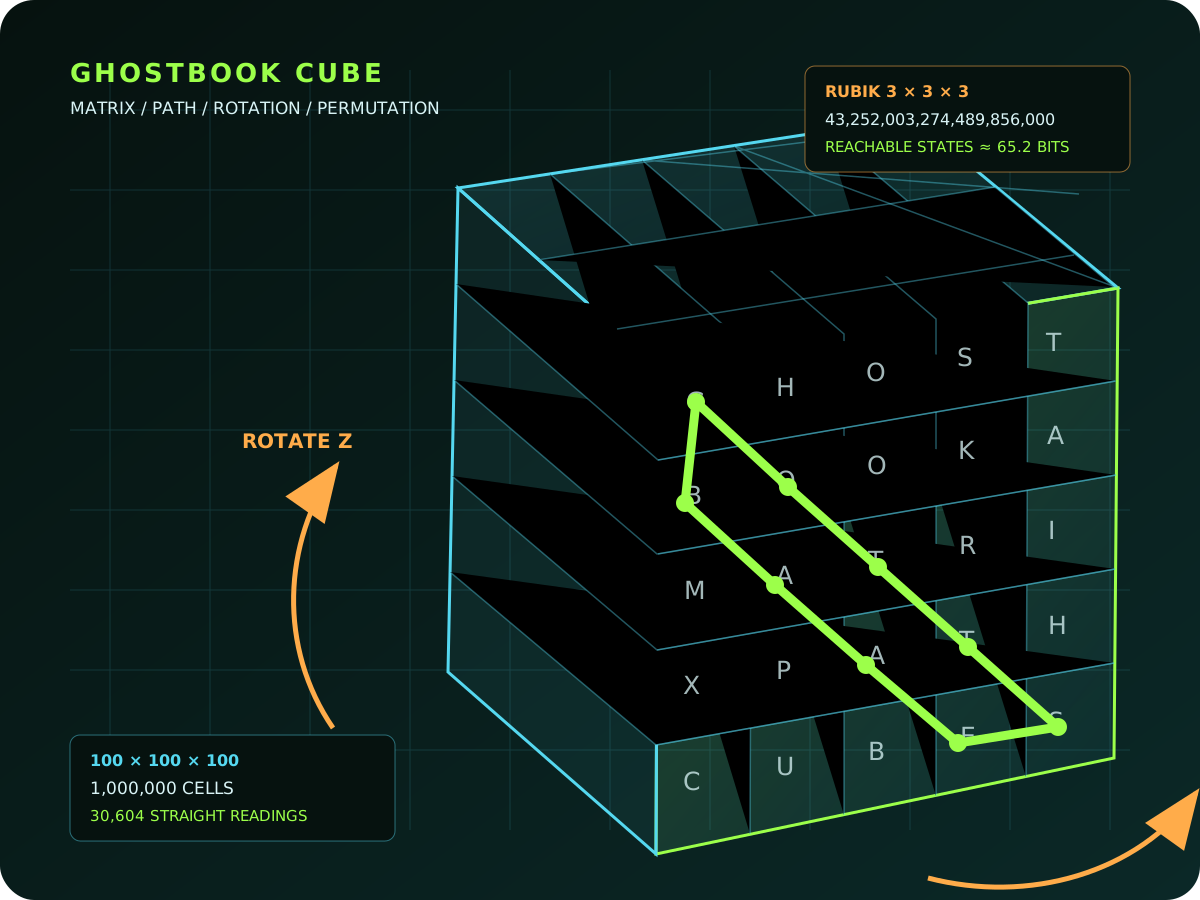
The traditional book imposes an almost one-dimensional geometry: a line of characters, divided into pages, read from beginning to end. Now imagine every sign occupying a cell in a cube, identified by three coordinates (x, y, z). A reader could move horizontally, vertically or through depth, follow a diagonal, jump from one point to another, or rotate entire layers before continuing. The book would become a manipulable alphabetic matrix.
What the third dimension adds, and what it does not
We must first remove an illusion. With the same number of letters, a third dimension creates no raw capacity. A line of one million characters and a 100 × 100 × 100 cube both hold N = 1,000,000 signs. If a key freely selects m positions among N, the number of selections remains the binomial coefficient C(N,m), whether the support is a line, square or cube.
For m = 100,000 selected positions among one million, there are approximately 2468,986 possible selections. Identifying one arbitrary selection therefore requires at least about 468,986 bits, or 58.6 kB. The cube does not erase the cost of the key; it gives that key a geometry.
The gain appears when the reading rule exploits that geometry:
- Local path. From an interior cell, six neighbours share a face. A key can then be described by a starting point and a sequence of six directions. For 100,000 steps, the upper bound is about 258,514 bits, or 32.3 kB, before subtracting impossible paths, forbidden returns and constraints imposed by the target letters.
- Free jumps. If each letter may reach any cell, a naive key requires approximately m log2N, close to 1,993,157 bits or 249 kB. The text becomes easier to recover, but the key is heavier than in the classical ordered model.
- Straight readings. A cube of side s has 3s² + 6s + 4 major straight lines through its cells: axes, plane diagonals and four body diagonals. For s = 100, this gives 30,604 unoriented lines, or 61,208 when both directions are counted.
The conclusion is precise: 3D does not manufacture free memory, but it supplies a vocabulary of routes. A key can become a sequence of simple gestures — rise, turn, cross, rotate a layer — rather than a long list of coordinates. Several ghost books may share cells and remain distinct through their paths. Without reuse, their combined length can never exceed one million cells. With reuse, the number of readings grows, but so do ambiguity and the information needed to describe each protocol.
Rotation and permutation: The Rubik’s Cube model
A global cube rotation provides only 24 orientations, barely 4.6 additional bits of choice. But when internal planes become movable, the scale changes. For a cube of side 100, independently permuting its 100 layers along three axes theoretically produces (100!)³ configurations, approximately 1,574 bits of key before reading even begins.
The Rubik’s Cube offers a concrete image of this power. Its 3 × 3 × 3 mechanism has exactly 43,252,003,274,489,856,000 reachable states, or about 65.2 bits. This immense figure does not mean that the object stores as many texts: a state becomes information only when sender and receiver share the puzzle rules, starting state and reading method. Permutation is less a hard drive than a transformation operator.
Installation: Ghostbook Cube
The installation could take the form of a transparent cube made from luminous cells or electronic-ink plates. Each cell displays one letter. Magnetic sensors record layer rotations, while a Three.js digital twin recalculates possible paths in real time.
- The visitor selects a ghost book from the collection or imports a text.
- The cube searches for a route through its current state and lights the letters it finds.
- If the route fails, one layer pulses: rotating it may bring the next letter closer.
- Every manipulation changes the visible text, the key and the reading topology at once.
- When the book is recovered, the cube replays the complete sequence as a choreography of light and rotation.
A physical 10 × 10 × 10 version would hold 1,000 signs. Its limited literary capacity would be offset by the legibility of the gesture. A virtual version could reach 100³ cells and compare strategies: lines, neighbourhoods, diagonals, rotations, paths with or without reuse. A Ghostbook Composer 3D could finally generate the cube’s alphabetic matter while optimising several hidden books at once.
The installation makes the true issue visible: the book is no longer merely content but a space of states. Reading means choosing an orientation, a transformation and a path. From an A.L.I perspective, an extraterrestrial message might likewise be distributed through a physical or cosmic matrix; its key would specify not only points, but the operations required to make the message legible.
14. The Ghostbook as an A.L.I problem
An interstellar message may be present without resembling a message. It might be less an autonomous object than a key applied to a shared corpus: star catalogue, hydrogen spectrum, cosmic background map, prime sequence or biological archive.
Does this save information? Only if sender and receiver already possess the same host in the same version and agree on the unit of reading. On Earth, changing Bible editions is enough to break a key. Between civilisations, the very concepts of letter, order and text may be absent.
The Ghostbook nevertheless offers a fertile hypothesis: a signal may be less a content than an instruction for navigating reality. Matter, sky or life would form the common book; the message would indicate which positions to connect.
15. What the Ghostbook actually demonstrates
The Ghostbook does not prove that every book is mystically present in every other book. It demonstrates something more precise and perhaps more unsettling:
- a long text contains an immense number of subsequences;
- a short, specially designed text can contain every text of a bounded length;
- the selection key carries most of the information;
- the meaning of “content” depends on reader, alphabet and protocol;
- the same support can become material archive, map, score or narrative generator.
The ghost book is therefore neither wholly in the book nor wholly in the key. It appears in their relation. This is where the hypothesis meets A.L.I: communication may not always mean sending an object; it may mean teaching another gaze where to travel.
Sources and further reading
- Princeton University, subsequences and longest common subsequence.
- Project Gutenberg, Shakespeare corpus.
- Project Gutenberg, King James Bible.
- Cambridge University Press, combinatorics on words and subwords.
- Kurd Lasswitz, The Universal Library.
- Jorge Luis Borges, Ficciones and “The Library of Babel”.
- Oulipo and combinatorial literature.
- David Guez, Paper Hard Drive.
- Centre Pompidou, interview with David Guez, Hors Pistes 2013.
- MIT OpenCourseWare, combinatorics and information entropy.
- Rubik’s official site, the 43 quintillion reachable states.
- Qu, Rokicki and Yang, Rubik’s Cube as a random walk on a permutation group.