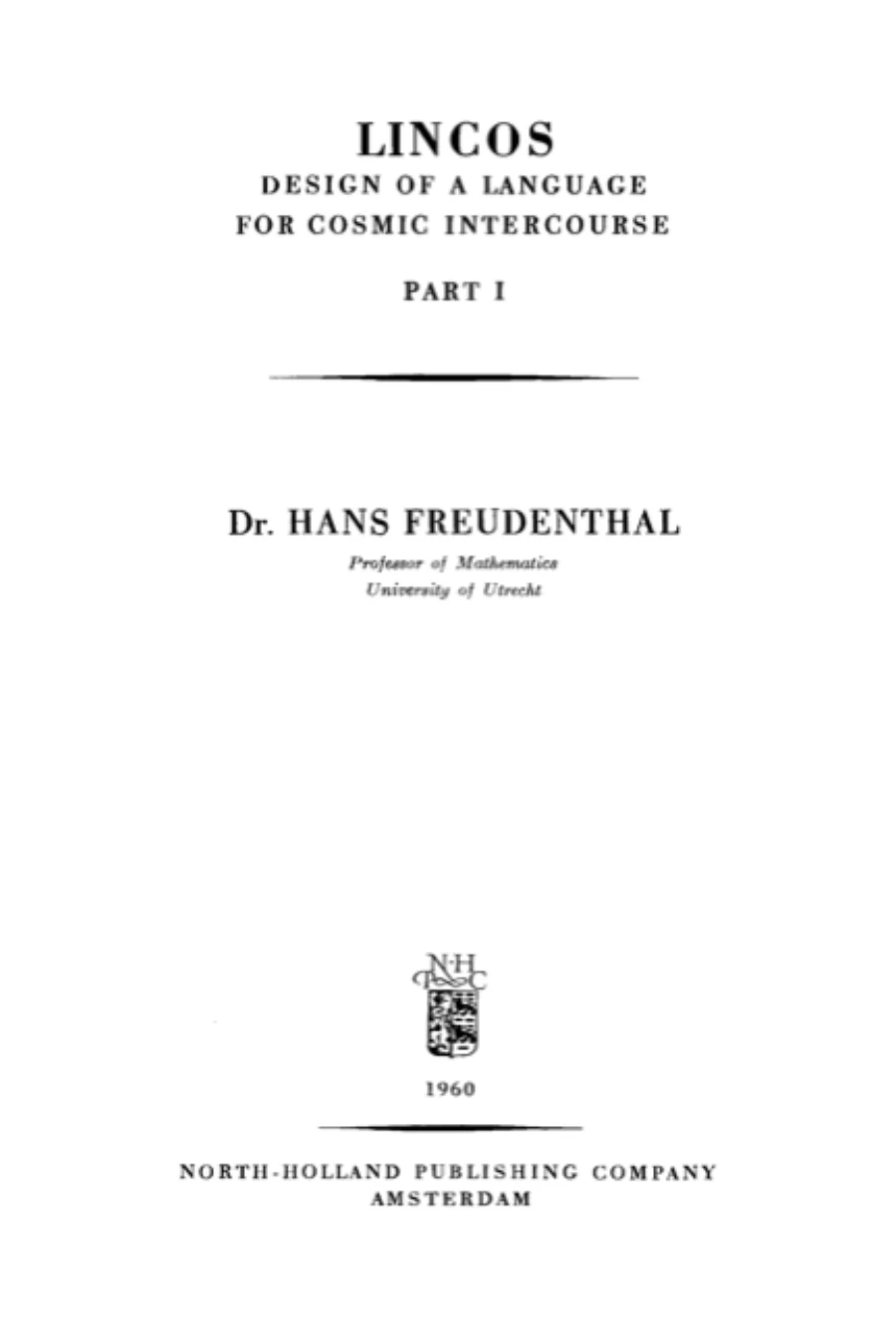
In 1960, mathematician Hans Freudenthal published Lincos: Design of a Language for Cosmic Intercourse. His ambition was formidable: to build a language that an extraterrestrial recipient could learn without a dictionary, prior translation, or any shared Earth language.
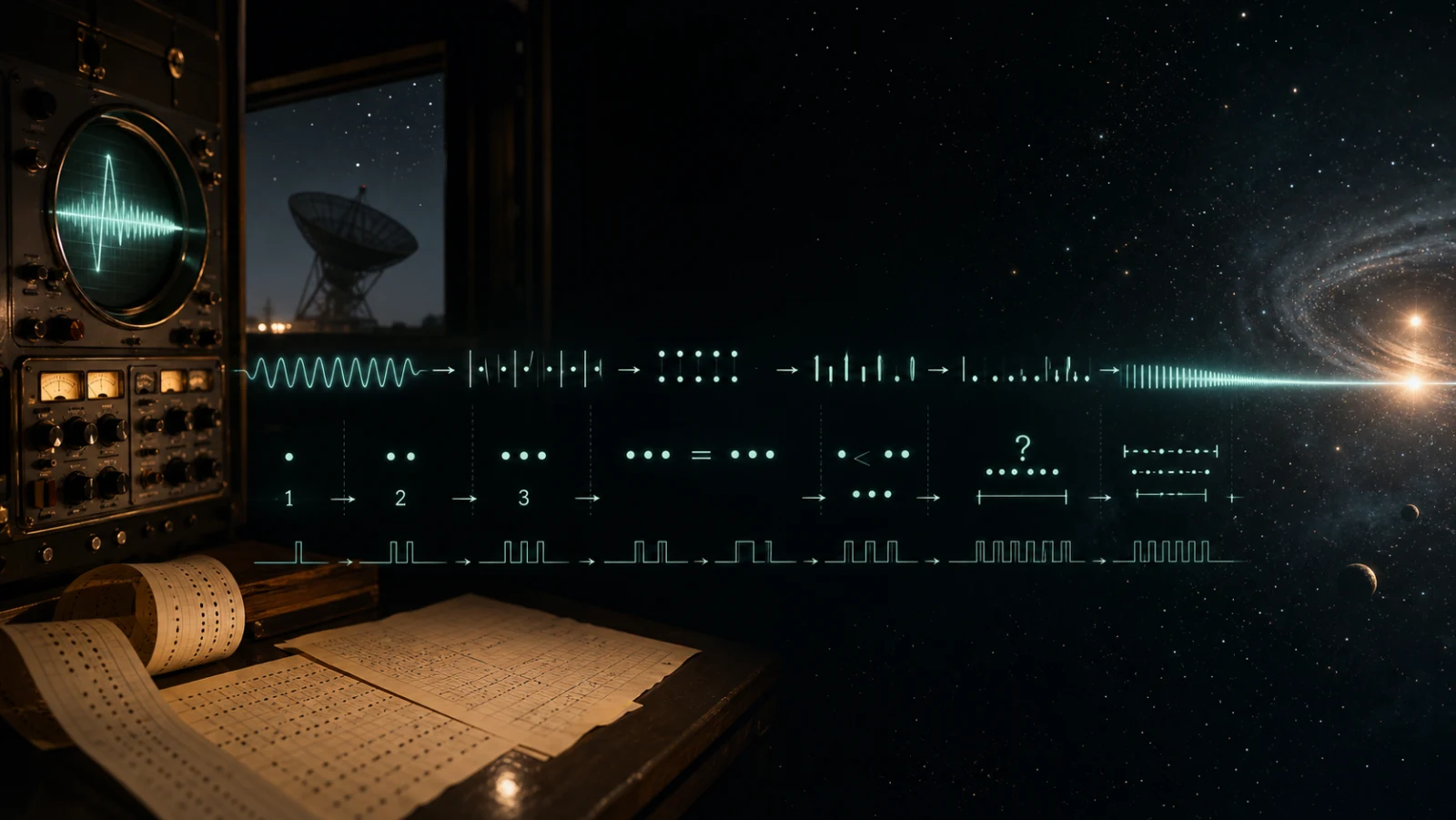
Lincos, short for lingua cosmica, is not merely an encrypted code. It is a lesson transmitted by radio. The message must first demonstrate how it works, then use acquired concepts to introduce more complex ones. A recipient has truly understood only when it can operate with the language: calculate, answer, correct, and compare. For A.L.I, Lincos is a major precedent because it reframes contact: the first message may not need to tell a story; it may need to teach how to learn.
1. Hans Freudenthal and a language without translation
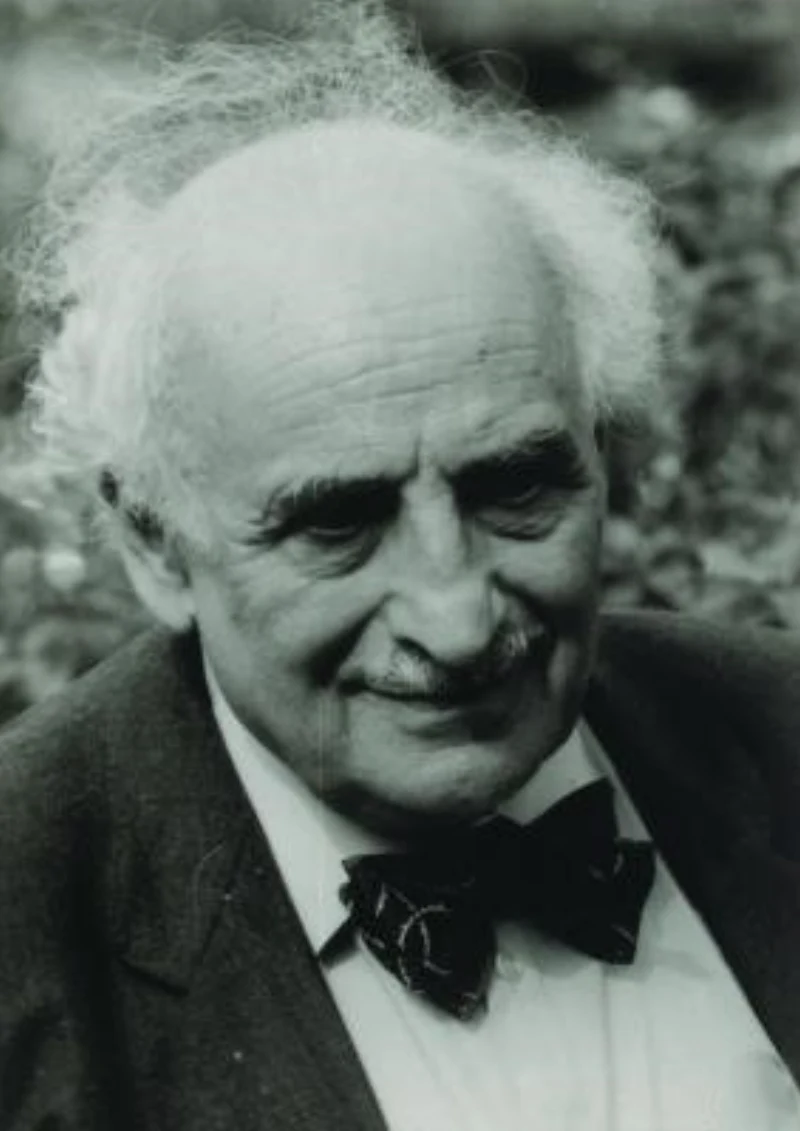
Hans Freudenthal (1905–1990) was a mathematician, philosopher of science, and theorist of education. Born in Germany and based in the Netherlands, he worked in topology before profoundly influencing mathematics education. This trajectory illuminates Lincos: the task is not only to invent universal symbols, but to organise a progression through which an unknown mind can reconstruct their meaning.
The book announces itself as “Part I.” It addresses mathematics, time, behaviour, and what Freudenthal calls conversation. Matter, life, and space were intended for a sequel that never appeared. The incompleteness is instructive: numbers are easier to transmit than biology, history, or lived experience.
2. Beginning ab ovo: the signal as first lesson
Freudenthal seeks to begin ab ovo—from the egg—with as little direct designation as possible. A sequence of identical pulses can introduce natural numbers: one pulse, then two, then three. Sets of true and false examples allow equality, inequality, addition, or multiplication to emerge. A sign does not naturally resemble its meaning; its position within repeated contrasts progressively constrains interpretation.
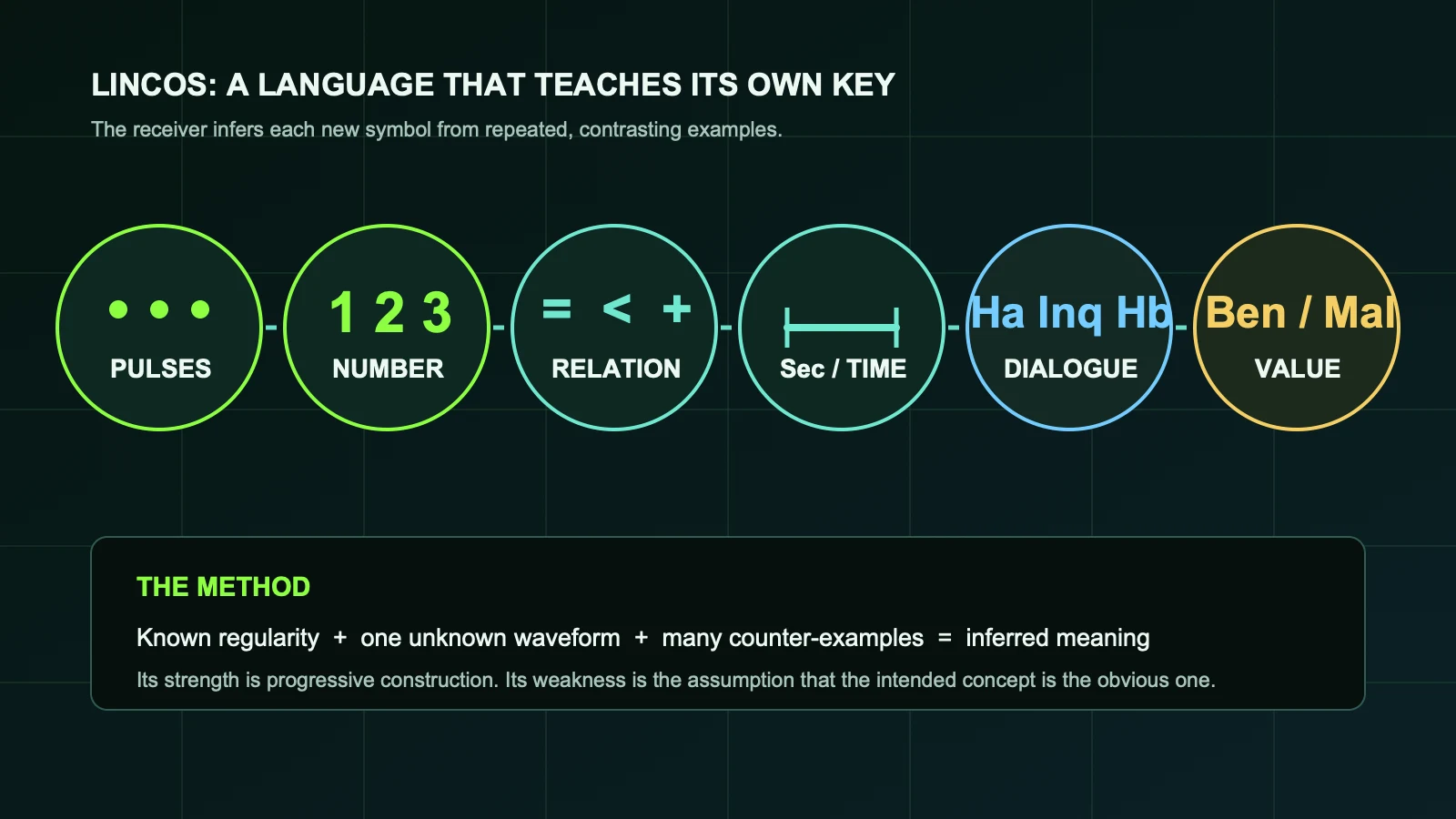
In linguist Pierre Valore’s reconstruction, a sequence such as 1 + 1 = 10 ∈ Ver is contrasted with 1 + 1 = 11 ∈ Fal. Ver and Fal function as true and false. The recipient must simultaneously infer numbers, operators, equality, and the evaluation of the statement. The method is powerful, but it does not eliminate assumptions: it presumes a mind that seeks regularities and favours a mathematical interpretation over an acoustic, aesthetic, or ritual one.
3. A language that builds its own units
Lincos uses radio signals whose duration and wavelength may vary. The medium therefore serves as a ruler. Once numbers and relations have been taught, the protocol can define a temporal unit from a reference pulse: Dur —— = Sec a. The physical duration of the message becomes an object inside the message.
This move matters to A.L.I. Meaning is not external to the channel: frequency, duration, silence, and repetition participate in grammar. But this richness also creates ambiguity. A pause may separate two signs, two sentences, or two pedagogical sequences. What the sender treats as punctuation may be read as data. A cosmic language must explain not only its symbols but also its blanks.
4. From equation to conversation
Lincos makes its boldest leap when Freudenthal leaves arithmetic and stages interlocutors. Conventional names such as Ha and Hb identify agents. The order of elements progressively teaches who speaks, to whom, and in what mode.
A simplified exchange can be read as follows:
Ha Inq Hb ?x 2x = 5Hb Inq Ha 5/2Ha Inq Hb Ben
Ha asks Hb for the value of x. Hb answers. Ha evaluates the response with Ben, “good.” The language distinguishes Ver/Fal, concerning truth, from Ben/Mal, evaluating an answer or conduct. A social scene appears inside a radio stream.
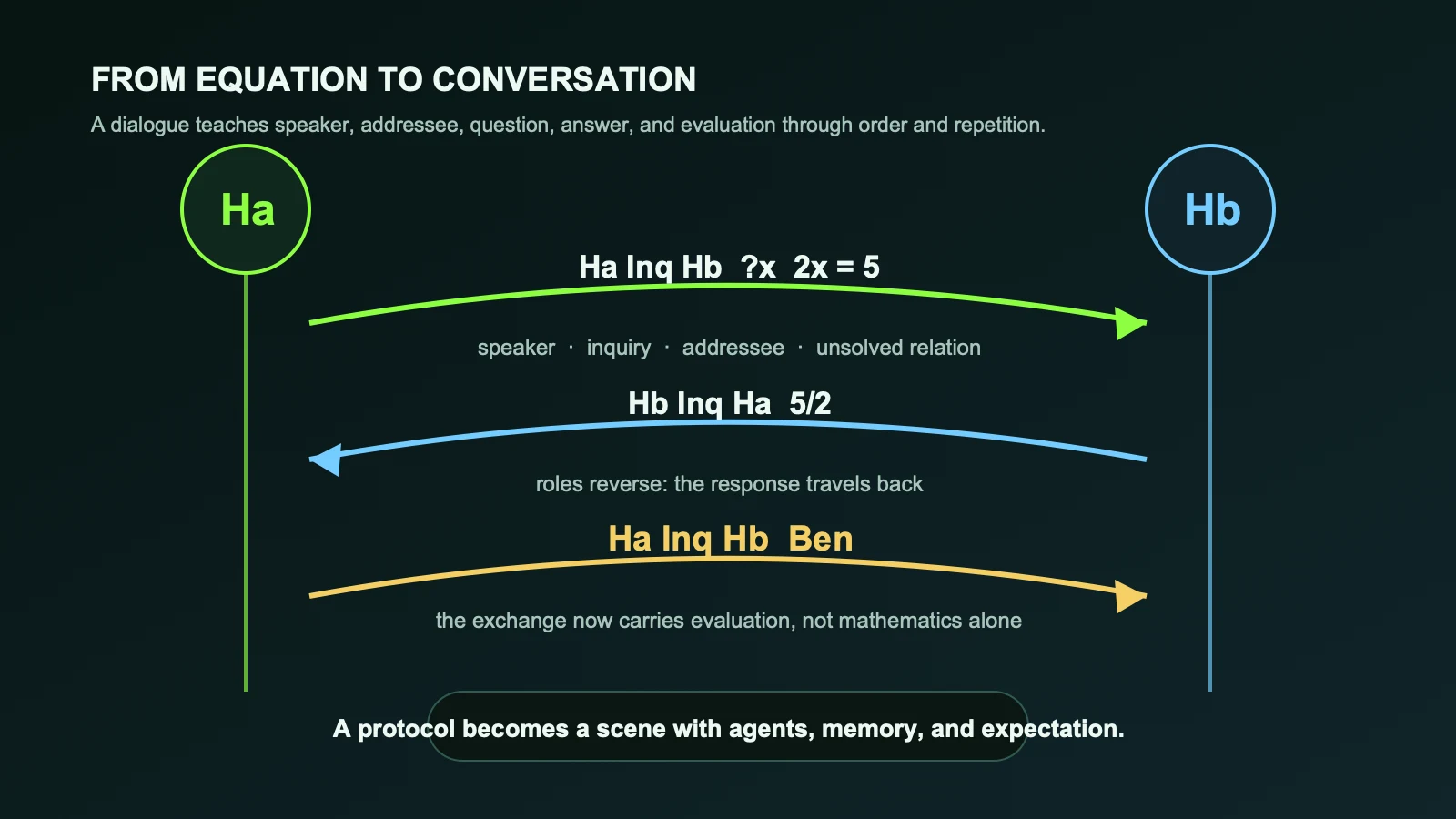
This progression opens the possibility of teaching knowledge, ignorance, desire, expectation, promise, or play. It also reveals a threshold: once Ben and Mal appear, language no longer merely describes a world; it proposes a norm. What seems “good” to the sender may have no equivalent for the recipient.
5. What Lincos already assumes
A language without common language can never begin from nothing. Lincos assumes at least a recipient capable of segmenting a signal, remembering examples, comparing sequences, seeking coherence, distinguishing repetition from variation, and accepting that a sender is trying to teach.
- Logic may not be unique. Even if arithmetic describes invariants, the chosen signs and the method for inferring them remain conventional.
- The required number of examples is unknown. What seems obvious to a human after three repetitions may require a hundred examples—or never become obvious—to another cognition.
- The channel is noisy and non-interactive. Across interstellar distances, the teacher cannot watch the learner hesitate and adjust the lesson immediately.
- The transition to life and culture is fragile. An equation can be tested locally; organism, justice, fear, or history depend on situated experience.
- The recipient remains anthropomorphised. Freudenthal himself acknowledged that the project presupposes mental states and experiences comparable to ours.
Contemporary criticism does not make Lincos useless. It reveals its experimental role: each difficulty locates a human assumption that the protocol had treated as self-evident.
6. Legacy: from Lincos to astrolinguistics
Lincos is generally described as the first systematic attempt at a language designed for interstellar communication. Later messages, including the 1999 and 2003 Cosmic Calls, reused the idea of a mathematical teaching preamble without transmitting Freudenthal’s complete language. In 2013, astronomer and computer scientist Alexander Ollongren published Astrolinguistics, extending the ambition of a logic-based language toward music, behaviour, and more complex annotations.
Modern work places greater emphasis on robustness, information theory, interaction, and plural interpretations. The question is no longer only “how do we encode what we know?” but “how can the other test that it has understood?”
7. A.L.I hypothesis: plural Lincos
A.L.I could retain Freudenthal’s pedagogical principle while abandoning a single path. A plural Lincos would transmit several reading hypotheses in parallel. Each new symbol would be accompanied by counterexamples, redundancy across media, and tests requiring the recipient to transform the message.
Protocol 1 — Proof of decoding
The recipient should not merely repeat a sequence. It must produce a new answer: complete an unfamiliar series, intentionally correct an error, or translate a relation into another rhythm. Understanding becomes verifiable action.
Protocol 2 — Multimodal message
The same relation is encoded through radio pulses, light, image, sound, and movement. No channel is presented as the true language. Their intersection separates structure from support and welcomes different perceptual biologies.
Protocol 3 — The anti-dictionary
For each sign, the message retains several possible interpretations and indicates which observations could separate them. Language no longer conceals ambiguity; it encodes ambiguity as part of the conversation.
8. A teaching machine before a universal language
Lincos is probably not a finished universal language. It is something more productive: a conceptual machine that forces humanity to expose the steps by which it turns a signal into a shared world. It reminds us that contact with an unknown intelligence is not a matter of sending a dictionary into the void, but of building a learning situation without a present teacher, a common body, or perhaps a reply for decades.
Sixty-six years after publication, Lincos remains a concrete working base for A.L.I. It gives us a method, an example, and a warning: we can teach a key inside the message, but we can never guarantee that the other will open the same door.
References and further reading
- Hans Freudenthal — Lincos: Design of a Language for Cosmic Intercourse, original text, 1960.
- Goldreich, Juba, and Sudan — A Theory of Goal-Oriented Communication, including a critical appendix on Lincos.
- NASA — Archaeology, Anthropology, and Interstellar Communication.
- Alexander Ollongren — Astrolinguistics, Springer, 2013.
- Dumas and Dutil — “An analogy-based extraterrestrial language”, Acta Astronautica.
- Hans Freudenthal — “Towards a Cosmic Language”, Cosmic Search.