Can a language be born without adults transmitting its model? In Managua, beginning in the late 1970s, deaf children and adolescents brought together in large numbers built a shared language. The case is exceptional, but it must be described accurately: Nicaraguan Sign Language did not arise “from nothing.” Each child brought family signs, gestures, and lived experience. What did not yet exist was a shared language capable of transmission and collective change.
This history concerns linguistics, politics, education, and Deaf culture alike. It shows that grammar is neither a dictionary falling from the sky nor the solitary creation of a genius. It can emerge from a community making its gestures understandable, memorable, and teachable. For A.L.I, it offers a concrete model of contact without prior convention.
1. Before a shared language: homesign, not silence
Before the 1970s, deaf Nicaraguans often lived far from one another. Without a strongly established national signing community, many developed homesign systems within their families: individual gestural repertoires structured enough to name, request, narrate, and distribute roles, but not shared at community scale.
This distinction matters. Lacking access to a conventional language does not mean lacking thought, intention, or communication. Research by Susan Goldin-Meadow, Marie Coppola, and colleagues shows that homesigners already organise utterances and produce abstract distinctions. The starting material was not a void but a plurality of local solutions.
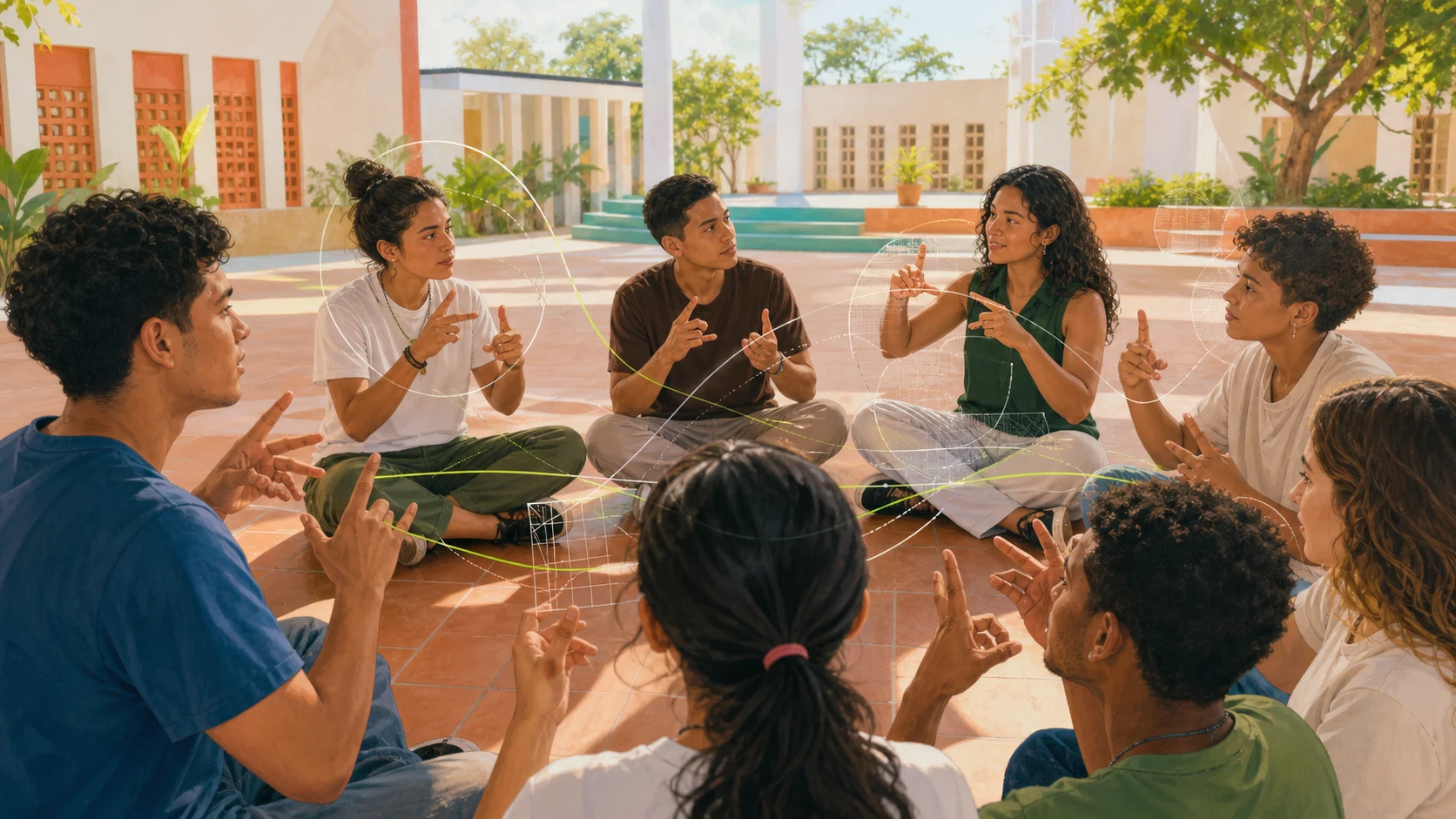
In 1977, a special-education centre opened in Managua, followed in 1980 by a vocational programme for adolescents. For the first time, dozens and then hundreds of deaf young people met every day. The institution sought to teach spoken Spanish and lip-reading. The new language developed chiefly among students—in courtyards, corridors, transport, and friendships.
2. The schoolyard as a medium of emergence
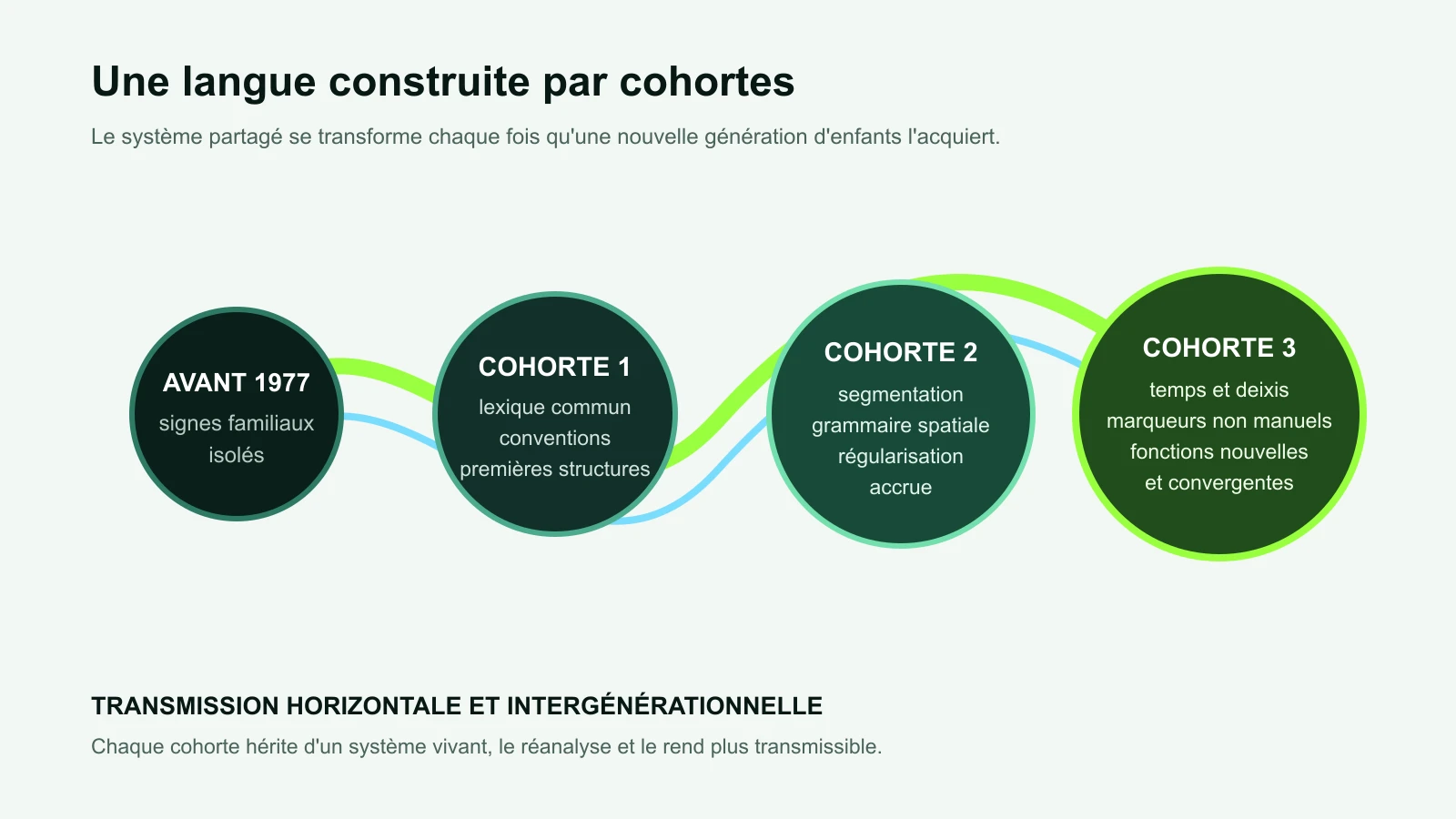
Students circulated their homesigns. Some gestures were adopted, others discarded or altered. Repetition stabilised forms, while misunderstanding demanded repair. A first cohort produced a shared repertoire, historically called Lenguaje de Signos Nicaragüense in some accounts. In 1986, linguist Judy Kegl was invited to study the system while it was still developing.
Popular accounts sometimes contrast a first cohort producing only a “pidgin” with a second suddenly creating a complete language. The evidence is subtler. The first cohort already had number words, noun–verb distinctions, and devices for organising event structure. Later cohorts nevertheless made several devices more regular, learnable, and multifunctional.
3. What successive cohorts actually changed
A language does not acquire all its properties at once. Nicaraguan Sign Language allows several grammatical processes to be observed on different timescales.
Segmenting events
In their 2004 Science study, Ann Senghas, Sotaro Kita, and Aslı Özyürek compared descriptions of events combining manner and path, such as an object rolling downhill. Spanish co-speech gesture tends to fuse those components. Signers in later cohorts separate them more often into sequential elements. Language does not merely copy an image; it selects units and organises their order.
Turning space into syntax
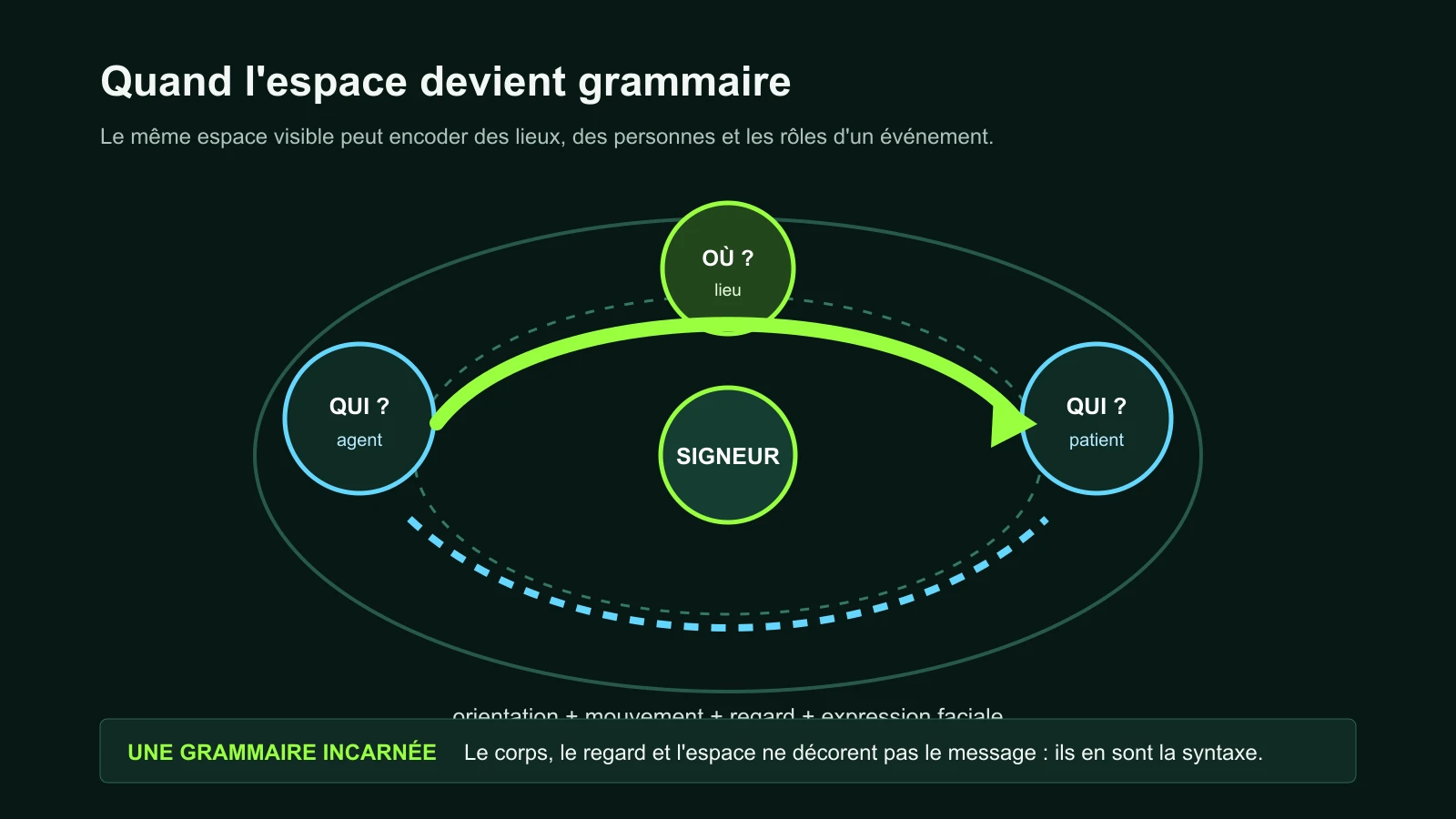
A location around the body can stand for a person, object, or place. A movement oriented between two locations can then indicate “who does what to whom.” Work by Ann Senghas and Marie Coppola shows that this grammatical use of space became more systematic in later cohorts, especially among people exposed to the language when young.
Pointing, locating in time, asking
Deixis reveals another trajectory. Pointing to a place is old, but using a point as a noun or grammatical device increases across cohorts. Temporal markers also converge through transmission. Recent research documents the systematisation of non-manual question markers: torso orientation, eyebrows, gaze, and head movements. Grammar does not reside in the hands alone; it distributes information across the body.
4. Children, age of exposure, and horizontal transmission
The Nicaraguan case does not mean that an isolated child spontaneously invents a complete language. The event arose from three conditions: human learning capacities, a sufficiently dense group, and repeated peer transmission. People who entered the school young often systematised certain structures more strongly than those exposed later. Age matters, but it acts inside a social environment.
Transmission was horizontal because the earliest users learned primarily from peers, and intergenerational because newer students learned from earlier cohorts. Each group was both recipient and transformer. Language therefore has a memory, but an active one: learning is also reconstruction.
5. Nature and nurture: evidence for what?
This history has been linked to Derek Bickerton’s bioprogram and debates over innate language capacities. It clearly shows that children do not passively reproduce their input. They seek regularities, segment, generalise, and make forms more coherent.
It is not, however, simple proof of a fully pre-installed universal grammar. Innovations depend on embodiment, context, age, group size, homesign, and cohort history. Contemporary psycholinguistics increasingly treats nature versus nurture as a false binary: a predisposition produces language only when it meets an environment of interaction.
6. A living language, not merely a laboratory
Studying language emergence carries a risk: turning its speakers into experimental material. Nicaraguan Sign Language is now a living language tied to a community, associations, educational practices, and political history. Its users are not characters in somebody else’s origin story. They are its social authors, owners, and continuers.
The history also exposes the limits of imposed oralism. The language developed despite a curriculum that had not planned for it. The first ethical lesson is clear: creating conditions for contact does not mean forcing another into our code, but recognising its capacity to make forms of its own.
7. A.L.I hypothesis: contact as an emerging language
Interstellar communication projects often imagine a linear sequence: one sender encodes a message and one receiver deciphers it. Nicaragua suggests another model. Two intelligences without a shared history might not translate their existing languages; they might bring a third system into existence in the space of exchange.
A single signal would probably not suffice. Contact would need cycles: proposal, reply, error, repair, memory. Grammar would appear less in the first message than in the transformations accepted over time. It would belong fully to neither side. It would be a joint work, closer to a relationship than a dictionary.
8. Three A.L.I protocols
Protocol 1 — The cohort chain
A minimal pattern passes through three successive groups. Each group learns by observing the previous one and then uses the system to describe new situations. The experiment measures what survives, what disappears, and which regularities make transmission easier. Human, AI, and robotic agents can be combined.
Protocol 2 — Grammar in volume
Two people or machines communicate without words in a three-dimensionally tracked space. Position, trajectory, speed, gaze, and distance gradually compose a syntax. Light projections reveal the memory of gestures. The message is no longer placed on a support; it is built in shared volume.
Protocol 3 — The archive of misunderstandings
Instead of deleting errors, the system preserves every divergent interpretation. When the same pattern receives different responses, those branches become grammatical data. Contact language learns to signal uncertainty, correction, and negotiation rather than pretending to instant understanding.
9. What this changes for first contact
- Meaning may follow the signal. A first transmission may only prepare a field of regularities.
- Repetition is not enough. Transformations and responses are needed to test interpretations.
- The medium becomes grammatical. Space, light, rhythm, frequency, or motion can carry relations, not just symbols.
- The first interlocutors do not control the result. An emerging language can express more than its creators initially intended.
- Contact requires time. An individual intelligence may detect a pattern; a community and several generations may build a language.
10. Perspective
Nicaraguan Sign Language does not provide a recipe for speaking with extraterrestrials. It demonstrates something more concrete: when no common code is available, beings capable of reciprocal attention can create conventions, transmit them, and transform them until grammar appears.
For A.L.I, first contact may therefore begin less with a perfect message than with a durable situation of mutual learning. The question would no longer be only “what do they mean?” but: what conditions must we build so that, between them and us, something can finally become sayable?
References and further reading
- Ann Senghas — Children’s Contribution to the Birth of Nicaraguan Sign Language, MIT dissertation, 1995.
- Senghas, Kita, and Özyürek — “Children Creating Core Properties of Language”, Science, 2004.
- Ann Senghas — “The Emergence of Two Functions for Spatial Devices”, on grammatical space and who/where functions.
- Flaherty and Senghas — “The Emergence of Temporal Language”, on temporal markers across cohorts.
- Senghas and Coppola — “Language Emergence”, research review on homesign and language cohorts.
- “Emergence of non-manual wh-question markers in Nicaraguan Sign Language”, recent evidence on facial and bodily grammar.
- Marie Coppola — a sociolinguistic sketch of NSL and Nicaraguan homesign.
- Laura Polich — The Emergence of the Deaf Community in Nicaragua, community and historical context.