How can we say “danger, do not dig here” to beings who will live ten millennia from now? We do not know their language, beliefs, institutions, or even the value they will assign to a monument. The disposal of radioactive waste has already made this an actual experiment in communication with an unknown civilisation.
Nuclear semiotics studies how warnings might outlast ordinary languages and states. It brings together engineering, linguistics, archaeology, anthropology, art, and information theory. For A.L.I, it relocates interstellar contact along the axis of time: the recipient is not light-years away, but far enough in the future to become almost as alien.
1. Two horizons: 10,000 and 100,000 years
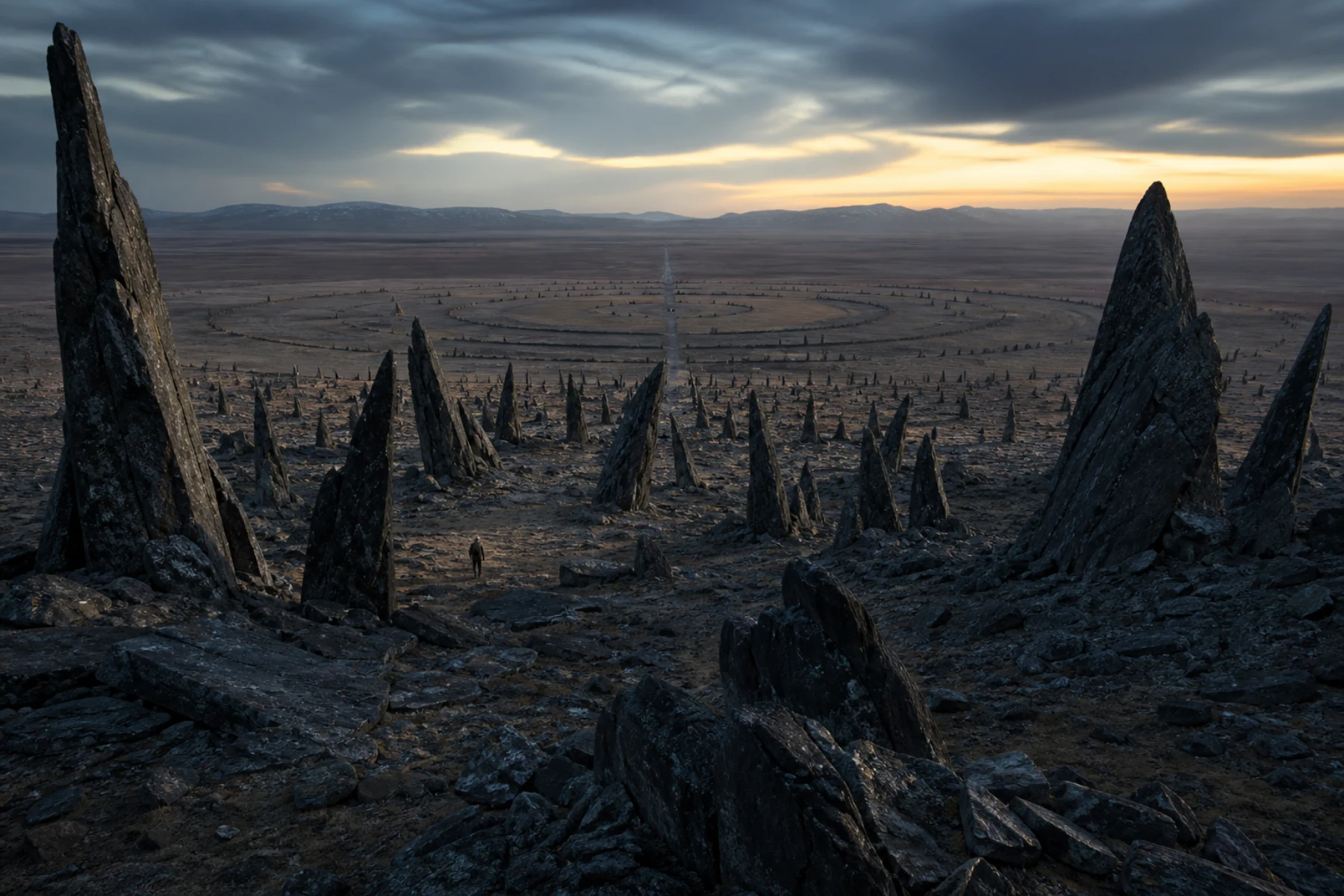
In the United States, the Waste Isolation Pilot Plant (WIPP) in New Mexico receives defence-related transuranic waste. US regulation established a 10,000-year performance period. This prompted teams to explore how a future human intrusion might be deterred.
In France, Andra works on a longer scale. Its memory programme investigates how information might be conserved and transmitted over centuries, millennia, and, for some systems, up to 100,000 years. The two figures should not be conflated: they belong to different projects, waste types, and safety frameworks.
In both cases, the problem exceeds the durability of a plaque. Languages disappear, borders move, archives burn, and institutions change purpose. A warning has to convey the existence, location, nature, duration, and appropriate response to a hazard.
2. Thomas Sebeok: relaying a message from generation to generation
In 1980 the Human Interference Task Force brought specialists together to consider the memory of nuclear repositories. Semiotician Thomas A. Sebeok published Communication Measures to Bridge Ten Millennia in 1984. His conclusion was stark: no isolated sign can be guaranteed for ten thousand years.
Sebeok recommended redundancy, several levels of complexity, and a relay system that would periodically recode the knowledge into current languages and techniques. He also proposed an “atomic priesthood”, a body of guardians maintaining rituals, stories, and taboos. The provocative phrase exposes a central fact: long-lived information depends as much on social organisation as on material.
The solution creates its own risk. A caste can monopolise knowledge, convert it into power, or lose credibility. The message becomes dependent on an authority that no designer can control for millennia.
3. Ray cats: embedding warning in life and folklore
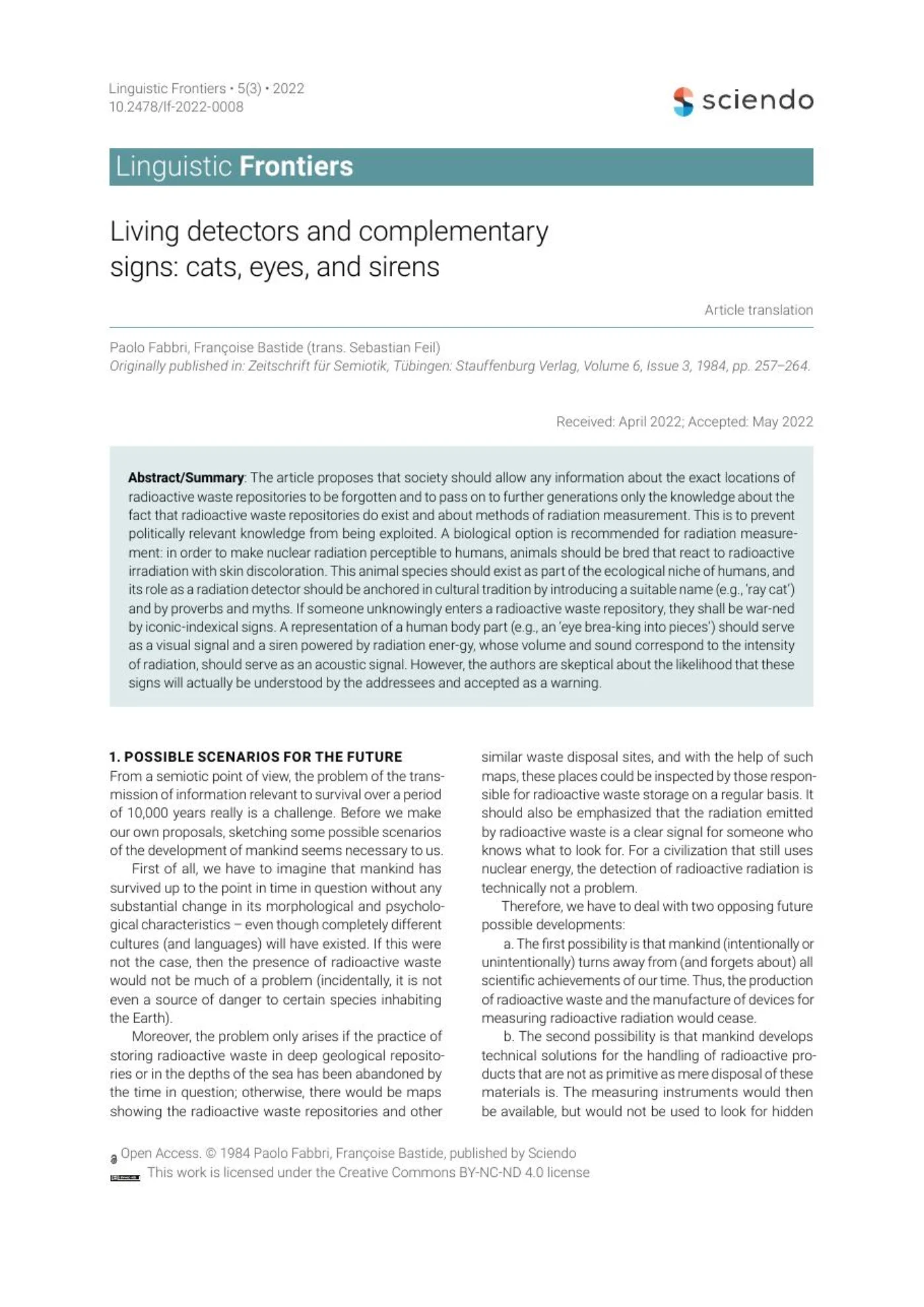
In their 1984 proposal, Françoise Bastide and Paolo Fabbri imagined animals bred to change skin colour in the presence of radiation. These “ray cats” would be supported by songs, proverbs, and stories linking their changing appearance to an invisible danger. The translated paper is available as Living detectors and complementary signs: cats, eyes, and sirens.
The project was never implemented. Its force lies in a reversal: rather than asking stone to speak, it imagines a signal reproducing with life while its meaning circulates through popular culture. Its weakness is equally instructive: a species may vanish, mutate, migrate, or survive while folklore changes meaning.
4. Sandia: making the landscape itself communicate
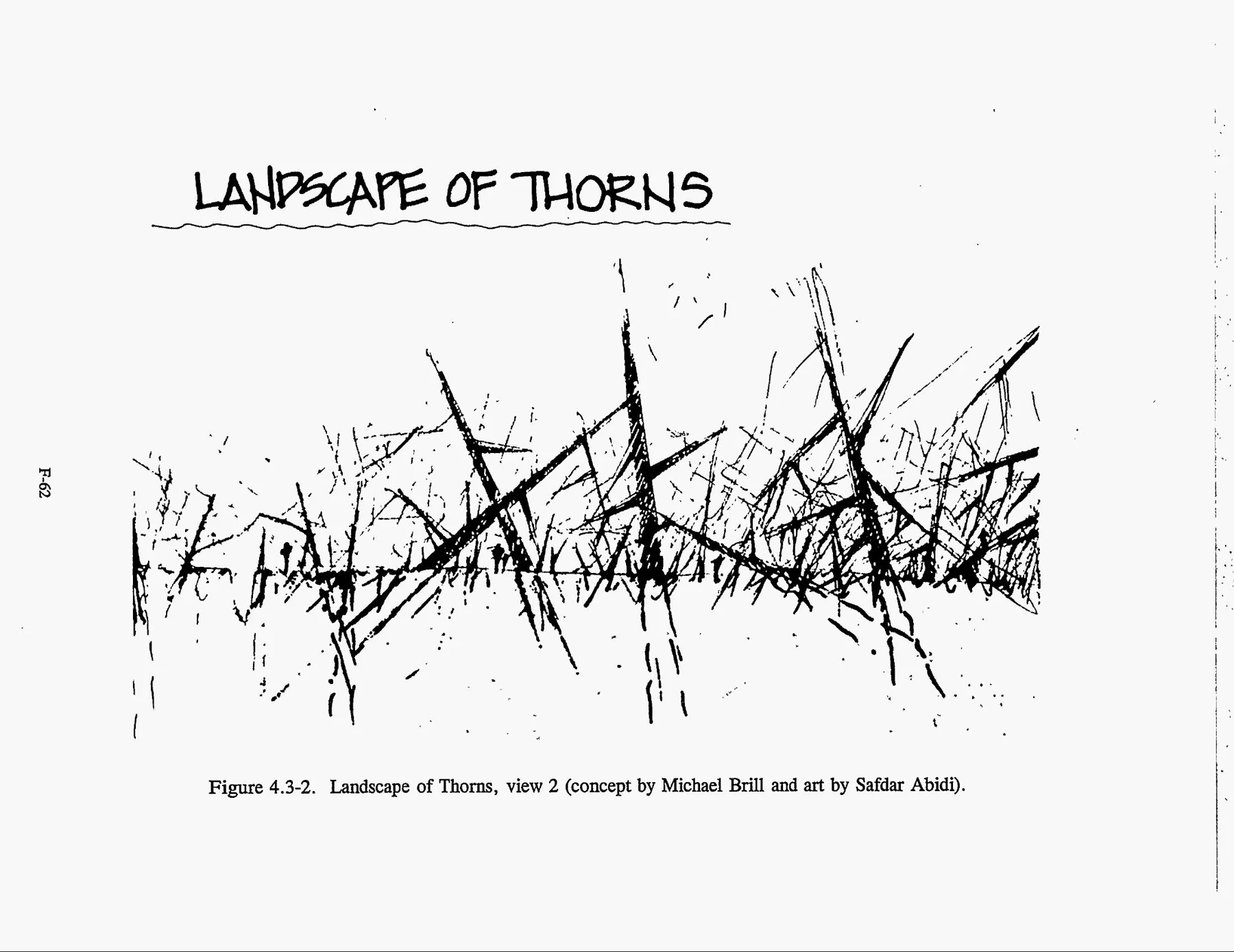
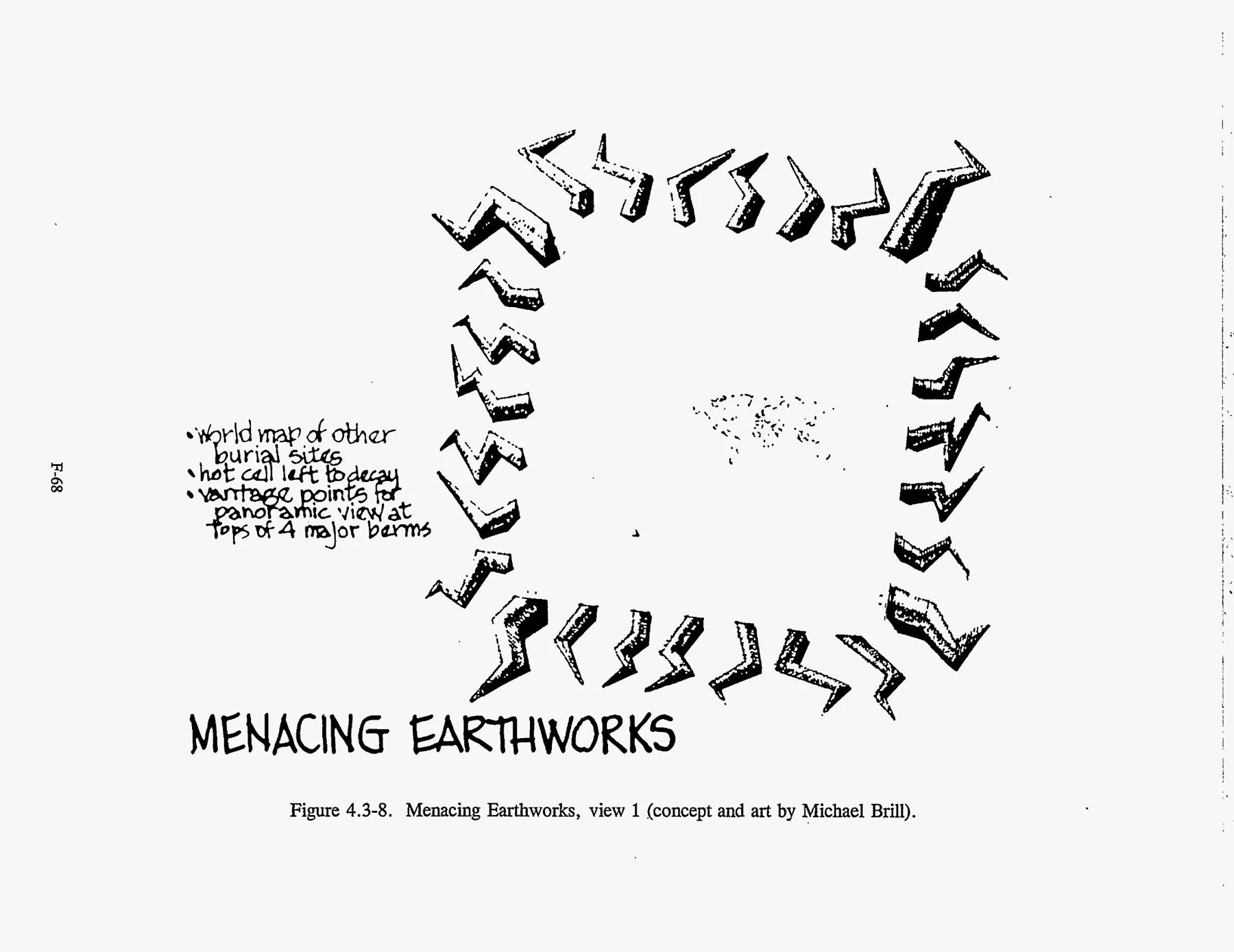
The 1993 Sandia report, Expert Judgment on Markers to Deter Inadvertent Human Intrusion into the Waste Isolation Pilot Plant, does not seek a miraculous pictogram. It proposes a distributed system: large earthworks, perimeter markers, reading walls, information chambers, maps, archives, and messages at several levels.
The best-known concepts—Landscape of Thorns, Menacing Earthworks, and Forbidding Blocks—use irregular, aggressive, or uncomfortable forms. A site should communicate danger before a text is understood. These were exploratory studies and drawings, not built designs.
The teams also formulated four message levels: something artificial is present; it signifies danger; it explains the nature of that danger; and it finally supplies detailed technical information. A visitor might therefore receive something even when unable to read everything.
5. The monument paradox: warning can attract
The more costly, precise, and durable a marker appears, the more likely it is to be read as a royal tomb, temple, or sign of buried treasure. Sandia’s authors therefore considered an architecture without honour: rough materials, irregular geometries, low reuse value, and little decorative virtuosity.
Yet the absence of a monument creates the opposite risk: the site may be forgotten and rediscovered accidentally. Every solution oscillates between two failures—being too visible and inviting exploration, or becoming invisible and warning no one.
The same paradox applies to METI. A message designed to announce our presence may attract a recipient whose intentions are unknown. Communication begins before content, with a political decision about becoming detectable.
6. Andra: material, institutional, and social memory
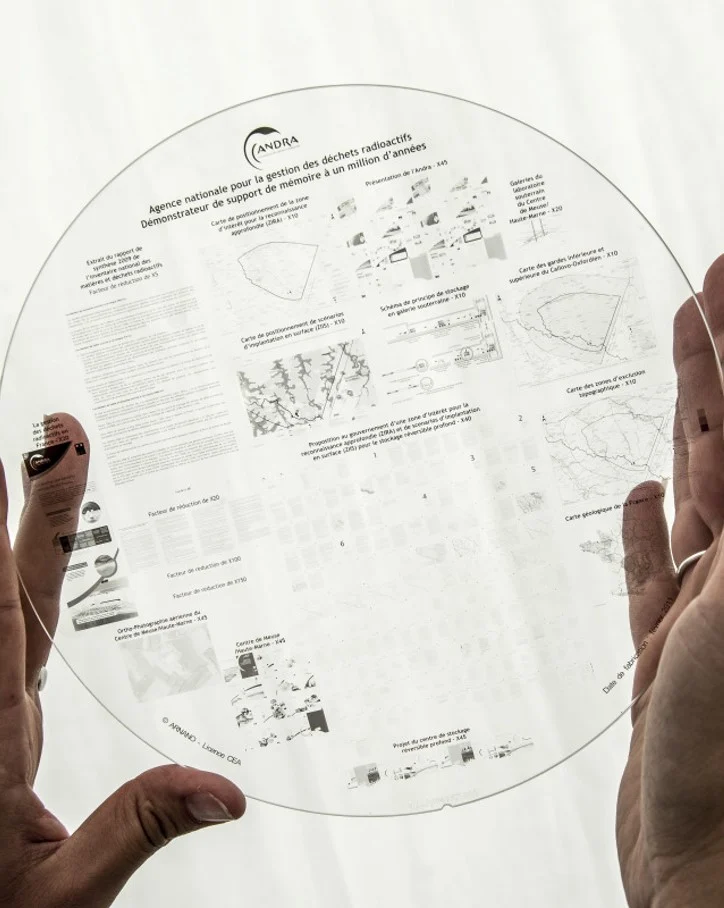
Andra does not rely on one solution. Its approach combines memory records, archives, regulation, local knowledge, durable media research, signs, and social practice. Its programme asks how future generations might be warned when current symbols are no longer intelligible.
One experiment uses a sapphire disc carrying micro-engraved information. The medium aims at density and resistance, but it must still be located, recognised as a document, and viewed with the right instrument. Material durability does not automatically produce legibility.
Internationally, the OECD Nuclear Energy Agency’s Records, Knowledge and Memory initiative assembled a toolbox of thirty-five mechanisms: markers, archives, maps, regulation, museums, international lists, local culture, and intergenerational transfer. Memory is treated as an ecosystem rather than a single object.
7. Building for ten millennia: Long Now and Rosetta
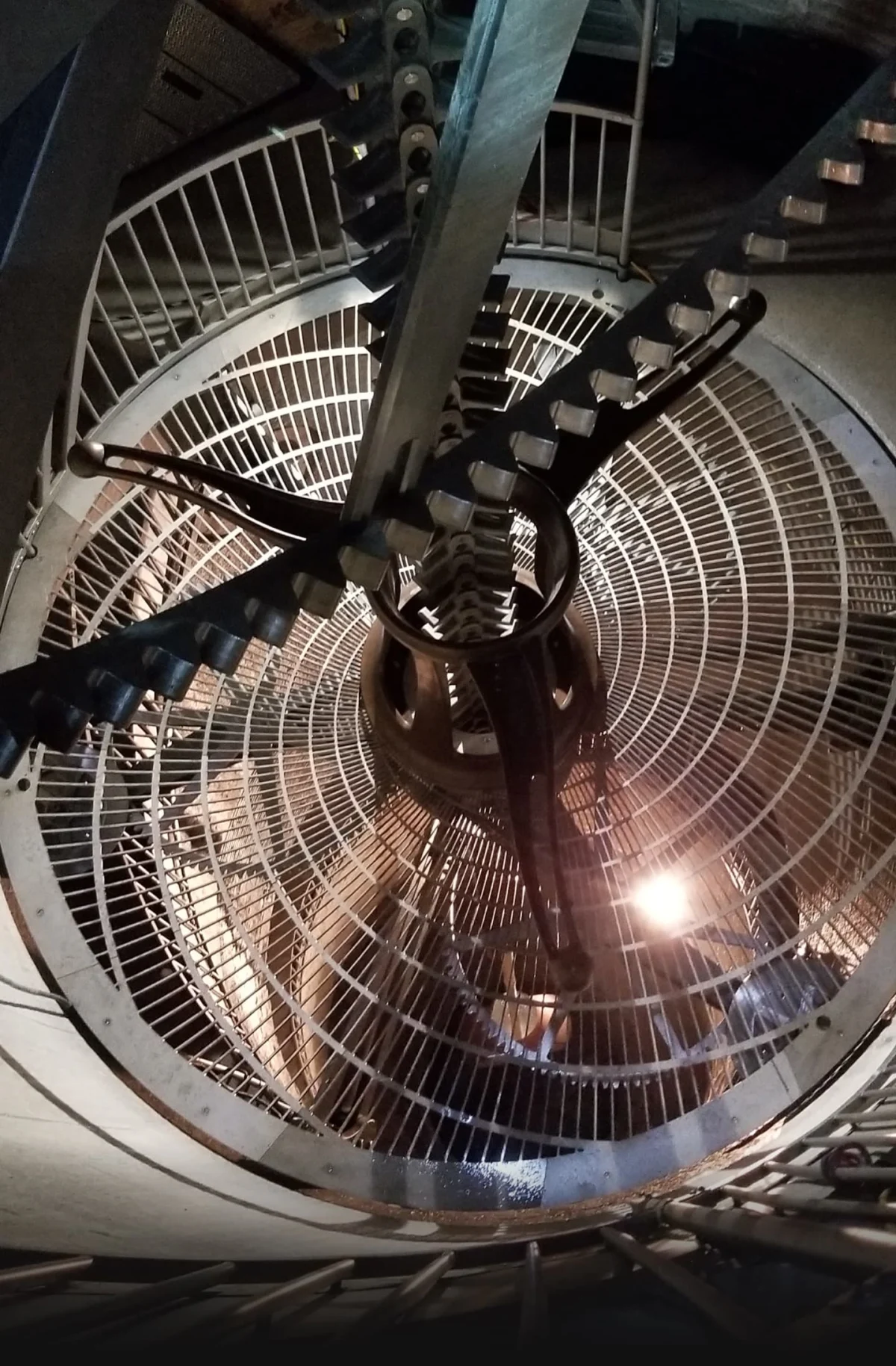
The Clock of the Long Now is a monumental mechanical clock designed for ten thousand years. It does not communicate a hazard, but makes an almost inconceivable duration physically present. What must be built today to make a future visitor think in millennia?
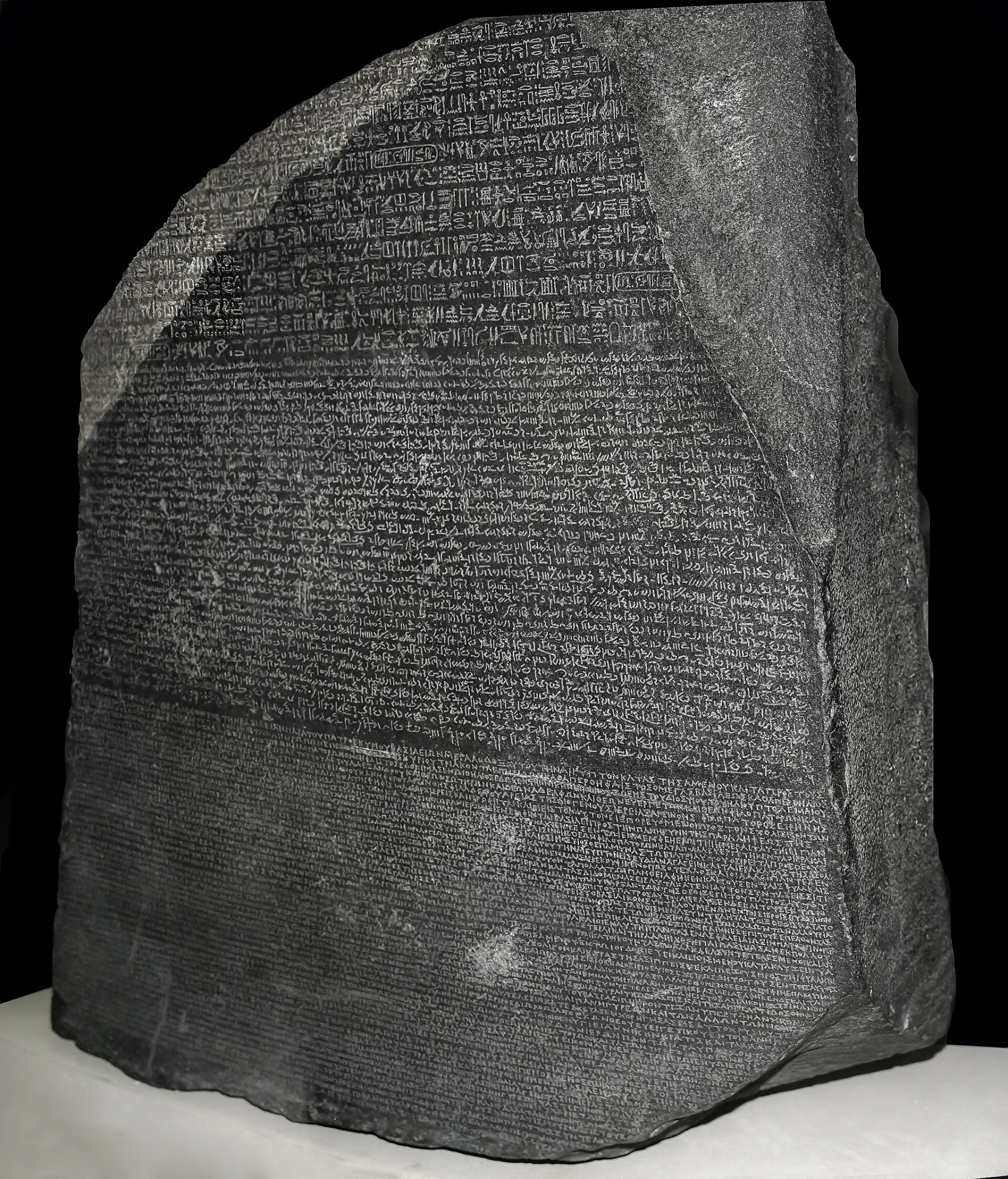
The foundation’s Rosetta Project stores thousands of pages documenting more than one thousand languages on a microscopic disc. Its visible spiral and successive scales invite discovery of the reading method. The medium contains the beginning of its own tutorial.
8. EXOST1: an extraterrestrial object as temporal archive
In EXOST1, David Guez proposes an archival protocol tied to an encounter with an interstellar object. The project no longer asks only how to conserve an Earthly warning; it imagines a medium linking human time to cosmic trajectories.

Nuclear semiotics and EXOST1 share an intuition: a message must travel with a scenario of rediscovery. Storing data is not enough; one must imagine the gestures, instruments, and stories through which it could be recognised as data.
9. A.L.I hypothesis: the layered message
Drawing on this work, A.L.I proposes treating a message not as a sentence but as a stratification of channels. Each layer should survive the loss of others and help reconstruct them.
- Physical form creates a perceptible difference: this place or object is not natural.
- Repetitive signal indicates intention and supplies measurable units.
- Graduated code moves from number to relation and from relation to content.
- Technical archive documents risk, context, and verification methods.
- Social memory circulates stories, practices, taboos, and institutions able to renew the message.
- Revision lets each period copy, translate, criticise, and extend the whole without erasing earlier states.
This architecture does not promise perfect understanding. It organises several chances of partial understanding. In interstellar contact, a receiver might first detect regularity, then arithmetic, and finally a relation between message and environment.
10. Prototype: a beacon that teaches its own reading
An A.L.I prototype could consist of six rings. The first establishes a pulse; the second demonstrates prime numbers; the third associates numbers, durations, and forms; the fourth repeats these relations through light, sound, and relief; the fifth describes location and hazard; the sixth stores several dated human translations.
The object would be tested with groups deprived of some channels: no text, no vision, no sound, missing fragments, or altered order. Success would not mean “understand everything” but reconstruct a rule, formulate a hypothesis, and test it.
11. Three artistic experiments
The monument that refuses admiration
An installation confronts visitors with three architectures: alluring, menacing, and almost invisible. Which one would they explore? The work measures the paradox among repulsion, curiosity, and forgetting.
Folklore under controlled mutation
A warning is passed over several weeks through oral narrative, song, drawing, and gesture. Every transmission is archived to reveal what survives and which redundancies recover the initial core.
The archive without instructions
Several objects containing the same information are shown without explanation. Some expose their reading mechanism, others do not. The installation demonstrates that an archive’s first message is always: “I am an archive.”
12. Critical position
No system can guarantee that a warning will retain its meaning for ten thousand years. Nuclear semiotics does not abolish uncertainty or present responsibility. It does, however, challenge a dangerous illusion: that a message exact today will remain exact without maintenance, institutions, or social relations.
For A.L.I, the lesson is decisive. Communication with an unknown intelligence is not a matter of choosing the best symbol. It requires a situation in which a recipient can detect intention, compare evidence, produce an interpretation, and correct it. Contact is not a sign sent once; it is a possibility of reading maintained in matter, time, and culture.
LABO question: how can a message remain strange enough to signal intention, simple enough to reconstruct, and modest enough not to become a sacred monument?
Primary references
- Thomas A. Sebeok, Communication Measures to Bridge Ten Millennia, US Department of Energy report, 1984.
- Sandia National Laboratories, Expert Judgment on Markers…, full WIPP marker report, 1993.
- Françoise Bastide and Paolo Fabbri, “Living detectors and complementary signs”.
- OECD Nuclear Energy Agency, Preservation of Records, Knowledge and Memory Across Generations.
- Long Now Foundation, Clock of the Long Now.
- Long Now Foundation, Rosetta Project.
- David Guez, EXOST1.