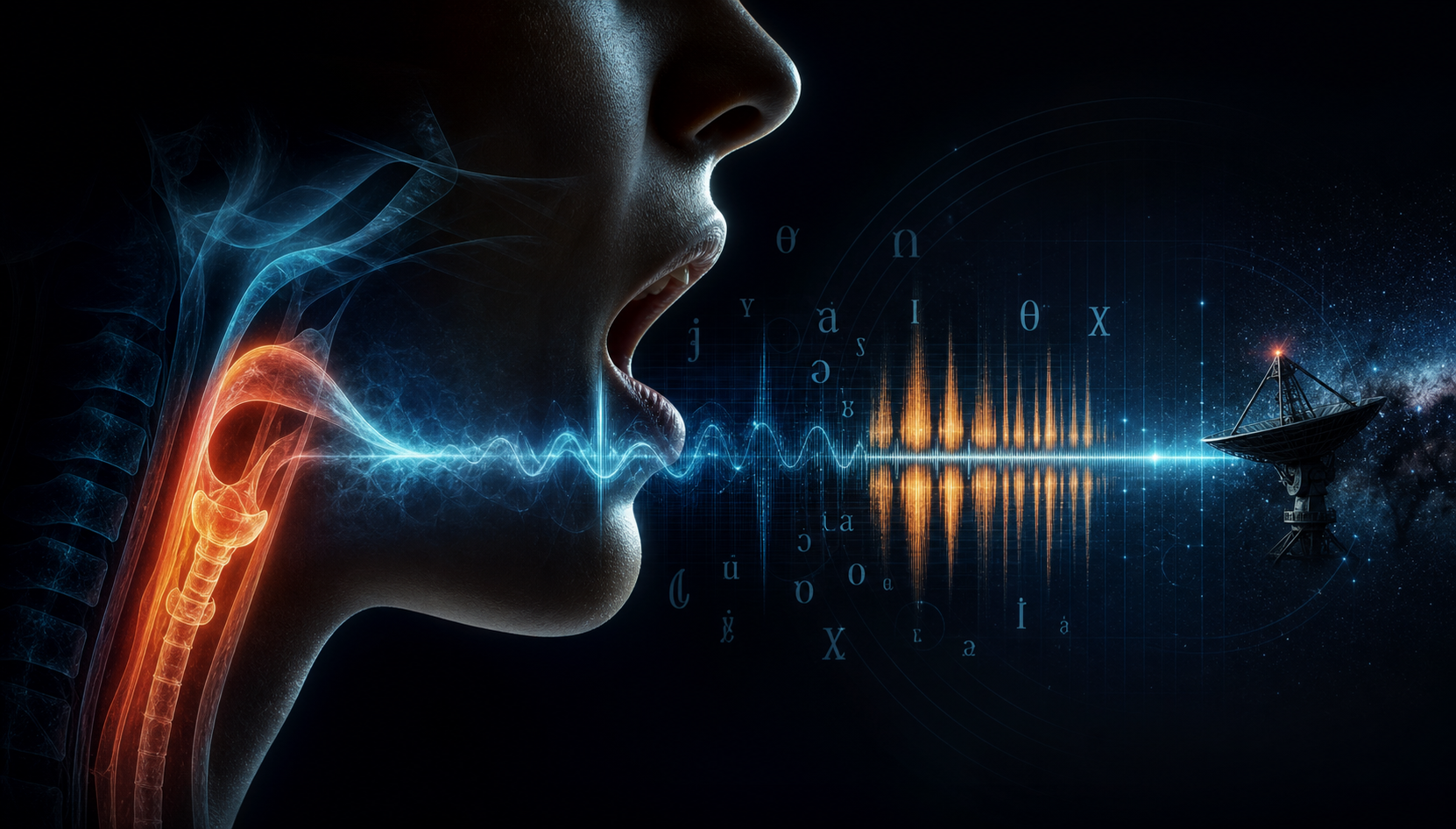
Hypothesis: before inventing an extraterrestrial alphabet or a complete vocabulary, A.L.I could work with a more primitive layer: phonemes, the minimal sound units that can distinguish meaning inside a language.
Phonemes may become an interface between human language and a more guttural, bodily form of communication: breath, growl, vibration, throat friction or organic signal. The goal is not to imitate a caricature of “alien speech”, but to build an intermediate zone between voice, body and code.
Phoneme, Sound, Signal
A phoneme is not just a noise. It is a sound difference that matters inside a system. In English, /p/ and /b/ distinguish words such as pat and bat. In a contact language, we might not begin with words, but with very simple oppositions: open/closed, short/long, breathy/vibrating, low/high, continuous/interrupted.
/a/  open vowel
/u/  closed rounded vowel
/h/  glottal breath
/ʔ/  glottal stop
/ʁ/  voiced uvular friction
/χ/  voiceless uvular breath
/ħ/  pharyngeal friction
/ʕ/  voiced pharyngeal friction
Why Move Toward the Guttural?
Guttural sounds use the back of the mouth, the throat, the glottis, the pharynx or the uvula. They feel more physical than very frontal consonants such as /p/, /t/ or /s/. This bodily quality is useful for imagining a communication system that is not entirely verbal.
An intermediate language could therefore use fewer words and more elementary vocal gestures: breathing, blocking, releasing, vibrating, scraping, holding a tone, or suddenly cutting the flow.
Possible Phonemic Palette
A deliberately small inventory can become a minimalist contact grammar:
| Function | Phoneme | Gesture | Possible meaning |
|---|---|---|---|
| Call | /h/ | open breath | presence, attention |
| Threshold | /ʔ/ | glottal stop | beginning, break, boundary |
| Matter | /ʁ/ | voiced uvular friction | body, nearness, mass |
| Distance | /χ/ | voiceless uvular friction | far, outside, breath |
| Depth | /ħ/ | voiceless pharyngeal friction | alert, intensity, depth |
| Answer | /m/ | nasal hum | agreement, reception |
Examples of Proto-Words
From this palette, very short forms can be produced: almost animal, but still structured.
ha      = I call / I am here
ʔa      = beginning / opening
haʔ     = attention, cut
ʁa      = nearby presence
χu      = distance, outside
ħam     = signal received, but unstable
ʔa-ʁa   = approach
χu-χu   = distant repetition
ha-m    = call confirmed
ʁa-ʔ-χu = presence, break, withdrawal
These examples are not a full language. They form a threshold system: human enough to be produced by a mouth, abstract enough to become sound material, and limited enough to be learned as a code.
Between Human Voice and Other Voice
Such a language could sit between three regimes:
- Human speech: recognizable phonemes, possible articulations, IPA transcription.
- Guttural voice: breath, friction, vibration, growl, glottal stop, throat texture.
- Machine signal: spectral analysis, duration, intensity, fundamental frequency, sound envelope.
The same element could be spoken by a person, transformed by software, and displayed as a spectrogram. The alphabet would no longer be only written: it would be breathed, heard and measured.
Sound Depends on Biology
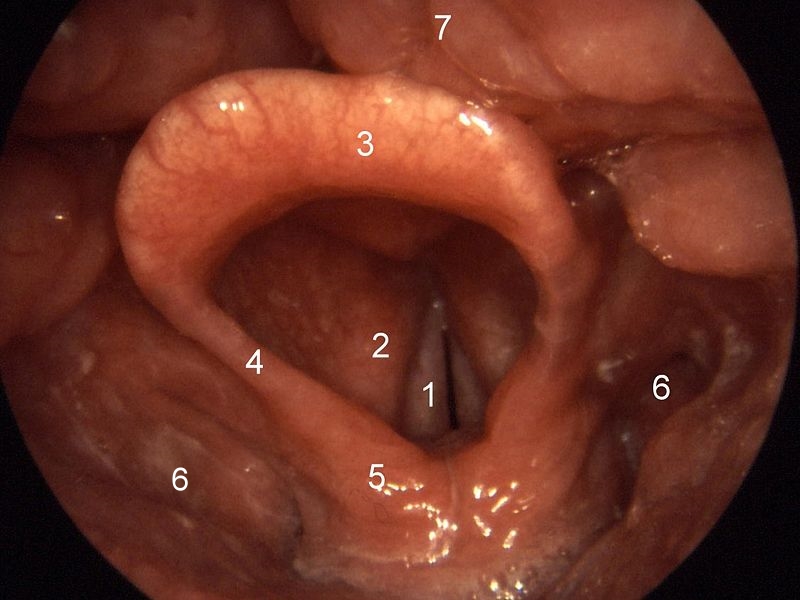
In the coding and decoding of an extraterrestrial language, one fundamental limit must be kept in mind: sound always depends on the biology of the beings that produce and receive it. A human voice exists because we have lungs, a larynx, vocal folds, a mouth, a tongue, a palate, teeth, nasal cavities and ears adapted to certain frequencies.
Another life form might have no throat, might not breathe air, might not hear through eardrum vibration, might not produce sounds inside our audible range, or might use another medium entirely: water, ground, membrane, electric field, pressure, light or internal vibration. What we call a “phoneme” might therefore be only a human translation of a much broader biological phenomenon.
- Emission biology: what organs produce the signal: throat, membrane, skin, shell, fluid, electric organ?
- Propagation medium: does the signal travel through air, water, ground, a machine in vacuum, or another support?
- Reception biology: does the being hear with ears, pressure sensors, sensory hairs, electric receptors or chemical receptors?
- Available frequencies: is the language audible to us, ultrasonic, infrasonic, vibrational or entirely non-sonic?
From this perspective, A.L.I should not assume that sound is universal. Sound is one possibility among others, tied to bodies, environments and perceptual thresholds. Encoding means translating a biology into a signal; decoding means avoiding the mistake of treating our own vocal apparatus as a cosmic norm.
A.L.I Prototype
A prototype could become a “phoneme workshop”:
- a microphone captures the visitor’s voice;
- software detects breath, vibration, glottal attack, duration and pitch;
- each phoneme is translated into a graphic sign, a light or a waveform;
- a voice synthesizer answers with a deeper, slower or more guttural version;
- the visitor learns to produce a short contact sequence.
human voice → IPA phoneme → sound analysis → A.L.I sign → synthetic guttural answerSound Excerpts
These sounds are short synthetic sketches: they do not claim to reproduce an existing language, but they make the phonetic gestures of the post audible.
Composition Exercise
A minimal contact phrase could be:
ha ʔa m
call / opening / reception
Or a more dramatic form:
χu χu ʔ ʁa m
far / far / threshold / presence / received
The phrase is not translated word by word. It works like a score of vocal gestures. Order, tension, duration and repetition matter more than vocabulary.
Sources and Tools
- International Phonetic Association - IPA Chart: the official International Phonetic Alphabet chart.
- UCLA Phonetics Lab Archive: recordings and phonetic transcriptions from many languages.
- PHOIBLE: a database of phonological inventories from the world’s languages.
Critical Position
The risk would be to confuse “guttural” with “primitive” or “monstrous”. These sounds should instead be treated as precise, rich articulations present in many human languages. Their A.L.I value lies in their transitional quality: a zone where language remains bodily while becoming signal.
LABO question: can we invent a contact language that begins not with words, but with gestures of throat, breath and vibration?