For this hundredth article, I am delighted to present A.L.I, the project I created. A.L.I stands for Alien Language Interface. It is an artistic research project devoted to a simple yet dizzying question: how might a non-human intelligence recognise a signal, understand a structure, interpret a pattern, receive an archive or answer a message?
This question is not limited to a hypothetical conversation with extraterrestrials. It forces us to reconsider everything we call language: words, certainly, but also numbers, images, sounds, light, gestures, bodies, machines, landscapes, myths and silences. It turns contact into a field of artistic experimentation.
An Author's Project
I initiated A.L.I to give a shared form to questions that have run through my work for more than twenty years. My practice as an artist and author moves between art and science, networks, communication devices, memory, delayed time and technological fictions. A.L.I gathers these threads without confining them to one discipline.
Science supplies facts, measurements, instruments and limits. Art shifts the point of view, constructs situations and makes perceptible what still exists only as a hypothesis. Philosophy asks who speaks, to whom, through which categories and with what responsibility. Literature, cinema and popular culture preserve the imaginary forms through which contact has already been rehearsed thousands of times.

Articles as Pre-Texts
The LAB texts are not conclusions. I regard them as pre-texts: working surfaces where a scientific idea, an artwork, a history or a fiction can meet another field. Each article attempts to be precise about facts and free in its projection. It distinguishes what is established, what is debated and what belongs to an A.L.I hypothesis.
This method allows unusual connections. The augmented Drake equation encounters exoplanets and the biases of our models; the contemporary Pioneer plaque becomes a problem of cultural design; Lincos meets the limits of mathematical grammar; the Arecibo message becomes a collective protocol rather than a single binary image.
A Constellation of Fields
Across roughly one hundred bilingual articles, several broad ensembles have emerged:
- SETI, METI and technosignatures: radio telescopes, candidate signals, transmitted messages, interstellar artefacts and repeatability criteria.
- Languages of life: animal vocalisations, plant intelligence, interspecies communication, evolution, extremophiles and astrobiology.
- Mathematics and computation: prime numbers, information theory, encoding, AI, networks, quantum computing and systems of proof.
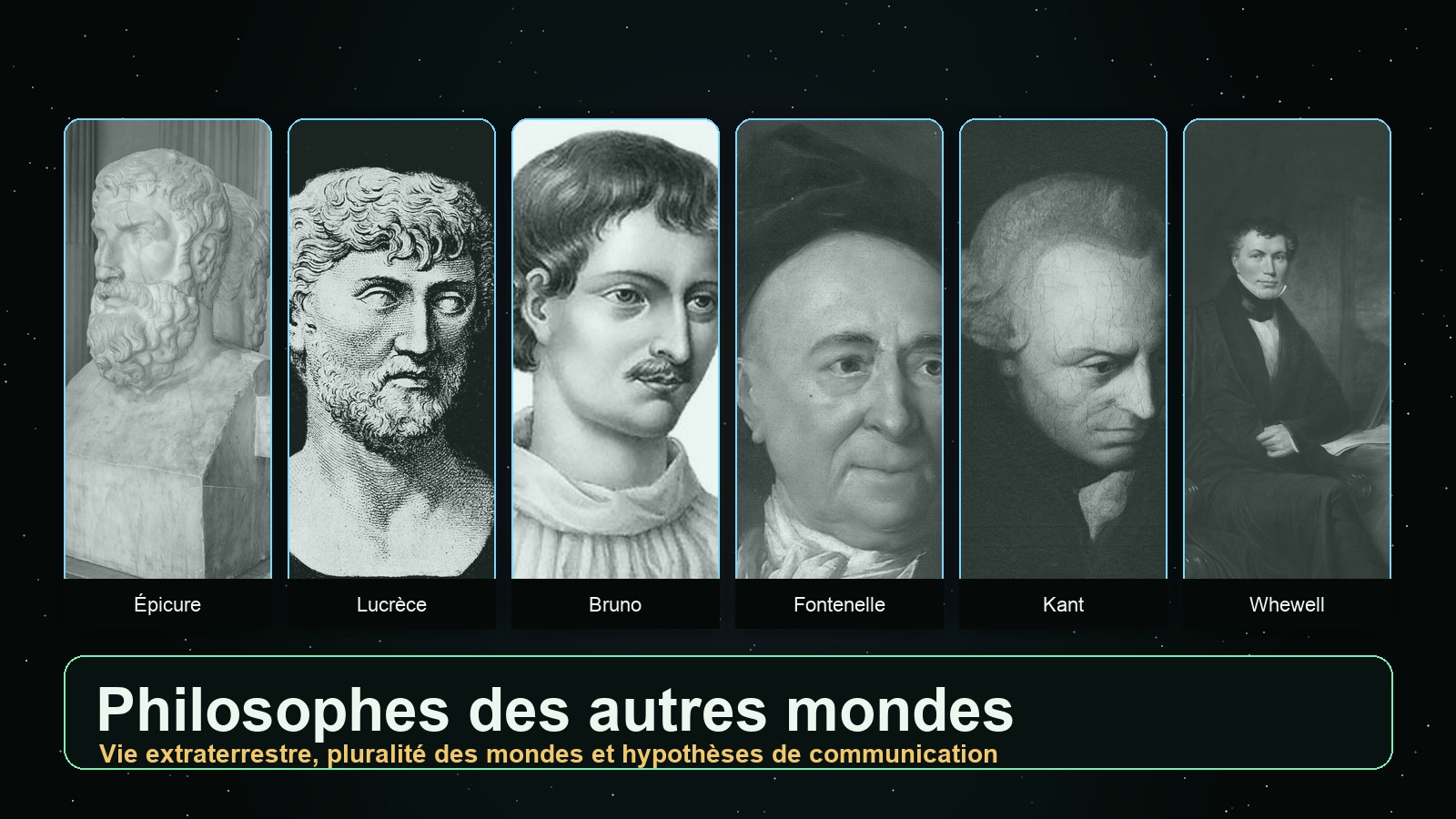
- Anthropology and philosophy: myths, rites of passage, alterity, truth, translation, hospitality and responsibility before the unknown.
- Arts and narratives: literature, cinema, music, dance, Land Art, installations, ufology and popular culture.
These categories are not separate shelves. They form a network. The Earth Species Project, for instance, connects AI, bioacoustics, conservation and terrestrial METI. Extremophiles move the biological boundaries of habitability and open the question of panspermia. Levinas reminds us that before any translation, contact already involves an ethics of the other.
What the Fields Teach One Another
The project does not seek a ready-made universal language. It studies the minimal conditions that allow something to become readable as language. A signal must be distinguished from noise, intention recognised without being projected too quickly, repetition constructed, measurement proposed, context supplied and verification made possible.
Structural anthropology and rites of passage suggest that contact could consist of stages rather than instant translation. Quantum physics and the article on truth and falsehood remind us that reality does not always fit a binary opposition. Ethology shows that language can be spatial, chemical, gestural or collective. Art teaches us to treat ambiguity not as failure, but as material.
These crossings produce a central hypothesis: the first problem of contact may not be translating a sentence, but recognising that a relationship is beginning.
A Laboratory That Became Multimedia
A.L.I is no longer only a sequence of pages. Every article exists in French and English, with images, references, an audio capsule, a podcast and a video Reel. The text can be read, heard, viewed and re-edited. This circulation is not merely editorial packaging: it tests the same idea across several media and temporalities.
The corpus now gathers approximately 2.7 million characters in French and English, nearly two hundred audio capsules, several hundred images and more than two hundred local videos. More importantly, it contains hundreds of internal and external links. No article should remain alone: each is a doorway to another text, a scientific source, an artwork, a document or a contradiction.
A.L.I — Opus 1
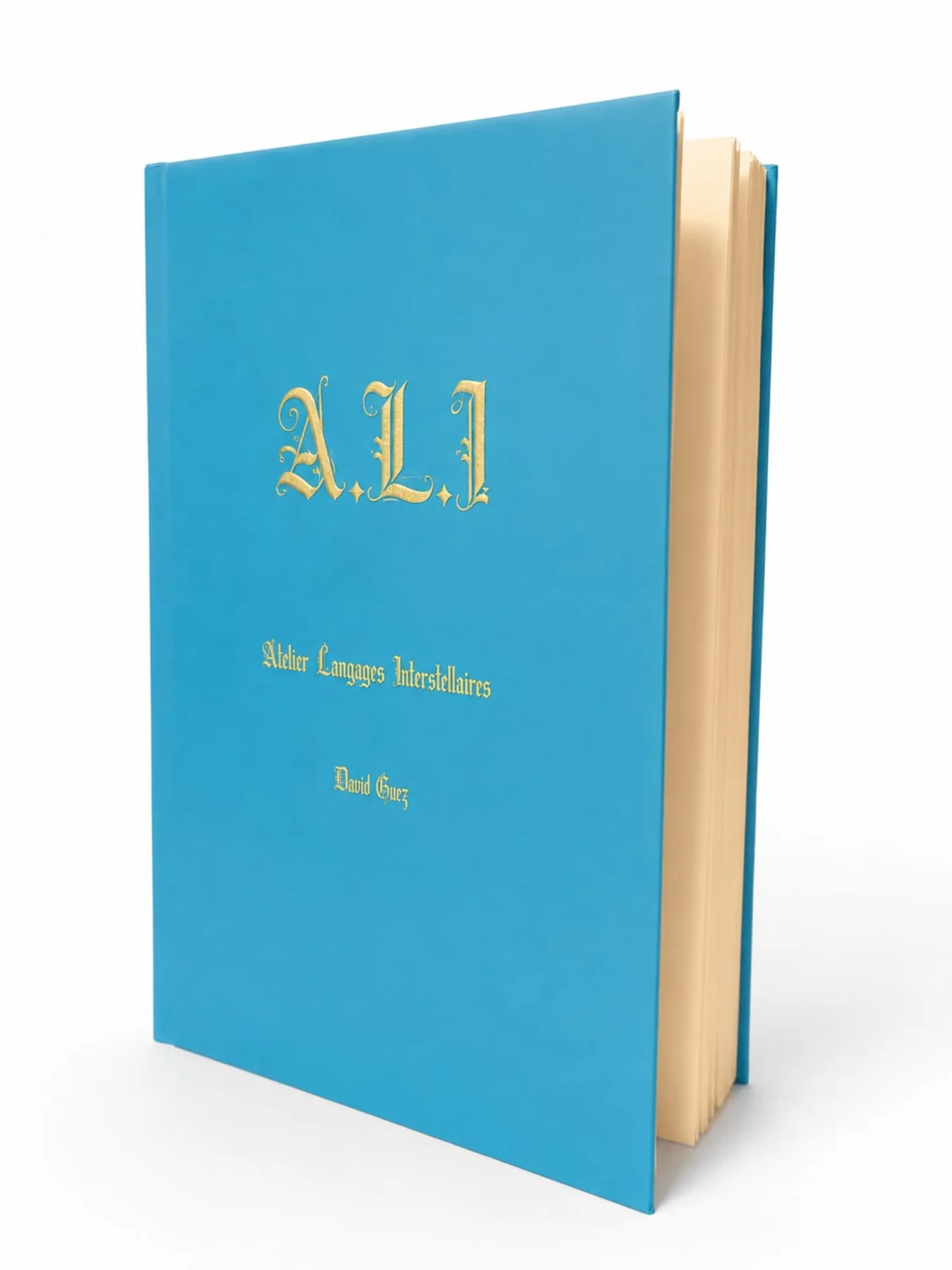
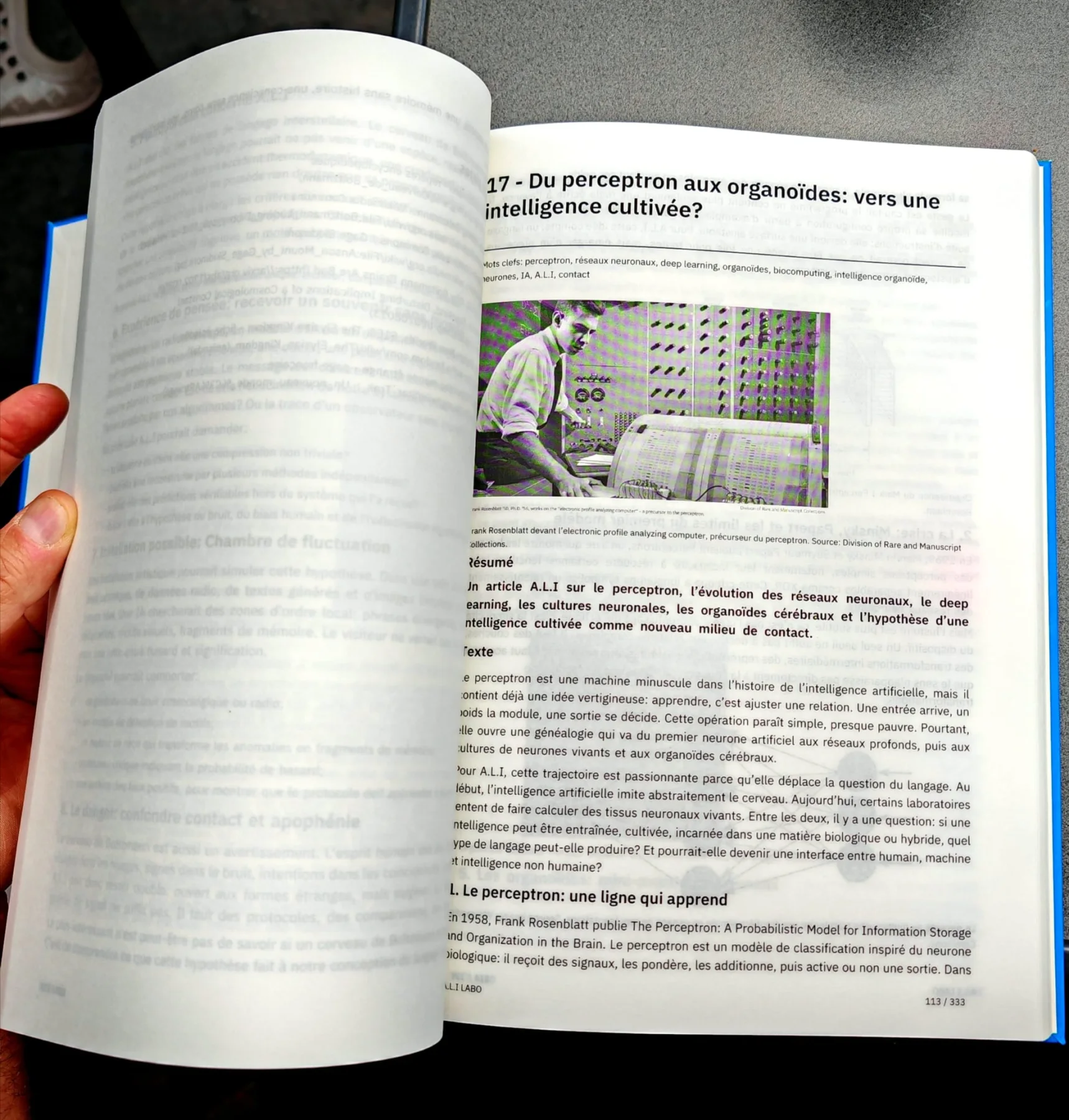
The publication of A.L.I — Opus 1 marked a first stage. The book does not close the LAB; it takes a snapshot of it. Its 543 pages move the digital network into a heavy, sequential, printed object. Articles become an archive that can be explored differently, with an index, concepts and adjacencies that a screen does not produce in the same way.
The passage from website to book also reveals an essential tension. Should an interstellar message be living, editable and networked, or stable, self-contained and transmissible without infrastructure? A.L.I deliberately keeps both forms: the website evolves; the book records a moment.
From Texts to Objects
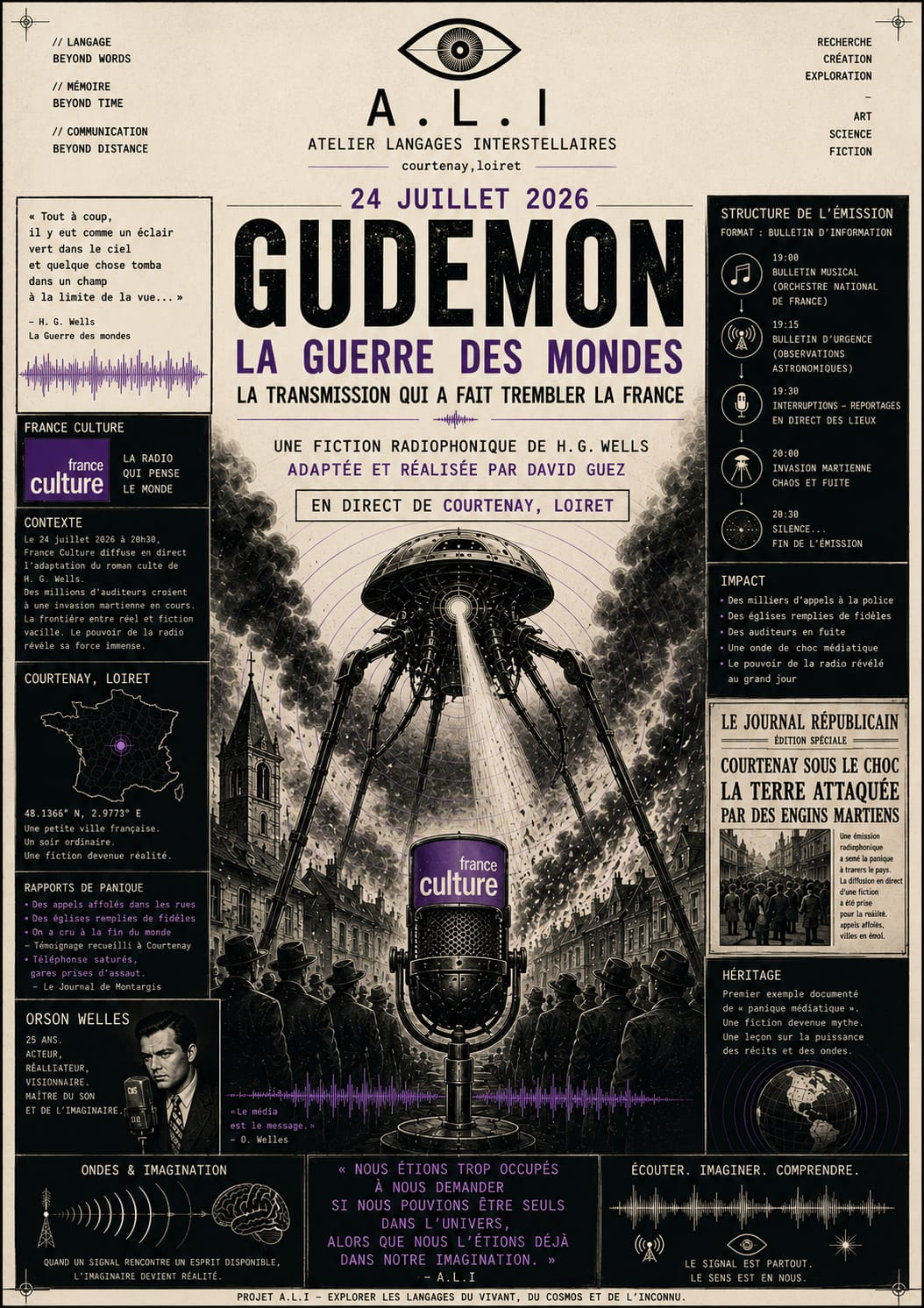
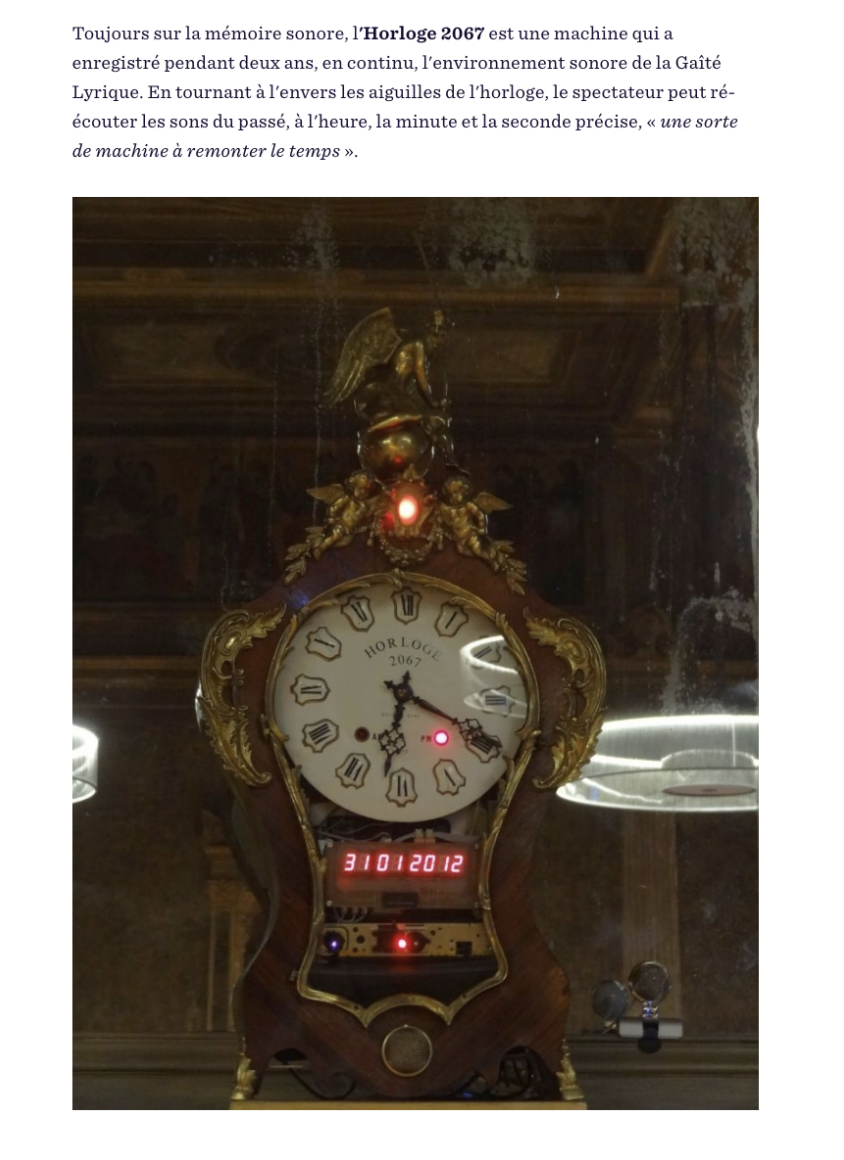
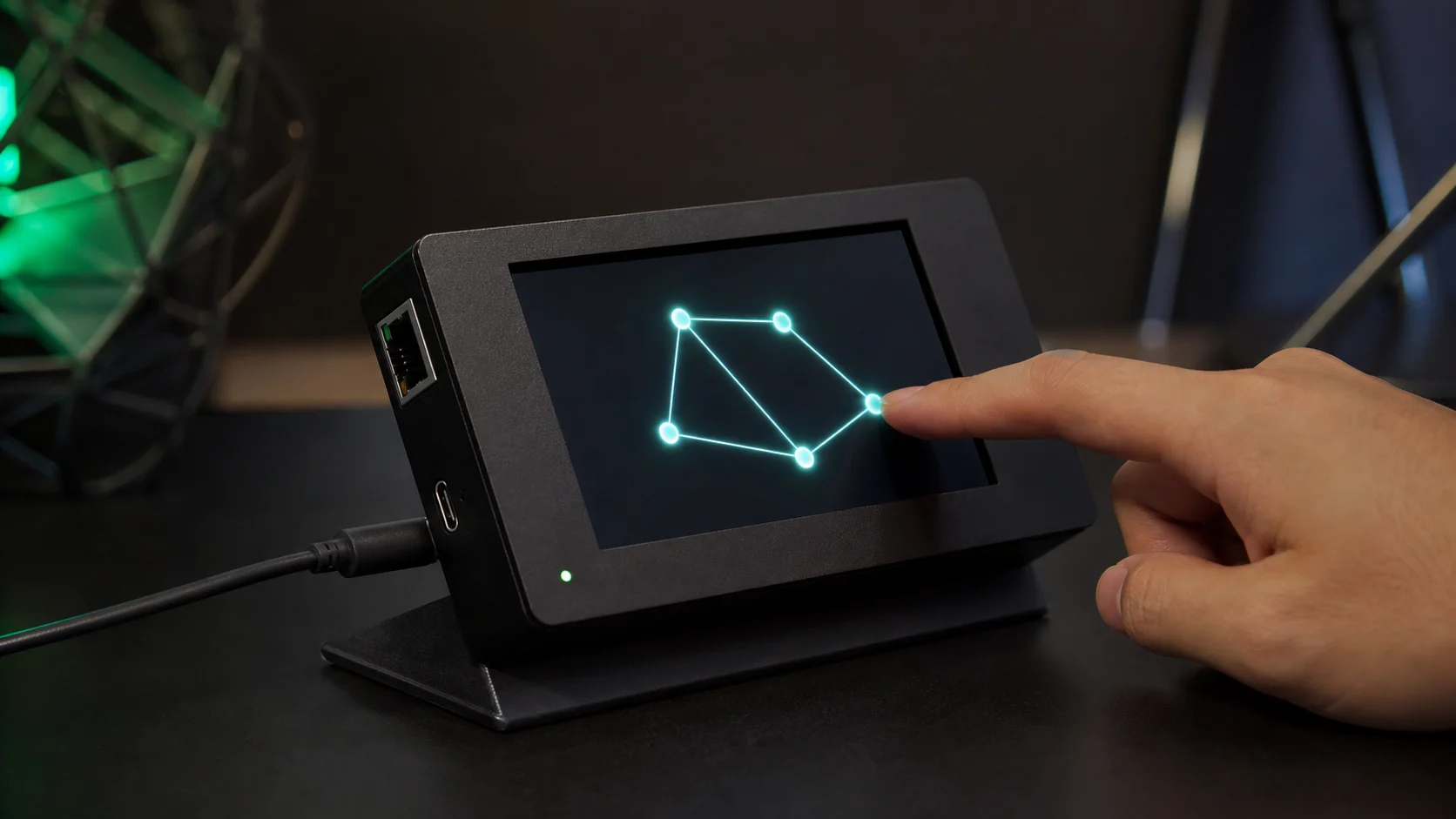
The LAB feeds concrete realisations. Ghostbook Reader turns reading into an algorithmic investigation. GUDEMON replays the power of radio fiction to temporarily alter reality. PLANETARY GLYPH imagines a voluntary network of luminous objects composing a distributed planetary sign each night.
These objects are not illustrations added after the articles. They put hypotheses to the test. A protocol must work with people, machines, errors, delays, refusals and asymmetries of power. Contact then becomes a practice: drawing, listening, synchronising, waiting and documenting.
Why Continue?
After one hundred articles, A.L.I has not found an extraterrestrial language. That was never its aim. The project has built a space where knowledge and imaginaries that rarely meet can work together. It has shown that a message is always more than content: it is a medium, a duration, an energy, an assumed recipient, a verification method and a politics of relation.
I want to continue this laboratory by giving more room to experiments, collaborations, objects and testable protocols. It must also keep correcting the human blind spots of the project: our anthropocentrism, sensory categories, narratives of conquest and desire for an immediate answer.
The hundredth article is therefore not a final assessment. It is a threshold. A.L.I remains an attempt to make readable what might circulate between two worlds, while accepting that the most important contact may already be taking place among our disciplines, species, machines and ways of thinking.
I am not trying to write the message meant for the unknown. I am trying to build the conditions in which we might recognise that a message has arrived.